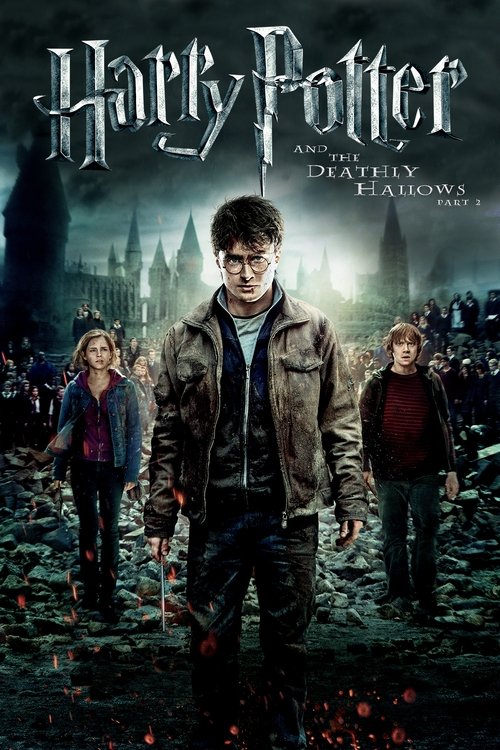
Harry Potter and the Deathly Hallows: Part 2
2011 · David Yates
For finishing the journey — the capstone of a marathon rewatch, or when you want an epic finale that earns its tears. Assumes you've come this far; it's a reward, not an entry point.
What it's about
The final chapter of the boy wizard's story: Harry, Ron and Hermione race to destroy the last anchors of Voldemort's power while the war they've been dodging for years finally arrives at Hogwarts' gates. What begins as a daring vault heist becomes a full siege of the school, and every character from a decade of films takes a side.
The experience
Almost wall-to-wall climax — dark, fast and surprisingly emotional, paying off ten years of setup with battles that feel like loss as much as spectacle. If you've grown up with these characters, it plays like a farewell; expect a lump in your throat between the explosions.
Performances
Alan Rickman's Severus Snape, doled out in glances and clipped lines across eight films, gets his fullest hour here — a performance of extraordinary restraint that reframes everything before it.
The craft
David Yates stages the Battle of Hogwarts as a genuine war film — stone bridges, shield walls, a castle coming apart — with a decade of production design paying off in every frame. Alexandre Desplat's mournful score threads the spectacle with grief, and the scale demands the biggest screen and best sound you can manage.
Why it matters
The record-shattering conclusion to the most commercially durable film franchise of its era, it closed out a serial that an entire generation grew up inside and set the template for the two-part finale.
Snapshot
The eighth and final film adapted from J.K. Rowling's seven-novel cycle, Deathly Hallows: Part 2 is the concluding half of a single book split across two releases. Where Part 1 (2010) was a wandering, wintry fugitive drama, Part 2 is almost entirely climax: a compressed siege picture that moves from the Gringotts vault break-in to the Battle of Hogwarts and the final confrontation between Harry Potter and Lord Voldemort. Directed by David Yates — who by this point had steered the franchise since Order of the Phoenix (2007) and would direct four of the eight films — it functions as both the resolution of a decade-long serial and, in industrial terms, the capstone of the most commercially durable film franchise of its era. Its ambitions are valedictory rather than expository: it assumes total audience literacy in the world it inherits and spends its capital on spectacle, grief, and closure.
Industry & production
The Potter films were a Warner Bros. enterprise produced by Heyday Films (David Heyman), with David Barron co-producing and Rowling herself credited as a producer on the final installments — a mark of the authorial control she retained over the adaptation. Principal photography for both Deathly Hallows films was conducted as a single continuous shoot across roughly a year (into 2010) at Leavesden Studios outside London, the purpose-built home of the series and later the site of the Warner Bros. Studio Tour. Splitting the seventh novel into two features was, in retrospect, one of the more consequential industrial decisions of the period: it maximized the commercial yield of a finite source text and established a template that subsequent young-adult franchises would copy.
The film was a substantial financial success — it grossed well over a billion dollars worldwide and stood at the time as the highest-earning entry in the franchise and one of the top-grossing films then released; I would avoid citing a precise figure from memory, but the scale of its performance is uncontested. It marked the end of a production apparatus that had run continuously for a decade, employing a largely stable British crew and cast whose members had, in several cases, grown up on the soundstages. That continuity — of Stuart Craig's production design across all eight films, of Heyman's producing hand, of the principal actors — is itself part of the film's meaning and its reception.
Technology
Part 2 was released in 3D, a conversion performed in post-production rather than captured natively. This is a notable detail of the series' history: Warner Bros. had planned a 3D release for Part 1 but abandoned it when the conversion could not be completed to standard in time, so Part 2 became the only Potter film to reach theaters in stereoscopic 3D. The photography itself was shot photochemically on 35mm film, finished through a digital intermediate, consistent with the series' house look under cinematographer Eduardo Serra.
Visual effects were the film's largest technical undertaking, distributed among the major London and international houses that had serviced the franchise, under the series' longtime visual-effects supervisor Tim Burke and the effects work of MPC, Double Negative, Framestore, Cinesite and others. The standout set pieces — the Gringotts vault and the escape on the back of a blind Ukrainian Ironbelly dragon, the collapse of Hogwarts under Voldemort's siege, the disintegration of Voldemort's body into ash — represent the maturation of digital creature and destruction work in the pre-Gravity, late-2000s blockbuster idiom. I would not attempt to attribute specific shots to specific vendors without documentation, as the work was heavily divided.
Technique
Cinematography
Eduardo Serra, who shot both Deathly Hallows films, gives Part 2 a desaturated, ash-and-slate palette that pushes the series' progressive darkening to its endpoint. Where the early Chris Columbus films were warm and storybook-bright, Serra's Hogwarts is a war zone lit in cold blues, grays, and firelight, with the color drained toward monochrome in the battle's worst hours. The film's most discussed visual passage is "The Prince's Tale," the flashback montage that reveals Severus Snape's history; it is shot in a softer, memory-inflected register that deliberately contrasts with the film's dominant grimness, and it recalls, in fragments, the warmer light of earlier installments.
Editing
Mark Day, editor of the four Yates-directed entries, structures the film around acceleration. The narrative is essentially a single long third act, and the cutting sustains momentum across a sprawling ensemble battle by intercutting parallel objectives — the hunt for Horcruxes, the defense of the castle, the private duel — so that the audience never loses the through-line amid the spectacle. The pacing decision to slow abruptly for "The Prince's Tale" and the "King's Cross" limbo sequence is the film's key rhythmic gambit: two islands of stillness inside a torrent of action.
Mise-en-scène / staging
Stuart Craig's production design closes the series by literally dismantling its most iconic space. Hogwarts, built and rebuilt across eight films, is besieged, breached, and half-ruined; the film stages its emotion partly through the destruction of familiar architecture — the Great Hall as a triage ward, the courtyards as body-strewn battlefields. The staging is consciously that of siege and war cinema rather than fairy tale, with defensive shield-charms, marching statuary, and lines of the dead laid out in the aftermath.
Sound
Alexandre Desplat, who scored both Deathly Hallows films, composed the final music of the series. He opens Part 2 with "Lily's Theme," a fragile, wordless soprano motif tied to Harry's mother and to the theme of sacrificial love, and he weaves John Williams's foundational "Hedwig's Theme" back into the finale as a gesture of closure across the decade. The sound design of the Battle of Hogwarts — stone shattering, spellfire, the low register of the giants and the dragon — anchors the fantasy in physical weight.
Performance
The film gives its most memorable work to its supporting veterans. Alan Rickman's Snape, revealed across "The Prince's Tale" as a figure of concealed, lifelong grief, is widely regarded as the emotional core of the film and one of the defining performances of the series. Ralph Fiennes plays Voldemort's collapse from menace into brittle terror. Julie Walters's Molly Weasley delivers the film's most-quoted line in the duel with Bellatrix (Helena Bonham Carter, who also performs the extended sequence of Hermione disguised as Bellatrix). Maggie Smith's McGonagall is given a rousing turn animating the castle's defenses. The three leads — Daniel Radcliffe, Rupert Grint, and Emma Watson — carry the film into a maturity the series had been building toward for ten years, with Radcliffe's Harry moving from action to acceptance in the walk toward his own death.
Narrative & dramatic mode
As the second half of a bisected novel, Part 2 is structurally unusual: it has almost no first act. It begins mid-quest, presumes the audience carries all prior context, and operates as pure rising-and-breaking action toward catharsis. Its dramatic mode is tragic-heroic — the bildungsroman resolved as a myth of willing sacrifice. The pivotal narrative turn is not a battle but a revelation and a choice: the disclosure of Snape's loyalty and of Harry's status as an unwitting Horcrux, followed by Harry's decision to walk into the forest to be killed. The "King's Cross" sequence, a liminal white-space dialogue with Dumbledore after Harry's apparent death, is the film's philosophical center, staging death not as defeat but as a threshold. The nineteen-years-later epilogue closes the serial in a deliberately domestic, generational key, trading epic for continuity.
Genre & cycle
The film sits at the confluence of several traditions: the fantasy adventure, the British boarding-school story, and the coming-of-age epic. Within the Potter cycle it represents the terminus of a tonal migration — from children's fantasy toward a darker, war-inflected adult mode that the later films openly embraced. In the wider genre landscape it belongs to the 2000s–2010s wave of literary-fantasy franchise adaptation launched by Peter Jackson's Lord of the Rings, sharing that cycle's investment in world-completeness, ensemble battle climaxes, and the adaptation of a beloved and voluminous text under intense fan scrutiny.
Authorship & method
Deathly Hallows: Part 2 is best understood as a work of franchise authorship — a collaborative house style stewarded by returning craftspeople rather than the singular vision of an auteur. David Yates directed with an emphasis on grounded emotion and grim atmosphere, favoring restraint over whimsy; his four films gave the back half of the series a consistent, somber identity. Steve Kloves, who scripted seven of the eight films (all but Order of the Phoenix), adapted Rowling's dense final volume with an eye to compression, streamlining subplots while preserving the novel's key revelations and set pieces. Eduardo Serra (cinematography), Mark Day (editing), Stuart Craig (production design), and Alexandre Desplat (score) form the creative spine described above. Overseeing all of it was producer David Heyman, whose continuity from the first film to the last, together with Rowling's authorial oversight, gave the series an unusual coherence for a decade-long studio franchise.
Movement / national cinema
Though financed and distributed by a Hollywood studio, the Potter films are fundamentally a product of the British film industry: shot in England, designed and crewed by British artisans, and cast almost entirely with British and Irish actors, from the child leads to a roll call of the national theatrical establishment. In this sense Part 2 is a landmark of the UK's role as a production hub for large-scale Anglo-American filmmaking, and its cultural "Britishness" — the boarding school, the class textures, the deep bench of stage-trained character actors — is inseparable from its identity. It belongs to a lineage of British fantasy that runs through Tolkien and C.S. Lewis and the English children's-literature tradition.
Era / period
The film is a defining artifact of the late-2000s/early-2010s blockbuster era: the age of the transmedia franchise, the split-finale release strategy, and the post-conversion 3D boom that followed Avatar (2009). It also marks a generational milestone — the film and its original audience aged in tandem across ten years, giving its conclusion a real-world weight of collective growing-up that few franchises have replicated. It arrived at the moment the industry was consolidating around exactly this kind of pre-sold, world-building intellectual property.
Themes
The film's governing theme is the acceptance of mortality. Its title refers to the Tale of the Three Brothers and the three Deathly Hallows, an allegory in which the wise response to death is not to flee or conquer it but to meet it "as an old friend." Harry's arc — culminating in his voluntary walk to be killed — dramatizes sacrificial love as the answer to Voldemort's fear-driven quest for immortality through the Horcruxes, which fragment and corrupt the soul. Adjacent themes braid through this: memory and hidden interiority (Snape's lifelong grief in "The Prince's Tale"); choice versus destiny; the transmission of love across generations, made literal in the epilogue; and courage as a communal rather than solitary virtue, embodied in the collective defense of Hogwarts and Neville Longbottom's emergence as a hero.
Reception, canon & influence
Critically, Part 2 was received as a strong and satisfying conclusion — widely regarded as among the best entries in the series and praised for its emotional payoff, Rickman's performance, and the scale of its climax. It earned Academy Award nominations in craft categories (art direction, makeup, and visual effects among them), though, as with the franchise as a whole, it did not convert them to wins — a fact often noted in accounts of the series' curious Oscar record. I would not cite specific critical scores or awards results from memory beyond this.
Influences on the film (backward): Most directly, Rowling's novel and the accumulated visual and tonal grammar of the seven films preceding it. More broadly, the film draws on the British fantasy and boarding-school traditions, the mythic structure of the hero's sacrificial death and return, and the modern fantasy-epic blueprint established by Jackson's Lord of the Rings, whose ensemble battle climaxes and world-completeness set audience expectations for how such a saga should end. The war-film register of the Battle of Hogwarts — siege, triage, the laying-out of the dead — reflects the series' late-period reach toward more adult cinematic idioms.
Legacy (forward): Its most concrete industrial legacy is the normalization of the two-part finale, adopted shortly after by The Twilight Saga: Breaking Dawn, The Hunger Games: Mockingjay, and others, reshaping how studios monetized the endings of literary franchises. It closed the original Potter saga while seeding the continuation of Rowling's "Wizarding World" into the Fantastic Beasts films and stage sequel, and it consolidated Leavesden and the UK as a franchise-filmmaking capital. Culturally, it stands as a generational touchstone — the endpoint of a shared decade-long experience for its audience — and its imagery of Hogwarts under siege has become part of the common vocabulary of twenty-first-century fantasy. Its lasting critical reputation rests less on formal innovation than on the rare achievement of bringing an enormous, beloved serial to a coherent and emotionally resolved close.
A Deleuzian reading
The Great Hall with the tables pushed back and the dead laid out in rows.
The full Deleuzian reading of Harry Potter and the Deathly Hallows: Part 2 →
Reception
Landed in 2011 as the rare franchise finale critics actually loved — rave reviews, a billion-dollar gross, and 'they stuck the landing' consensus. Fifteen years on it's less a film people debate than a generational ritual: the night a decade of childhoods officially ended.
How Harry Potter and the Deathly Hallows: Part 2 was received, from release to now →
How to watch Harry Potter and the Deathly Hallows: Part 2: what to notice on a first viewing
- Watch the color drain out of Hogwarts. Eduardo Serra works in ash and slate: cold blues, grays, firelight. In the worst hours the image is close to monochrome. The storybook warmth of the early films is entirely gone. Ten years of darkening arrive here. The palette tells you what kind of story this has become.
- Look at what the Great Hall is being used for. Stuart Craig built that room for the first film and kept it standing through eight. Here the tables go back, stone dust hangs in the air, and the courtyards fill up. The staging is siege cinema. Nobody explains what the room means. The film gets its feeling by breaking architecture you already know.
- Listen to how quietly the film starts. Desplat opens on Lily's Theme, a wordless soprano line tied to Harry's mother. No fanfare, just one voice. The biggest franchise in the world opens its last film with one voice. The score says goodbye before the plot does.
- Track the three things happening at once during the siege. Mark Day keeps the hunt for objects, the defense of the castle and the private duel running side by side. The film breathes out to the whole battle, then back in to one line of action. You never lose the through-line inside the spectacle. This is old convergent cutting, run at franchise scale.
- Notice that the film starts in the middle of something. There is no setup. One novel was split in two and this is the second half, so it opens mid-quest and assumes you carry everything. From the first minute the picture is rising action. The film spends nothing on explanation and everything on consequence. Ten years of setup are its first act.
Influences: the films it descends from and the films it influenced
- The Lord of the Rings: The Return of the King (2003) — Set the blueprint for the fantasy-saga finale as a wall-to-wall siege climax, using massive-scale crowd-simulation VFX to make an army-versus-army battle the emotional culmination that the Battle of Hogwarts directly emulates.
- Harry Potter and the Prisoner of Azkaban (2004) — Introduced the desaturated, naturalistic, handheld visual grammar and grounded emotional register that displaced the series' early storybook brightness and became the house style the finale inherited.
- Harry Potter and the Order of the Phoenix (2007) — Yates's entry point to the franchise, where he set the somber, restrained, atmosphere-over-whimsy directorial identity he carried through to Part 2's climax.
- Harry Potter and the Half-Blood Prince (2009) — Immediate predecessor sharing the same craft spine (Yates, Kloves, Craig, Desplat), rehearsing the low-key palette and the death-of-a-mentor gravity that Part 2 pays off.
- Henry V (1989) — British war-cinema staging of medieval siege as mud, exhaustion and the laying-out of the dead, the register the Battle of Hogwarts reaches for in its triage and casualty tableaux.
- Excalibur (1981) — British Arthurian mythic-fantasy of the sacrificial king and the acceptance of mortality, staging magic and death in the same somber, painterly key the finale adopts.
- Girl with a Pearl Earring (2003) — Showcase of cinematographer Eduardo Serra's painterly low-key, desaturated photochemical compositions, the same eye he brought to Part 2's muted, ash-toned imagery.
- Wonder Boys (2000) — Screenwriter Steve Kloves's method of compressing a dense literary source while protecting its key revelations, the adaptation discipline he applied across seven Potter films including the final volume.
- The Empire Strikes Back (1980) — Model for the darkened middle-to-late saga chapter built on a paternal/mentor revelation and a hero's confrontation with self-sacrifice, structurally echoed in Snape's memories and Harry's walk to death.
- The Twilight Saga: Breaking Dawn – Part 2 (2012) — Directly adopted the two-part literary-finale model Part 2 normalized, splitting a single novel to stretch a franchise's ending into two theatrical events.
- The Hunger Games: Mockingjay – Part 1 (2014) — Extended the split-finale monetization template, bisecting a concluding novel and building its climax around siege and war-film idioms in the manner Part 2 legitimized.
- Fantastic Beasts and Where to Find Them (2016) — Yates's direct continuation of the Wizarding World, carrying forward the same grounded-grim house style, Stuart Craig design language, and franchise-authorship model consolidated at Leavesden.
- Harry Potter and the Cursed Child (2016) — The staged sequel that extends the saga's mythic sacrificial-hero structure and franchise continuity seeded by Part 2's closing of the original arc.
- Harry Potter and the Deathly Hallows: Part 1 (2010) — The other half of Serra's photochemical 35mm bisection of the novel, deliberately the quiet, wandering movement whose stillness makes Part 2's siege pay off as release.
- The Queen (2006) — Alexandre Desplat's restrained, motif-driven scoring that underlines emotion through economy rather than bombast, the same compositional approach he brings to Part 2's elegiac cues.
- The Hobbit: The Battle of the Five Armies (2014) — Contemporary fantasy-epic that likewise resolves its saga through an extended digital-destruction siege climax, sharing the crowd-VFX-driven battle-as-finale craft.
Similar films
- The Lord of the Rings: The Return of the King (2003) — influence & lineage · same viewing thread
- The Hobbit: The Battle of the Five Armies (2014) — influence & lineage · same viewing thread
- Harry Potter and the Deathly Hallows: Part 1 (2010) — influence & lineage
- Harry Potter and the Half-Blood Prince (2009) — influence & lineage
- Harry Potter and the Prisoner of Azkaban (2004) — influence & lineage
- The Lord of the Rings: The Two Towers (2002) — same viewing thread
- The Lord of the Rings: The Fellowship of the Ring (2001) — same viewing thread
- The Odyssey (2026) — same viewing thread
All the films related to Harry Potter and the Deathly Hallows: Part 2 →
Watch it with: curated runs of related films
- Studio-Sized Mythmaking — A run of blockbuster quest epics — fellowships forged, dark lords faced, and long roads home — that rhyme on scale, world-building, and the pull of a saga you can lose a weekend inside.