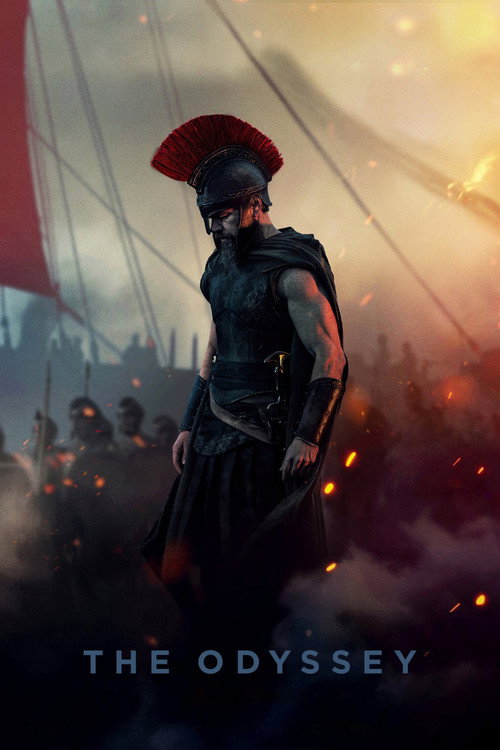
The Odyssey
2026 · Christopher Nolan
Nolan's Homer adaptation selling out IMAX 70mm shows a full year before release — the purest data point yet for event-ization: cinema sold like a stadium tour.
For when you want an event — the big-canvas, clear-your-evening spectacle that reminds you why theaters exist. Emotionally it runs from white-knuckle to wistful; it's an epic about longing for home as much as fighting monsters.
What it's about
Odysseus, king of Ithaca, won the Trojan War with a wooden horse and a lie — now he has to get home, and the journey will cost him a decade. Between vengeful gods, sea monsters, and islands that trap men in stranger ways, the voyage tests his cunning as much as his courage, while a kingdom and a family wait on the far shore. It's the oldest adventure story there is, mounted at the largest possible scale.
The experience
Vast and immersive — a mythic epic that alternates thunderous set pieces with eerie, dreamlike stretches at sea. It aims for awe: the feeling of being very small on very big water, with the gods watching.
The craft
Christopher Nolan shot this with IMAX cameras and his trademark insistence on practical, in-camera scale — real ships, real water, real locations standing in for the mythic Mediterranean. Paired with a massive score and his knack for cross-cut tension, it's engineered for the biggest screen and best sound system within reach; seeing it small genuinely loses something.
Why it matters
Nolan's first plunge into ancient myth after conquering nearly every other genre, and one of the defining big-screen events of its year — a bet that classical epic storytelling can still fill theaters.
Snapshot
The Odyssey is Christopher Nolan's adaptation of Homer's epic: Odysseus's long journey home after the Trojan War to reunite with Penelope and take back his kingdom from the suitors who have overrun it. It is his first film since Oppenheimer (2023). It premiered at the Odeon Luxe Leicester Square in London on July 6, 2026, and opened wide in the United States and the United Kingdom in mid-July. It runs 173 minutes. It is the first feature shot entirely on IMAX film cameras. Nolan wrote and directed it, and he kept the team behind his late period: cinematographer Hoyte van Hoytema, editor Jennifer Lame and composer Ludwig Göransson. Matt Damon plays Odysseus at the head of a very large ensemble.
The film was a major commercial and critical success. It had the biggest opening of Nolan's career and passed The Dark Knight Rises to become his highest-grossing film. By mid-October 2026 it had taken $1.789 billion worldwide, making it the second-highest-grossing film of the year. Reviews were mostly enthusiastic, with a small group of dissenters. Debate went beyond the review pages: classicists objected to its dialogue and tone, some of its casting choices drew bad-faith attacks, and its shoot in Western Sahara was criticized on political grounds.
Industry & production
The Odyssey is one of the largest productions of Nolan's career, with a reported budget of $250 million. Principal photography lasted 91 days, from February 25 to August 5, 2025. The shoot covered Morocco, Western Sahara, Greece, Italy, Iceland and Scotland, plus the Universal Studios lot in Los Angeles. The Ithaca scenes were filmed at the Castello di Santa Caterina, a hilltop site reached on foot. Ruth De Jong was production designer and Ellen Mirojnick costume designer.
The logistics followed from the decision to shoot everything on photochemical IMAX. Exposed negative was flown from distant locations to the FotoKem lab in Burbank for processing. The production used more than two million feet of film. Nolan's long-held preference for real places over digital environments took the crew to working coastlines, deserts and northern landscapes, not soundstage substitutes.
The choice of locations caused controversy. Writing in The Guardian, the Sahrawi writer Mohamed Sleiman Labat criticized the decision to film in Moroccan-occupied Western Sahara. He argued that it put the production in the service of a state publicity effort to legitimize an illegal occupation.
Commercially, the film turned its scale into a return. It opened to $264.1 million worldwide, Nolan's biggest opening, and fell only to $90 million domestic in its second weekend, which pushed its global total to $639.9 million. By August 10 it had passed $1.1 billion, overtaking The Dark Knight Rises as Nolan's top grosser. IMAX 70mm engagements were extended from mid-August into mid-September because of demand. By August 10 the film had also passed Avatar as the highest-grossing IMAX release. As of October 18, 2026, its worldwide total stood at $1.789 billion: $625 million domestic and $1.16 billion international.
Technology
Technology is the film's most widely discussed achievement. The Odyssey is the first feature shot entirely on IMAX film cameras, which record on 15-perforation 65mm stock and produce the largest frame in commercial motion-picture use. Nolan had used IMAX photography for set pieces and long stretches of The Dark Knight, Interstellar, Dunkirk, Tenet and Oppenheimer. This film takes that campaign to its end point.
The format had always been limited by its cameras, which were loud enough to make synchronized dialogue difficult and bulky enough to restrict where they could go. The production worked with a new, quieter IMAX camera nicknamed "Kigley," built with carbon-fiber components and soundproofing. A coffin-sized soundproof housing, known on set as the blimp, weighed more than 136 kilograms and took six people to move. Because the rig was so large, a mirror system was devised so actors could see each other past the camera and keep their eyelines in close dialogue scenes. Anne Hathaway praised the system as truly ingenious.
The result is unusually hard to exhibit as intended. Only about forty screens worldwide can project the film in IMAX 70mm. Its premium-format success therefore depended on a small, specialized network of venues, and that network sold out. Nolan has called IMAX the best film format ever invented. The film's box office, with IMAX becoming the largest-grossing release in that format's history, is the strongest commercial support yet for his long argument that photochemical capture and theatrical projection are a better imaging pipeline, not nostalgia.
Technique
Cinematography
Hoyte van Hoytema, Nolan's cinematographer since Interstellar (2014), has described the look of the film as an intimate kind of epic, and reviewers broadly agreed. Critics noted how he balances the huge IMAX frame with close-ups that keep the drama at human scale. Some observed that, despite the all-IMAX capture, the film feels grounded instead of grandiose: its magic happens in recognizable, almost mundane landscapes and not in fantastical vistas. Night and low-light scenes look naturalistic while daylight colors stay vivid. This follows from van Hoytema's work on Dunkirk and Oppenheimer, where he learned to use the large-format camera for proximity as well as spectacle.
Editing
Jennifer Lame, who cut Tenet and Oppenheimer, edited the film, and she faced the structural challenge Homer's poem poses. The film is non-linear. It moves between Odysseus's memories of his voyage and Telemachus's search for his father, and it nests flashbacks inside one another in the way Homer embeds tales within tales. Critics praised Lame's handling of both epic conflict and private moments, and several noted that the film moves quickly across its three hours. Not everyone was convinced. Some reviews found the parallel journeys of father and son unevenly balanced, and part of the online audience thought the non-linear telling and cutting were confusing.
Mise-en-scène / staging
Nolan's preference for photographing over synthesizing shapes the whole production. He told interviewers that the most important thing was to use the real world, and he resisted a fully computer-generated approach to the poem's mythic material. The sea scenes were shot aboard the Draken Harald Hårfagre, a modern-built Viking longship, not a digital vessel. The actors trained with the ship's crew and rowed for hours at sea. Visual effects are used sparingly and kept for mythic moments, so the supernatural appears inside a physical, weathered world instead of replacing it. Nolan said he approached the poem's creatures the way he would any other character, not as monsters to be rendered as spectacle. Some viewers took issue with the film's fight choreography.
Sound
Göransson's score is the most distinctive element of the film's sound. It largely avoids a traditional orchestra in favor of bronze gongs, voices, and reconstructions of the ancient Greek aulos and lyre. Critics heard it as both ancient and avant-garde, a texture that places the story in a deep past without the familiar conventions of the historical-epic score. It also continues the rhythmic, percussion-driven approach Göransson brought to Tenet and Oppenheimer.
Performance
Matt Damon plays Odysseus, his most substantial work with Nolan after a supporting role in Oppenheimer. Around him: Tom Holland as Telemachus, Anne Hathaway as Penelope, Robert Pattinson as the suitor Antinous, Lupita Nyong'o as both Helen of Troy and Clytemnestra, Samantha Morton as Circe, Zendaya as Athena, Charlize Theron as Calypso, Jon Bernthal as Menelaus, Benny Safdie as Agamemnon, and John Leguizamo as the swineherd Eumaeus. Himesh Patel, Elliot Page and Bill Irwin also appear.
Morton's Circe is reported to have drawn applause on set, something Nolan reportedly had not seen since Heath Ledger's Joker. The Rotten Tomatoes critics' consensus praised the ensemble as a whole. Not everyone agreed. The Jewish Chronicle's John Nathan argued that the starry casting sometimes risks trivializing the material, citing Theron's Calypso.
The cast also delivers its lines in American accents, breaking the long habit of historical epics defaulting to British ones. The Hollywood Reporter's James Hibberd treated this as a striking departure. Before release, Nolan defended the plain register: he said the poem itself is earthy, grounded and accessible, and that arguments held before anyone had seen the film were beside the point.
Narrative & dramatic mode
Homer's Odyssey is a nostos, a homecoming story built on delay. Odysseus is kept from Ithaca for years by divine hostility, mortal error and temptation, while at home Penelope and Telemachus hold out against predatory suitors. The poem begins in medias res and recovers its hero's earlier trials through retrospective narration. Its thematic engine is metis, cunning intelligence set against brute force.
Nolan keeps that recursive design instead of straightening it out. The film braids two lines of action. One is Odysseus's voyage, told largely through memory. The other is Telemachus's search: guided by Athena, he learns that his father is alive and held on an island. Inside this frame the film layers its flashbacks, from a bard's recitation in the palace to scenes of the war at Troy to individual characters' memories, mirroring Homer's own technique of stories told inside stories. The material suits Nolan, whose films since Memento have been built from fractured chronology and subjective memory, and here the fractured structure comes from the source itself.
The dramatic register is serious, even severe. Variety's coverage was summarized as finding a major set piece every few minutes, each one big enough to be the climax of an ordinary summer blockbuster. Nathan noted that Odysseus's violence often reads as spite more than heroism, which complicates the poem's celebration of its hero.
Genre & cycle
The film combines the mythological epic with the contemporary blockbuster and joins a long cycle of screen antiquity. That cycle runs from the mid-century Hollywood and Italian peplum films and Ray Harryhausen's stop-motion mythologies through Gladiator (2000), Troy (2004) and the stylized 300 (2007). Nolan has acknowledged the Harryhausen pictures and the Greek-mythology films he watched as a child as part of the film's background. The finished work leans away from their fantasy pageantry and toward something rougher and more physical.
Critics placed it in a double lineage. Monica Castillo of The A.V. Club saw a meeting of old and new Hollywood, a nod to the spectacles of earlier decades and also a morality play on a vast scale. William Bibbiani of TheWrap went further and treated it as a horror epic. The genre novelty lies less in the subject than in the seriousness and technical apparatus brought to it. It is an auteur-scale event film that applies the full resources of the modern tentpole to canonical literary material, in a tradition reaching back to David Lean's landscape epics.
Authorship & method
The Odyssey is a Nolan film in the fullest auteurist sense. He wrote the screenplay and directed, and the film shows the consistent habits of his career: practical photography, IMAX capture, a theatrical-first release, and a close repertory of collaborators. It is also an outlier. Most of Nolan's films come from original screenplays or work he developed himself, and here he adapts a public-domain classic. He called Homer's poem the foundational text, the urtext, of his own work, and said an adapter honors an original by interpreting it as strongly as they personally can.
Nolan described his writing process in interviews. He reads widely, writes notes from memory instead of from the page, sketches for months, and then writes the script straight through from the first page. For the film's visual and atmospheric tone he cited two specific models: the textures of Andrei Tarkovsky's Andrei Rublev (1966) and the environment and wind of Akira Kurosawa's Ran (1985). Both are historical epics in which landscape and weather carry as much meaning as action.
The key collaborators are the constants of his late career. Hoyte van Hoytema has shot every Nolan feature since Interstellar. Jennifer Lame has cut his films since Tenet. Ludwig Göransson, Nolan's main musical voice since Tenet after the long partnership with Hans Zimmer, wrote the score. Ruth De Jong (production design) and Ellen Mirojnick (costumes) complete the core team.
Movement / national cinema
Nolan resists easy national-cinema labels. He is British-born and American-based, works in English within the Hollywood studio system, and brings a European art-cinema sensibility to structure and time. He belongs less to a movement than to a transatlantic tradition of large-scale auteur filmmaking. The Odyssey makes that transnational character literal: a Greek text, shot across North Africa, the Mediterranean and the North Atlantic, voiced in American English, drawing openly on Soviet and Japanese masters.
If the film belongs to a movement, it is the small current of directors defending photochemical, theatrically exhibited spectacle against streaming-era economics. Nolan has led that cause more visibly than anyone, and The Odyssey is his strongest evidence for it so far.
Era / period
The film comes out of the post-pandemic film industry: a shrunken theatrical middle, franchise dominance, and an anxious debate about whether cinema can survive as a communal, big-screen art form. Oppenheimer's success in 2023 suggested that original, adult, format-driven event films could still draw mass audiences. The Odyssey tested that idea at a higher budget and with harder exhibition requirements, and won. Its run, sustained by strong word of mouth and premium-format demand that kept a few dozen 70mm screens booked for weeks past their scheduled end, now stands as one of the period's clearest arguments for theatrical exhibition.
The period's culture wars also shaped how the film was received. Casting Lupita Nyong'o as Helen of Troy drew attacks from commentators including Matt Walsh and Elon Musk, which others condemned as racist; Nyong'o answered that beauty cannot be performed. Entertainment Weekly reported that Elliot Page's casting prompted transphobic memes. The controversy over the American accents showed how much modern audiences still expect antiquity to sound British on screen.
Themes
Nolan's version keeps the poem's central concerns: homecoming and its long deferral, cunning against force, and how identity wears down and reasserts itself across years of exile. Critics singled out hospitality, the sacred duty of host to guest that the Greeks placed under Zeus's protection. The film treats it as a moral law whose violation measures a world's decay. Reviewers noted its interest in the erosion of honor, in betrayal that survives victory, and in broken bonds and rejected hospitality as a warning about humanity more generally. Steven D. Greydanus of Decent Films saw in this a departure for Nolan, a film centrally about what human beings owe one another.
The film also favors the human over the divine. The gods are present, but critics found its emphasis on mortal choice and suffering more than divine intervention. Several readings stressed how dark it is. Peter Bradshaw of The Guardian read it as a metaphor for the emptiness and exhaustion that follow war. Bibbiani called it Nolan's most sensitive film, one almost entirely concerned with the torments of the soul: a personal blockbuster about self-loathing and shame played out on an enormous scale. Nathan's sense that Odysseus's violence reads as spite fits this view of a hero damaged by what he has survived. The emotional center is still the poem's: the long ache of the journey home.
These concerns echo Nolan's recurring subjects: the subjective distortion of time, memory as the reconstruction of a self, and the moral cost of survival, which ran through Memento, Interstellar, Dunkirk and Oppenheimer. Here they come with Homer's authority.
Reception, canon & influence
Critics were broadly positive. The film debuted at 98% on Rotten Tomatoes from early reviews and settled at 94% across 515 reviews. The site's consensus praised its majestic sweep, its ensemble and its success in giving myth primal human feeling. Metacritic records a score of 88 from 63 critics, signifying universal acclaim. Audiences agreed: an A CinemaScore, an 81% "definitely recommend" rating on PostTrak, and a 96% audience score on Rotten Tomatoes.
The most enthusiastic critics made big claims. Bibbiani at TheWrap called it Nolan's finest achievement. Robbie Collin of The Daily Telegraph named it the best film of the year to that point. Clarisse Loughrey of The Independent stressed its unprecedented scale. Manohla Dargis of The New York Times saw an anomalous big-studio entertainment that had turned a 3,000-year-old poem into a smart, thoughtful film. Variety praised it as a thrilling achievement while finding it aloof. A smaller group dissented sharply. Stephanie Zacharek of Time found it lifeless and dismissed it as a dud. Richard Brody of The New Yorker argued that Nolan made an epic poem prosaic. Odie Henderson of The Boston Globe found it overserious and weighed down by its own bleakness.
Classicists added a separate critique. Mary Beard found the film lacking in sex and humor and its character dynamics weakly handled. Emily Wilson, whose translation of the poem is widely read, judged it a simple action film with poorly written dialogue. Online reaction was reported as split despite near-universal admiration for the images.
The influences on the film (backward) are clear and partly documented by Nolan himself. Homer's Odyssey, about three thousand years old, is the source of the whole tradition of journey-and-return narrative, and Nolan places it at the root of his own work. The film's look draws on Andrei Rublev and Ran, two epics in which mud, fire, wind and weather are dramatic forces. Its relationship to myth on screen goes back to Harryhausen and the Greek-mythology films of Nolan's childhood, which it rejects in method while honoring in spirit. Its technical lineage is the large-format photography Nolan has spent two decades extending, and behind that the landscape epic of David Lean.
The film's legacy (forward) so far lies most visibly where the production pushed hardest. It proved that a feature can be shot entirely on IMAX film, and that such a feature, shown properly in very few venues, can anchor a global mass-audience event. Its record IMAX gross and extended 70mm run make the strongest industrial case yet for premium large-format capture and exhibition. It also reopened the old argument over how the ancient world should sound and look on screen, from accents to casting. Its most lasting inheritance may prove as much technological and industrial as artistic: further proof of the kind of cinema Nolan has spent his career defending.
A Deleuzian reading
Begin with the oars.
The full Deleuzian reading of The Odyssey →
Reception
Reviews debuted at a 98% Tomatometer before settling at 94% across 515 reviews, with Metacritic at 88 and audiences grading it an A on CinemaScore, and a $264.1 million worldwide opening, Nolan's biggest, snowballed into $1.789 billion by mid-October, the second-biggest film of 2026.
How The Odyssey was received, from release to now →
How to watch The Odyssey: what to notice on a first viewing
- Watch how often the giant frame cuts in close to Damon's face. Van Hoytema shot everything on IMAX film, the biggest frame there is, yet he keeps moving in tight on faces and hands. Wide sea, then a close face, then wide sea again. The scale never swallows the man. You read Odysseus's world through its size and his face through its nearness, in the same format.
- Track the jumps between Odysseus at sea and Telemachus at home. Lame braids two journeys. Odysseus's voyage arrives mostly as memory, while Telemachus, guided by Athena, searches for news of his father. The film nests flashbacks inside flashbacks, including a bard's recitation in the palace. Homer told his story as tales inside tales, and Nolan keeps that layering. Knowing which layer you are in keeps the three hours clear.
- Look at the ship. It is a real longship on real water. Nolan shot the sea scenes aboard the Draken Harald Hårfagre, a modern-built Viking ship, and the actors trained to row it for hours. The spray, the oars and the strain on the men are physical. Because the voyage is real labor on a real sea, the rare effects shots for gods and creatures land inside a weathered world rather than replacing it.
- Listen for gongs, voices and old Greek pipes instead of an orchestra. Göransson builds the score from bronze gongs, human voices and reconstructions of the ancient aulos and lyre, driven by percussion the way his Tenet and Oppenheimer scores were. The music places the story in a deep, strange past without the swelling strings you expect from a historical epic.
- Listen to the accents. Everyone speaks plain American English. Damon, Holland, Hathaway and Pattinson talk in their own voices, with none of the British stage diction historical epics usually adopt. Nolan defended the plain register as true to the poem's earthiness. Kings, suitors and swineherds sound like people in a room, which pulls the myth toward ordinary speech and away from pageant.
The whole guide to watching The Odyssey, with the keys for a rewatch →
Influences: the films it descends from and the films it influenced
- Lawrence of Arabia (1962) — Establishes the 70mm grammar Nolan borrows: staging a lone human figure against vast unbroken landscape so scale is read through the frame rather than cutting, shooting real terrain in large format instead of building it.
- 2001: A Space Odyssey (1968) — Model for large-format (Super Panavision 70) capture married to in-camera practical effects and an odyssey structure that treats scale and duration themselves as the subject — the technical-plus-thematic reach Nolan explicitly chases.
- Ben-Hur (1959) — Prototype of the 65mm ancient-world epic whose set pieces (the chariot race) are staged physically at full scale in-camera rather than faked, the practical-spectacle argument Nolan inherits.
- Ulysses (1954) — The immediate generic template — a mid-century Homeric screen adaptation compressing the epic into a star-vehicle voyage — against which Nolan's version is measured and defined.
- Jason and the Argonauts (1963) — Benchmark for realizing Greek myth's monsters through tangible in-camera effects (Harryhausen's stop-motion) so the fantastical registers as physically present, the practical-over-digital ethos Nolan extends.
- Spartacus (1960) — Super Technirama 70 antique epic that scales crowd and battle through real massed bodies in large format, an early instance of Kubrick's technical ambition Nolan cites as inheritance.
- Barry Lyndon (1975) — Period photography built from available and practical light and painterly composed tableaux, the naturalist-practical lighting discipline that runs forward into van Hoytema's approach.
- Doctor Zhivago (1965) — Epic emotion generated from real landscape, weather and journey rather than studio sets — Lean's landscape-driven historical method Nolan names as a direct ambition.
- Let the Right One In (2008) — Early van Hoytema work defining his restrained naturalist lighting and available-light discipline, the photographic signature that becomes Nolan's late visual grammar.
- Dunkirk (2017) — Nolan's first feature shot predominantly on IMAX 65mm film, the direct proof of concept that a narrative feature can be captured almost entirely in the large format The Odyssey pushes further.
- Oppenheimer (2023) — The immediate methodological predecessor: IMAX film capture (including custom IMAX black-and-white stock), Göransson's rhythm-forward score and Jennifer Lame's cutting — the exact collaborator apparatus reassembled here.
- Interstellar (2014) — First Nolan–van Hoytema collaboration, establishing their practice of IMAX capture with practical in-camera photography of physical environments rather than green-screen.
- Tenet (2020) — Ludwig Göransson's first Nolan score, introducing his textural orchestral-electronic, rhythm-forward writing to Nolan's cinema, alongside van Hoytema IMAX and full-scale practical set pieces.
- The Hateful Eight (2015) — Contemporary revival of large-format 65/70mm capture and roadshow exhibition as a theatrical event, the same industrial argument that premium format can anchor a mass audience.
- Her (2013) — Showcases van Hoytema's warm, naturalistic practical-light cinematography — the softened, source-motivated lighting sensibility he carries into his Nolan features.
- Black Panther (2018) — Establishes Göransson's percussion-driven, texture-forward scoring method — rhythm as primary orchestral material — the compositional voice he brings to Nolan's recent films.
Similar films
- Jason and the Argonauts (1963) — influence & lineage · same viewing thread
- Tenet (2020) — influence & lineage
- Interstellar (2014) — influence & lineage
- Dunkirk (2017) — influence & lineage
- 2001: A Space Odyssey (1968) — influence & lineage
- Harry Potter and the Deathly Hallows: Part 2 (2011) — same viewing thread
- Avengers: Endgame (2019) — same viewing thread
- The Lord of the Rings: The Return of the King (2003) — same viewing thread
All the films related to The Odyssey →
Watch it with: curated runs of related films
- Studio-Sized Mythmaking — A run of blockbuster quest epics — fellowships forged, dark lords faced, and long roads home — that rhyme on scale, world-building, and the pull of a saga you can lose a weekend inside.