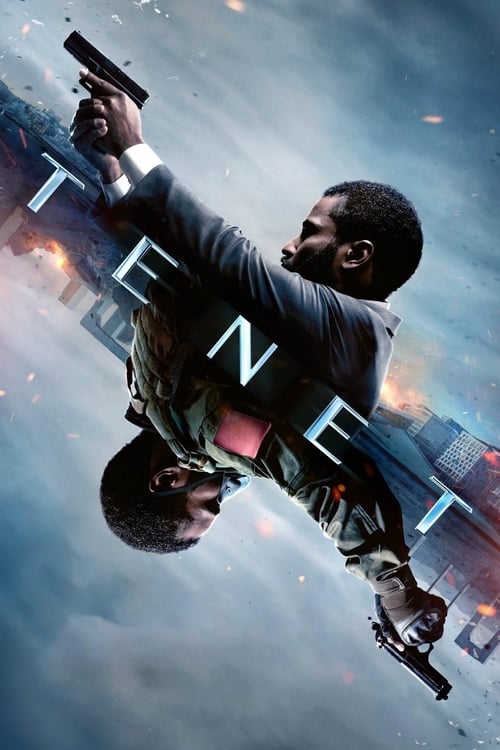
Tenet
2020 · Christopher Nolan
The director whose every release is treated as a referendum on theatrical cinema itself: Oppenheimer's IMAX-70mm pilgrimage culture, the Barbenheimer phenomenon, and now The Odyssey selling out screenings a full year in advance. Naming him signals you believe in the big screen; arguing about him (cold characters, muddy sound mixing) is its own cottage industry.
When you're craving pure spectacle with a brain-teaser inside — the kind of blockbuster you watch twice, once for the rush and once for the mechanics. Not one for a tired night; it demands (and rewards) alertness.
What it's about
A nameless American agent is recruited into a shadow organization with one word for a passkey — Tenet — and pointed at a Russian arms dealer trafficking in something worse than plutonium: objects whose entropy runs backwards. Stopping him means mastering espionage where cause and effect can flow in either direction, across a mission that hops from Mumbai to Oslo to the Amalfi coast.
The experience
Loud, propulsive and deliberately disorienting — a puzzle-box action film that runs at full sprint and dares you to keep up. Some sequences are jaw-dropping even when you're not sure which way time is flowing; confusion is part of the ride, not a bug you can avoid.
Performances
John David Washington anchors the mayhem with cool charisma, Robert Pattinson gives the film its wit and warmth, and Elizabeth Debicki carries its only real emotional stakes; Kenneth Branagh makes a genuinely menacing heavy.
The craft
Nolan stages the reversed-time action practically — real stunts, real vehicles, entire fight scenes choreographed to run forwards and backwards at once — and the scale is enormous. The pounding score and physical sound mix make this a film built for the biggest screen and loudest system you can find.
Why it matters
Released mid-pandemic as the test case for whether blockbusters could survive without theaters, it became a flashpoint — argued over, memed, rewatched — and pushed the time-bending action film to its logical extreme.
Snapshot
A globe-spanning espionage thriller built on a single conceit drawn from thermodynamics: entropy can be reversed. An unnamed Protagonist (John David Washington) is recruited by a covert organization called Tenet to prevent a Russian oligarch, Andrei Sator (Kenneth Branagh), from triggering an algorithmic weapon capable of running time itself backwards, destroying the future in order to preserve the past. Shot across seven countries on practical sets and with live-action spectacle at an extraordinary scale, Tenet is among the most formally ambitious mainstream films of its era—and one of the most controversial, dividing critics between admiration for its engineering and frustration with its emotional opacity. Released into the teeth of the COVID-19 pandemic in September 2020, it became a test case for theatrical survival as much as a film in the ordinary sense.
Industry & Production
Tenet was produced by Syncopy Inc., Nolan's company with producer Emma Thomas, and financed and distributed by Warner Bros. Pictures. The budget was reported at approximately $200–225 million, with marketing costs raising the total outlay considerably higher. Nolan had developed the inversion concept over nearly a decade before committing to a screenplay, conducting research into theoretical physics and working through the logistical implications of staging action sequences involving simultaneously forward and inverted motion. Principal photography ran from May to November 2019, with units in the United Kingdom, Estonia, Denmark, India, Italy, Norway, and the United States.
The production is perhaps best known for its embrace of practical filmmaking at an extreme scale. For a key sequence set in an Oslo airport freeport, the production purchased a decommissioned Boeing 747 and used the aircraft itself as a set piece, crashing it into a building for a filmed explosion rather than constructing a miniature or composite. This decision—logistically expensive but visually unimpeachable—was consistent with Nolan's long-standing production philosophy. The release was delayed twice from its original July 2020 date as the pandemic shuttered global cinemas; Warner Bros. committed to a theatrical premiere beginning September 3, 2020, positioning Tenet as a symbolic standard-bearer for the survival of theatrical exhibition. The film ultimately grossed approximately $363 million worldwide, a figure widely characterized as underperforming relative to production and marketing costs, though the distorting effect of pandemic-era attendance restrictions makes definitive judgment difficult.
Technology
The central technological achievement of Tenet is the filmic representation of inversion: objects, people, and ballistics moving backward through time within forward-moving photographic space. The production employed a combination of genuinely reversed camera footage, purpose-built rigs operating in reverse, and on-set choreography of actors performing actions designed to read as coherent when the film is played backward. No single optical trick accomplishes this; the sequences required each element—falling debris, vehicle movement, gunfire, stunt choreography—to be engineered and shot individually for its temporal direction, then composited into a single coherent frame.
Nolan shot Tenet primarily on 70mm film using IMAX cameras in partnership with cinematographer Hoyte van Hoytema, continuing the large-format commitment established on Dunkirk (2017). IMAX sequences constitute a significant portion of the runtime, particularly in the action set pieces. The film resists heavy digital post-processing; van Hoytema and Nolan have both emphasized the primacy of what is captured optically in camera. The Tallinn car chase—involving vehicles traveling in opposing temporal directions on a live motorway—required extraordinary coordination of multiple camera positions and live stunt work. Whether the effects fully convince audiences on first viewing became a point of critical debate, but the underlying production methods are formally documented and practically verifiable.
Technique
Cinematography
Hoyte van Hoytema, working with Nolan for the third time after Interstellar (2014) and Dunkirk, shot Tenet with a palette conspicuously cooler and more metallic than his predecessors' work on Nolan films. The image is hard and glassy rather than warm: blues and silvers dominate, suggesting the sterile internationalism of freeports, oligarch yachts, and glass-clad megacities. Wide lenses are used aggressively in action sequences to preserve spatial legibility during moments of extreme choreographic complexity—a practical choice with an aesthetic effect, forcing audiences to actively parse simultaneous forward and inverted motion within a single frame rather than relying on cutting to clarify. The IMAX sequences expand the aspect ratio to fill a full square frame, most dramatically in the Stalsk-12 climax, where the scale of simultaneous forward and inverted armies across a ruined industrial landscape becomes the film's most overtly sublime image.
Editing
Tenet marked Nolan's first film without longtime editor Lee Smith, who had cut every picture from Batman Begins (2005) onward. Jennifer Lame, whose prior credits include Noah Baumbach's Marriage Story (2019), brought a different sensibility to large-format action filmmaking. The editing of inversion sequences required structural decisions without strong precedent: how long to hold on a reversed action before cutting, how to interweave forward and backward momentum without losing spatial coherence. Lame and Nolan's solution tends toward sustained takes in moments of greatest complexity—the Oslo freeport fight, the Tallinn chase—relying on the shot's internal logic rather than montage to generate tension. Critics were divided on whether this patience is clarity or obscurity.
Mise-en-scène / Staging
Nolan's staging of the inversion sequences operates on a principle of doubled geography: any significant location in the film is implicitly a space that will be, or has already been, traversed in both directions. This produces a peculiar form of dramatic irony in which attentive viewers understand that background details—scorch marks, debris patterns, moving vehicles—are consequences of events not yet shown. The film's spatial design, overseen by production designer Nathan Crowley (a long-standing Nolan collaborator), emphasizes vast, liminal, and anonymous architecture: freeports, power plants, the stripped industrial terrain of Stalsk-12. Human figures are consistently dwarfed. The effect is less warmth than grandeur, less drama than demonstration.
Sound
Ludwig Göransson's score is the most formally integrated element of the film's sound design. Göransson, replacing Hans Zimmer, built the score around reversed and compressed audio material: instruments played backward, recordings run in reverse and re-orchestrated, sonic palindromes that mirror the film's temporal logic. The score pulses and compresses rather than resolving through conventional harmonic progression, creating a texture of relentless forward pressure. The practical consequence of Tenet's sound design more broadly—dense, loud, and heavily layered—drew sustained criticism for rendering significant amounts of dialogue inaudible in theatrical exhibition. Nolan acknowledged audience responses on this point but maintained that the film's sound mix was intentional. The dialogue intelligibility issue became one of the defining controversies of the film's release.
Performance
John David Washington anchors the film as the Protagonist—a deliberately depersonalized figure whose lack of a proper name signals his function more than his interiority. Washington, a former professional athlete turned actor whose previous leading role in Spike Lee's BlacKkKlansman (2018) was markedly warmer, plays the role as professional competence under pressure: controlled, witty in an understated register, and deliberately unreadable. Robert Pattinson as Neil, the Protagonist's contact and eventual friend, provides the film's most conventional emotional texture; his ease in ensemble is palpable. Elizabeth Debicki as Kat, Sator's estranged wife, is given the film's closest approach to a traditional emotional arc. Kenneth Branagh's Sator is intentionally outsized, a late-Nolan villain in the tradition of The Dark Knight Rises' Bane rather than Heath Ledger's Joker: more instrument than person.
Narrative & Dramatic Mode
Tenet operates primarily as what might be called a demonstration narrative—a film whose dramatic mode is explicative rather than experiential. Its emotional payoff is primarily intellectual: the satisfaction of a closed temporal loop resolved, of information revealed to have been present from the film's opening minutes. The film is structured around two interleaved revelations: that the future is sending inverted weapons into the past, and that the Protagonist himself is the founder of the organization he is recruited into, operating on foreknowledge derived from his own future. This causal loop—sometimes called a bootstrap paradox—forecloses questions of character agency in ways that deliberately strain the conventions of the thriller, in which the protagonist must be capable of meaningful choice. Whether this constitutes a dramatic flaw or a deliberate philosophical provocation is a primary axis of the film's critical dispute.
Genre & Cycle
Tenet operates squarely within the tradition of the globe-trotting espionage thriller established by the James Bond franchise, to which it explicitly gestures: the opera house opening, the weaponizable yacht, the obscenely wealthy villain, the multinational ensemble of glamorous locations. It is also a science fiction film in the hard-concept tradition—closer in spirit to the speculative rigor of 2001: A Space Odyssey (1968) than to the action-SF of the Marvel cycle. Within Nolan's own filmography, Tenet belongs to a loose cycle of high-concept puzzle films that includes Memento (2000) and Inception (2010), all of which embed their narrative within a formal conceit derived from an unusual relationship to time or consciousness. The film's scale and franchise ambitions align it with the era of tentpole cinema that dominated Hollywood production in the 2010s.
Authorship & Method
Nolan wrote the original screenplay unassisted, as with all his films from Memento onward except the Dark Knight trilogy collaborations with his brother Jonathan. He is among the small number of directors working at major-studio budget scales who retain complete creative control and final cut. His production methods—location shooting over soundstage work, practical effects over CGI, film over digital capture—constitute an authorial stance as much as an aesthetic preference, positioning Tenet against the digitally composited, franchise-driven mainstream even as it operates within that ecosystem.
Van Hoytema's visual sensibility, now established across three Nolan films, has become definitionally associated with this phase of Nolan's work: large-format, location-driven, analytically composed. Göransson's arrival signals a shift in sonic identity: his work is more physically visceral, less harmonically lyrical, than Zimmer's Nolan scores. Jennifer Lame's editing, while not yet definitive across a body of work, represents a generational transition in Nolan's creative collaborators. Production designer Nathan Crowley has been Nolan's closest sustained visual collaborator after van Hoytema, responsible for the monumental industrial textures that run through The Dark Knight trilogy, Interstellar, and Tenet.
Movement / National Cinema
Nolan is British-born, educated at Cambridge, and holds dual British-American citizenship; his filmmaking career has been conducted almost entirely within the American studio system while retaining conspicuous British collaborators and sensibilities. Tenet is a transatlantic production in the fullest sense: British directorial intelligence applied to American money and global subject matter. It has no strong affiliation with any national cinema tradition in the way that, say, a film of the British New Wave or the French politique des auteurs would. It belongs instead to the supranational mode of prestige Hollywood blockbusters in the post-studio era.
Era / Period
Tenet arrives at the apex of the prestige-blockbuster era: a period roughly 2008–2022 during which major studios allocated budgets previously associated only with franchise spectacle to films conceived as stand-alone authorial statements. Nolan was the preeminent practitioner of this mode, and Tenet is its most extreme expression—a studio film of uncompromising formal difficulty produced at a scale ordinarily reserved for IP sequels. Its release also marks the moment at which the pandemic fundamentally disrupted the theatrical distribution model that had sustained this era; the film's commercial fortunes are inseparable from that disruption. Nolan had already begun development on Oppenheimer (2023) during Tenet's post-production, and his subsequent move from Warner Bros. to Universal Pictures following disputes over Warner's simultaneous HBO Max release strategy marks a visible turning point in the studio relationship that had enabled this era of his career.
Themes
Tenet is organized around entropy—specifically the thermodynamic second law, which holds that disorder increases in a closed system over time—and its hypothetical reversal. The film extends this into a meditation on temporal determinism: if the future can communicate with the past, and if the Protagonist is himself the architect of the mission he is recruited into, then free will collapses into a closed causal loop in which agency is illusory. Sator's motivation—a dying man who, knowing the world will end, decides to accelerate its ending—condenses the film's environmental subtext: the oligarchic destruction of futures that others will have to inhabit. The recurring phrase "what has happened, happened" functions as the film's philosophical motto, advocating a form of temporal fatalism as the only tenable stance toward irreversible causality. Beneath the formal pyrotechnics, Tenet is a film preoccupied with the impossibility of undoing consequences.
Reception, Canon & Influence
Critical response at release was genuinely divided and unusually polarized for a Nolan film. Many reviewers praised the film's formal ambition, its action choreography, and Göransson's score while citing the dialogue intelligibility problem, the emotional distance of the protagonist, and the expository density of the screenplay as significant liabilities. The film holds a critical consensus roughly in the range of its director's less-celebrated pictures—appreciably below The Dark Knight (2008) or Inception, closer to Interstellar in its ratio of advocates to detractors.
The influences on Tenet are recognizable: the Bond franchise's espionage grammar, the closed-loop paradox traditions of written science fiction (Heinlein's "By His Bootstraps," various Philip K. Dick), the avant-garde possibilities of reversed footage explored by filmmakers from Jean Cocteau onward, and, within Nolan's own work, the structural lessons of Memento and the layered simultaneity of Inception. The film's engagement with entropy is consistent with a strand of post-war physics-inflected science fiction but has no single obvious cinematic ancestor.
Its forward legacy is harder to assess. Tenet did not generate imitators in the way that The Matrix (1999) or Inception manifestly did, partly because its formal vocabulary is so thoroughly dependent on Nolan's specific production infrastructure. Within Nolan's own trajectory, it represents the limiting case of puzzle-film formalism, and Oppenheimer (2023) reads in retrospect as a deliberate correction—a turn toward biographical drama and emotional directness after Tenet's austere abstraction. Whether Tenet will ultimately be regarded as a transitional work within Nolan's canon or as a self-sufficient major statement remains genuinely open; the film's formal density ensures that rewatch culture sustains engagement with it in ways that uncomplicated spectacle does not.
A Deleuzian reading
Notice the scorch mark before the fire.
The full Deleuzian reading of Tenet →
Reception
Released as 'the film that would save cinemas' in COVID-era 2020, it landed to mixed reviews and endless complaints about inaudible dialogue; since then it's been steadily reappraised by fans who rewatch it like a puzzle box, though it never fully shed the 'cold Nolan' tag.
How Tenet was received, from release to now →
Influences: the films it descends from and the films it influenced
- Orphée (1950) — Cocteau's reverse-footage technique—actors filmed walking backward through a mercury-bath set, the footage then inverted in the cut to simulate mirror-world passage—is the direct cinematographic ancestor of Tenet's practical inversion photography, applying the same reversal logic at action-sequence scale.
- La Jetée (1962) — Marker embeds the bootstrap paradox structurally: the protagonist's final image is his own death, which he now recognizes as the childhood memory that opened the film; Tenet inherits this closed-causal-loop architecture, where retroactive reframing of earlier footage constitutes the film's central epistemological pleasure.
- From Russia with Love (1963) — The Bond film that codified the tradecraft grammar Tenet inherits wholesale: the classified briefing withholding mission parameters from protagonist and viewer simultaneously, the weapons-specialist exposition scene, and the Istanbul location sequence as anonymous professional choreography.
- The Spy Who Came in from the Cold (1965) — Oskar Werner's Leamas is the template for Tenet's deliberately unnamed Protagonist: a professional operative kept ignorant of his mission's true purpose, instrumentalized as a chess piece by his own organization, photographed by Oswald Morris in a cool desaturated palette that strips interiority from the espionage hero.
- 2001: A Space Odyssey (1968) — Kubrick's staging of human figures dwarfed by monumental liminal corridors—interiority withheld, psychology subordinated to designed space—and his practical-miniature-and-front-projection approach at maximum production scale establish the formal grammar Nolan inherits for hard SF with a depersonalized protagonist.
- Heat (1995) — Mann's wide-angle staging of the downtown Los Angeles shootout—architectural geometry channeling professional movement without coverage-and-montage cutting—is the direct ancestor of Tenet's Stalsk-12 siege: symmetrically matched professional forces, analytical lens, urban topography as action grammar rather than backdrop.
- The Matrix (1999) — The Wachowskis pioneered staging demonstrations of physics-exception rules as extended kinetic sequences where the viewer learns new physics through choreography rather than exposition; Tenet inherits this pedagogy-through-action approach directly for its inverted-movement and inverted-combat sequences.
- Memento (2000) — Nolan's inversion of narrative chronology as an epistemological device—the viewer's temporal disorientation encoding the protagonist's cognitive condition—is the direct structural precursor to Tenet's inversion logic, scaling the same formal principle from subjective amnesia to objective thermodynamic physics.
- Inception (2010) — The demonstration-narrative structure—Cobb explains dream-physics to Ariadne while folding Paris in real time—is the exact expository method Tenet applies to inversion; Nathan Crowley's transformation of recognizable locations into monumental liminal architecture (rotating hotel corridor, snow fortress) is reprised directly in Tenet's opera house and Stalsk-12 bunker.
- Dunkirk (2017) — Van Hoytema's first full-scale deployment of 70mm IMAX for sustained practical-location action establishes the visual grammar Tenet extends to inverted combat; the multi-strand simultaneous chronology—three timelines of different duration converging at a single event—is the direct structural predecessor to Tenet's forward/inverted pincer operation at Stalsk-12.
- The Dark Knight Rises (2012) — Van Hoytema's large-format location photography and escalated practical-effects maximalism — a Boeing 747 crashed in-camera for the airport sequence — extend TDKR's position that photochemical capture of actual events carries epistemic weight CGI cannot match; Smith's sequence architecture governs the Oslo freeport and highway inversion passages.
- Interstellar (2014) — Extends Interstellar's non-Euclidean temporal logic into large-scale action choreography: the palindromic battle sequence renders time inversion through practically choreographed spatial sequences, continuing Nolan's commitment to making impossible geometries physical rather than digital.
- Oppenheimer (2023) — Jennifer Lame returns as editor and van Hoytema continues as cinematographer in Nolan's deliberate formal correction: the non-linear chronology (Strauss interrogation disrupting the Manhattan Project timeline) extends Tenet's temporal fragmentation, but the protagonist's interiority is now filled with psychological specificity, trading Tenet's austere depersonalization for biographical directness as a conscious course correction.
- Tinker Tailor Soldier Spy (2011) — Hoyte van Hoytema—before his Nolan collaboration—establishes here the specific cold-war visual grammar Tenet inherits: cool analytical palette, de-saturated institutional interiors, and the depersonalized intelligence professional whose competence is demonstrated procedurally rather than through emotional display; the cinematographer's sensibility runs unbroken into Tenet.
- Looper (2012) — Johnson constructs a bootstrap paradox where a character explicitly acknowledges that diagramming the causal loop 'would take all day'—then proceeds with forward dramatic momentum despite logical instability; Tenet adopts the identical stance when Neil instructs the Protagonist not to try to understand the time mechanics, prioritizing kinetic propulsion over theoretical resolution.
- Arrival (2016) — Villeneuve and Bradford Young's wide-angle, desaturated staging of incomprehensible geometry, combined with a screenplay that retroactively reframes all prior footage through a temporal paradox reveal, constitutes the closest parallel to Tenet's epistemological strategy: both films use the retroactive reframing of the opening sequence as their central structural payoff.
- Annihilation (2018) — Garland and Rob Hardy's practical staging of the doppelgänger pool sequence—a mirrored figure mimicking then diverging from the protagonist's movements in a sustained single take—is the closest sibling to Tenet's inverted-combat choreography: temporal doubling solved as a practical photography problem rather than a CGI composite.
- The Odyssey (2026) — Ludwig Göransson's first Nolan score, introducing his textural orchestral-electronic, rhythm-forward writing to Nolan's cinema, alongside van Hoytema IMAX and full-scale practical set pieces.
Similar films
- Inception (2010) — influence & lineage
- The Matrix (1999) — influence & lineage
- Memento (2000) — influence & lineage
- Oppenheimer (2023) — influence & lineage
- Dunkirk (2017) — influence & lineage
- Tinker Tailor Soldier Spy (2011) — influence & lineage
- Black Bag (2025) — shared sensibility
- Spider-Man: No Way Home (2021) — shared sensibility
All the films related to Tenet →