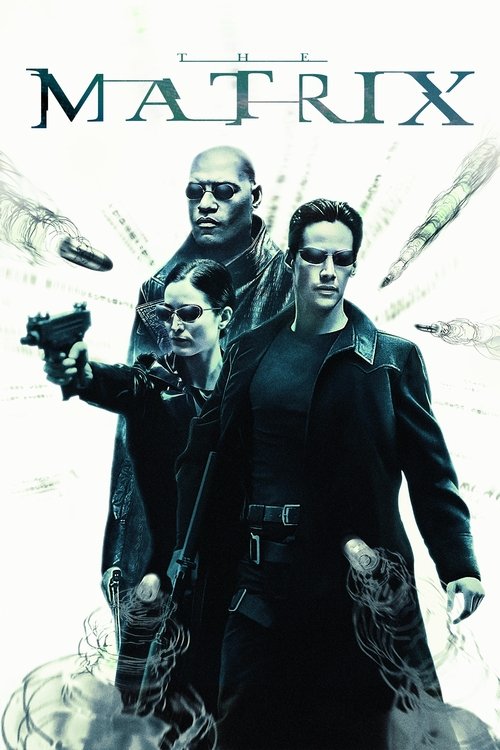
The Matrix
1999 · Lana Wachowski
For when you want an action movie that also rewires your head — pure adrenaline you can argue about afterward. Comfort viewing for sci-fi fans, a revelation if you've somehow never seen it.
What it's about
A hacker who goes by Neo senses something is off about the world — and he's right. Reality, it turns out, is a vast computer simulation built by intelligent machines to pacify a conquered humanity, and a band of underground insurgents led by the enigmatic Morpheus recruits him for the war being fought outside it. What follows is part chase thriller, part martial-arts showcase, part fable about waking up.
The experience
Sleek, propulsive, and genuinely mind-bending — it moves like a great action movie while quietly planting questions about what's real that stick with you after. The pacing is relentless but never confusing, and the big set pieces still land with a jolt.
Performances
Keanu Reeves's stillness is exactly right for a man learning the rules of reality don't apply to him, Laurence Fishburne gives Morpheus a true believer's gravity, and Hugo Weaving makes Agent Smith a villain of pure contemptuous menace.
The craft
This is the film that gave the world bullet time — the camera swiveling around frozen action — and married Hong Kong wire-work fight choreography to Hollywood scale. The green-tinted digital world, black-leather styling, and thunderous sound design created a visual language a whole decade of movies borrowed. Absolutely rewards the biggest screen and loudest speakers you can find.
Why it matters
It redefined what an action blockbuster could look like and think about, spawned endless imitations of its signature effects, and pushed simulation-theory talk from philosophy seminars into everyday conversation.
Snapshot
A computer hacker named Thomas Anderson, who operates under the alias Neo, discovers that the world he inhabits is an elaborate computational simulation maintained by machine intelligences to pacify a subjugated human population. Recruited by a band of insurgents led by the enigmatic Morpheus, Neo is drawn into the war between humanity and its machine oppressors. The Matrix arrived at the end of the twentieth century as one of the defining syntheses of popular cinema: a Hong Kong–inflected American action film, a philosophical fable about perception and liberation, and a technical landmark that reshaped how movies could move. Its cultural residue — in the visual lexicon of action cinema, in the spread of simulation-theory discourse, in the black-leather wardrobe of a decade — persists decades after its release.
Industry & production
The Matrix was co-directed by Lana Wachowski and Lilly Wachowski, then credited as "The Wachowski Brothers," and produced by Joel Silver for Silver Pictures and Village Roadster Films (Warner Bros. subsidiary), with distribution through Warner Bros. Pictures. The Wachowskis had established themselves with the neo-noir thriller Bound (1996), but The Matrix represented a leap in scale — the reported production budget fell in the range of sixty million dollars, with additional marketing expenditure. The film shot almost entirely in Sydney, Australia, at Fox Studios Australia, a choice driven by favorable exchange rates, tax incentives, and access to large purpose-built stages. The casting of Keanu Reeves as Neo followed an apparently competitive consideration of other leading men; reports have long circulated that Will Smith declined the role, though the full contours of the casting process remain partially undocumented. Carrie-Anne Moss and Hugo Weaving were cast through more conventional audition processes; Laurence Fishburne brought an established gravity to Morpheus. The production ran approximately approximately four months of principal photography before extensive post-production work, driven by visual effects pipelines that were unprecedented in scope.
Technology
The Matrix's central technical achievement — now known as "bullet time" — was the result of collaboration between the directors, visual effects supervisor John Gaeta, and a team at Manex Visual Effects. The technique involved arranging an arc of still cameras (in some iterations over a hundred) around a subject and triggering them in rapid sequence, then interpolating frames using computer-generated imagery to produce continuous motion through what appeared to be a frozen or extremely decelerated moment in time. The effect had precursors in still photography and in earlier commercial work, but The Matrix was the first theatrical feature to deploy it at scale and with cinematic intention, building sequences around its logic rather than treating it as an isolated trick. Gaeta and his team were awarded the Academy Award for Best Visual Effects. Composite photography — particularly the green-tinted "digital rain" of falling code in the title sequence — became one of the most imitated and parodied visual signatures in subsequent cinema. Practical wire work, rigged by Hong Kong stunt coordinator Yuen Woo-ping and his team, was integral to the action design; the cast underwent months of physical training before and during shooting. Sound designer Dane Davis was awarded the Academy Award for Best Sound Editing, recognizing equally innovative work in the aural dimension.
Technique
Cinematography
Bill Pope, the film's director of photography, developed a distinctive chromatic strategy in collaboration with the Wachowskis: scenes set within the simulated world of the Matrix were rendered with a greenish cast — achieved through filtration, production design choices, and post-production color work — while sequences in the "real world" aboard the hovercraft Nebuchadnezzar were lit in colder, bluer tones, reinforcing the ontological distinction. Pope favored wider lenses than was then conventional in action cinema, pushing focal planes to create a sense of spatial compression in close combat. The lobby-sequence shootout and the rooftop fight with Trinity both exemplify his approach: slow build through choreographic staging, then an eruption of compressed, directionally coherent violence. The camera is often kinetic but rarely arbitrary; movement tends to be motivated by action or revelation.
Editing
Zach Staenberg, who received the Academy Award for Best Film Editing, faced an unusual challenge: he was editing sequences designed around a technology whose final form did not exist until late in post-production. The bullet-time passages required precise structural framing — conventional high-speed footage establishing context before the frozen interpolation, then a return — and Staenberg's integration of these moments into the broader rhythm of sequences prevented them from feeling like isolated demonstrations. The pacing of the film overall moves through marked phases: a slow, paranoid first act; an accelerating middle section as Neo is trained; and an action-intensive third act. Transitions between the Matrix's reality and the real world deploy visual and editorial cues — the black screen, the shifts in color temperature — that train the viewer to track ontological status.
Mise-en-scène / staging
Production designer Owen Paterson worked from references in Japanese cyberpunk animation and in the visual lexicon of American urban noir to construct the Matrix's city (built largely on Sydney locations, dressed to read as an unspecified American metropolis) and the Nebuchadnezzar's grimy, analog interior. The costuming — long black coats, dark glasses, conspicuously tailored leather — owes debts to Hong Kong cool and to an operatic tradition of screen villainy, here extended equally to the protagonists. Yuen Woo-ping's choreography drew from the wire-assisted wuxia tradition that had already transformed Hong Kong action in the 1990s; the decision to use him was directly influenced by his work on Fist of Legend (1994) with Jet Li. Fights are staged with spatial legibility unusual in Hollywood action of the period: camera placement tends to frame combatants in full frame, preserving the geometry of the contest.
Sound
Don Davis composed the orchestral score, which combined symphonic passages with electronic textures in ways that anticipated the hybrid scoring that would become standard in blockbuster cinema over the following decade. The film also deployed a licensed soundtrack drawn from industrial rock and electronic music — Rob Zombie, Rage Against the Machine, Marilyn Manson, Prodigy — that positioned it within a late-1990s youth-culture context while reinforcing the narrative's techno-nihilist edge. The sound design itself is architecturally complex: the hollow, processed quality of sound within the Matrix contrasts with the rawer, more chaotic texture of reality-level sequences. The iconic sound of the bullet-time slow-down — a stretched, bass-heavy distortion of ambient noise — was created by Dane Davis's team and became one of the most immediately recognizable audio signatures in popular cinema of the era.
Performance
Reeves plays Neo with a deliberate flatness in the first two acts that reads as both character-internal (Anderson is dissociated, living a double life) and strategic, reserving expressive range for the film's final phase. The approach was criticized by some reviewers but coheres within the film's logic: the emergence of Neo's physicality and confidence is the dramatic arc, and Reeves tracks it economically. Fishburne's Morpheus is played with a prophet's gravity; his line deliveries are measured, oracular, occasionally self-conscious in ways the film frames as conviction rather than affectation. Hugo Weaving's Agent Smith — voice deepened, cadence made precise and slightly inhuman — became one of the defining screen antagonists of its decade, the performance carrying an implied contempt for humanity that functions as the film's ideological shadow. Carrie-Anne Moss as Trinity navigates a role that risks subordination and largely escapes it through physical authority and a consistent reserve that the script respects without always earning.
Narrative & dramatic mode
The Matrix follows the classical structure of the hero's journey as codified by Joseph Campbell and widely adopted in Hollywood screenwriting: the call to adventure, the refusal, the crossing of a threshold, initiation, and return. What distinguishes its deployment is the thickness of philosophical freight carried by each structural beat. The "red pill/blue pill" choice — embrace disorienting truth or remain in comfortable illusion — operates both as a plot hinge and as a figure for Cartesian skepticism, Gnostic initiation, and (as scholars have extensively noted) a broader invitation to rethinking one's given reality that has been interpreted across multiple registers, including as trans allegory. The film's debt to Jean Baudrillard is explicit — his Simulacra and Simulation appears as a prop in Neo's apartment — though Baudrillard himself publicly distanced his work from the film's use of it, arguing that it domesticated simulation into a recoverable illusion rather than the more radical proposition he intended. The Oracle figure operates as a structural mechanism for managing the tension between determinism and free will that the film poses but does not finally resolve.
Genre & cycle
The Matrix emerges from and decisively redirects several genre cycles. It is a science fiction film in the cyberpunk lineage established by William Gibson's Neuromancer (1984) and Philip K. Dick's speculative fiction more broadly — both of which the Wachowskis have cited as formative influences. It is simultaneously a martial arts film in the Hong Kong mode, particularly as that mode was being translated into international co-productions through the 1990s. It participates in the late-1990s blockbuster science fiction cycle that included Dark City (1998), Existenz (1999), and The Thirteenth Floor (1999) — all exploring simulation, constructed reality, and identity. But The Matrix synthesizes these strands at a scale and with a popular clarity that the others did not achieve, and its success retroactively positioned it as the cycle's defining text. Its influence on the superhero film cycle that emerged in the following decade — particularly in the grammar of enhanced-human action sequences — is substantial.
Authorship & method
Lana and Lilly Wachowski wrote and directed The Matrix, making it an unusually strong auteur project within the studio system. Their working method — documented in interviews and on-set accounts — involved exhaustive pre-visualization, including frame-by-frame storyboards and animatic sequences, giving the film a choreographic precision unusual in large-budget production. Bill Pope, who had shot Army of Darkness and other mid-budget genre films, was a collaborator whose visual sensibilities aligned with the Wachowskis' interest in comic-book spatial logic. Zach Staenberg had a pre-existing working relationship with the directors; the editor's contribution was to test whether their elaborate formal schemes would cohere at feature length under narrative pressure — they largely did. Don Davis and the music supervisors constructed a sonic environment whose two registers (orchestral score, licensed industrial) reinforced rather than competed with each other. Yuen Woo-ping's role was formative: his insistence on the extended training period that preceded shooting reshaped the film's physical vocabulary at a structural level.
Movement / national cinema
The Matrix was an American studio production made offshore — in Australia, with an international cast and crew — and is most accurately classified within American popular cinema. Yet it represents a moment of genuine globalization in genre filmmaking: the Hong Kong action tradition, Japanese anime aesthetics, and Australian production infrastructure all contributed materially to its form. The Wachowskis have been clear about their debt to Mamoru Oshii's Ghost in the Shell (1995), reportedly showing the film to Joel Silver to articulate their visual ambitions; traces of Oshii's contemplative pacing and his treatment of the body-as-interface are legible in the earlier acts of The Matrix. This cross-cultural synthesis was not merely cosmetic: Yuen Woo-ping's choreographic vocabulary changed how American action cinema thought about the human body in motion, a shift the film catalyzed and that persists in the contemporary action-film mainstream.
Era / period
The Matrix belongs to the last years of the pre-digital transition blockbuster era — made when CGI was capable enough to enable wholly new formal possibilities but before its complete ubiquity had normalized those possibilities or eroded their surprise. Its release in March 1999 placed it in a millennial cultural moment characterized by widespread anxiety about technology, mediation, and the nature of the real; the film's themes resonated with a cultural atmosphere shaped by the approaching Y2K event, by the dot-com boom's euphoria and its incipient anxieties, and by a broader popular interest in questions of digital existence and virtual reality that was then novel rather than settled. The late 1990s were also a period of formal experiment and generic recombination in Hollywood — the same year that produced Fight Club, Being John Malkovich, Eyes Wide Shut, and American Beauty — and The Matrix occupies an unusual position in that moment as a genuine blockbuster event film that was also, by any fair account, a serious work of genre cinema.
Themes
The film's thematic architecture is built around a tension between liberation and determinism. Neo is prophesied — the Oracle and Morpheus both frame him as "the One" — yet the film dramatizes the question of whether prophecy is knowledge or self-fulfilling construction. The simulation premise licenses an investigation of epistemology: how do we know the world we perceive is real? The film draws on Plato's Allegory of the Cave, Descartes' evil demon thought experiment, and Baudrillard's simulacrum, popularizing these philosophical frameworks in ways that, depending on one's assessment, either democratized philosophical discourse or flattened it into consumable metaphor. Questions of embodiment — the body as prison, as vehicle for liberation, as surface inscribed by systems of control — run through the action sequences and the narrative equally. The film has been read extensively as a trans allegory, a reading that Lilly Wachowski has confirmed as intentional, in which the protagonist's rejection of an assigned identity and discovery of a truer self maps onto the experience of gender transition; this interpretive layer has become increasingly central to scholarly and critical discussion of the film in the years since the Wachowskis came out publicly.
Reception, canon & influence
The Matrix received strongly positive notices on release, with critics praising its formal ambition and its integration of philosophical content into blockbuster structure. It performed exceptionally well commercially, becoming one of the highest-grossing films of 1999, and was awarded four Academy Awards in technical categories. The film's critical standing has remained high; it routinely appears on lists of significant science fiction films and of significant films of the 1990s.
The film's backward influences are extensively documented. Beyond Ghost in the Shell and Baudrillard, the Wachowskis drew on Mamoru Oshii's broader corpus, on the cyberpunk literary canon (Gibson, Dick, Neal Stephenson), on wuxia film traditions, on American comic books, and on a lineage of Hollywood science fiction from Blade Runner (1982) onward. Dark City (1998) — shot on the same Fox Studios Australia stages — shares enough thematic and visual DNA that the extent of influence is debated, though the two films were in development concurrently.
Its forward influence was immediate and global. "Bullet time" became the most-imitated visual effect of the early 2000s, appearing in films, television advertisements, and music videos in such volume that parody and satire followed almost immediately. Charlie's Angels (2000) codified the Wachowski action grammar into a lighter, more self-conscious register; the superhero film cycle that accelerated through the following decade adopted the wire-assisted, choreographed combat vocabulary the film had popularized. Video games were influenced directly — Max Payne (2001) built its central mechanic around bullet-time as a gameplay element. The sequels, The Matrix Reloaded and The Matrix Revolutions (both 2003), were commercially successful but received with markedly more mixed critical responses; The Matrix Resurrections (2021), directed by Lana Wachowski alone, was read by many critics as a meditation on franchise culture and creative self-repetition, reopening the canonical conversation about what the films as a whole mean and for whom.
A Deleuzian reading
Near the end, in a corridor he has run down before, Neo stops running.
The full Deleuzian reading of The Matrix →
Reception
A sleeper hit in spring 1999 that quietly out-cooled The Phantom Menace and swept four technical Oscars, it's since been reappraised again — with Lilly Wachowski confirming in 2020 that the trans allegory readings were intentional, giving a 25-year-old blockbuster a whole new critical life.
How The Matrix was received, from release to now →
Influences: the films it descends from and the films it influenced
- Ghost in the Shell (1995) — The Wachowskis explicitly cited this film; the cascading digital-code title aesthetic and the philosophical architecture of machine-mediated consciousness as existential trap were both directly appropriated, with the Matrix's opening compositing sequence quoting Oshii's digital-body visual language almost verbatim.
- Akira (1988) — Cited by the Wachowskis as a direct pre-visualization reference; Otomo's fluid animation of physics-defying body movement through architecturally complex urban space — particularly low-angle tracking through corridor environments — directly informed the Wachowskis' storyboarding methodology for action sequences.
- A Better Tomorrow (1986) — The costuming of Neo and Trinity in long black coats and dark glasses directly cites Chow Yun-fat's iconic look; the Wachowskis consciously imported Hong Kong heroic bloodshed iconography as their protagonists' visual grammar, transposing it into American blockbuster register.
- Hard Boiled (1992) — The lobby shootout's internal choreographic logic — slow spatial establishment of topography, then eruptive full-frame violence organized around directional coherence — replicates Woo's method of staging gunfights as elaborately structured set pieces with their own rhythmic arc rather than as cut-rapid chaos.
- Iron Monkey (1993) — Yuen's choreographic grammar here — wide-frame full-body framing to preserve spatial legibility, wire-assisted aerial combat with geometric clarity — is the direct template that the Wachowskis transplanted when they hired him as The Matrix's action director after viewing this film.
- Blade Runner (1982) — Scott's use of chromatic filtration to signal the ontological status of artificial environments — desaturated amber industrial light coding dystopian unreality — is the formal precursor to Bill Pope's green/blue ontological split, which systematizes that strategy into a structurally legible two-key code.
- Dark City (1998) — Shot on the same Fox Studios Australia stages with overlapping production infrastructure, Proyas's film established the genre grammar The Matrix directly extends: antagonists who rewrite physical space, a protagonist who discovers the constructed nature of his world, and a grimy brutalist urban design language that Owen Paterson's Matrix production design elaborates.
- Johnny Mnemonic (1995) — Reeves's performance in Longo's Gibson adaptation established the template for the affectless, reactive, slow-to-comprehend protagonist that Neo directly inherits: a man surrounded by a cyberpunk world he barely grasps, whose minimal expression reads as compressed interiority under technological pressure rather than vacancy.
- Terminator 2: Judgment Day (1991) — Bullet-time photography extended T2's mandate — CGI enlisted to stage a physically impossible narrative event rather than to generate spectacle — applying the same logic of 'freeze what cannot be frozen' that T2 used for the T-1000's morph shots; the film also inherits T2's machines-have-won Judgment Day scenario as its literal premise.
- Total Recall (1990) — The Wachowskis build their entire narrative architecture on Total Recall's dual-track epistemological premise — is the protagonist's experienced reality simulated or actual? — and their specific red-pill/blue-pill scene directly rewrites Total Recall's pivotal doctor-with-a-pill sequence, inheriting its structural ambiguity as the foundational myth of their trilogy.
- The Wild Bunch (1969) — The film's overcranked 'gun-fu' set pieces descend from the slow-motion gunfight aesthetic Peckinpah codified and Woo transmitted, pushing variable-speed bullet ballet to its technological extreme.
- The Killer (1989) — The 'gun fu' lobby shootout — slow-motion, two-handed pistol choreography treated as dance — descends directly from Woo's bullet-ballet, now fused with wire-fu and bullet-time.
- Crouching Tiger, Hidden Dragon (2000) — Yuen Woo-ping's commercial and critical rehabilitation in Hollywood — proven by The Matrix — enabled Lee to deploy identical wire choreography in a prestige art-cinema context; the film uses Yuen's signature wide-frame full-body spatial grammar, making wire-fu legible to Western art-house audiences on the credibility The Matrix had established.
- Kill Bill Vol. 1 (2003) — Tarantino hired Yuen Woo-ping directly, and the Crazy 88 sequence and the O-Ren rooftop fight both deploy wire-assisted wuxia choreography in an American genre context; The Matrix was the commercial proof-of-concept that made this hire legible to Miramax and that gave Yuen the Hollywood leverage to accept.
- Equilibrium (2002) — Gun Kata formalizes The Matrix's choreographed gunfight logic into an explicitly geometric martial art: protagonists compute opponent positions via probability geometry and move through combat as if executing a codified form, directly extending the premise that small-arms combat can carry a rule-based visual syntax derived from martial-arts staging.
- 300 (2006) — Snyder systematized The Matrix's structural use of speed-ramping — decelerating action to mark a technical peak moment, then ramping back to real-time — as a constant stylistic register across an entire film, transforming what Staenberg deployed as an isolated editorial device into the baseline visual language of blockbuster combat choreography.
- Inception (2010) — Nolan adopted The Matrix's formal vocabulary for constructed false realities: color-temperature coding of nested reality levels, action choreography staged within architecturally impossible spaces, and the structural logic of layered simulation as simultaneous philosophical question and action-set-piece generator — the hallway fight replicates the bullet-time logic of physics made malleable by will.
- John Wick (2014) — Stahelski, who doubled Reeves on the Matrix films and absorbed its staging principles on set, transposed The Matrix's full-frame body-complete combat legibility into a purely practical, wire-free register: wide lenses, minimal cutting during exchanges, complete spatial orientation — the same choreographic grammar stripped of wire work and regrounded in observable kinetic skill.
- Mission: Impossible II (2000) — Legitimized wire-assisted choreography and slow-motion ballistic action at Hollywood blockbuster scale immediately before MI:II's production, creating the audience expectation and studio tolerance for wirework gun-fu that made Woo's approach commercially viable rather than marginal.
- Everything Everywhere All at Once (2022) — The concealed-world narrative architecture—an ordinary person learns reality is layered—and the bullet-time / freeze-frame multi-angle choreographic grammar are the genre conventions EEAAO consciously inherits, subverts, and emotionally recharges by redirecting their logic toward immigrant interiority.
- Tenet (2020) — The Wachowskis pioneered staging demonstrations of physics-exception rules as extended kinetic sequences where the viewer learns new physics through choreography rather than exposition; Tenet inherits this pedagogy-through-action approach directly for its inverted-movement and inverted-combat sequences.
- The Matrix Reloaded (2003) — Established John Gaeta's photogrammetry 'bullet-time' rig that Reloaded extends into the fully virtualized, untethered camera and Universal Capture digital doubles of the Burly Brawl.
- The Adjustment Bureau (2011) — Suited Agents policing a covertly managed reality, plus the device of ordinary doorways used as instantaneous portals between distant locations — both lifted into the Bureau's hat-and-door mechanics.
- Oblivion (2013) — Provides the reality-is-a-constructed-lie withheld-revelation structure in which the hero's perceived world and even his memories are an engineered deception.
- eXistenZ (1999) — Released the same year, Cronenberg's film deploys a collapsing nested-simulation structure with indistinguishable reality layers, positioning organic game-pod bio-technology in the same functional and philosophical role as the Matrix's digital architecture; both films cite Baudrillard's simulacra framework as their explicit philosophical spine.
- The Fifth Element (1997) — The Wachowskis' hybrid wire-work and digital-effects action choreography, and their construction of a costumed-archetype mythological language delivered through theatrical frontal staging, constitute a parallel evolution of the same practical-digital blockbuster grammar Besson was developing simultaneously.
- The Matrix Revolutions (2003) — Origin of bullet-time — the John Gaeta virtual-camera array and CG interpolation that Revolutions extends into fully synthetic 'virtual cinematography' for the Burly Brawl-scale superbrawl.
- Open Your Eyes (1997) — Sibling entry in the millennial simulation-anxiety cycle, dramatizing the same suspicion that lived reality is a constructed virtual layer that can be exited, arriving two years after Amenábar's version.
- Vanilla Sky (2001) — A cycle-mate in the turn-of-millennium simulated-reality puzzle film, using the 'your world is a constructed illusion' reveal as its structural spine.
- Tron (1982) — Its premise of consciousness moving inside a coded digital world, visualized as cascading green grid-code, is the cyberpunk descendant of Tron's seminal image of humans rendered as programs within the system.
- Bound (1996) — The Wachowskis' own next step: the same obsessively precise plotting and camera virtuosity from Bound scaled up, with escaping a controlling system literalized as the film's premise.
- Cowboy Bebop: The Movie (2001) — A contemporaneous fusion of Hong Kong gun/wire choreography with trench-coat sci-fi noir, arriving at the same synthesis of martial-arts realism and stylized metaphysical cool.
- Star Wars: Episode I - The Phantom Menace (1999) — A turn-of-millennium digital-effects spectacle released the same year, pushing the same fusion of composited CG environments and choreographed action into the mainstream blockbuster.
- V for Vendetta (2006) — Same authorial circle: the awakening-from-imposed-illusion narrative, the trench-coated messianic outsider, and fetishized slow-motion combat choreography recur as a shared Wachowski signature.
- Detective Conan: The Phantom of Baker Street (2002) — Codified the millennial rule that the mind's death inside a simulation kills the sleeping body, paired with the benevolent-vs-hostile machine intelligence dichotomy Phantom's AI inverts.
- Blade (1998) — Developed in parallel and released seven months later with the same fusion — leather-and-shades costume, Hong Kong-trained choreography imported wholesale into a Western action frame, and gun set pieces cut to industrial-electronic needle-drops.
Similar films
- Ghost in the Shell (1995) — influence & lineage
- Inception (2010) — influence & lineage
- John Wick (2014) — influence & lineage
- Blade Runner (1982) — influence & lineage
- Dark City (1998) — influence & lineage
- Johnny Mnemonic (1995) — influence & lineage
- Akira (1988) — influence & lineage
- eXistenZ (1999) — influence & lineage
All the films related to The Matrix →
Film essays and courses that include it
- Wire, Bullet, Body: The Grammar of Hong Kong Action
- Impossible Made Visible: One Hundred Years of Engineered Spectacle
- The Blockbuster Blueprint: From Epic to Universe
- After the Monolith: Science Fiction's Formal Inventions
- Built to Think, Made to Feel
- The Crystal and the Trap
- The Screen That Thinks
- What Comes After the Time-Image?
- A City Filming Its Own Disappearance
- The Beautiful Death
- The Fear That Moved From the Machine to the Self
- When the Image Stopped Being Real
- The Thing We Build in Our Image