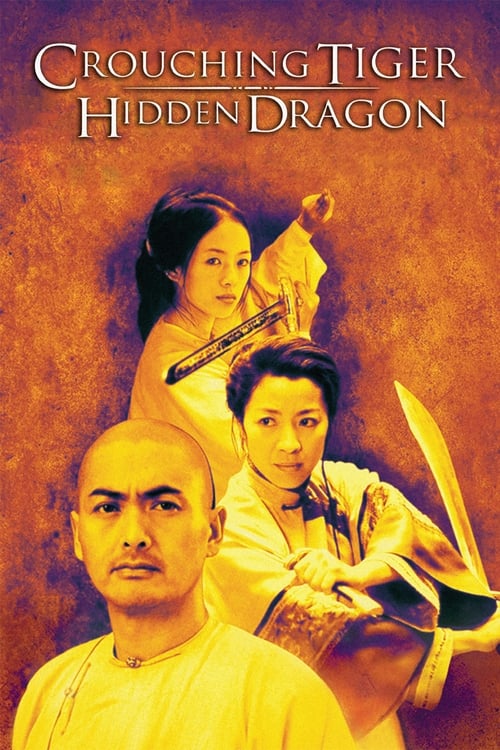
Crouching Tiger, Hidden Dragon
2000 · Ang Lee
For a night when you want to be swept away — romance, adventure, and real ache in one sitting. It's a crowd-pleaser with a bruised heart, easy to fall into but it lingers.
What it's about
In Qing-dynasty China, two legendary warriors — a swordsman ready to retire and the woman he has loved for years without ever saying so — are drawn out of their quiet resolve when a fabled sword, the Green Destiny, is stolen. The trail leads to a governor's teenage daughter, a secretly brilliant fighter chafing against an arranged marriage, and to a fugitive from the warriors' past. What starts as a hunt for a blade becomes a story about duty, desire, and what freedom actually costs.
The experience
Swooning and melancholy in equal measure: fighters run up walls and duel in swaying treetops, yet the film keeps returning to two people who can't quite say what they feel. It's exhilarating in the action and quietly heartbreaking in between, with a stately pace that earns every eruption.
Performances
Michelle Yeoh gives the film its soul, playing decades of unspoken love with almost nothing but stillness and glances; Zhang Ziyi, in a breakout role, is all reckless fire opposite her; Chow Yun-fat brings a weary, courtly grace to the swordsman caught between them.
The craft
The wire-assisted fight choreography turns combat into conversation — a rooftop chase and a bamboo-forest duel that feel like dance and argument at once. Ang Lee stages spectacle as emotion, so every set piece tells you something about who these people are, and the mountain vistas and Tan Dun's cello-driven score reward the biggest screen and best speakers you can find.
Why it matters
It became the rare subtitled film to conquer Western multiplexes, won four Academy Awards, and opened the door for a wave of prestige martial-arts epics while making Zhang Ziyi an international star.
Snapshot
A Taiwanese-American co-production that achieved the nearly unprecedented: a Mandarin-language wuxia film became a mainstream crossover phenomenon in Western markets, winning four Academy Awards and—at the time of its release—becoming the highest-grossing foreign-language theatrical release in US box-office history. Adapted from the fourth novel of Wang Dulu's "Crane-Iron Pentalogy," the film braids a restrained adult romance—warriors Li Mu Bai (Chow Yun-fat) and Yu Shu Lien (Michelle Yeoh), long in love, perpetually deferring—with the explosive coming-of-age of aristocratic rebel Jen Yu (Zhang Ziyi), whose theft of the legendary Green Destiny sword catalyzes the plot. Ang Lee treats the spectacular wire-work action sequences as emotional argument rather than spectacle, so that each fight scene doubles as a psychological confrontation between characters with conflicting visions of freedom, duty, and desire.
Industry & production
The film was produced by Hsu Li-kong, Bill Kong, and Lee himself through a complex international arrangement involving Good Machine International (Lee's long-standing New York production company), Columbia Pictures Film Production Asia, Zoom Hunt International Productions, and Edko Films. This transnational structure gave Lee access to mainland Chinese locations—Anhui province, Inner Mongolia, and the Gobi Desert—while retaining creative control that a purely studio arrangement would have complicated. The budget has been reported in various sources at approximately $17 million USD, modest by Hollywood standards for a film of its visual ambition; precise figures should be treated with some caution given differing accounting practices across co-producing entities.
Sony Pictures Classics handled North American theatrical release, positioning the film not as an ethnic-niche arthouse title but as a general-audience event. The marketing campaign foregrounded the spectacular action while allowing the emotional and philosophical registers to surprise audiences. The casting brought together performers from across the Chinese-speaking world—Chow Yun-fat (Hong Kong), Michelle Yeoh (Malaysian-born, working primarily in Hong Kong), Zhang Ziyi (mainland China), and Chang Chen (Taiwan)—all performing in Mandarin, which introduced notable tonal and accentual differences across the cast and generated some critical commentary within Chinese-language reception. That multilingual texture also embodied the film's own transnational ambitions rather than simply appearing as a production compromise.
Zhang Ziyi, then twenty years old, had appeared in Zhang Yimou's The Road Home (1999) the previous year but was otherwise largely unknown internationally. Her casting as Jen—a role demanding extraordinary physical conditioning and considerable emotional range—proved decisive to the film's success and launched one of the more significant international careers in contemporary cinema.
Technology
Crouching Tiger, Hidden Dragon inherits and refines the wire-rigging tradition of Hong Kong martial arts cinema, deploying it at a scale and with a visual sophistication that exceeded prevailing commercial practice. The fight choreography was designed and executed by Yuen Woo-ping, who had been brought to wide Western attention by his work on The Matrix (1999) the previous year; his presence on the film was both a practical asset and a signal of genre credibility. The wire work required elaborate rigging infrastructure across multiple locations, and a significant portion of post-production was devoted to digitally erasing visible rigs—a process that, while standard in Hong Kong wire-fu cinema, was integrated here into a more sustained visual realism than the genre typically pursued.
The actors—particularly Zhang Ziyi, who had no prior martial arts training—underwent months of physical conditioning and wire-harness rehearsal before principal photography. Peter Pau shot in the anamorphic format, enabling the wide compositional fields the film's aerial sequences require; Pau won the Academy Award for Best Cinematography. Tim Yip served as both production designer and costume designer—a relatively unusual double credit—and won the Oscar for Best Art Direction. His visual scheme established a heightened Qing-dynasty world consistent with the genre's mythological distance from strict historical documentation.
Technique
Cinematography
Peter Pau constructs a palette of marked contrasts: the lacquered darkness of Beijing's nocturnal alleys and rooftops; the deep jade-greens of the bamboo forest; the bleached ochres and purples of the Xinjiang desert in the film's extended flashback. Each major location carries its own chromatic signature, linking environment to emotional register. The flying sequences are shot with an unusual serenity—Pau frequently holds the camera level rather than tilting to track vertical action, allowing the figures to appear suspended in a space that obeys different physical laws. In the courtyard duel between Shu Lien and Jen, the camera remains calibrated tightly to the two women, using scale and proximity to track what rapidly becomes as much conversation as combat.
Editing
Tim Squyres, Lee's regular editor across most of his career, organizes the film's intricate temporal structure—the deep flashback to Jen and Lo's desert encounter is embedded within the main narrative's forward momentum—without foregrounding the complexity as such. The editing rhythm in action sequences tends toward short but not frantic cuts; Squyres and Lee resist the increasingly hyperkinetic cutting emerging in contemporary Hollywood action cinema, trusting each shot to contain whole exchanges of movement. The contrast in tempo between the Peking rooftop chase and the quiet, nearly wordless aftermath scenes is handled with considerable tact.
Mise-en-scène / staging
The film's most celebrated set-pieces think choreographically about what fighting means between these specific characters. The bamboo-forest duel between Li Mu Bai and Jen—with both combatants suspended in swaying treetops—is staged simultaneously as a test, a seduction, and a failed pedagogical overture. The courtyard fight between Shu Lien and Jen runs through a sequence of weapons that Jen successively neutralizes, each substitution revealing her mastery while literalizing her refusal to be contained by any single form or allegiance. Lee stages the non-combat scenes with comparable attention to proxemic tension: Shu Lien and Li Mu Bai orbit each other in rooms and on terraces, desire declared through small adjustments of position and gaze that the genre's melodramatic tradition licenses without demanding verbal articulation.
Tim Yip's production design situates characters within architecture that comments on them: Jen's family compound is formal, layered, enclosed; the jianghu spaces—inns, mountain paths, open desert—are expansive and ungoverned. Costume color and silhouette legibly distinguish character registers without resolving into simple allegory.
Sound
Tan Dun's score is the film's most debated aesthetic element. Working with a Western string orchestra enriched by Chinese instruments—pipa, erhu—and a vocal soloist, Dun composed music that refuses easy synthesis, keeping its sources audibly distinct and sometimes in productive friction. The cello solos performed by Yo-Yo Ma, which anchor the film's most elegiac passages, became the score's signature; Dun won the Academy Award for Best Original Score. Some critics found the Western orchestral textures incongruous with the Chinese setting; others heard the hybridity as precisely fitting for a film built across cultural boundaries. The sound design gives combat a heightened tactility—the crack of impact, the hiss of drawn steel, the exhalation of effort—while the desert sequences open into near-silence broken by wind.
Performance
Michelle Yeoh's performance is the film's emotional spine. Shu Lien is a woman of exceptional capability who has organized her life around prohibition—of a love she considers foreclosed by loyalty to a dead friend, of the freedom Jen embodies and she can only observe. Yeoh plays this with great economy; her physicality carries the weight of the characterization in ways that exceed anything dialogue could specify. Chow Yun-fat, whose Hong Kong persona—the gun-wielding urban hero of John Woo's films—is almost entirely absent here, brings a contained gravity that makes Li Mu Bai's rare moments of longing all the more legible for their restraint.
Zhang Ziyi's performance as Jen is deliberately harder to read: petulant, brilliant, self-destructive, charismatic in turns. Her work is most interesting as a physical performance, the body articulating a psychology the character herself may not fully access. Chang Chen is persuasive as Lo partly because the desert flashback places him in a generic world—sun, pursuit, unguarded desire—more comfortable with directness than the main narrative permits.
Narrative & dramatic mode
The film operates in what might be called the wenyi mode of Chinese melodrama—a tradition foregrounding emotional interiority and unfulfilled longing against material or social constraint—filtered through wuxia adventure conventions. The Green Destiny sword circulates as a Hitchcockian MacGuffin: it motivates pursuit, unlocks backstory, and precipitates confrontation, while its value is ultimately symbolic, a figure for the power and freedom that each major character desires and none can straightforwardly claim.
The structure is more complex than classical Hollywood three-act plotting: the long desert flashback constitutes an almost autonomous romantic narrative embedded within the thriller chase, and the ending resists resolution in a manner consistent with the source material's tragic register. Li Mu Bai's death—from a poison that Shu Lien could not counter in time, while he uses his final conscious moments not to transmit martial secrets but to confess love—is managed with a tonal control that avoids both genre sentimentality and modernist irony.
Genre & cycle
Crouching Tiger, Hidden Dragon belongs to the wuxia (武俠) tradition: a Chinese literary and cinematic genre structured around the jianghu, the "rivers and lakes," a semi-mythological world of wandering martial artists whose code of honor (xia) exists in productive tension with the Confucian social order. The genre's literary roots extend back centuries in Chinese popular fiction; its cinematic history runs through the early Republican-era films of the 1920s and 1930s, the Cantonese and Mandarin studio productions of the 1950s, and—crucially for Lee's film—the Shaw Brothers and Golden Harvest productions of the 1960s through 1980s.
Lee's film restores narrative and thematic weight that the commercial action-cinema cycle had often minimized, and centers female protagonists whose interiority and agency exceed their function as spectacle or prize. In this it echoes the prestige wuxia of King Hu (Come Drink with Me, 1966; A Touch of Zen, 1971), which similarly used the genre's spatial freedom and female warrior figures to pursue philosophical inquiry. Where Hu's films carry a Buddhist and Taoist metaphysical atmosphere, Lee's is more strictly psychological and melodramatic in register.
Authorship & method
Ang Lee studied film at the University of Illinois before completing his MFA at NYU's Tisch School of the Arts, where he formed his long-term partnership with James Schamus—producer, co-writer, and intellectual collaborator. Schamus co-wrote Crouching Tiger alongside Wang Hui-Ling and Tsai Kuo-Jung, adapting Wang Dulu's novel while restructuring it toward the film's characteristic double-plot architecture.
Lee's career before Crouching Tiger demonstrates an unusual genericism: the "Father Knows Best" trilogy (Pushing Hands, 1992; The Wedding Banquet, 1993; Eat Drink Man Woman, 1994) dealt with Taiwanese-Chinese family dynamics; Sense and Sensibility (1995) was a canonical Austen adaptation; The Ice Storm (1997) and Ride with the Devil (1999) were distinctly American in setting. This range is not restlessness but method: Lee approaches each project as a student of its genre conventions, working from inside those conventions toward personal thematic concerns rather than imposing a recognizable signature style. His central preoccupation—the cost of repression, the energy that accumulates around prohibited desire, and the violence or tragedy that follows when repression is absolute—finds its most operatic expression in Crouching Tiger.
Movement / national cinema
The film's national-cinema identity is genuinely complex. It was submitted to the Academy Awards as Taiwan's representative foreign-language entry—and won—yet it was shot almost entirely in mainland China, financed through a multinational arrangement, and directed by a Taiwanese-American. This transnational identity is not merely an administrative artifact but something the film thematizes: the jianghu is itself a placeless space, neither fully within nor fully outside the civic world, and the casting across Chinese regional cinemas emphasizes a pan-Chinese cultural inheritance rather than any single national formation.
Lee's relationship to Taiwanese cinema is oblique. He trained abroad and was not part of the Taiwanese New Wave—Hou Hsiao-hsien, Edward Yang, Tsai Ming-liang—that had defined the international image of Taiwanese cinema through the 1980s and 1990s. His career is better understood as part of a diaspora Chinese cinema that includes directors who moved across Hong Kong, Hollywood, and the international festival circuit: a cinema defined not by geography but by mobility.
Era / period
The film is set during the Qing dynasty, though the jianghu setting characteristically floats free of strict historical specificity. The political world is gestured at—Jen's father occupies a provincial official position—without anchoring the action to recoverable historical events. This temporal indeterminacy is generic convention rather than vagueness; the jianghu has always existed in a mythologized adjacency to the historical order, subject to its social pressures but not governed by its calendar.
The film's production in 2000 situates it at a specific moment in Chinese cinema more broadly: the mainland's fifth-generation filmmakers (Zhang Yimou, Chen Kaige) had achieved international prestige through the 1980s and 1990s but were encountering criticism for a perceived turn toward commercial spectacle; Hong Kong cinema was navigating the post-handover transition with uncertain creative energy; and Taiwanese cinema was recognized critically but had limited commercial reach. Crouching Tiger arrived into this landscape as a synthesis that bypassed the distinctions between these national formations and demonstrated that a Chinese-language film could command a genuinely international audience.
Themes
The film's central thematic opposition is between the formal and the free—the disciplined containment represented by Shu Lien (and, differently, by Li Mu Bai) and the ungoverned desire represented by Jen. This opposition is not simply valorized on one side: the film does not endorse Jen's self-destructive freedom over Shu Lien's costly discipline; it traces the tragedy that results when either is absolute. Li Mu Bai's project—to make Jen his disciple, to channel her extraordinary ability into the Wudang tradition—is offered as a possible synthesis, and its failure is the film's central loss.
The Green Destiny materializes this thematic: it is a weapon of exceptional power that becomes destructive in the wrong hands, and the question of who possesses the right hands is inseparable from questions of character, gender, and legitimate transmission of knowledge. Female transgression and its consequences run through all three major female figures: Shu Lien, who has sublimated desire into professional excellence; Jade Fox (Cheng Pei-pei), whose exclusion from formal training by a sex-segregated system turned her murderous; and Jen, who refuses the terms of both the social world and the martial world and cannot locate a third option. Lee's gender politics here are more ambivalent than straightforwardly feminist: the film mourns the structures it depicts without dismantling them, finding tragedy rather than resolution in the encounter between individual will and institutional constraint.
Reception, canon & influence
Critical reception: The film was received with widespread critical enthusiasm on release, praised particularly for its action choreography, its emotional intelligence within the genre frame, and Zhang Ziyi's breakthrough performance. The four Academy Awards—Best Foreign Language Film, Best Cinematography, Best Art Direction, Best Original Score—consolidated its prestige status. Subsequent scholarly reception has been more nuanced, with productive debates around its construction of a pan-Chinese cultural identity for Western consumption, the coherence of its synthesis between genre spectacle and art-cinema interiority, and the specific terms of its gender politics. These debates remain open.
Influences on the film (backward): Wang Dulu's source novel belongs to the tradition of popular Chinese genre fiction developed during the Republican period (1912–1949). The film's most direct cinematic debt is to King Hu's prestige wuxia, which established the precedent for using the genre's spatial freedom to carry philosophical weight; the bamboo-forest sequence is inconceivable without A Touch of Zen. The Shaw Brothers films of Chang Cheh provided a different register: operatic, kinetic, physically excessive. The Peking Opera tradition—in which stylized combat is already a performance mode governed by codified rhythm—underlies the choreographic approach throughout. Lee has cited classic Hollywood westerns as a structural influence, noting the parallel between the jianghu and the frontier as liminal spaces where the social order's constitutive contradictions become visible and dramatic.
Legacy (forward): The film's commercial success in Western markets opened a window for subsequent high-budget Chinese-language productions to seek genuine international distribution. Zhang Yimou's Hero (2002) and House of Flying Daggers (2004) followed directly in its wake, and the decade's cycle of prestige wuxia productions—many of them mainland Chinese films with comparable budgets and transnational ambitions—is substantially attributable to Crouching Tiger's commercial proof of concept. The film's influence on Hollywood action cinema is real but harder to isolate precisely, partly because Yuen Woo-ping's wire choreography had already entered mainstream American production through The Matrix the previous year. Kill Bill (2003–2004) absorbed wuxia conventions consciously and with explicit citation; numerous subsequent action films borrowed the aerial combat aesthetic without necessarily acknowledging its genealogy. The bamboo-forest sequence has achieved the status of a set-piece touchstone, cited and homaged with a frequency that places it among the more durable action images in post-millennial cinema.
A Deleuzian reading
Watch the way Yu Shu Lien sets down a teacup.
The full Deleuzian reading of Crouching Tiger, Hidden Dragon →
Reception
A genuine phenomenon in 2000 — 10 Oscar nominations and a record-smashing US run for a subtitled film — though famously lukewarm with some Chinese-speaking audiences at the time, who balked at the stars' non-native Mandarin. A quarter-century on, it's settled comfortably into the canon as the great crossover wuxia film.
How Crouching Tiger, Hidden Dragon was received, from release to now →
Influences: the films it descends from and the films it influenced
- Come Drink with Me (1966) — Invented the female xia as a figure of combined martial authority and withheld desire, including the inn-space as a contained arena for proxemic confrontation—the genre grammar that CTHD's Yu Shu Lien directly inherits.
- A Touch of Zen (1971) — The bamboo grove aerial combat staged as spiritual transcendence rather than physical stunt establishes the exact template for CTHD's forest duel; Hu's treatment of wire-work as metaphysical argument is the direct formal ancestor of Lee's wire-fu-as-emotional-argument.
- Spring in a Small Town (1948) — The foundational wenyi grammar of deferral: desire that cannot be declared displaced onto elliptical proximity, near-speech, and gesture—the precise structural language of Li Mu Bai and Shu Lien's entire relationship.
- The Last Emperor (1987) — Sakamoto and Byrne's East-West hybrid orchestral score for an international China co-production established the model Tan Dun refines: Chinese melodic material embedded in Western symphonic infrastructure, with a foregrounded Western solo voice (cello displacing synthesizer).
- Raise the Red Lantern (1991) — Established location-specific chromatic palettes as the primary carrier of moral and psychological argument in transnational Chinese prestige cinema; Peter Pau's environment-coded color work in CTHD—jade bamboo, bleached desert, lacquered urban night—inherits this grammar directly.
- Once Upon a Time in China (1991) — Established the modern prestige wuxia commercial template—Pan-Chinese casting, spectacular wire-work at scale, mythological nationalism, and glossy anamorphic cinematography—that CTHD refines for Western crossover.
- Iron Monkey (1993) — Yuen's mature wire-choreography vocabulary integrating aerial combat with character psychology and legible dramatic stakes—the specific physical-emotional grammar he transfers directly to CTHD's fight sequences.
- The Bride with White Hair (1993) — Codified the wuxia tragic-romance template of two warriors whose love is destroyed by martial duty and clan loyalty, providing the emotional architecture for CTHD's Li Mu Bai and Shu Lien storyline of irreversible deferral.
- Ashes of Time (1994) — First sustained demonstration that wuxia material could sustain art-cinema fragmented temporality, impressionistic editing, and combat as expression of psychological interiority rather than genre entertainment—opening the formal space CTHD then occupies commercially.
- Sense and Sensibility (1995) — Lee and Schamus developed their method of using literary genre adaptation to generate structural repression—emotion withheld, expressed through constraint rather than declaration—as the film's primary dramatic engine, transferred wholesale into CTHD's martial register.
- The Matrix (1999) — Yuen Woo-ping's wire-choreography sequences here created the technical pipeline, Western crew familiarity, and international audience fluency with wire-work grammar that made CTHD's immediate production at its scale and its crossover positioning commercially viable.
- Eat Drink Man Woman (1994) — Scales up the meticulous craft-coordination Lee developed choreographing the cooking sequences into wuxia action choreography, with Tim Squyres editing and the same restraint between coded duty and forbidden desire.
- Hero (2002) — Inherits CTHD's chromatic palette grammar and takes it to structural extreme—each narrative strand assigned its own dominant color—while deploying Yuen Woo-ping's wire-choreography vocabulary in an explicitly nationalistic prestige wuxia shaped by CTHD's crossover model.
- House of Flying Daggers (2004) — The bamboo grove combat sequence explicitly quotes CTHD's forest duel staging; the wenyi melodrama structure of triangulated desire expressed through swordplay is borrowed and amplified to tragic excess.
- Brokeback Mountain (2005) — Lee redeploys CTHD's structural repression architecture—anamorphic widescreen landscape as chromatic emotional register, desire expressed through what cannot be enacted rather than spoken—transposing the formal system intact into an American Western genre frame.
- The Grandmaster (2013) — Inherits CTHD's staging of martial combat as proxemic argument, using slow-motion restraint in fight sequences to foreground psychological interiority and frame combatants as expressing longing and loss through their physical grammar rather than kinetic spectacle.
- The Assassin (2015) — Radicalizes CTHD's restrained action-cutting to near-stasis, staging wuxia violence in long takes with minimal editorial intervention and treating landscape as emotional architecture in a manner descended from but more austerely committed than CTHD's chromatic environment grammar.
- Everything Everywhere All at Once (2022) — Casting Michelle Yeoh activates her martial-arts persona established here as a layer of meaning—EEAAO's action sequences work partly because they play against and within Yeoh's established physical register, making her character's competence intertextually legible from the first fight.
- Kung Fu Hustle (2004) — Yuen Woo-ping's prestige wire-fu here created the international 'crouching-tiger cycle' whose gravity-defying grammar Kung Fu Hustle both extends and affectionately parodies.
- Life of Pi (2012) — Lee's own transnational-prestige template, deploying genre spectacle as a vehicle for interior emotion and cross-cultural address that Pi's syncretic fable extends.
- Lust, Caution (2007) — Assembles the exact craft company reused here — co-writer Wang Hui-Ling and editor Tim Squyres — and builds transnational Chinese period drama around repressed desire that can only be expressed obliquely.
- Kung Fu Panda (2008) — Yuen Woo-ping's weightless wire-fu — treetop drifting and rooftop pursuit choreographed for grace over impact — is the model for KFP's aerial, gravity-teasing combat staging.
- Ne Zha 2 (2025) — Yuen Woo-ping's wire-fu grammar of weightless, gravity-defying combat and mid-air rooftop duels is the live-action fight vocabulary the film translates into unbound CG camera moves.
- Red Cliff (2008) — Opened the international art-house-crossover market for Chinese period martial epics and the wire-assisted choreographic aesthetic that made Red Cliff's global rollout viable.
- In the Mood for Love (2000) — Simultaneous crystallization of proxemic desire as a formal register: both films independently stage longing through calibrated framings of physical proximity that cannot complete its movement, using the space between bodies—not dialogue—as primary dramatic argument.
- The Matrix Reloaded (2003) — Shares Yuen Woo-ping as action director, applying the same wire-fu rooftop-and-treetop choreography to prestige drama the year before Reloaded scaled it up digitally.
- Shadow (2018) — Reframes wuxia as painterly art cinema with landscape-as-canvas combat (the bamboo duel), establishing the prestige-wuxia mode Shadow operates within.
- Kill Bill: Vol. 1 (2003) — Shares Yuen Woo-ping's wire-fu choreography vocabulary — the airborne, gravity-defying swordplay and rooftop pursuit grammar that Yuen brought directly into the House of Blue Leaves fight.
- Memoirs of a Geisha (2005) — Elevated Zhang Ziyi to global stardom and conditioned Western appetite for sumptuous, English-subtitled Asian-set prestige spectacle — the transnational global-Hollywood market Memoirs was engineered to inherit.
Similar films
- Hero (2002) — influence & lineage · same viewing thread
- House of Flying Daggers (2004) — influence & lineage · same viewing thread
- Once Upon a Time in China (1991) — influence & lineage · same viewing thread
- The Grandmaster (2013) — influence & lineage
- Come Drink with Me (1966) — influence & lineage
- The Assassin (2015) — influence & lineage
- Brokeback Mountain (2005) — influence & lineage
- In the Mood for Love (2000) — influence & lineage
All the films related to Crouching Tiger, Hidden Dragon →
Watch it with: curated runs of related films
- Wuxia and Its Heirs — Watch these as a bloodline — King Hu's weightless swordplay flowering into Zhang Yimou's painted epics and finally Tarantino's homage, all built on choreography as dance.