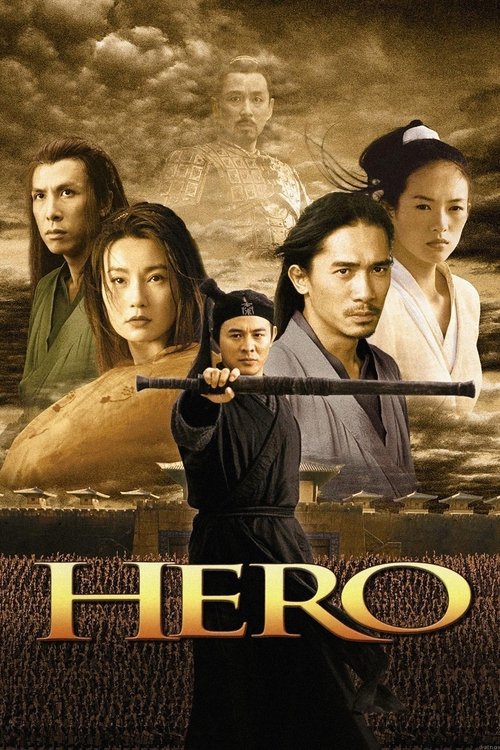
Hero
2002 · Zhang Yimou
For when you want pure visual splendor — a film you could frame shot by shot — and you're happy to let the story circle and deepen rather than race. Comfort viewing for the eyes, with a quiet ache underneath.
What it's about
On the eve of China's first unification, a nameless swordsman is granted an audience with the King of Qin, claiming to have killed the three legendary assassins who nearly took the king's life. Seated across from the most powerful man in the warring kingdoms, he tells the story of how he did it — and the king, no fool, has his own ideas about what really happened. The same events replay in competing versions, each one shifting who these warriors were and what they wanted.
The experience
It moves like a dream of combat rather than a brawl: duels staged in falling leaves, on the surface of a lake, in a hail of arrows, each retelling drenched in a single saturated color. Slow-burning and hypnotic between bursts of action, it builds to something surprisingly mournful — less an adrenaline rush than a spell.
Performances
Jet Li carries the film with stillness rather than swagger, while Tony Leung Chiu-wai and Maggie Cheung give the assassin couple a wounded, grown-up gravity that turns sword fights into love scenes. Zhang Ziyi and Donnie Yen round out a once-in-a-generation cast of martial-arts royalty.
The craft
Zhang Yimou keys each version of the story to its own color — red, blue, white, green — so you always know whose truth you're inside, and Christopher Doyle's cinematography makes every frame look like silk. The wirework choreography aims for ballet, not impact, and Tan Dun's score of drums and solo violin gives it an epic melancholy. Absolutely a big-screen, good-speakers film.
Why it matters
Riding the wave after Crouching Tiger, Hidden Dragon, it became a global blockbuster that proved Chinese-language epics could top Western box offices, and it launched a decade of lavish pan-Asian historical spectacle.
Snapshot
Hero (Yingxiong) is Zhang Yimou's lavish entry into the wuxia martial-arts epic, made in the immediate wake of Ang Lee's Crouching Tiger, Hidden Dragon (2000) and pitched at a scale that dwarfed anything Chinese-language cinema had previously attempted. Set in the Warring States period on the eve of China's first imperial unification, it stages a deceptively simple frame — a nameless swordsman (Jet Li) recounts to the King of Qin how he eliminated three legendary assassins — and refracts that account through competing, color-keyed retellings until the "truth" dissolves into a meditation on power, sacrifice, and what the film calls tianxia, "all under heaven." It assembled an unprecedented constellation of pan-Chinese talent: Hong Kong stars Tony Leung Chiu-wai, Maggie Cheung, and Donnie Yen alongside mainland-trained Zhang Ziyi and Chen Daoming, photographed by Christopher Doyle and scored by Tan Dun. Beautiful, formally audacious, and politically contentious, Hero became both an international art-house sensation and the subject of sustained debate about its apparent endorsement of unification through force.
Industry & production
Hero was conceived as a flagship co-production drawing mainland Chinese, Hong Kong, and overseas financing, and was widely reported at release to be the most expensive film produced in China to that date, with budget figures generally cited in the low tens of millions of US dollars (precise figures vary across sources and should be treated cautiously). The ambition was strategic as much as artistic: Zhang, long China's most internationally visible director, was deliberately working in a popular commercial idiom — the wuxia spectacle — to prove that a mainland production could compete on the global stage that Crouching Tiger had opened.
The film's distribution history is itself part of its story. After enormous success in Asian markets, the North American rights were acquired by Miramax, which then held the film for an extended period — close to two years — before releasing it in the United States in August 2004 under a "Quentin Tarantino Presents" banner. That delayed release nonetheless opened at number one at the US box office, a rare feat for a subtitled film and a marker of how thoroughly Hero crossed over. It received an Academy Award nomination for Best Foreign Language Film and competed for the major prize at the Berlin and Venice festival circuit, cementing Zhang's standing while also drawing the scrutiny of Western critics attentive to its politics.
Technology
Hero is a film of the late-celluloid moment: shot photochemically on 35mm and built around in-camera spectacle rather than digital construction. Its astonishing palette — successive episodes saturated in red, blue, white, green, and finally near-monochrome — was achieved primarily through production design, costume, location, and lighting rather than heavy post-production grading, which gives the color blocks their material, lacquered intensity. Computer-generated imagery is present but largely effacing: it augments the massed Qin army, multiplies arrows into darkening clouds, and extends environments, but the film's signature images depend on physical elements — thousands of real arrows, wind-driven autumn leaves, water, and silk. Wire-assisted aerial combat, the inherited grammar of Hong Kong action cinema, is the dominant "effect," with performers suspended and flown by rigging teams. The result feels handcrafted at a scale that anticipates the fully digital blockbusters to come without yet surrendering to them.
Technique
Cinematography
Christopher Doyle's photography is the film's most celebrated technical achievement and central to its meaning. Doyle, best known for his restless, improvisatory work with Wong Kar-wai, here submits to a far more composed and architectonic visual scheme, organizing the picture around chromatic chapters in which an entire reality is bathed in a single hue. The most quoted sequences are exercises in pure visual music: the duel amid swirling golden leaves that flush blood-red at a moment of grief; the duel fought across the mirror surface of a lake, bodies skimming the water; the rain-soaked courtyard combat rendered in cold steel-greys. Doyle exploits scale relentlessly — tiny human figures against the dunes of the northwestern deserts, the lake at Jiuzhaigou, and the endless grids of the Qin palace — so that landscape and architecture become moral and political forces pressing on the characters. The cinematography drew wide critical acclaim and awards recognition, though the precise tally is best confirmed against the record.
Editing
The cutting, credited to Zhai Ru and Angie Lam, serves a famously recursive structure. Because the narrative consists of nested, contradictory accounts, the editing must repeatedly return to the same encounters and re-stage them in different colors and emotional registers; continuity here is thematic rather than literal. Within action set-pieces the rhythm is comparatively legible and sustained — Zhang and his collaborators favor held, decipherable compositions over the fragmentary cutting of much contemporary Hollywood action, allowing the choreography and the color fields to register. The film also deploys extreme slow motion at climactic instants (a single drop of water, a falling leaf, the arrest of a blade) to lift physical combat into the register of ritual.
Mise-en-scène / staging
Hero is staged as a series of tableaux. Emi Wada's costumes — Wada being the designer celebrated for Kurosawa's Ran — move in flowing monochrome silks that read as much as kinetic abstraction as clothing; the autumn-leaf and courtyard sequences depend on fabric as a graphic element. The production design renders the Qin court as a vast, depopulated geometry of black columns and candle-rows that visually embodies the impersonal machinery of the emerging state. Compositions are frequently symmetrical and frontal, framing characters as emblems. The recurring motif of calligraphy — swordsmanship taught through brushwork, a besieged calligraphy school continuing to write under arrow-fire — fuses the film's aesthetic and thematic commitments: the line of the brush and the line of the blade are presented as expressions of the same disciplined spirit.
Sound
Tan Dun's score is integral, not decorative. Building on the percussion-and-strings idiom he had developed for Crouching Tiger, Tan wrote music of ceremonial weight, and the score's solo violin passages were performed by Itzhak Perlman, lending the combat a plangent, elegiac voice. Drums drive the martial sequences; sustained strings carry the film's lyricism and loss. The sound design isolates and amplifies small events — the patter of rain, the hum of a plucked string, the rush of a single arrow — within otherwise hushed spaces, so that silence becomes a tension-bearing element and violence often arrives as much through sound as image.
Performance
The casting is itself a statement of pan-Chinese cinematic unity. Jet Li, in one of his most restrained performances, plays Nameless with a stillness that withholds rather than projects, suiting a protagonist whose true intentions are the film's central mystery. Tony Leung Chiu-wai and Maggie Cheung, as the lovers Broken Sword and Flying Snow, bring the interior, melancholic register honed in their Wong Kar-wai films, grounding the spectacle in adult longing and disillusion. Zhang Ziyi's Moon is all volatile devotion; Donnie Yen's Sky and Chen Daoming's calculating, isolated King of Qin round out an ensemble in which performance is deliberately stylized — figures in a fable rather than psychological portraits. The acting is calibrated to the film's emblematic mode, gesture and bearing carrying meaning the dialogue leaves implicit.
Narrative & dramatic mode
Hero is structured as a frame tale containing multiple, mutually contradicting versions of the same events — a design routinely and accurately compared to Kurosawa's Rashomon. Nameless tells the King how he defeated the assassins Sky, Broken Sword, and Flying Snow; the King counters with his own skeptical reconstruction; further revisions follow, each visually coded by color so that the viewer experiences truth as a matter of perspective, motive, and ideology. The dramatic engine is not "what happened" but "why one would choose to die" — the film is ultimately about a decision withheld and then made, an assassination abandoned in the name of a larger peace. This converts the action-film promise of a climactic kill into an anti-climax of renunciation, a structural choice that is both the film's boldest stroke and the root of its political controversy.
Genre & cycle
The film belongs to wuxia — the centuries-old Chinese tradition of chivalric martial-arts storytelling — and specifically to the prestige, internationally aimed wuxia revival that Crouching Tiger, Hidden Dragon inaugurated. It opened a short, intense cycle of big-budget Chinese historical martial-arts epics that included Zhang's own House of Flying Daggers (2004) and Curse of the Golden Flower (2006), Chen Kaige's The Promise (2005), and Feng Xiaogang's The Banquet (2006). Within that cycle Hero is the inaugural and most formally radical entry, the one that most fully subordinates plot to image and most explicitly yokes the genre's spectacle to a thesis about statecraft.
Authorship & method
Hero is a Zhang Yimou film in the fullest sense — the work of a director who began as a cinematographer (on Chen Kaige's Yellow Earth) and whose authorship has always been bound up with color, composition, and the expressive use of landscape and crowd. After the intimate social dramas and the lush melodramas of his early career, Hero marks his pivot into large-scale popular spectacle, a turn that would culminate in his direction of the 2008 Beijing Olympics opening ceremony, which shares the film's vocabulary of massed, color-coded human formations.
His collaborators are essential to the achievement. Christopher Doyle's cinematography supplies the chromatic architecture. Tan Dun's score, with Perlman's violin, supplies its emotional and ceremonial spine. Emi Wada's costumes turn movement into graphic design. The martial choreography was directed by the veteran Hong Kong action master Ching Siu-tung (Tony Ching), whose flowing, gravity-defying style — developed across decades of Hong Kong fantasy cinema — gives the duels their lyrical weightlessness. The screenplay is credited to Zhang with Li Feng and Wang Bin. The editing by Zhai Ru and Angie Lam realizes the recursive structure. The film is thus best understood as a summit meeting of mainland and Hong Kong craft traditions under Zhang's controlling visual intelligence.
Movement / national cinema
Zhang emerged as a leading figure of China's "Fifth Generation" — the cohort of directors trained at the Beijing Film Academy after the Cultural Revolution who renewed Chinese cinema in the 1980s with formally bold, often allegorical work. Hero represents that generation's arrival at, and accommodation with, blockbuster filmmaking and the state. As a mainland super-production engaging Hong Kong stars and international markets, it is also a landmark in the post-handover integration of Chinese-language cinemas into a single commercial field. The film's relationship to the Chinese state is precisely what makes it contentious: many critics read its endorsement of unification under a ruthless king as an allegory for, or accommodation with, centralized power, while defenders argue the film is more ambivalent than its detractors allow. That debate is itself a central fact of the film's place in national-cinema history and should be presented as a genuine interpretive dispute rather than a settled verdict.
Era / period
The film is set in the third century BCE, during the late Warring States period and the rise of the Qin state whose king would become Qin Shi Huang, China's first emperor and unifier. It mythologizes a foundational moment of Chinese statehood — the forging of a single empire out of warring kingdoms — and treats that history as legend rather than chronicle. Produced in the early 2000s, it speaks equally to its own moment: a confident, rapidly globalizing China on the cusp of its Olympic decade, projecting cultural power outward through a story about the costs and necessity of unity.
Themes
The film's governing concept is tianxia — "all under heaven" — the idea that an end to the suffering of the warring kingdoms justifies submission to a single sovereign, even a tyrant. Around it cluster the film's recurring oppositions: the individual will against the collective good; vengeance against renunciation; the sword against the brush. Calligraphy recurs as the figure for a discipline that unites art, war, and self-mastery, and for a higher understanding that lifts the swordsman beyond killing. Sacrifice — the choice to die, or to let one's enemy live, for an ideal larger than the self — is the moral pivot. Love and political conviction are set against each other in the Broken Sword–Flying Snow relationship. And throughout runs an epistemological theme inherited from its Rashomon structure: that truth is shaped by who tells it and to what end.
Reception, canon & influence
Critically, Hero was widely praised as a visual masterpiece — its color, composition, and choreography drawing near-unanimous admiration — even as a significant strand of commentary registered unease at its perceived politics, with some prominent critics reading it as an apologia for authoritarian unification and others defending its ambivalence and beauty. It was a massive commercial success in Asia and a breakout art-house hit in the West, opening at number one at the US box office and earning a Best Foreign Language Film Academy Award nomination. It now sits securely in the canon of twenty-first-century world cinema and is routinely cited as a high point of the wuxia revival.
Looking backward, the film draws on deep wuxia literary and cinematic traditions, on the narrative architecture of Kurosawa's Rashomon, on the Hong Kong action lineage embodied by choreographer Ching Siu-tung, and on the commercial template established by Crouching Tiger, Hidden Dragon. Its costume and tableau sensibility connects to Kurosawa's late epics through designer Emi Wada, and its musical idiom extends Tan Dun's Crouching Tiger score.
Looking forward, Hero set the terms for the cycle of big-budget Chinese historical epics that followed, including Zhang's own House of Flying Daggers and Curse of the Golden Flower, and demonstrated to the global industry that a mainland-Chinese spectacle could command international screens and prestige. Its color-coded, formally abstract approach to action influenced subsequent filmmakers internationally, and its visual vocabulary of synchronized, chromatic mass spectacle resurfaced in Zhang's own direction of the 2008 Beijing Olympics ceremony. More broadly, it stands as a key text in arguments about the relationship between popular spectacle and state power in contemporary Chinese culture — a film whose beauty and politics remain, productively, inseparable.
A Deleuzian reading
Start with the leaves.
The full Deleuzian reading of Hero →
Reception
A blockbuster in China and an Oscar nominee, it then sat on Miramax's shelf for nearly two years before its 2004 US release — where it stunned everyone by topping the American box office two weekends running, almost unheard of for a subtitled film. Once dogged by charges that its politics soured the spectacle, it's now firmly canonized as one of the most beautiful films of the 2000s.
How Hero was received, from release to now →
Influences: the films it descends from and the films it influenced
- Rashomon (1950) — Supplies the recursive narrative architecture Hero borrows wholesale — the same event retold in contradictory color-coded versions, with truth deferred and the 'true' account withheld until the final pass.
- Ran (1985) — Costume designer Emi Wada, who dressed Ran's color-divided armies, brings the same graphic use of saturated robes as battlefield identification directly into Hero's massed formations.
- A Touch of Zen (1971) — Establishes the painterly-landscape wuxia and trampoline-assisted aerial swordplay — fighters skimming bamboo and water — that Ching Siu-tung's lyrical weightless choreography in Hero descends from directly.
- Come Drink with Me (1966) — Codifies the dance-like, rhythmically edited tea-house duel and the female swordmaster archetype that Hero's stylized, emblematic combatants and percussive cut-on-movement editing extend.
- A Chinese Ghost Story (1987) — Hero's own choreographer perfecting his signature here — fabric, hair and bodies floating on near-invisible wires in slow, gravity-defying arcs — the exact lyrical wire-fu vocabulary he repeats in the lake and forest duels.
- Swordsman II (1992) — Ching's high-velocity, physics-defying group wire-fu and palm-blast spectacle is the Hong Kong fantasy-action template he imports into Hero's mainland prestige frame.
- Yellow Earth (1984) — Zhang Yimou shot it as cinematographer, developing the Fifth Generation grammar of human figures dwarfed by vast graphic landscape that becomes Hero's landscape-scale compositional signature.
- Raise the Red Lantern (1991) — Zhang's own earlier mastery of color as architectural system — symmetrical lantern-red tableaux organizing the frame — is the chromatic-tableau method Hero abstracts into whole color-keyed chapters.
- Ashes of Time (1994) — Christopher Doyle's heat-saturated, smeared step-printed wuxia cinematography here is the chromatic-architecture sensibility he carries into Hero's color-coded retellings.
- Crouching Tiger, Hidden Dragon (2000) — The immediate commercial template — crossover art-house wuxia with Tan Dun's solo-string score (Yo-Yo Ma there, Perlman in Hero) and weightless treetop wire-fu that Hero scales up and stylizes.
- The Last Emperor (1987) — Zhang Yimou and Christopher Doyle systematize TLE's chromatics-as-structure into explicit codification: each flashback version of the assassination plot is rendered in a different dominant color (red, blue, green, white), converting what Storaro used as atmospheric epoch-grammar into overt narrative architecture.
- Kagemusha (1980) — Christopher Doyle's color-coded narrative segments — each hue corresponding to a perspective and a moral argument — systematize Kagemusha's clan color taxonomy into a narrative grammar where color organizes epistemology rather than merely identifying faction.
- House of Flying Daggers (2004) — Zhang's immediate follow-up reruns the formula — single dominant color per sequence (the green bamboo and golden-field set-pieces), echo-game choreography and extreme slow-motion projectiles.
- Curse of the Golden Flower (2006) — Pushes Hero's color-keyed mass spectacle to its limit — armies in synchronized gold formations filling the frame as graphic pattern, the same massed-human-tableau vocabulary Zhang then staged at the 2008 Olympics.
- Shadow (2018) — Zhang inverts Hero's own premise — draining the chromatic-chapter system to a near-monochrome ink-wash palette while keeping the calligraphy motif and tableau staging, a deliberate negative of Hero's saturated color.
- 300 (2006) — Internationalizes Hero's formula of color-graded, formally abstract combat — speed-ramped extreme slow-motion and a single tonal palette per sequence turning battle into moving graphic design.
- Kung Fu Panda (2008) — Zhang and Christopher Doyle's color-coded, painterly widescreen wuxia — saturated single-hue duels composed for anamorphic scope — informs KFP's use of scope framing and its stylized, palette-driven set-piece design.
- Ne Zha 2 (2025) — Its color-coded, painterly maximalism — massed arrows, leaves and banners saturating the frame — is the spectacle logic behind the film's kinetic cinematographic density.
- Red Cliff (2008) — The immediate wuxia-epic that made big-budget Chinese historical productions bankable and set the template of painterly, color-blocked large-scale spectacle Red Cliff inherits.
- The Promise (2005) — A direct entrant in the big-budget pan-Chinese wuxia-epic cycle Hero opened, deploying the same CGI-augmented color spectacle and fable framing to chase its international template.
- The Grandmaster (2013) — Extends the abstract, weather-and-color-drenched martial-arts image — combat shot as slow-motion textural detail rather than legible exchange — sharing Hero's treatment of the duel as formal poetry.
- Kill Bill: Vol. 1 (2003) — Shares the chromatic-chapter device and color-keyed showdown (the House of Blue Leaves snow duel), drawing on the same King Hu / wire-fu lineage to stage combat as stylized, desaturated-to-saturated set-piece.
- The Last Duel (2021) — Extends the Rashomon model through chromatic chapter differentiation — each account assigned a distinct palette that externalizes the narrator's emotional investment — establishing the precedent for Wolski's triptych modulation strategy in which the three chapters' visual registers are calibrated to the subjectivity governing each.
- The Assassin (2015) — Zhang's painterly, color-coded wuxia built on nested embedded-parable narration shares The Assassin's strategy of telling a martial tale through framed, recounted story-within-story structure.
- Triumph of the Will (1935) — Zhang choreographs vast color-coded armies into abstract geometric ornament filmed from above and head-on, extending the same submission-as-transcendence staging of the individual dissolved into ordered mass.
- Memoirs of a Geisha (2005) — Color-blocked, painterly martial spectacle that defined the early-2000s wave of lush Chinese-language films Memoirs draws its stars and visual ambition from.
- Farewell My Concubine (1993) — Pushes Fifth Generation expressionist color-modulation to its limit, assigning each narrative chapter a dominant hue so color itself carries story information — the logical extension of the movement's chromatic staging.
- Lady Snowblood (1973) — Extends the painterly single-combat tableau—negative-space color-field duels in falling leaves and over a still lake—as choreographed formal set-pieces rather than realist fights.
- Dolls (2002) — Released the same year, it segments its melodrama into monochrome color blocks in which costume and dyed fabric carry the storytelling — a parallel, independent instance of color-and-costume-as-structure in East Asian art melodrama.
- Kung Fu Panda 2 (2011) — Zhang's painterly, color-coded chapters and figures dwarfed against vast monochrome landscapes are echoed in KFP2's scale-contrast compositions and its stylized 2D memory palettes.
- The Ballad of Narayama (1958) — Structures its narrative into monochrome color chapters where palette encodes truth-value and emotion, a wuxia parallel to Narayama's lighting-and-color-as-narration built on Asian theatrical stylization.
Similar films
- House of Flying Daggers (2004) — influence & lineage · same viewing thread · often watched together
- Crouching Tiger, Hidden Dragon (2000) — influence & lineage · same viewing thread
- Kill Bill: Vol. 1 (2003) — influence & lineage · same viewing thread
- Shadow (2018) — influence & lineage · often watched together
- The Grandmaster (2013) — influence & lineage
- Raise the Red Lantern (1991) — influence & lineage
- Ashes of Time (1994) — influence & lineage
- Once Upon a Time in China (1991) — same viewing thread
All the films related to Hero →
Watch it with: curated runs of related films
- Wuxia and Its Heirs — Watch these as a bloodline — King Hu's weightless swordplay flowering into Zhang Yimou's painted epics and finally Tarantino's homage, all built on choreography as dance.