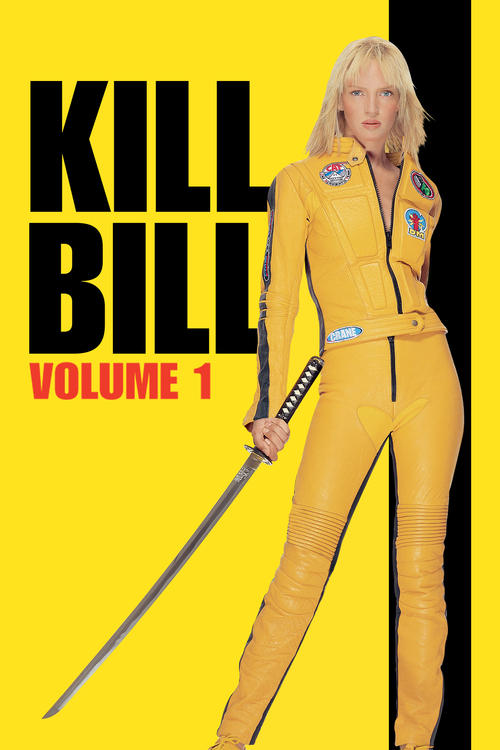
Kill Bill: Vol. 1
2003 · Quentin Tarantino
Generates discourse without releasing anything: the abandoned Movie Critic "final film," podcast hot takes (dunking on Marvel actors as "not movie stars," snubbing Toy Story 3), and the eternal "what will the tenth film be" watch. The industry's loudest opinion-haver.
For when you want to be electrified — a Friday-night movie that goes all the way. Not one for the squeamish, but if you're craving style, momentum, and a heroine on a warpath, this is the fix.
What it's about
A former assassin known as The Bride is gunned down by her own team — and by Bill, the boss and lover who ordered it — at her wedding rehearsal. She survives, wakes from a coma, and starts working down a list, hunting the Deadly Viper Assassination Squad one by one. This first volume takes her to Tokyo, sword in hand, toward a yakuza queen and a snow-garden showdown.
The experience
Pure adrenaline with a movie-lover's grin: stylized, blood-soaked, often funny, and paced like a mixtape of everything its director ever loved. The famous nightclub battle is one of the most sustained rushes in modern action cinema.
Performances
Uma Thurman is iconic here — physical, furious, and wounded all at once, a performance built with Tarantino over years. Lucy Liu matches her with icy, explosive menace as O-Ren Ishii.
The craft
Tarantino throws every tool at the screen — anime interludes, black-and-white passages, split screens, a needle-drop soundtrack that became instantly recognizable — and choreographs swordplay as spectacle with real weight. The House of Blue Leaves sequence alone justifies the biggest screen and loudest speakers you can find.
Why it matters
It re-energized the martial-arts homage for Western audiences, cemented The Bride's yellow tracksuit as pop iconography, and confirmed Tarantino as a filmmaker who could turn his obsessions into event cinema.
Snapshot
Kill Bill: Vol. 1 is Quentin Tarantino's fourth feature, a high-velocity revenge thriller built as an explicit homage to the grindhouse and martial-arts traditions Tarantino absorbed as a video-store clerk and lifelong cinephile. Conceived with star Uma Thurman during the production of Pulp Fiction (1994), it follows a former assassin known as The Bride, left for dead at her own wedding rehearsal by her ex-employer and lover Bill, as she awakens from a coma and begins methodically hunting the members of the Deadly Viper Assassination Squad. The film is the first half of a single story split into two releases by distributor Miramax when the combined cut ran past three hours; Vol. 1 concentrates on the Japan-set portions of the narrative, culminating in the celebrated "House of Blue Leaves" battle against the Crazy 88. It is Tarantino's most overtly stylized, least dialogue-driven film to that point — a deliberate pastiche assembled from the genres he loved, foregrounding choreography, color, and rhythm over the talk-heavy structures of his earlier work.
Industry & production
The film was produced by A Band Apart, Tarantino's production company, and distributed by Miramax Films, then run by Harvey and Bob Weinstein, who had backed Tarantino since Reservoir Dogs and Pulp Fiction. Kill Bill marked Tarantino's return to directing after a six-year gap following Jackie Brown (1997), and it was his most expensive and logistically ambitious production yet, shot across multiple countries including China (at the Beijing Film Studio), Japan, Mexico, and the United States.
The most consequential industrial decision was the split into two volumes. The assembled film ran well over three hours, and Miramax — in consultation with Tarantino — chose to release it as two separate features, with Vol. 1 arriving in October 2003 and Vol. 2 in April 2004. This was a notable commercial gambit: it allowed two theatrical windows and two revenue streams from a single shoot, while reframing the audience's experience around the cliffhanger structure of the serials and exploitation programs the film venerates. Tarantino has spoken of the two volumes as a single work, and a recombined "Whole Bloody Affair" version has screened only rarely and never received a wide home-video release, which remains the case as of this writing.
The production also leaned on Hong Kong and Japanese craft traditions: action choreography was overseen by Yuen Woo-ping, the celebrated fight director of The Matrix and Crouching Tiger, Hidden Dragon, and the animated O-Ren Ishii origin sequence was produced with the Japanese animation studio Production I.G. These collaborations were both creative and industrial gestures, importing the actual personnel of the traditions Tarantino was quoting rather than imitating them at a remove.
Technology
Kill Bill: Vol. 1 was shot photochemically on 35mm film, consistent with Tarantino's well-documented preference for celluloid over digital capture. The film is most technologically distinctive not in its capture format but in its embrace of stylistic shifts between media and processes. The "House of Blue Leaves" sequence famously transitions into high-contrast black-and-white for part of its most graphically violent passage — a choice widely understood to have been partly motivated by the desire to modulate the intensity of the bloodshed, and partly as a formal homage to the monochrome textures of classic samurai cinema. The film also moves into a stark blue-silhouette mode at one point in the battle.
The most striking technological-aesthetic gambit is the extended anime sequence depicting O-Ren Ishii's childhood and rise, animated by Production I.G. Folding hand-drawn Japanese animation directly into a live-action American feature was a comparatively bold formal move for a mainstream 2003 release, and it allowed Tarantino to depict extreme content (the murder of O-Ren's parents) in a register that live action would have rendered unbearable. Beyond these set pieces, the film's effects are largely practical — squibs, stage blood, and physical stunt work — in keeping with its grindhouse lineage, rather than the digital compositing that dominated much studio action of the period.
Technique
Cinematography
The film was photographed by Robert Richardson, the Oscar-winning cinematographer long associated with Oliver Stone and later a frequent Tarantino collaborator. Richardson's signature top-light — a hot, near-vertical key that halos hair and shoulders — is visible throughout, lending even grimy settings a graphic crispness. The cinematography is unusually maximalist in its register-switching: saturated color in the House of Blue Leaves interiors, monochrome and silhouette in the fight's peak, the desaturated palette of the El Paso wedding-chapel flashback, and the flat, bright look of the suburban "Bride vs. Vernita Green" duel. Richardson's compositions favor bold frontality and clean lines of sightline, supporting the film's comic-book legibility. The camera is highly mobile in the action sequences — crane moves, the overhead "God's-eye" shot of the Crazy 88 melee, and the long descent into the restaurant — but often locks into rigorous symmetry for the standoffs.
Editing
Editor Sally Menke, Tarantino's indispensable collaborator who cut every one of his films until her death in 2010, shapes the film's distinctive rhythm. Vol. 1 is structured achronologically, organized into named chapters that withhold and rearrange information — a hallmark of Tarantino's screenwriting realized in the cut. Menke's editing modulates between long, suspense-building takes and rapid, percussive cutting in combat, and it manages the film's abrupt tonal and medium shifts (live action to anime, color to black-and-white) without losing momentum. The chaptered, non-linear assembly is essential to the film's effect, generating dramatic irony and deferring the revelation of the wedding-chapel massacre that motivates the entire revenge plot.
Mise-en-scène / staging
The film is among Tarantino's most designed. The House of Blue Leaves is a purpose-built environment — a Tokyo restaurant with a balconied dining room and an adjoining garden with a footbridge and pool — engineered to stage a large-scale, spatially varied battle. The Bride's yellow-and-black tracksuit is the film's central iconographic object, a direct citation of the costume Bruce Lee wore in the unfinished Game of Death. Costuming and production design throughout function as a dense lattice of quotation: the assassins' aliases, weapons, and looks each gesture toward genre antecedents. Staging foregrounds the duel as a formal unit — two combatants, a charged space, a ritualized buildup — borrowed from both the samurai film and the spaghetti Western.
Sound
The sound design heightens the film's comic-book stylization, with exaggerated, almost onomatopoeic effects for blade strikes and a deliberately punctuated use of silence and music. The most celebrated instances are Tarantino's signature gestures: the sudden zoom-and-sting, and the use of pre-existing recordings as emotional and rhythmic punctuation. The score and song selection — assembled by Tarantino as a curated mixtape rather than a through-composed score — includes the RZA's contributions (the Wu-Tang Clan producer served as a music supervisor figure for the film's hip-hop-inflected sensibility), Luis Bacalov's "The Grand Duel" theme drawn from spaghetti-Western soundtracks, the surf-rock of Tomoyasu Hotei's "Battle Without Honor or Humanity," Santa Esmeralda's flamenco-inflected "Don't Let Me Be Misunderstood," and Nancy Sinatra's cover of "Bang Bang (My Baby Shot Me Down)" over the opening. The needle-drop curation is itself a primary authorial technique.
Performance
Uma Thurman anchors the film with a largely physical, often near-silent performance; The Bride speaks comparatively little, and Thurman carries the role through bodily commitment, expression, and the iconography of grief and resolve. The supporting cast is built as a gallery of genre archetypes: Lucy Liu's O-Ren Ishii, regal and lethal; Vivica A. Fox's Vernita Green; Daryl Hannah's eye-patched Elle Driver; Sonny Chiba — himself a martial-arts-cinema legend — as the sword-maker Hattori Hanzo, a piece of casting that doubles as homage; and Chiaki Kuriyama as the flail-wielding schoolgirl Gogo Yubari. David Carradine, cast as Bill, is heard but barely seen in Vol. 1, his presence deferred to the second film.
Narrative & dramatic mode
Vol. 1 operates in a heightened, presentational mode — closer to myth, comic book, and revenge-tragedy ritual than to psychological realism. Its dramatic engine is the simplest in the genre: a wronged protagonist works through a list of targets. Tarantino complicates this spine through non-linear chaptering, withholding the full circumstances of the wedding-chapel massacre and reordering the kills out of chronological sequence (the second target on the list is dispatched first). The mode is openly self-aware and citational; characters and situations announce their genre lineage. Emotional stakes are real but stylized — the maternal motif (The Bride's pregnancy; Vernita Green's daughter; O-Ren's murdered mother) threads genuine pathos through the carnage, lending the spectacle a recurring undercurrent of motherhood and loss that the violence is constantly measured against.
Genre & cycle
The film is a deliberate synthesis of multiple genre cycles: the Hong Kong and Shaw Brothers kung-fu film, the Japanese samurai (chanbara) and "lady-assassin" pictures (notably the Lady Snowblood lineage, an acknowledged touchstone), the Italian spaghetti Western, the Japanese yakuza film, blaxploitation, and the broad category of 1970s "grindhouse" exploitation. Rather than belonging to a single cycle, Kill Bill is a meta-genre artifact — a revenge film assembled from the conventions of many revenge traditions at once. It sits within the broader turn-of-the-millennium revival of martial-arts spectacle in Western cinema (alongside The Matrix and the crossover success of Crouching Tiger, Hidden Dragon), but distinguishes itself by wearing its sources on its surface rather than naturalizing them.
Authorship & method
Kill Bill: Vol. 1 is the work of an auteur whose method is curation and recombination. Tarantino wrote and directed, and the film is credited as based on a character ("The Bride") he and Thurman developed together. His authorial signature is everywhere: chaptered structure, pop-cultural and cinephilic quotation, needle-drop music supervision, sudden tonal shifts, stylized violence, and strong female leads. The film foregrounds its key collaborators as co-authors of its texture: cinematographer Robert Richardson (the look), editor Sally Menke (the rhythm), action choreographer Yuen Woo-ping (the fights), the RZA (the musical sensibility), and Production I.G (the animated sequence). Tarantino's "score" is not composed but assembled from records, an authorial act of selection that distinguishes his soundtracks. Vol. 1 represents a deliberate pivot in his method — from the dialogue-driven crime films of his first three features to a kineticism-first cinema in which movement, color, and music carry the load.
Movement / national cinema
The film is an American production but a transnational object, both in its making and its references. It belongs to no national-cinema movement in the strict sense; rather, it is an act of cross-cultural absorption by a filmmaker steeped in the export cinemas that reached American audiences through grindhouse theaters and video stores — Hong Kong, Japan, and Italy chief among them. Its closest movement-affiliation is to American postmodern pastiche cinema of the 1990s and 2000s, of which Tarantino is the central figure, defined by ironic-yet-reverent quotation of genre. The film's deliberate importation of Asian craft personnel complicates any simple charge of appropriation, even as that tension remains a live subject in critical writing on the film.
Era / period
Released in 2003, Kill Bill: Vol. 1 arrived at the height of the post-Matrix, post-Crouching Tiger mainstreaming of wire-fu and Asian martial-arts aesthetics in Hollywood, and amid a broader early-2000s vogue for stylized, referential genre cinema. It also belongs to the moment of Miramax's peak influence as the dominant force in prestige-adjacent American independent distribution. Its split-release strategy reflects the era's increasingly sophisticated theatrical-window economics. Coming six years after Jackie Brown, it reintroduced Tarantino to a new decade's audience and inaugurated the more genre-saturated, homage-driven second phase of his career that would continue through Death Proof, Inglourious Basterds, and Django Unchained.
Themes
The film's governing theme is revenge as both moral structure and aesthetic pleasure — the satisfaction and the cost of retribution, staged as ritual. Running beneath it is a sustained meditation on motherhood and the maternal: The Bride's pregnancy at the moment of her near-murder, her duel interrupted by Vernita Green's young daughter, and O-Ren Ishii's primal childhood trauma all bind the violence to questions of family and inheritance. The film also explores female agency and the female body as instrument of violence, placing women at the center of a genre historically organized around male combatants. Threaded throughout is a meta-theme of cinema itself — the film's dense citation makes movie-love and the act of homage a subject as much as a method, so that the work is partly about the genres it inhabits.
Reception, canon & influence
Kill Bill: Vol. 1 was a commercial success and was widely, if not unanimously, praised on release; critics frequently divided over whether its relentless stylization and graphic violence amounted to dazzling formal mastery or empty pastiche. Admirers celebrated its craft, energy, and the House of Blue Leaves set piece as a landmark of modern action staging; skeptics questioned its emotional weight relative to Tarantino's earlier, more character-driven films. Detailed contemporary box-office and award specifics are best confirmed against primary records rather than asserted here.
Influences on the film (backward): The work is an anthology of acknowledged sources — the Lady Snowblood and lady-assassin films of 1970s Japan; Shaw Brothers and Hong Kong kung-fu cinema; the swordsmanship and revenge codes of the chanbara; Bruce Lee (the Game of Death tracksuit); Sonny Chiba's Street Fighter persona; spaghetti Westerns (via Bacalov and Morricone-adjacent music and the duel form); and the broad grindhouse-exploitation tradition. The contemporaneous wire-work vocabulary of The Matrix and Crouching Tiger (channeled through Yuen Woo-ping) is also a direct technical lineage.
Legacy (forward): Kill Bill helped cement the early-2000s legitimacy of homage-driven, hyper-stylized genre filmmaking in mainstream cinema, and The Bride in her yellow tracksuit became an enduring icon, widely referenced and parodied. The film consolidated Tarantino's transition into his homage-heavy later career and reinforced the model of the curated-soundtrack-as-score that countless subsequent filmmakers have emulated. It is frequently cited in discussions of female-led action cinema and remains a touchstone for action choreography and color-coded, chaptered storytelling. Within Tarantino's own filmography it stands as the pivot toward the genre-saturated mode that defines his second act.
A Deleuzian reading
Start with the face.
The full Deleuzian reading of Kill Bill: Vol. 1 →
Reception
A box-office hit in 2003 but dogged by critics who called it empty pastiche — dazzling surface, no soul. Two decades on, it's canonized as one of the defining films of the 2000s and the purest hit of Tarantino's grindhouse-scholar mode.
How Kill Bill: Vol. 1 was received, from release to now →
Influences: the films it descends from and the films it influenced
- Lady Snowblood (1973) — Supplies the chaptered revenge-as-ritual structure, the snow-against-blood color contrast, and the lone female assassin whose arterial spray is staged as stylized geyser rather than gore — Tarantino lifts the visual grammar of the duel directly.
- Game of Death (1978) — The Bride's yellow-and-black tracksuit is a one-to-one costume quotation of Bruce Lee's, importing his tiered single-combat-up-the-levels structure into the House of Blue Leaves escalation.
- The Street Fighter (1974) — Sonny Chiba's brutal close-quarters karate persona is cast directly as Hattori Hanzo, and the film's exploitation-grade impact editing — hard cuts on the blow — informs the fight cutting rhythm.
- Five Deadly Venoms (1978) — The Shaw Brothers template of color-coded named adversaries, each with a signature combat style introduced via on-screen title card, models the Deadly Viper roster and its presentational character intros.
- Django (1966) — The spaghetti-Western duel-as-narrative-unit and Bacalov's score (whose cue Tarantino repurposes) supply the operatic stand-off framing transplanted onto the chanbara sword confrontation.
- Once Upon a Time in the West (1968) — The extreme-duration face-off built on extreme-close-up eyes, ritual stillness before violence, and Morricone-style musical leitmotif-as-character is the operatic grammar Tarantino applies to the showdowns.
- Branded to Kill (1967) — Suzuki's pop-art saturated color, abrupt black-and-white shifts, and anti-realist presentational staging of the hitman genre prefigure Tarantino's medium-shifting, stylization-over-coherence approach.
- The Matrix (1999) — The contemporaneous Yuen Woo-ping wire-work that legitimized Hong Kong choreography for Western audiences is the shared technical lineage; both stage combat as authored, balletic spectacle rather than realist brawling.
- Ninja Scroll (1993) — The anime idiom of hyper-violent chanbara — exactly the register of the Production I.G O-Ren origin sequence — establishes the animated-violence-as-myth mode Tarantino splices into live action.
- The Good, the Bad and the Ugly (1966) — Tarantino deploys Morricone's 'L'estasi dell'oro' and other GBU cues as dramatic architecture at climactic moments, reproducing the music-first editorial principle; the extreme close-up/wide oscillation—eyes, sword hands, arena geography—structures the Crazy 88 sequence according to GBU's facial-register binary.
- Hard Boiled (1992) — Tarantino appropriates Woo's affective counterpoint—the deliberate scoring of graphic violence with lyric or incongruously beautiful music—and the operatic editing rhythm that treats action sequences as self-contained formal units with their own tempo, climax, and release.
- Sanjuro (1962) — The Crazy 88 sequence directly cites and reproduces Sanjuro's blood-geyser practical effect — the sudden high-pressure arterial spray from a severed vessel — as explicit homage, reintroducing the technique to contemporary cinema with the lineage made unmistakable.
- Kill Bill: Vol. 2 (2004) — The literal continuation completes the chaptered revenge arc, pivoting the kinetic-first stylization toward the dialogue-driven mode and resolving the motherhood theme seeded in Vol. 1's opening.
- Sin City (2005) — Extends the high-contrast saturated/monochrome-shift color grammar and the comic-panel presentational violence into a fully stylized, palette-coded chaptered anthology of revenge.
- Sympathy for Lady Vengeance (2005) — Inherits the female-led, ritualized revenge built on color-symbolism and chaptered structure, treating vengeance as stylized aesthetic spectacle rather than psychological realism.
- Atomic Blonde (2017) — Carries forward the female-assassin-as-icon and the curated-needle-drop-mixtape-as-score model, building set pieces around a single sustained physical-combat showcase in the House of Blue Leaves tradition.
- John Wick (2014) — Extends the long-take, legible, choreography-forward 'gun-fu' set piece against waves of color-coded adversaries — the descendant of the House of Blue Leaves staging philosophy of clear, balletic combat geography.
- Sucker Punch (2011) — Inherits the genre-pastiche anthology of hyper-stylized female-warrior fantasy, mixing anime-inflected combat, saturated color, and a soundtrack-driven presentational-myth register directly traceable to Vol. 1.
- Scott Pilgrim vs. the World (2010) — Structured revenge as chapter-carded, boss-by-boss duels punctuated with an anime interlude—genre-pastiche fight staging Scott Pilgrim inherits wholesale.
- Zombieland (2009) — Its chaptered, rule-bookish stylization and slow-motion blood-ballet scored to pop cues informs Zombieland's slow-motion kill montages and game-like framing.
- Bullet Train (2022) — Model for the ironic Japanese-pop needle-drop (here reworked as J-pop covers of Western songs) scoring a Western star slicing through a Tokyo underworld of themed assassins.
- Crouching Tiger, Hidden Dragon (2000) — Shares Yuen Woo-ping's wire-fu choreography vocabulary — the airborne, gravity-defying swordplay and rooftop pursuit grammar that Yuen brought directly into the House of Blue Leaves fight.
- Pulp Fiction (1994) — Establishes Tarantino's signatures repurposed here — non-linear chaptered structure with titled segments, the curated needle-drop mixtape functioning as score, and editor Sally Menke's tonal-shift rhythm.
- Natural Born Killers (1994) — Robert Richardson's hot top-light and genre-pastiche format-switching (color/B&W/anime) extend the cinematographer's NBK visual method into the next decade.
- The Matrix Reloaded (2003) — Released the same year with Yuen Woo-ping choreographing its sword duels, a parallel Western appropriation of Hong Kong wire-stunt craft into blockbuster cinema.
- Hero (2002) — Shares the chromatic-chapter device and color-keyed showdown (the House of Blue Leaves snow duel), drawing on the same King Hu / wire-fu lineage to stage combat as stylized, desaturated-to-saturated set-piece.
- Django Unchained (2012) — Sibling in Tarantino's revenge mode: chaptered construction, a wronged protagonist's bloody list, and Richardson's top-light-halo close-ups deployed at moments of resolve.
- Zatoichi (2003) — Contemporaneous chanbara pastiche treating heightened, stylized blood spray as a self-aware aesthetic flourish rather than realism — the same digital-era reinvention of the sword film.
- The Taste of Tea (2004) — Ishii directed the O-Ren Ishii anime origin sequence for Tarantino, a direct collaborator link demonstrating the same technique — hand-drawn animation interpolated into live-action narrative — he deploys in his own film.
- Kamikaze Girls (2004) — Cuts abruptly into a full anime sequence and stylized flashback chapters within a live-action film, endorsing the same anime-cutaway-as-backstory device Nakashima uses for Momoko's Rococo-era reveries.
- Puss in Boots: The Last Wish (2022) — Prior pastiche that fuses Leone standoff geometry with abrupt anime-style tonal and frame-rate gear-shifts inside a fight — the same mid-scene stylistic gear-change the Wolf duels deploy.
- Death Proof (2007) — The same authorial toolkit — feminist-revenge genre pastiche propelled by a compiled needle-drop soundtrack and dense cinephile citation in place of an original score.
- Furiosa: A Mad Max Saga (2024) — Extends the chaptered female-avenger revenge saga staged in an operatic, mythologized register with named-chapter title cards structuring the vendetta.
Similar films
- Kill Bill: Vol. 2 (2004) — influence & lineage · same viewing thread · often watched together
- Lady Snowblood (1973) — influence & lineage
- Pulp Fiction (1994) — influence & lineage
- Ninja Scroll (1993) — influence & lineage
- Sin City (2005) — influence & lineage
- Crouching Tiger, Hidden Dragon (2000) — influence & lineage · same viewing thread
- Dragon Inn (1967) — same viewing thread
- Once Upon a Time in China (1991) — same viewing thread
All the films related to Kill Bill: Vol. 1 →
Watch it with: curated runs of related films
- Wuxia and Its Heirs — Watch these as a bloodline — King Hu's weightless swordplay flowering into Zhang Yimou's painted epics and finally Tarantino's homage, all built on choreography as dance.