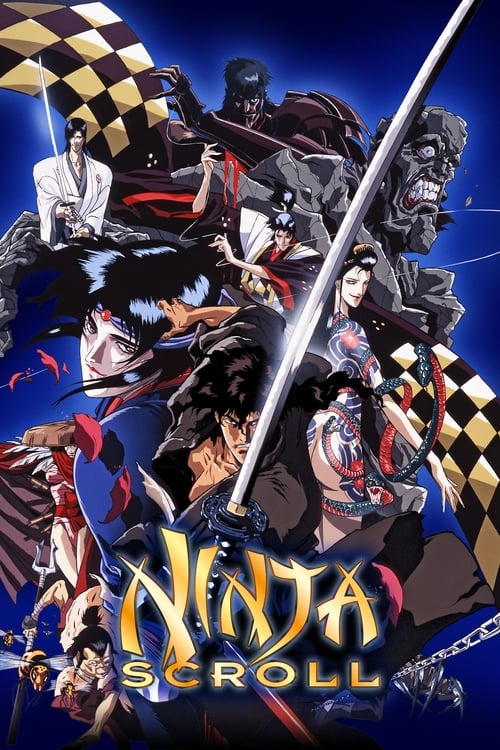
Ninja Scroll
1993 · Yoshiaki Kawajiri
For when you're craving dark, stylish action with real edge — a late-night watch for grown-ups, closer to a blood-soaked samurai pulp novel than to anything family-friendly.
What it's about
Jubei is a masterless swordsman drifting through a mythologized feudal Japan, selling his blade for gold or a worthy cause. He's dragged into a plot against the shogunate driven by the Eight Devils of Kimon — a band of ninja with grotesque superhuman powers — and finds himself allied with Kagero, a poison-taster kunoichi whose body is itself a weapon, and Dakuan, a wily government spy who plays everyone. At the center waits an enemy from Jubei's past who cannot be killed.
The experience
Fast, brutal, and gorgeously drawn — a chain of inventive duels, each against an opponent with a nastier power than the last, threaded with a doomed, restrained romance. Fair warning: it's genuinely adult, with graphic violence and sexual violence; the tone is pulp tragedy, not popcorn.
The craft
Yoshiaki Kawajiri and studio Madhouse animate action with a slasher's timing and a painter's eye — every Devil is a distinct design nightmare, and the fights are choreographed for shock and clarity at once. The hand-drawn craft holds up beautifully; it rewards a big screen and the sound up loud.
Why it matters
One of the key films that carried anime into Western living rooms in the 1990s, it defined the 'adult anime' idea for a generation and its wandering-swordsman-versus-monsters template has been imitated in animation and games ever since.
Snapshot
Ninja Scroll (Japanese title Jūbei Ninpūchō, roughly "Jubei's Ninja Wind Scroll") is a feature-length theatrical anime directed by Yoshiaki Kawajiri and produced by the Tokyo studio Madhouse. Running roughly 94 minutes, it follows Jubei Kibagami, a masterless swordsman-for-hire in a mythologized feudal Japan, who is drawn into a conspiracy by the Eight Devils of Kimon—a band of grotesquely superhuman ninja serving a plot to topple the shogunate. Alongside a doomed female poison-taster ninja, Kagero, and a manipulative government spy, Dakuan, Jubei confronts an enemy from his past who cannot be killed. The film is a landmark of adult-oriented anime: a lean, brutal, sexually frank action-fantasy that, together with Akira and Ghost in the Shell, formed the core of anime's first major crossover into Western home video in the 1990s. Its reputation rests less on narrative innovation than on the density and confidence of its craft—Kawajiri's signature fusion of chanbara swordplay, horror imagery, and hard-edged draftsmanship.
Industry & production
Ninja Scroll was made at Madhouse, the studio co-founded in 1972 by Osamu Dezaki, Rintaro, Masao Maruyama, and Yoshiaki Kawajiri after they left Mushi Production. By the early 1990s Madhouse had become a home for director-driven, technically ambitious work aimed at older audiences, and Kawajiri was among its defining talents. The film emerged from the tail end of Japan's OVA (original video animation) boom of the 1980s, a market that had made stylish, violent, erotic genre animation commercially viable outside the children's and family sphere. Where much of Kawajiri's prior work (Wicked City, Demon City Shinjuku) had been produced for video, Ninja Scroll was a theatrical production, giving it a larger canvas and a higher finish.
The specific financing and budget figures for the film are not well documented in English-language sources, and I will not invent them. What is clear is that the project was conceived as an original story rather than an adaptation, written by Kawajiri himself—unusual latitude that reflects his standing at the studio. The film's commercial afterlife proved more consequential than its domestic theatrical run: licensed for the West by Manga Entertainment, it became a staple of the VHS and later DVD market in the United States and United Kingdom, where it reached a cult audience far larger than a single Japanese release might suggest. Precise box-office or unit-sales numbers are not something I can reliably cite.
Technology
Ninja Scroll is a work of traditional cel animation, produced photochemically before the digital compositing pipelines that would reshape anime later in the decade. Backgrounds were hand-painted; character animation was drawn and inked on celluloid and shot on an animation stand. The film predates the widespread adoption of digital ink-and-paint in Japanese studios (which came in the mid-to-late 1990s), and its texture is unmistakably analog: the grain of painted skies, the layered atmospheric haze of forests and gorges, the physical depth achieved through multiplane-style staging of foreground and background cels.
Within those constraints, the technological ambition lies in the sheer quality of the drawing and the fluidity reserved for key action beats. Rather than distributing motion evenly, the production concentrated resources on set-piece confrontations—limbs, blades, blood, and transforming bodies rendered with full animation—while economizing elsewhere. This is not a technical breakthrough film in the manner of Akira's celebrated frame counts; its achievement is one of controlled craft within a conventional cel workflow.
Technique
Cinematography
Because this is animation, "cinematography" refers to the design of the virtual camera, framing, and lighting rather than photographed reality. Kawajiri's visual language is aggressively cinematic: low angles that monumentalize the Devils of Kimon, canted compositions in moments of threat, and a fondness for silhouette and chiaroscuro drawn from horror and film noir. Light is treated as a dramatic agent—torchlit interiors, moonlit exteriors, and the sudden bloom of fire or blood against dark grounds. The palette runs to deep earth tones, cold blues, and arterial reds, with high-contrast shadow work modeling faces and bodies. Depth is constructed through staged planes and selective focus effects, and the "lens" frequently pushes in on eyes and hands at the instant of violence.
Editing
The cutting is built around rhythm and impact. Dialogue and travel sequences are edited economically, sometimes flatly, in order to bank time and resources for the combat encounters, which are cut with precision: anticipation, a held beat, then a burst of movement resolved in a decisive strike. Kawajiri favors the graphic shock cut—an abrupt transition to a severed limb, a spray of blood, a body undone—rather than prolonged choreographed exchange. The episodic structure, in which Jubei faces the Devils largely one at a time, gives the film a sequential, almost anthology-like cadence, each duel functioning as a self-contained showcase.
Mise-en-scène / staging
The staging is the film's signature. Each of the Eight Devils is conceived as a discrete visual and physical idea—stone skin, a body that hosts a nest of wasps or snakes, a shadow that can flatten and slide—so that every encounter reinvents the rules of the fight. Kawajiri stages combat around these gimmicks, choreographing space so that the environment (a forest, a burning village, a ship, a cliff) becomes an active element. The feudal Japanese setting is rendered with atmospheric specificity, but it is a mythic, gothic feudalism, closer to horror than to historical drama.
Sound
Kaoru Wada composed the score, which blends orchestral and traditional Japanese instrumentation to underscore the period-fantasy atmosphere and to punctuate action. The sound design leans into the visceral: the ring and slice of steel, the wet punctuation of wounds, and ambient washes of wind, fire, and forest that give the animated world a physical presence. As with most anime of the era, the film exists in a Japanese original and later English dub; discussion of "sound" here concerns the original Japanese production.
Performance
Vocal performance carries characterization. Jubei is voiced in a laconic, weary register that suits his wandering-swordsman archetype; Kagero's performance carries the film's undertow of tragedy and constrained desire; Dakuan supplies wheedling comic cunning; and the principal antagonist, Genma, is given a theatrical, gloating menace. The English-language dub produced for the Western release became, for many overseas viewers, the definitive vocal track and part of the film's cult identity—though I would not attribute specific casting details without confirmation.
Narrative & dramatic mode
The film's dramatic mode is picaresque action-tragedy. Its engine is a chain of duels—Jubei versus each Devil—strung on a conspiracy plot involving gold, a deadly plague, and a bid to seize power. The structure is deliberately episodic, closer to the serialized ninja adventure than to a tightly braided three-act screenplay, and the "scroll" of the title suggests exactly this unrolling sequence of encounters. Beneath the momentum runs a fatalistic strain: Kagero's arc, in which physical closeness is literally lethal, gives the film its emotional core and its melancholy, and Jubei's confrontation with a resurrected enemy frames the story as a reckoning with an inescapable past. Character psychology is sketched economically; the film trusts iconography and action to carry meaning that dialogue only gestures toward.
Genre & cycle
Ninja Scroll sits at the intersection of chanbara (the samurai/swordplay tradition of Japanese cinema), the ninja adventure, and supernatural horror, filtered through the adult-OVA sensibility of 1980s anime. Its lineage runs back to live-action ninja and samurai films and, importantly, to the literary tradition of Futaro Yamada's Ninpōchō ("ninja arts scroll") novels—hyper-inventive, erotic, grotesque tales of ninja with fantastical powers. The Japanese title's echo of that tradition is deliberate, even though the film is an original story rather than a Yamada adaptation. Within anime, it belongs to a cycle of violent, stylish, mature-rated genre films and OVAs that Kawajiri himself did much to define.
Authorship & method
The film is strongly authored. Kawajiri wrote and directed it, and its aesthetic—kinetic violence, gothic-erotic imagery, hard graphic draftsmanship, and horror staging—is continuous with his earlier Wicked City (1987) and Demon City Shinjuku (1988). His method concentrates the animation budget on peak moments and builds each sequence around a strong visual conceit.
Among key collaborators, character designer and animation director Yutaka Minowa was central to the film's look; his sharp, muscular figure drawing gives the Devils their menace and Jubei his flint. The composer was Kaoru Wada. The production was anchored at Madhouse, whose producer Masao Maruyama was a longtime creative partner of Kawajiri; I attribute specific roles cautiously where the English-language record is not fully explicit. As writer-director, Kawajiri occupies the auteur position, but the film is very much a Madhouse house-style achievement built on the studio's animator talent.
Movement / national cinema
As Japanese animation, Ninja Scroll belongs to no formal "movement" but to a moment: the maturation of anime into a medium capable of sustained adult genre filmmaking, and its subsequent globalization. Domestically it draws on Japan's deep cinematic traditions of the samurai film and on the popular literature of ninja fantasy. Internationally, it became one of the works through which non-Japanese audiences learned what anime could be for older viewers—positioning it within the story of anime as an export culture rather than within any avant-garde or national-realist current.
Era / period
Released in 1993, the film stands at a pivot point. It arrives at the crest of the OVA era and just before the digital transition that would transform anime production later in the decade. Its 1993 release places it in the same narrow window as Ghost in the Shell (1995) and in the wake of Akira (1988)—the three films most responsible for anime's Western breakthrough. Its diegetic period, meanwhile, is a mythologized Edo-era Japan of shoguns, spies, and clandestine ninja clans, treated less as history than as a dark-fantasy stage.
Themes
The film's recurring concerns are the wandering warrior's rootlessness and code; the inescapability of the past, embodied in the returning antagonist; and the entanglement of intimacy with danger, most poignantly in Kagero, whose body is poison and whose desire is therefore fatal. Power and corruption drive the plot—gold, plague, and the machinery of a coup—while the human characters are caught between vast, impersonal schemes. Bodies themselves are a persistent theme: the Devils are variations on the body transformed, weaponized, or monstrous, and the film's frankness about flesh, in both violence and sexuality, is part of its meaning rather than mere sensation. Underlying all of it is a fatalistic, almost tragic worldview in which survival is possible but connection is costly.
Reception, canon & influence
Contemporary Japanese critical documentation of the film in English is limited, and I will not overstate it. Its canonical status was largely built abroad and over time. Through Manga Entertainment's Western release, Ninja Scroll became one of the defining "gateway" anime for English-speaking audiences in the 1990s, frequently named alongside Akira and Ghost in the Shell as the films that established anime's adult credibility in the West. Among fans and many critics it is regarded as a high point of Kawajiri's career and of Madhouse's action output.
Backward, the film draws on live-action chanbara and ninja cinema, on horror iconography and film-noir lighting, and on the fantastical-ninja literary tradition associated with Futaro Yamada's Ninpōchō novels; within Kawajiri's own filmography it is a refinement of the violent-gothic mode of Wicked City and Demon City Shinjuku.
Forward, its legacy is substantial. It spawned a Japanese television continuation, Ninja Scroll: The Series (2003), which followed a new protagonist rather than Jubei. Kawajiri's international profile, boosted by the film, led to work on English-language and hybrid projects, including a segment ("Program") of The Animatrix (2003) and the direction of Highlander: The Search for Vengeance (2007), while his Vampire Hunter D: Bloodlust (2000) extended the same stylistic universe. More diffusely, Ninja Scroll helped fix a template for adult anime action in Western reception and is frequently cited by Western filmmakers and animators who came of age on 1990s import video. Its most durable influence is aesthetic: the marriage of elegant swordplay, body-horror invention, and unflinching graphic violence that a generation of viewers first encountered here.
Reception
Barely a blip in Japan on release, it exploded in the West on Manga Entertainment VHS tapes and became one of the 'holy trinity' of 90s gateway anime alongside Akira and Ghost in the Shell. Today it's still canon for 90s anime heads, though modern rewatches grapple with just how gleefully lurid it is.
How Ninja Scroll was received, from release to now →
How to watch Ninja Scroll: what to notice on a first viewing
- Watch how deep shadow swallows most of each frame. Kawajiri lights each scene in high-contrast chiaroscuro, silhouette and shadow modeling faces and bodies, with torchlight, moonlight, and sudden blooms of fire or blood against dark ground. The dark is not empty. It is where the film keeps deciding what you can and cannot see.
- Notice how low the camera sits during fight scenes. Kawajiri repeatedly shoots the Devils of Kimon from low, canted angles that monumentalize their bodies and tip the frame off level at moments of threat. The camera makes each opponent look larger and more wrong before a single blow lands.
- Watch how abruptly the film cuts to a wound. Kawajiri favors a sudden, graphic shock cut, an abrupt jump to a severed limb or a spray of blood, rather than a prolonged choreographed exchange. The violence lands as a shock because the editing refuses to let you brace for it.
- Notice that each enemy has one distinct physical gimmick. Every one of the Eight Devils of Kimon is built around a single visual idea, stone skin, a body hosting a swarm, a shadow that flattens and slides. Each fight resets the rules, so you have to relearn what is even possible every time.
- Listen for traditional instruments layered under the orchestral score. Kaoru Wada blends orchestral scoring with traditional Japanese instrumentation, and the sound design foregrounds the ring of steel and the wet impact of every wound. The mix keeps one foot in period atmosphere and one in visceral, physical impact.
The whole guide to watching Ninja Scroll, with the keys for a rewatch →
Influences: the films it descends from and the films it influenced
- Wicked City (1987) — Kawajiri's own prototype for the erotic-grotesque transforming-body monster and the method of concentrating the animation budget on a few peak set-pieces, carried directly into Jubei's Devils of Kimon duels.
- Demon City Shinjuku (1988) — Establishes the supernatural martial-arts duel staged under hard expressionist chiaroscuro and low-angle framing that Ninja Scroll sharpens into house style.
- Golgo 13: The Professional (1983) — Madhouse's adult-action template of unflinching graphic violence plus Dezaki's held 'postcard' freeze-frame stills, a studio grammar Kawajiri absorbed working alongside him.
- Samurai Reincarnation (Makai Tensho) (1981) — Live-action adaptation of Futaro Yamada's Ninpocho fiction: resurrected swordsmen with monstrous single-power gimmicks and gothic-erotic supernatural swordplay, the literary-cinematic mold Ninja Scroll works in.
- Shinobi no Mono (1962) — Codifies the episodic structure of discrete, technique-driven ninja set-pieces adapted from serialized ninja fiction, the beat-by-beat 'each foe is a new gimmick' shape.
- Yojimbo (1961) — Source of the masterless wandering ronin archetype and the low-angle framing that monumentalizes the lone swordsman inside a corrupt landscape.
- Sanjuro (1962) — The final duel's shocking geyser of arterial blood is the live-action precedent for the graphic-spray killing that anime action, including Jubei's, stylizes.
- Lone Wolf and Cub: Sword of Vengeance (1972) — Episodic wandering-swordsman narrative built on concealed gimmick weaponry and stylized fountain-of-blood dispatches — the chanbara pulp grammar Ninja Scroll animates.
- Neo Tokyo (1989) — Extends the 'Running Man' impact vocabulary — one-frame white flash on contact, bodies opened along drawn arcs of motion, foreground limbs distorted by simulated wide-angle — into feature-length choreography.
- Vampire Hunter D: Bloodlust (2000) — Direct extension of Ninja Scroll's gothic-swordplay and body-horror universe, same chiaroscuro draftsmanship and Minowa-lineage muscular figure work.
- The Animatrix: Program (2003) — Exports his low-angle, high-contrast chanbara duel staging into a Western franchise via a samurai-VR sword fight built around a single visual conceit.
- Highlander: The Search for Vengeance (2007) — Feature-length application of Ninja Scroll's action-tragedy revenge structure and kinetic swordplay staging to an English-language property.
- Kill Bill: Vol. 1 (2003) — Tarantino's acknowledged debt: geyser arterial spray and gimmick-weapon single combat, even folding an animated chanbara sequence into a live-action film.
- Basilisk: The Kouga Ninja Scrolls (2005) — Another Yamada Ninpocho adaptation extending the 'one grotesque power per warrior' gimmick-combat duel template that Ninja Scroll popularized in animation.
- Afro Samurai (2007) — Carries the low-angle chiaroscuro chanbara and graphic swordplay into a Western co-production, inheriting Ninja Scroll's cool-lone-swordsman-versus-episodic-foes design.
- Sword of the Stranger (2007) — Extends the Madhouse-style peak-moment swordfight choreography — weighty, blood-flecked, precisely animated duels concentrating budget on climactic clashes.
- Kizumonogatari Part 3: Reiketsu (2017) — Choreographs weighty, grotesquely fluid violence that snaps abruptly into stillness — the full-animation-versus-freeze dynamic Oishi deploys in Kizu's fight set-pieces.
- Jujutsu Kaisen 0 (2021) — Kawajiri's grotesque supernatural bestiary and folk-horror grotesquerie established the deformed, body-horror monster design vocabulary that JJK's curses inherit in their asymmetric, orifice-heavy staging.
- Demon Slayer: Kimetsu no Yaiba Infinity Castle (2025) — Established the adult chiaroscuro demon-combat idiom of anime — grotesque yōkai antagonists dispatched in high-contrast shadow — the tonal and lighting register Infinity Castle's duels operate in.
- Berserk: The Golden Age Arc III - The Advent (2013) — Codifies the seinen grotesque-combat idiom the trilogy inherits: monstrous bodily deformation, blood as texture, and violence held long enough to read as horror rather than action.
- Fist of the North Star (1986) — Normalized anime body-detonation gore (exploding bodies, rupturing flesh) that Ninja Scroll refines from spectacle into precise body-horror invention.
- Akira (1988) — Shares the body-horror transformation of flesh and lavish concentrated-budget animation; together they fixed the Western 'gateway anime' trio that established adult credibility abroad.
- Vampire Hunter D (1985) — Contemporaneous OVA fusion of gothic-horror iconography with swordplay and film-noir lighting — the same aesthetic bloodstream Kawajiri would later inherit directly.
Similar films
- Sword of the Stranger (2007) — influence & lineage
- Kill Bill: Vol. 1 (2003) — influence & lineage
- Yojimbo (1961) — influence & lineage
- Akira (1988) — influence & lineage
- Vampire Hunter D: Bloodlust (2001) — shared sensibility
- Ichi the Killer (2001) — shared sensibility
- Jin-Roh: The Wolf Brigade (1999) — shared sensibility
- Lady Snowblood (1973) — shared sensibility