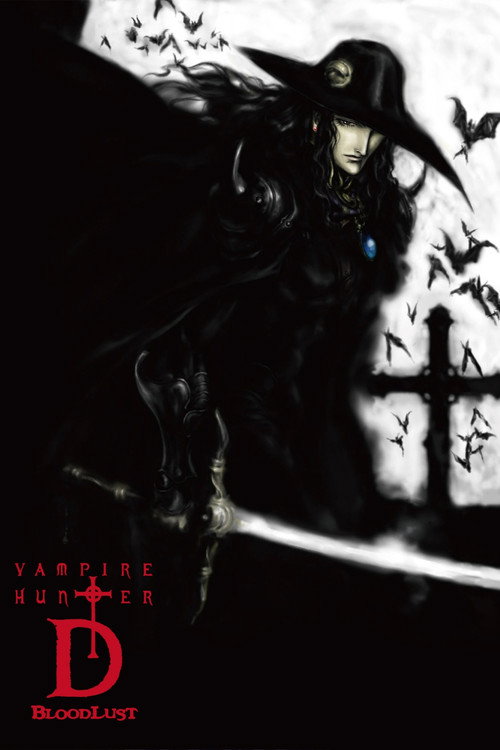
Vampire Hunter D: Bloodlust
2001 · Yoshiaki Kawajiri
For a late-night watch when you want something dark and beautiful — adult animation with real atmosphere, more haunted than horrifying. Fair warning: it earns its gore.
What it's about
In a far future where vampire nobility rules the ruins of Earth — half gothic Europe, half lawless frontier — the bounty hunter D is hired to retrieve a young woman carried off by an undead aristocrat. D is a dhampir, born of human and vampire and welcome among neither, and he's racing a squabbling family of rival hunters across the wasteland to reach her first. The closer everyone gets, the less the abduction looks like what it seemed.
The experience
Sleek, moody, and violent, but with a doomed romanticism threading through the swordplay that you don't expect from an action film this stylish. It's brooding rather than breakneck — gorgeous, melancholy pulp.
The craft
Yoshiaki Kawajiri, Madhouse's master of elegant pulp, renders a world where a vampire's castle rises like a cathedral out of a post-apocalyptic desert — Dracula by way of the wasteland — with some of the most sumptuous hand-drawn animation of its era. Unusually, its dialogue was recorded in English first, aimed straight at Western audiences.
Why it matters
It stands among the last great fully hand-drawn anime features, made just as the industry shifted to digital, and it marked the moment anime consciously reached westward for a global audience.
In a far future where vampire nobility rules over a ruined, half-gothic, half-frontier Earth, the dhampir bounty hunter D — born of both bloodlines, welcome in neither — is hired to retrieve a young woman carried off by an undead aristocrat, racing a squabbling family of rival hunters across the wasteland. Yoshiaki Kawajiri, Madhouse's master of elegant pulp (Ninja Scroll, Wicked City), adapted Hideyuki Kikuchi's third D novel into something statelier than his usual fare: a doomed romanticism threads through the swordplay, and the vampire's castle rises like a cathedral out of Dracula by way of Mad Max. Produced with American distribution in mind — its dialogue was recorded in English first — it belongs to the moment when anime was consciously reaching westward. It is also a swan song: among the last great features drawn in traditional cel animation, its moonlit blues and candle-glow interiors painted by hand at the very twilight of the technique.
Reception
It slipped into US theaters in 2001 via a tiny Urban Vision release and made barely a ripple, but two decades of home-video word-of-mouth turned it into a hand-drawn holy relic — it now reliably tops 'most gorgeous anime films ever' threads and packs repertory screenings.
How Vampire Hunter D: Bloodlust was received, from release to now →
Influences: the films it descends from and the films it influenced
- Vampire Hunter D (1985) — The first Kikuchi adaptation that fixed the template Bloodlust reworks — Amano-derived character design, the wisecracking parasitic Left Hand, and the dhampir bounty-hunter riding a cybernetic-Gothic frontier.
- Wicked City (1987) — Kawajiri's own erotic-grotesque template: monsters that morph mid-motion into fanged, insectile anatomy, rendered in inky airbrushed shadow — the exact morphology recycled for the Barbarois mutants.
- Demon City Shinjuku (1988) — Established Kawajiri's Madhouse workflow of Amano-adjacent designs staged against ruined-cathedral architecture lit by single hard key-lights throwing long diagonal shadows.
- Ninja Scroll (1993) — The blueprint for Bloodlust's action grammar — a gallery of themed super-powered assassins picked off one by one, each duel built on smear-frame blade arcs and chiaroscuro so hard the figures read as cut-paper silhouettes.
- Nosferatu (1922) — Source of the expressionist cast-shadow vocabulary — the vampire announced by his projected silhouette climbing a wall — which Kawajiri restages as hand-inked shadow theater.
- Horror of Dracula (1958) — Hammer's aristocratic-seducer vampire and its saturated blood-red-against-stone palette inside a cathedral-scaled castle interior, the tonal model for Meier Link's doomed nobility.
- Once Upon a Time in the West (1968) — The lone bounty-hunter myth staged in extreme wide desolation and elegiac slow tempo, its doomed-romantic gunfighter elegy transposed onto D's wandering frontier.
- The Road Warrior (Mad Max 2) (1981) — The post-apocalyptic wasteland-western iconography — leather-clad marauders, armored vehicles crossing a dead frontier — that Bloodlust fuses onto its Gothic horror (a cited influence).
- Bram Stoker's Dracula (1992) — Recast the vampire as tragic doomed lover in dense in-camera shadow and painterly texture, directly feeding Bloodlust's Meier-and-Charlotte doomed-romanticism core.
- Angel's Egg (1985) — Carries Amano's delicately linear, ornamental gothic character design directly into animation, the same illustrator-to-anime translation Angel's Egg pioneered as a landmark of Amano's screen work.
- Neo Tokyo (1989) — Migrates Kawajiri's hand-inked chiaroscuro into digital compositing — the same hard-edged key light and black-void backgrounds now achieved with layered gradient masks rather than airbrushed cels.
- Hellsing (2001) — Extends the Gothic-action vampire — a superhuman dhampir agent dispatching monsters in cathedral shootouts drenched in the same hard-shadow, blood-red staging.
- Sword of the Stranger (2007) — Carries forward Kawajiri's fluid single-blade duel choreography — weighted, gravity-obeying swordplay in long unbroken action cuts — into the next animation generation.
- Van Helsing (2004) — Hollywood's monster-hunter-versus-aristocratic-vampire spectacle, mashing Dracula Gothic with pulp-western gadgetry in the same Universal-monsters-meet-action key Bloodlust struck.
- Castlevania (2017) — Builds its Gothic-cathedral vampire aesthetic — Ayami-Kojima/Amano-lineage character design, arterial reds against cavernous stone, dhampir hunter protagonist — directly on the Vampire Hunter D visual grammar.
- Kizumonogatari Part 3: Reiketsu (2017) — Renders vampire-horror through baroque architecture and mutating grotesque anatomy, the gothic monster-design lineage Kizumonogatari's Kiss-Shot and enemy vampires extend.
- Jujutsu Kaisen 0 (2021) — Its gothic, grief-haunted loner protagonist paired with fluid gore-forward swordwork models the fusion of melancholic interiority and kinetic violence that Yuta's arc runs on.
- Berserk: The Golden Age Arc III - The Advent (2013) — Precedent for the European medieval-gothic iconography and painterly infernal color palette — deep reds, candlelit blacks — that shapes the film's grotesque-tableau lighting.
- X (1996) — A fellow late-Madhouse feature built on apocalyptic cathedral-as-battlefield staging and lavish hand-painted backgrounds pushing cel animation to its maximalist ceiling.
- Metropolis (2001) — The other 2001 Madhouse twilight-of-cel showcase — hand-painted retro-future backgrounds layered under limited early digital compositing, the same craft moment Bloodlust occupies.
- Blood: The Last Vampire (2000) — Contemporary dhampir monster-hunter heroine conceived for the Western market with an English-language-first orientation, paralleling Bloodlust's English-first recording and westward reach.
Similar films
- Ninja Scroll (1993) — influence & lineage
- Sword of the Stranger (2007) — influence & lineage
- Demon Slayer: Kimetsu no Yaiba Infinity Castle (2025) — shared sensibility
- Lady Snowblood (1973) — shared sensibility
- Redline (2009) — shared sensibility
- Cowboy Bebop: The Movie (2001) — shared sensibility
- Throne of Blood (1957) — shared sensibility
- Spirited Away (2001) — shared sensibility