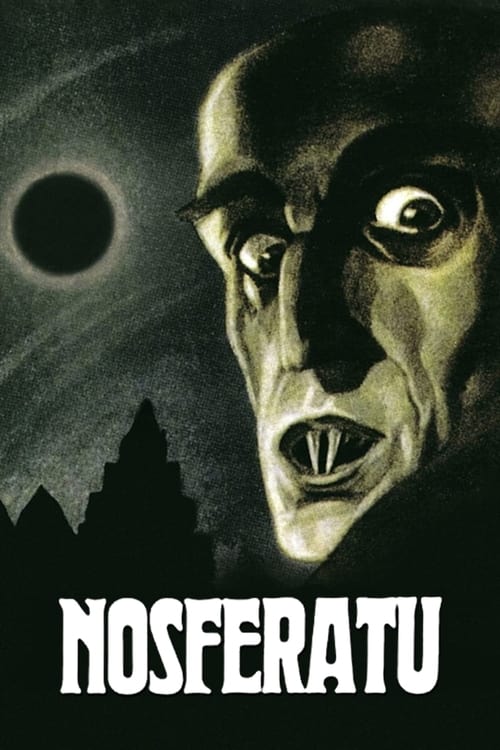
Nosferatu
1922 · F. W. Murnau
For a late night when you want atmosphere over jump scares — candles-lit, silent-film-curious, in the mood for something that feels like the original haunted artifact. More hypnotic than terrifying, and stranger than you expect.
What it's about
A young estate agent leaves his happy marriage to travel to a remote Carpathian castle and close a property deal with the reclusive Count Orlok — who turns out to be something ancient and hungry. When the Count sets sail for the agent's hometown, he brings plague and shadow with him, and his fixation settles on the young man's wife.
The experience
A century old and still genuinely creepy — a slow, dreamlike crawl of dread built from shadows, empty streets, and one of the most unnerving figures ever put on screen. It feels less like a story than a nightmare you're remembering.
Performances
Max Schreck's Count Orlok remains one of cinema's indelible creations: rat-fanged, stiff-fingered, rising like a plank from his coffin — a vampire played as vermin and pestilence rather than seduction, and never really bettered.
The craft
Murnau shot on real locations — actual castles, mountains, and sea — and fused them with expressionist shadow-play, so the horror feels rooted in the physical world. The famous images (a shadow climbing a staircase, a ghost ship gliding into harbor) still compose half the visual vocabulary of vampire cinema; see it with a good live or restored score if you can.
Why it matters
An unauthorized adaptation of Dracula that a court ordered destroyed, it survived in bootleg prints to become the foundation of the vampire film and a cornerstone of German Expressionism, echoing through a hundred years of horror.
Snapshot
Nosferatu, eine Symphonie des Grauens ("A Symphony of Horror") is the foundational vampire film and one of the supreme achievements of German Expressionist cinema. Directed by F. W. Murnau for the small Berlin firm Prana-Film, it is an unauthorized adaptation of Bram Stoker's Dracula (1897), its names and details changed in a thin and legally insufficient attempt to evade copyright. The bones of the story are Stoker's: an estate agent, here called Thomas Hutter, travels to a remote Carpathian castle to conclude a property sale with the reclusive Count Orlok, only to discover that his host is a plague-bearing undead creature who follows him home by sea to the fictional German town of Wisborg, fixing his desire on Hutter's wife, Ellen. What distinguishes the film from the century of vampire pictures it spawned is its conception of the monster: Max Schreck's Orlok is not a seductive aristocrat but a rat-like, spectral revenant — bald, taloned, hollow-eyed, an embodiment of pestilence rather than eros. The film is celebrated for its use of real exterior locations, its eerie performance style, and a handful of images — the shadow climbing the staircase, the Count rising rigidly from his coffin — that have become permanent furniture in the visual vocabulary of horror.
Industry & production
Prana-Film was founded in 1921 by Enrico Dieckmann and the artist and occultist Albin Grau, the latter of whom served as producer and production designer and was the film's true creative instigator; Nosferatu was the company's first and, owing to the catastrophe that followed, only completed feature. Grau reportedly conceived the project out of his interest in the supernatural, and his designs — costumes, Orlok's makeup concept, the cryptic occult lettering of the contract Hutter signs — shaped the film's distinctive look. The production operated on modest means relative to the prestige output of UFA, the dominant German studio of the era, and this economy partly explains the film's reliance on authentic locations rather than expensive studio construction.
The decisive fact of the film's industrial history is legal. Prana-Film had not secured the rights to Dracula, and the changes made to the source were cosmetic. Bram Stoker's widow, Florence Stoker, acting through the British Incorporated Society of Authors, sued for copyright infringement. Prana-Film, financially overextended and effectively bankrupt, offered little resistance, and the courts ruled against the production. A judgment ordered that all prints and negatives of Nosferatu be destroyed. That the film survives at all is the result of copies having already circulated internationally beyond the reach of the German court's order; surviving prints were reassembled over subsequent decades, and the film exists today only through this patchwork of dispersed copies, with intertitle wording, tinting, and even some footage varying between restorations. The most authoritative modern restorations have worked to reconstruct the original German intertitles and the tinting scheme. This survival-against-erasure is itself central to the film's mystique.
Technology
Nosferatu is a product of the silent, hand-cranked, orthochromatic era of filmmaking, and its aesthetic is bound up with the limits and affordances of that technology. Orthochromatic film stock was insensitive to red and highly sensitive to blue, which affected the rendering of skin tones and made certain makeup and lighting choices read differently on screen than to the eye — a factor in the ghastly pallor of the photography. As a silent film, it was designed for projection with live musical accompaniment and carried its narrative through performance, staging, and intertitles rather than synchronized dialogue.
The film is notable for its deployment of in-camera and editing-based special effects, most of them well established by 1922 but used here with unusual expressive purpose. Stop-motion and accelerated (under-cranked) photography animate Orlok's coach as it speeds through the forest and make his loading of coffins appear unnaturally swift and jerky. A celebrated shot of the Count's coach approaching the castle is presented in negative, so that the forest reads as a ghostly white-on-black landscape, marking Hutter's passage into a supernatural realm. The vampire's vanishing — Orlok dissolving in the light of dawn — is achieved through a simple dissolve/superimposition, one of the first times a film visualized a vampire's destruction by sunlight, a convention the film effectively invented (Stoker's novel does not kill Dracula this way). These effects, technically modest, are integrated into the storytelling rather than offered as spectacle.
Technique
Cinematography
The cinematography is credited to Fritz Arno Wagner, one of the major German cameramen of the period, with Grau's production design as an inseparable partner. The film's most consequential photographic decision is its commitment to location shooting. Where canonical Expressionist works like The Cabinet of Dr. Caligari (1920) built their unease entirely from painted, distorted studio sets, Nosferatu mixes studio interiors with extensive real exteriors — Carpathian and German landscapes, mountains, the Baltic coast, and actual historic architecture (locations in northern Germany and in the Slovak Carpathians have been identified by scholars). The effect is a kind of haunted realism: the supernatural is made to intrude upon recognizable, sunlit nature, which is arguably more disquieting than the hermetic dream-world of Caligari. The film is also famous for its expressive use of shadow — most indelibly the shot of Orlok's shadow ascending the staircase and, in the climactic scene, his clawed shadow-hand creeping across Ellen's body and seeming to clutch her heart, an image that renders the vampire's violation as pure silhouette.
Editing
The editing constructs a geography of dread through cross-cutting, a technique the film handles with sophistication. In the climactic stretch, Murnau intercuts between Orlok approaching across the street, Hutter, and the scholar-figure Bulwer, building simultaneity and inevitability. Earlier, the film cuts between the plague-ship Empusa bearing Orlok across the sea and the unsuspecting town awaiting it, and between Hutter trapped in the castle and Ellen, stricken with premonition, far away — a montage that binds the lovers and the monster across vast distance and insists on a sympathetic, almost telepathic connection between Ellen and the creature she will ultimately destroy. The pacing favors accumulation and dread over shock.
Mise-en-scène / staging
Albin Grau's design governs the film's visual world. Orlok's castle, the Gothic interiors, the eerie occult symbols on the contract, and above all the conception of the vampire's body are Grau's. The staging repeatedly exploits framing — Orlok glimpsed through doorways and arches, his rigid verticality contrasted with the rounded domestic spaces of Wisborg. The famous shot of the Count rising stiff and straight from his coffin on the ship, his body pivoting up as a single board, is a piece of pure graphic staging. The motif of the threshold — windows, doorways, ship's holds, the frame of the bedroom — runs throughout, with the vampire repeatedly figured as a force crossing boundaries he should not cross. Architecture and body rhyme: Orlok's pointed form echoes the Gothic arches he inhabits.
Sound
As a silent film, Nosferatu had no recorded soundtrack; it was accompanied in exhibition by live music. An original orchestral score was composed by Hans Erdmann for the premiere, though for much of the film's history this score was lost to general circulation and the film was screened with a wide variety of improvised or substitute accompaniments. Erdmann's score has been reconstructed in the modern restoration era, and the film has also attracted numerous alternative scores over the decades. The absence of a fixed soundtrack means that the experience of Nosferatu has always been musically unstable, varying enormously by presentation.
Performance
The performances range from the naturalistic to the frankly stylized. Max Schreck's Count Orlok is the film's centerpiece and one of the most influential performances in horror history: a creature of arrested, insectile movement, fixed stare, and grasping hands, achieving its terror through stillness and unnatural rhythm rather than histrionics. (Schreck's near-total absorption into the role later inspired the conceit, dramatized in the 2000 film Shadow of the Vampire, that he was himself a real vampire — a fiction with no basis in fact.) Greta Schröder plays Ellen as the film's moral and emotional center, her premonitory anguish and final act of sacrifice carrying the narrative's resolution. Gustav von Wangenheim's Hutter is comparatively broad and boyish, and Alexander Granach's Knock — the Renfield analog — is pitched toward grotesque caricature. The unevenness of register is itself characteristic of the period.
Narrative & dramatic mode
The film's dramatic mode is that of the supernatural folk tale or legend rather than psychological realism, framed explicitly as a "chronicle" of the plague that came to Wisborg. Its structure is a journey-and-return: an innocent ventures into a far country, encounters horror, and brings it home, where it must be confronted and expelled. The most significant departure from Stoker is the film's resolution. There is no Van Helsing-led band of hunters dispatching the vampire; instead, Ellen learns from an old book that a woman pure of heart can destroy the vampire by holding him at her side until cockcrow. She willingly offers herself, keeping Orlok at her bedside through the night until the rising sun destroys him — dying herself in the act. This makes the film's climax an act of feminine self-sacrifice rather than masculine combat, and it introduces the sunlight-kills-the-vampire convention that the source novel lacks. The dramatic logic is one of contagion and purification: the vampire is fused with plague (he travels with rats and pestilence), and his defeat is figured as the cleansing of an infected community.
Genre & cycle
Nosferatu is the originating text of the vampire film as a sustained genre and a cornerstone of the German horror/fantastic cycle of the early 1920s. It belongs alongside the other major works of the German "fantastic cinema" — Caligari, Murnau's own lost Der Januskopf (a Jekyll and Hyde adaptation), Wegener's The Golem (1920), Wiene's and Leni's later entries — that established the horror film's iconography. Within the vampire cycle specifically, Nosferatu establishes the template that the Universal Dracula (1931) and its descendants would both draw on and depart from, and its rodent-like, plague-associated monster offered an alternative lineage to the suave Lugosi-style aristocrat — a lineage later revived directly by Werner Herzog and others. It is simultaneously a horror film and a part of the broader Weimar art cinema, never wholly separable from the prestige currents of its national industry.
Authorship & method
The film is the product of a tight authorial triangle. F. W. Murnau, the director, was already emerging as one of Germany's most gifted filmmakers and would go on to The Last Laugh (1924), Faust (1926), and the American masterpiece Sunrise (1927); his contribution to Nosferatu is its compositional rigor, its integration of landscape, and its command of the moving and cutting image. Henrik Galeen, a key Expressionist screenwriter (co-writer of The Golem), wrote the screenplay, performing the adaptation of Stoker and the changes of name and setting. Albin Grau, producer and designer, was the project's originator and the author of its visual and occult conception. Fritz Arno Wagner photographed it, and Hans Erdmann composed the original score. Murnau's method here favored real locations and a carefully orchestrated relationship between human figures and natural or architectural space — an approach that distinguishes him from the more theatrically studio-bound of his contemporaries. Authorship of Nosferatu is genuinely shared; to credit Murnau alone is to understate Grau's and Galeen's roles.
Movement / national cinema
Nosferatu is a central work of Weimar-era German cinema and is conventionally classed within German Expressionism, though its relationship to that movement is complicated and worth stating precisely. Pure Expressionism, as exemplified by Caligari, externalized psychological states through stylized, anti-realist design. Nosferatu's landscapes are real, and its horror derives much of its force from the irruption of the uncanny into an actual, recognizable world — a strategy closer to Romanticism and to what would later be theorized as the uncanny than to doctrinaire Expressionism. It is thus often described as Expressionist in spirit and lighting but Romantic-naturalist in setting. The film belongs to the extraordinary flowering of German cinema in the early-to-mid 1920s that made the country, for a period, the most aesthetically advanced film culture in the world.
Era / period
The film was made in the early years of the Weimar Republic, in a Germany marked by the trauma of the First World War, defeat, and the onset of catastrophic inflation. Critics, following Siegfried Kracauer's influential (and much-debated) study From Caligari to Hitler, have read the Weimar horror cycle as expressing collective anxieties of a destabilized society, and Nosferatu's vision of an alien force bringing plague and death to a German town has been interpreted in light of recent mass death — the war and the 1918 influenza pandemic. Such readings should be held with appropriate caution as interpretation rather than documented authorial intent, but the film unmistakably belongs to, and registers the mood of, a society reckoning with mortality on a mass scale.
Themes
The film's governing theme is contagion: Orlok is inseparable from plague, traveling with a retinue of rats, leaving death in his wake, his vampirism figured less as seduction than as epidemic. Bound up with this is the theme of the threshold and the foreign intrusion — the monster crosses borders (national, domestic, bodily) that should hold him out. Desire and death are fused, but in a register of dread rather than romance; Orlok's fixation on Ellen is predatory and pestilential. The resolution foregrounds sacrifice and feminine agency: it is Ellen's knowledge and self-offering, not male violence, that destroys the vampire, making purity and willing sacrifice the film's redemptive values. Light and darkness operate as a literal moral and physical economy, culminating in sunlight as the agent of salvation. Underlying all of this is the Romantic theme of nature haunted — the natural world rendered uncanny, beautiful, and menacing at once.
Reception, canon & influence
Contemporary reception is partially obscured by the legal catastrophe that nearly erased the film; the lawsuit and destruction order dominated its early public existence, and for years it survived semi-clandestinely. Over the twentieth century, however, Nosferatu was rehabilitated into the highest rank of the silent canon and is now near-universally regarded as a masterpiece and the foundational vampire film.
Looking backward, the film's influences are clear: Bram Stoker's Dracula as its narrative source; the German Romantic and Gothic tradition in literature and painting; the contemporaneous Expressionist cinema (especially Caligari) in its lighting and shadow-play; and Albin Grau's occult interests in its symbolism. Looking forward, its influence is incalculable. It established the vampire's vulnerability to sunlight, a convention absent from the novel and now ubiquitous. Its physical conception of the monster — bald, clawed, rodent-like, pestilential — became a permanent alternative to the aristocratic vampire, directly revived in Werner Herzog's reverent remake Nosferatu the Vampyre (1979) with Klaus Kinski, dramatized in Shadow of the Vampire (2000), and echoed across decades of horror imagery (the Salem's Lot television vampire, Buffy's Master, and many others bear Orlok's stamp), as well as in the 2024 Robert Eggers remake. The staircase-shadow shot and the rising-from-the-coffin image are among the most quoted in all of cinema. Beyond the vampire genre, Nosferatu helped establish the grammar of the horror film as such — the expressive use of shadow, the slow accumulation of dread, the monster as the carrier of a society's fears — and Murnau's command of landscape and image fed forward into his own later work and into world cinema broadly. Few films of any era have been so thoroughly imitated, and fewer still have so nearly been destroyed and yet survived to define a genre.
A Deleuzian reading
Watch the hand.
The full Deleuzian reading of Nosferatu →
Reception
Bram Stoker's widow sued over this unauthorised Dracula adaptation and a court ordered every print destroyed — the film survived only through bootleg copies, going from legally condemned contraband to arguably the most revered horror film of the silent era.
How Nosferatu was received, from release to now →
Influences: the films it descends from and the films it influenced
- The Cabinet of Dr. Caligari (1920) — Established the chiaroscuro and painted-shadow grammar of Expressionist cinema that Murnau translated off the studio flats and onto real architecture and landscape.
- The Golem: How He Came into the World (1920) — Shares screenwriter Henrik Galeen and its method of framing the looming monster against vaulting, distorted architecture so the building rhymes with the body.
- The Student of Prague (1913) — Galeen's early occult-doppelgänger collaboration that pioneered the in-camera trick effects and supernatural-double staging Nosferatu later refined.
- Destiny (Der müde Tod) (1921) — Personifies Death as a gaunt figure crossing thresholds and gateways, modeling the threshold-motif staging and figure-in-landscape compositions Murnau adopts.
- Faust (1926) — Murnau's own later film deploys the giant plague-bringer looming over a town via in-camera superimposition, extending Nosferatu's contagion-as-shadow imagery.
- Vampyr (1932) — Constructs vampire dread from detached, autonomous shadows and ambient menace rather than spectacle, inheriting Nosferatu's slow accumulation of unease.
- Dracula (1931) — Codifies into a Hollywood genre the vampire film that Nosferatu founded, adapting the same Stoker source under license Murnau lacked.
- Cat People (1942) — Lewton-unit horror that keeps the monster offscreen and conjures terror through shadow and suggestion, extending Nosferatu's economy of dread.
- The Night of the Hunter (1955) — Transplants expressionist menacing silhouette and looming-shadow staging into an American sound film, a direct stylistic descendant of Wagner's photography.
- Nosferatu the Vampyre (1979) — Reverent near-shot-for-shot homage reviving Orlok's bald, clawed, rodent visage and pairing it with Herzog's landscape-mysticism and Kinski's stylized stillness.
- Bram Stoker's Dracula (1992) — Explicitly quotes Orlok's independently-moving cast shadow and rat-like clawed hands as direct visual citations of Murnau's imagery.
- Shadow of the Vampire (2000) — Dramatizes the production itself, meticulously replicating Max Schreck's makeup, stylized stillness, and the in-camera look of the original.
- Nosferatu (2024) — Remake that recovers the orthochromatic monochrome palette, candlelit expressionist shadow, and plague-rat contagion imagery of Murnau's original.
- Resurrection (2025) — Its vampiric monster carved out of chiaroscuro and cast-shadow effects gives Bi the silent-horror grammar — intertitles, stark key light — for the film's monster chapter.
- Sunrise: A Song of Two Humans (1927) — Murnau's systematic use of actual natural exteriors — the Wismar mudflats, the plague ship — timed and framed to feel mythic without painted-set artifice established the atmospheric-shadow grammar in natural locations that Sunrise's swamp sequences extend.
- M (1931) — M's director of photography Fritz Arno Wagner shot Nosferatu; the constricting deep-shadow compositions and use of architectural darkness as spatial enclosure in M's garret and warehouse sequences are a direct transposition of the visual grammar Wagner developed here, applied now to pursuit and entrapment in contemporary Berlin rather than Gothic Transylvania.
- The Last Laugh (1924) — Develops Murnau's 'unchained camera' and his treatment of architecture as an extension and oppressor of the human figure.
- Sunrise (1927) — Carries forward Murnau's integration of location landscape and the careful orchestration of human figures against natural space.
- Warning Shadows (1923) — Builds its entire narrative engine from cast shadow and silhouette-play, the same expressionist-shadow device Nosferatu made iconic on the staircase.
- Häxan (1922) — Shares the Weimar appetite for occult symbolism and plague-and-superstition imagery that Albin Grau's esoteric design brought to Nosferatu.
- Dr. Mabuse, the Gambler (1922) — Cinematographer Carl Hoffmann shot both films in the same year using the same orthochromatic stock technique — the blue-white makeup, absolute shadow, and sculptural facial contrast he develops across both productions establish a visual idiom in which moral corruption registers as physical texture.
- The Phantom Carriage (1921) — Extends the proto-horror grammar of the supernatural rendered through in-camera manipulation (negative exposure, undercranking) integrated with naturalistic location shooting.
- Die Nibelungen: Siegfried (1924) — Contemporaneous Weimar deployment of sculptural chiaroscuro and uncanny environment, sharing the movement's conviction that lighting and setting carry dread as much as performance.
Similar films
- Nosferatu the Vampyre (1979) — influence & lineage
- Nosferatu (2024) — influence & lineage
- Vampyr (1932) — influence & lineage
- Faust (1926) — influence & lineage
- Bram Stoker's Dracula (1992) — influence & lineage
- The Cabinet of Dr. Caligari (1920) — influence & lineage
- The Last Laugh (1924) — influence & lineage
- Häxan (1922) — influence & lineage
All the films related to Nosferatu →
Film essays and courses that include it
- Shadow, Psyche, Flesh: The Formal Breakthroughs of Horror Cinema
- Painted Shadows: German Expressionism and the Grammar of Dread
- The Undying Shadow: A Century of Vampire Cinema
- The Grammar of Dread: Twelve Films That Built Cinema's Language of Unease
- Devil at the Crossroads: The Gothic Roots of Vampire-Blues Cinema
- The Shadow That Outlived the Light
- The Time Traveler