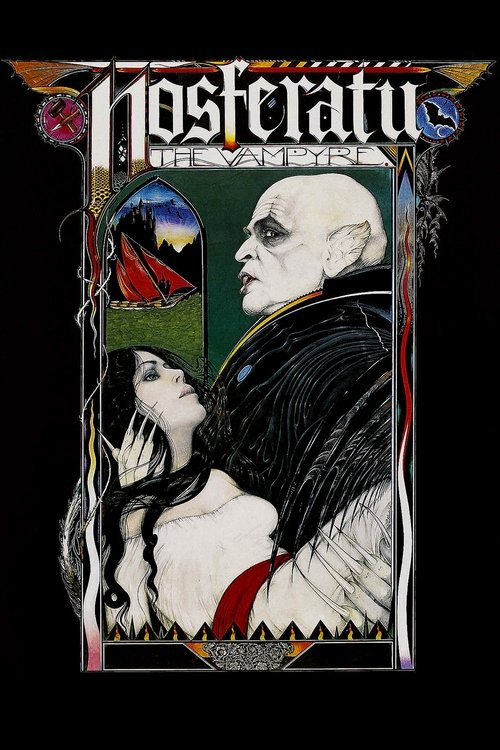
Nosferatu the Vampyre
1979 · Werner Herzog
For when you want horror as atmosphere — a slow, gorgeous, melancholy film for a late night when dread sounds more appealing than shocks. Definitely a challenge pick, not comfort food.
What it's about
A real estate agent leaves his young wife in a quiet German harbor town and travels deep into Transylvania to close a property deal with a reclusive count. What he finds in the castle is an ancient, grieving creature — and when the count sets sail for the agent's hometown, he brings plague, rats, and an old darkness with him. It's the Dracula story told as a slow tide of doom rolling toward an unsuspecting town.
The experience
Hypnotic and mournful rather than jumpy — the horror here is a mood that settles over you like fog. It moves at the pace of a funeral procession and somehow that's the point; scenes of the town coming undone are as beautiful as they are chilling.
Performances
Klaus Kinski plays the vampire not as a monster but as a creature in agony — hollow-eyed, whispering, sick with loneliness — one of the saddest portraits of immortality ever filmed. Isabelle Adjani matches him with a pale, sleepwalking intensity as the wife who understands the danger before anyone else.
The craft
Werner Herzog shoots landscapes — mountain passes, gray seas, canals filling with rats — like Romantic paintings come to life, and the droning, chanting score keeps the whole film suspended in a trance. It rewards patience and a dark room; the images are the event.
Why it matters
Herzog made it as a deliberate handshake across fifty years of German film history, reclaiming the silent classic it honors, and it stands as one of the great examples of a remake becoming its own masterpiece.
Snapshot
Werner Herzog's Nosferatu the Vampyre (Nosferatu: Phantom der Nacht in its simultaneous German-language version) is the most rigorous act of cinematic homage in the New German Cinema canon — a filmmaker reaching back across fifty years to claim a lineage the Nazi period had severed. Shot in 1978 and released in 1979, it follows F.W. Murnau's 1922 Nosferatu: Eine Symphonie des Grauens closely in structure while restoring the names Murnau had altered to evade Bram Stoker's copyright: Jonathan Harker, Lucy, Van Helsing, Count Dracula. The result is neither pastiche nor update but something rarer — an act of cultural mourning that transforms a horror film into an elegy for European Romanticism. Klaus Kinski's Dracula, bald and hollow-eyed, does not menace so much as suffer; his immortality is a curse, and the film's deepest horror is not death but the impossibility of dying.
Industry & production
The film was produced by Werner Herzog Filmproduktion in co-production with the French company Gaumont, with international distribution handled by 20th Century Fox — an unusual alignment of New German Cinema independence with mainstream studio reach. The French co-production element reflects Gaumont's active investment in European art cinema during this period, and it helped secure Isabelle Adjani, then at the height of her prestige following The Story of Adèle H. (1975), in the role of Lucy Harker.
Herzog shot in multiple countries simultaneously managing two complete language versions — German and English — with the same principal cast delivering dialogue in both languages on alternating takes. This was logistically demanding and relatively uncommon; it was driven by a desire to reach international markets without dubbing, and by Herzog's insistence that the film exist in a form native to each audience. The German-language version (Phantom der Nacht) is generally considered the primary cut and runs slightly differently in rhythm from the English.
Principal photography took place at Oravský Castle (Oravský hrad) in what was then Czechoslovakia (present-day Slovakia), which stood in for Castle Dracula's Transylvanian exterior, and in several towns in the Netherlands — most notably Schiedam and Delft — which served as the plague-ridden port city of Wismar. The choice of Dutch locations was deliberate: Herzog wanted the canal architecture and gabled facades of a real medieval mercantile city, and the Netherlands provided an authenticity that any studio reconstruction would have lacked.
Technology
Nosferatu the Vampyre was shot on 35mm color film, the standard gauge for major productions of the period. Herzog and cinematographer Jörg Schmidt-Reitwein worked throughout in available or near-available light where possible, supplementing with minimal artificial sources to preserve the natural quality of the image. The color palette across the film was carefully managed: Transylvania is rendered in deep, oversaturated earth tones and shadow-heavy interiors, while Wismar, as the plague advances, bleaches toward gray-green pallor. This tonal arc was achieved in part through practical location choices and in part through controlled exposure. No significant special optical effects were used; the production relied on location, costume, makeup, and staging rather than photochemical manipulation.
The famous sequence deploying thousands of rats — the estimate of around ten thousand is cited in production accounts, though precise figures vary by source — required extensive coordination with animal handlers and was shot in the streets and squares of Schiedam under controlled conditions. The rats were reportedly sourced through suppliers; the logistics of their management on location constitute one of the more unusual production challenges of the film.
Technique
Cinematography
Jörg Schmidt-Reitwein, Herzog's closest and longest-serving cinematographer across the 1970s, applies here a photographic philosophy consistent with their earlier collaborations: the camera is largely still or moves with glacial deliberation, and compositions lean toward the emblematic rather than the dynamic. Wide establishing shots of the Transylvanian landscape — mountain passes under low cloud, the castle silhouetted against pale sky — operate as landscape painting rather than narrative information, invoking the tradition of Caspar David Friedrich. Interior shots are often lit from a single source, with deep pools of darkness occupying half the frame. Rack focus is used sparingly; the depth of field tends toward the shallow, which isolates Kinski's made-up face from its environment and intensifies its strangeness.
The opening sequence, presenting real mummified corpses from a Mexican crypt over Popol Vuh's score, establishes the film's fundamental register before a single narrative image appears: this is cinema that looks at death directly, without the mediation of genre convention.
Editing
Beate Mainka-Jellinghaus, who edited the majority of Herzog's major works during the 1970s including Aguirre, the Wrath of God and The Enigma of Kaspar Hauser, cut Nosferatu with a rhythm that refuses conventional horror pacing. There are no shock cuts. Scenes run to their natural conclusion and sometimes past it; the edit favors duration over efficiency. The effect is somnambulistic — the film proceeds at something approaching the pace of a bad dream, and the horror accumulates through atmosphere rather than montage. The decision not to cut away from discomfort is central to the film's meaning: one must sit with Dracula's longing, and with Lucy's dying, without narrative relief.
Mise-en-scène / staging
Herzog stages for stillness and weight. Kinski's Dracula frequently occupies the edge or background of the frame, allowing him to register as a presence that the composition barely contains. The arrival of Dracula's ship in Wismar harbor — the vessel crewed only by plague-dead, rats swarming the dock — is staged as public event and private catastrophe simultaneously, the townspeople gathering as if the horror were a civic ceremony. The plague sequences in Wismar's main square, where survivors drag tables into the open air to eat and dance because the houses have become uninhabitable, were shot with real extras in the narrow Dutch streets and carry an ethnographic weight; they recall the tableaux of Bosch and Bruegel without directly quoting them.
Kinski's makeup — bald head, elongated ears and fingers, pallid skin, the rat-like incisors of Max Schreck's original — was designed to honor and extend Murnau's visual conception. The degree to which Kinski's performance animates or transcends the makeup is one of the film's persistent critical questions; the physical grotesquerie is inseparable from the pathos.
Sound
Popol Vuh, the Munich-based ensemble founded by Florian Fricke, provided the principal score. Their music is characteristically Eastern-influenced, drone-heavy, spiritual in register — synthesizer and treated acoustic instruments creating textures that resist identification with any historical period. The score does not underscore horror in the conventional sense; it meditates. Herzog also drew on existing music: passages from Wagner, and from Gounod's Faust, are incorporated at points where the film's engagement with German Romanticism moves closest to the surface. The diegetic soundscape — wind across the Transylvanian passes, the creak of the ship, the sound of rats in the streets — was designed with the care usually reserved for narrative dialogue; silence and ambient noise carry as much dramatic weight as the score.
Performance
Kinski's Dracula stands apart from nearly every other performance in the vampire genre by virtue of what it refuses. He does not seduce, does not charm, does not project power in the conventional sense of the word. His Dracula is ancient and exhausted, moving with a stiff, arthritic deliberateness that reads as the accumulated weight of centuries. The longing he expresses toward Lucy is conveyed through the quality of his attention more than any overt action. Bruno Ganz's Jonathan Harker charts the opposite trajectory — a man of rationalist confidence who returns home emptied and transfigured, the film's final image presenting him not as rescued but as converted, riding out across the flat Dutch landscape with Dracula's black cloak and something of Dracula's purpose. Isabelle Adjani carries the film's moral center; her Lucy is not a passive victim but the only character who correctly reads what is happening and chooses self-sacrifice as the sole available counter to it.
Roland Topor, the artist and novelist, plays Renfield with a grotesque vivacity that belongs to a different register than the rest of the film — more expressionist, more conventionally theatrical — and the dissonance may be intentional.
Narrative & dramatic mode
The film follows Stoker's broad architecture — Harker travels to Transylvania, is held by Dracula, who then emigrates to Wismar by sea, bringing plague; Lucy sacrifices herself to keep Dracula until dawn — but strips the plot of its investigative and procedural dimension. Van Helsing (Walter Ladengast) is present but ineffectual; the rational Victorian machinery that Stoker and the Hammer tradition placed at the narrative's center is here reduced to impotence. The dramatic mode is closer to myth or legend than to suspense: the outcome feels fated from the opening frames, and the film's interest lies not in whether Dracula will be stopped but in what his passage reveals about death, desire, and the limits of European modernity. The ending, in which Jonathan rides out presumably to spread what he has received, forecloses the possibility of resolution and aligns the film with tragedy rather than horror in the generic sense.
Genre & cycle
Nosferatu the Vampyre belongs simultaneously to the horror genre and to the European art-cinema tradition, and its critical history reflects the tension between these two contexts. Within the horror cycle, it arrived at a moment when the genre was being pulled in opposite directions — American slasher films and Italian giallo on one side, European gothic revivals on the other. Herzog's film is allied with none of these but engages seriously with the founding mythology. It participates in the late-1970s European reassessment of German Expressionist cinema that included scholarly reappraisals of Murnau, Lang, and Pabst, and it can be read alongside Wim Wenders's concurrent meditations on German cultural identity. It is not a sequel, a parody, or an adaptation in the commercial sense but a work of active cinematic criticism made in film form.
Authorship & method
Herzog's authorial signature — landscape as psychological projection, the protagonist as visionary or cursed figure, the documentation of extremity — is fully present. His decision to remake Murnau was not nostalgic but polemical: he has stated in interviews that Nosferatu (1922) represents the high point of German cinema, and that the Nazi period effectively poisoned the German Romantic tradition from which it drew. The remake was an attempt to reactivate that tradition by passing it through a contemporary consciousness.
Jörg Schmidt-Reitwein's cinematographic partnership with Herzog across this period produced a visual language that prioritized duration, landscape, and the uncanny over conventional dramatic photography. Beate Mainka-Jellinghaus's editing extended this through her characteristic resistance to acceleration. Florian Fricke's music, across multiple Herzog films, constitutes something close to a consistent sonic signature for the director's work of this decade — meditative, non-Western in orientation, indifferent to genre expectation.
Movement / national cinema
The film sits within the New German Cinema (Neuer Deutscher Film), the loosely affiliated movement of West German filmmakers — Herzog, Fassbinder, Wenders, Schlöndorff, von Trotta — who emerged in the 1960s and dominated European art cinema through the 1970s. The movement was characterized by auteurist ambition, engagement with German historical guilt, state subsidy through the Kuratorium junger deutscher Film and regional broadcasters, and a simultaneous engagement with and critique of Hollywood genre forms. Nosferatu is singular within the movement in its direct reclamation of silent German cinema as an ancestor; most New German Cinema was more explicitly engaged with the Nazi period or with contemporary social realities.
Era / period
The film was made in the immediate aftermath of the German Autumn of 1977 — the wave of RAF terrorism, the Mogadishu hijacking, the deaths of Baader, Ensslin, and Raspe — which had produced an atmosphere of national crisis and soul-searching. Herzog's turn toward a mythological register, rather than the social realism or explicit political engagement that characterized much of Fassbinder's contemporaneous work, reflects his consistent preference for the metaphysical over the documentary. Whether Nosferatu's plague imagery or its ending — civilization unable to stop what has been unleashed — resonates with that political context is a critical question the film itself leaves open.
Themes
Death as the condition that gives life meaning, and immortality as a horror rather than a gift, constitute the film's central opposition. Dracula does not want victims; he wants to die, and cannot. The film's sympathy lies with him, a move that fundamentally revises the moral architecture of the vampire story. Connected to this is the theme of contagion — physical, spiritual, civilizational — and the failure of rational institutions (medicine, law, the church) to address what they cannot categorize. The film is also, persistently, about landscape and the relationship between northern European consciousness and the natural world: the Transylvanian mountains are not exotic backdrop but an extension of a psychic state, and the flat Dutch polders of Wismar read as a civilization built on reclamation from the sea, provisional and fragile. The Romantic tradition Herzog is consciously invoking — Friedrich, Schopenhauer, the German idealists — haunts every composition.
Reception, canon & influence
Critical reception: The film was received positively by European critics as a serious art-cinema enterprise, and it performed respectably in international markets — though precise box-office figures for its various releases are not easily verified in the scholarly record. American critics were divided between those who valued the pace and atmosphere and those who found it inert; the genre audience expecting conventional horror was largely alienated. Over subsequent decades the film has been elevated to canonical status within both the vampire-film tradition and Herzog's body of work.
Influences on the film: Murnau's 1922 Nosferatu is the acknowledged primary source, and the debt is structural and iconographic. Beyond Murnau, Herzog drew on the German Romantic painting tradition — Friedrich's landscapes are the most direct pictorial antecedent — and on the literary Romanticism of Hoffmann and the early German gothic. Stoker's novel is present through the restored character names, but the novel's plot machinery is largely set aside. The influence of Dreyer's Vampyr (1932) in the film's oneiric texture and resistance to genre convention has been noted by critics, though Herzog has not foregrounded this connection.
Legacy: Nosferatu the Vampyre recalibrated the possibilities of the vampire film for a generation of filmmakers interested in moving the genre toward psychological interiority and away from spectacle. Jim Jarmusch's Only Lovers Left Alive (2013) is the most explicit descendant — its mournful, anachronistic vampires who suffer from immortality rather than celebrate it directly inherit Herzog's revision of the genre's moral logic. Tomas Alfredson's Let the Right One In (2008) shares the film's tonal desolation, though without direct citation. Herzog's approach to Murnau also established a template for thoughtful cinematic homage that treats the source film as a living cultural document rather than raw material for commercial exploitation. Within Herzog's own filmography, Nosferatu occupies a position analogous to Aguirre and Fitzcarraldo — a work in which the conditions of production, the extremity of performance, and the metaphysical ambition of the material fuse into something that exceeds its generic occasion.
A Deleuzian reading
The first thing is the face.
The full Deleuzian reading of Nosferatu the Vampyre →
Reception
In 1979 it drew respectful but divided notices — a Silver Bear at Berlin, yet plenty of critics called it a slow, sacrilegious retread of Murnau. Today it's canonized as one of the great vampire films and a peak of the Herzog–Kinski partnership, with the 2024 Eggers remake sending a fresh wave of viewers back to it.
How Nosferatu the Vampyre was received, from release to now →
Influences: the films it descends from and the films it influenced
- Nosferatu: Eine Symphonie des Grauens (1922) — Schmidt-Reitwein's chiaroscuro shadow-play directly quotes Albin Grau's expressionist lighting templates; Herzog reconstructs key compositions — the coffin-laden ship, the claw curling around the doorframe — as near-exact visual homages while restoring the character names Murnau had legally disguised.
- Faust (1926) — Murnau's pestilence sequences — charnel piles staged as Bosch tableaux, plague-clothed figures strewn across blighted squares — are the direct visual model for Herzog's rat-infested Wismar; both marshal medieval German pictorial iconography to frame supernatural contagion as historical catastrophe.
- Vampyr (1932) — Rudolph Maté's diffused available-light photography — achieved by shooting through gauze, producing an oneiric milky haze — and Dreyer's refusal to resolve horror scenes through conventional cutting directly inform Schmidt-Reitwein's low-light interiors and Mainka-Jellinghaus's duration-over-efficiency editing rhythm.
- The Seventh Seal (1957) — Bergman's staging of medieval plague as eschatological allegory — the Bosch-derived Death figure, the flagellant procession, the mass-death silhouette on the ridge — established the visual grammar of mythic-tragic European horror that Herzog deploys wholesale in Wismar, including the plague-as-collapse-of-rational-order thematic structure.
- Hour of the Wolf (1968) — Sven Nykvist's extreme single-source chiaroscuro interiors and Bergman's construction of a male protagonist consumed from within by demonic forces — horror framed as ontological torment rather than external predation — directly prefigures Herzog's conception of Dracula as sufferer rather than predator.
- Aguirre, the Wrath of God (1972) — The identical craft apparatus — Schmidt-Reitwein's landscape-as-destiny cinematography, Mainka-Jellinghaus's duration editing, Popol Vuh's drone score, Kinski's suffering megalomaniac performance — makes Nosferatu the Gothic variant of a formal system Herzog and his collaborators had already fully realized in Aguirre.
- Heart of Glass (1976) — Popol Vuh's electronic drone textures and Schmidt-Reitwein's Friedrich-esque Bavarian landscape photography both carry forward directly into Nosferatu; additionally, the hypnotized non-actors in Heart of Glass produce the same glassy, somnambulistic performance register that Kinski achieves through other means as Dracula.
- Shadow of the Vampire (2000) — Merhige literalizes what Herzog had implied — that the vampire's suffering is inseparable from the actor's — by treating Max Schreck as an actual vampire; the single-source low-key cinematography and somnambulistic duration pacing directly inherit Schmidt-Reitwein's and Mainka-Jellinghaus's formal vocabulary as conscious homage.
- Let the Right One In (2008) — Hoyte van Hoytema's available-light photography of Swedish winter — gray skies, snow-muted tones, darkness pressing against small lit zones — achieves the Caspar David Friedrich landscape quality Herzog sought; Alfredson's refusal of shock cuts and his duration-based editing rhythm continue Mainka-Jellinghaus's formal line into Scandinavian art cinema.
- Only Lovers Left Alive (2013) — Yorick Le Saux's available-light compositions and Jarmusch's duration editing with no shock cuts extend Herzog's formal vocabulary; most precisely, both films treat vampirism as the curse of immortality — not predatory menace — and commission non-generic music (Jozef van Wissem, SQÜRL) as score in the direct tradition of Popol Vuh.
- Thirst (2009) — Herzog's reframing of the vampire as a figure of theological desolation — the undead as condemned consciousness unable to die or be absolved — directly informs Thirst's conception of Sang-hyun as a priest whose vampirism is a specifically spiritual catastrophe rather than a predatory condition.
- Nosferatu (2024) — Restores the material's funereal Romantic gravity and plague-melancholy pacing — duration-over-shock and a death-haunted Ellen/Lucy whose surrender is willed, the emotional template Eggers extends.
- Interview with the Vampire (1994) — Reframes the vampire as an exhausted sufferer photographed in long, unhurried holds — the slow contemplative move on a mourning immortal, rather than the shock cut on a predator, is the shot Louis inherits.
- The Enigma of Kaspar Hauser (1974) — Mainka-Jellinghaus's duration-based editing rhythm — scenes extended well past narrative utility into enforced contemplation — is calibrated identically in both films; Schmidt-Reitwein's available-light photography serves the same alienating function, isolating an outsider figure from a social world incapable of accommodating him.
- Woyzeck (1979) — Shot the same year with the same cast and craft team, Woyzeck applies Büchner's fragmentary tragic structure through identical available-light staging and Mainka-Jellinghaus rhythm; Kinski's Woyzeck — a man destroyed by forces wholly indifferent to his suffering — is the mortal complement to his Dracula, completing a diptych of German Romantic suffering-figures.
- The Shining (1980) — Both films incorporate pre-existing Romantic and modernist orchestral music — Wagner and Gounod versus Bartók, Penderecki, and Berlioz — as horror score rather than commissioning genre-functional underscore, and both replace shock-cut montage with accumulative atmospheric duration as the primary mechanism of dread.
- Possession (1981) — Isabelle Adjani, who plays Lucy Harker in Nosferatu, immediately extended the mode of total physical self-surrender she had developed there; Bruno Nuytten's handheld low-light cinematography and Żuławski's duration-extended horror sequences continue the same horror–art-cinema hybrid register across a direct line of collaboration.
Similar films
- Vampyr (1932) — influence & lineage · often watched together
- Nosferatu (1922) — influence & lineage
- Heart of Glass (1976) — influence & lineage
- Hour of the Wolf (1968) — influence & lineage
- Woyzeck (1979) — influence & lineage
- Faust (1926) — influence & lineage
- Aguirre, the Wrath of God (1972) — influence & lineage
- Only Lovers Left Alive (2013) — influence & lineage
All the films related to Nosferatu the Vampyre →
Watch it with: curated runs of related films
- Haunted Castles and Restless Ghosts — A run of enchanted ruins, restless dead, and grief that won't stay buried — watch these when you want dread and reverie sharing the same frame.