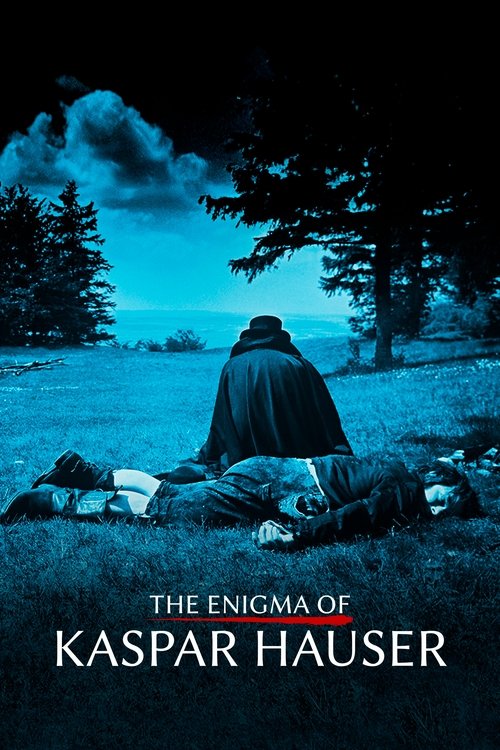
The Enigma of Kaspar Hauser
1974 · Werner Herzog
For when you want a film to chew on for days — something patient and genuinely unlike anything else, best met on a contemplative evening. This is a challenge in the gentlest sense: it asks you to slow down to its rhythm.
What it's about
In 1828, a young man appears in a Nuremberg square barely able to walk or speak, having spent his entire life chained in a cellar with no human contact. Taken in by the town, Kaspar Hauser learns language, music, and manners — and the film watches what happens when a mind formed entirely outside society meets the professors, priests, and aristocrats determined to explain him.
The experience
Slow, strange, and unexpectedly moving, with flashes of dry comedy as polite society keeps failing to comprehend its guest. It sneaks up on you — what starts as an odd historical curiosity ends up feeling like a quiet heartbreak about everything civilization can't answer.
Performances
Bruno S., a street musician with no acting training who had himself spent years in institutions, plays Kaspar with a rawness no professional could fake — every gesture and halting sentence feels lived rather than performed. It's one of the most singular screen presences ever filmed.
The craft
Herzog shoots the German countryside like a series of dream paintings and lets scenes breathe until they turn uncanny, punctuating the story with hazy visions that feel beamed in from another world. The stillness and the period detail give it the texture of a fable that actually happened.
Why it matters
A cornerstone of the New German Cinema and one of the films that made Herzog's reputation as cinema's great chronicler of outsiders and visionaries. Its casting of Bruno S. remains one of the most famous gambles in film history.
Snapshot
Released in West Germany under the title Jeder für sich und Gott gegen alle (Every Man for Himself and God Against All), Werner Herzog's fifth feature is an account of the historical Kaspar Hauser, who appeared in Nuremberg in May 1828 unable to walk properly or form speech, claiming to have lived his entire life in a windowless cellar. Herzog treats the case not as biography but as epistemological fable: the film asks what happens when a mind untouched by civilization confronts the rationalizing machinery of bourgeois society. Built around the extraordinary non-professional presence of Bruno S., it is among the definitive works of New German Cinema and a cornerstone of Herzog's career — an inquiry into perception, language, and the limits of what institutional reason can comprehend.
Industry & production
The film was produced through Herzog's own Werner Herzog Filmproduktion with support from the Zweites Deutsches Fernsehen (ZDF), the West German public broadcaster that co-financed a significant share of the New German Cinema's output during the 1970s. The television partnership gave Herzog a modest but workable budget and, crucially, creative autonomy; no specific production figures are on reliable public record, and any numbers circulating should be treated with caution. Principal photography took place in Bavaria, using period locations and natural landscapes that doubled credibly for early nineteenth-century Franconia. The production schedule was relatively compact, consistent with Herzog's preference for lean, expeditionary shoots. The film premiered at Cannes in 1975, where it won the Special Jury Prize (Prix du Jury) and the FIPRESCI Prize, bringing Herzog substantial international recognition and cementing New German Cinema's presence on the festival circuit.
Technology
The film was shot on 35 mm in the standard Academy ratio then customary for German theatrical productions. No unusual photochemical processes are documented, though Jörg Schmidt-Reitwein's lighting approach made extensive use of available and practical light, giving interiors a candlelit luminosity that reads as period-authentic without period artifice. The soundtrack draws entirely on pre-existing music — a deliberate choice that removed the need for a conventional scoring process and gave the film an anachronistic, dislocated musical texture. No evidence of process shooting or optical effects is on record; Herzog's approach was resolutely practical and location-based.
Technique
Cinematography
Schmidt-Reitwein, Herzog's principal cinematographer throughout the 1970s, photographs the Bavarian countryside with a patience that borders on contemplative. The film's opening — a long, near-hypnotic shot of grain swaying in wind before any human figure appears — establishes that the landscape itself is a cognitive proposition: nature as a system of signs Kaspar cannot yet read. Interior scenes are lit with deep shadows and warm practical sources that evoke Dutch Golden Age painting without literalizing the reference. The camera rarely hurries; it observes Kaspar with a steady, almost clinical gaze that mirrors the curiosity of the Nuremberg burghers while quietly implicating the viewer in the same act of scrutiny. When the film does move — in Kaspar's hallucinatory vision sequences — the camera loosens into something more liquid, the frame suddenly unstable in a way that registers the subjective rupture.
Editing
Beate Mainka-Jellinghaus, who edited many of Herzog's films from this period, maintains an unhurried, episodic rhythm that refuses the causal efficiency of classical narrative. Scenes end when they have exhausted their contemplative charge rather than when plot mechanics demand a cut. This creates a film that feels cumulative in the manner of a journal or case history: we accumulate impressions of Kaspar rather than following him through a conventional arc. The editing never attempts to smooth over the ontological strangeness of Bruno S.'s presence; the cuts preserve rather than resolve the uncanny quality of his performances.
Mise-en-scène / staging
Herzog stages Kaspar's encounters with civilization as a series of almost theatrical tableaux — the town square, the bourgeois parlor, the professor's study — environments that carry their social meaning through accumulated period detail. Kaspar is frequently placed at the edge of compositions, slightly outside the social geometries that organize everyone else in the frame. The effect is not expressionistic distortion but a calm spatial argument: the frame's conventions belong to a world Kaspar has not been socialized to inhabit. The film's most celebrated staged moment is Kaspar's narrated vision of the caravan of blind men being led into the mountains by a boy who will eventually also go blind — delivered by Bruno S. in direct address with the matter-of-fact gravity of a man reporting something he has seen, not imagined. Herzog does not illustrate the story; he trusts the speaking of it entirely.
Sound
The absence of an original score is the film's most distinctive sonic decision. Herzog uses pre-existing classical and early music — pieces by Pachelbel, Albinoni (including the Adagio in G minor, whose authorship is itself a scholarly controversy), and Renaissance polyphony — deployed with a placement that is often deliberately incongruous with dramatic context. The effect is of music arriving from another dimension of time, emphasizing Kaspar's displacement from the historical moment in which he finds himself. Ambient sound is recorded with Herzog's characteristic attention to environment: wind, livestock, crowds — the sensory texture of a world whose density Kaspar cannot yet process.
Performance
Bruno Schleinstein, known professionally as Bruno S., was a Berlin street performer and musician who had spent years in psychiatric institutions beginning in childhood. Herzog discovered him through a documentary short and cast him with the explicit understanding that his real history — his authentic experience of institutionalization, social exclusion, and late-acquired speech — would be the substrate of the performance. The result is categorically different from conventional acting: Bruno S. does not portray Kaspar Hauser's bewilderment; he inhabits a register of perception that has its own authority and strangeness. He cannot be assessed by the usual criteria. His physical awkwardness, the halting quality of his speech, the way he handles objects with concentrated unfamiliarity — these are not constructed effects but genuine characteristics that Herzog's direction refuses to normalize or exploit. The supporting cast of professional actors playing Nuremberg's burghers, doctors, and professors performs with a crisp social confidence that throws Bruno S.'s register into sharper relief: civilization as a performance style that Kaspar will never quite acquire.
Narrative & dramatic mode
The film proceeds episodically through Kaspar's emergence from captivity, his display to the townspeople, his absorption into bourgeois households, his tentative education, and finally his mysterious murder — the historical Hauser died of stab wounds in 1833, his assailant never identified. Herzog uses no voice-over, no explanatory titles after the opening intertitles establishing the historical case, and no psychologizing interiority. The narrative mode is observational and lateral: it accumulates episodes without organizing them into a developmental trajectory of mastery. Kaspar does not triumph over his origins. He learns to speak, play piano, and reason in partial, fragmentary ways, but the film makes clear that civilization's categories — its logical proofs, its social rituals, its confident explanations — are themselves a form of enclosure. The concluding scene, in which a clerk celebrates the discovery of Kaspar's autopsy findings as yielding "a satisfactory explanation," is among the most caustic ironies in 1970s world cinema.
Genre & cycle
The film occupies an unusual position at the intersection of the period drama, the case-study film, and the philosophical fable. It belongs loosely to a cycle of films from the late 1960s and early 1970s concerned with feral or isolated figures encountering civilization — François Truffaut's The Wild Child (1970) is the most direct predecessor, drawing on the roughly contemporary case of Victor of Aveyron. But where Truffaut treats the story through the frame of Enlightenment education and its partial successes, Herzog is more interested in what the encounter reveals about the civilization doing the educating. The film also participates in the New German Cinema's broader fascination with German historical and social identity, though it locates that inquiry in the early nineteenth century rather than the Nazi period.
Authorship & method
By 1974 Herzog had established a filmmaking practice built on what he would later formalize as the pursuit of "ecstatic truth" — a deeper, visionary truth that he distinguished from the "accountant's truth" of documentary fact. The Kaspar Hauser film is exemplary of this method: it is loosely based on historical record but freely departs from it, treating the historical case as raw material for a philosophical investigation rather than as a constraint. Herzog's casting strategy — his preference for non-professional actors with extreme personal histories, for physical presences that carry the weight of lived experience — reaches its most sustained expression here. Jörg Schmidt-Reitwein, who would go on to shoot Heart of Glass (1976) and Nosferatu the Vampyre (1979) with Herzog, shares the director's appetite for landscape as metaphysical proposition. The film's music selections, assembled by Herzog himself, reflect his autodidactic engagement with European classical and early music as a resource for emotional and temporal dislocation. Beate Mainka-Jellinghaus's editing embodies the structural patience that Herzog's observational approach requires.
Movement / national cinema
The film is a central document of New German Cinema, the loose movement of directors who emerged in the wake of the 1962 Oberhausen Manifesto, in which a group of young filmmakers declared the old German cinema dead and claimed the right to create a new one. Herzog, Wim Wenders, Rainer Werner Fassbinder, Volker Schlöndorff, and others defined a cinema that was formally adventurous, internationally oriented, and willing to address German history, identity, and social reality without the evasions of the earlier commercial industry. Herzog's contributions to the movement were distinctive in their refusal of urban realism or Brechtian strategy: his cinema reaches instead toward landscape, myth, and extremity, drawing as much on German Romanticism as on post-war reconstruction anxiety. The Kaspar Hauser film's Cannes reception in 1975 helped establish New German Cinema as a force on the international festival and art-house circuit, alongside the work Fassbinder was producing at similar speed and ambition.
Era / period
The film belongs to a specific moment in post-1968 European art cinema when the political confidence of the late 1960s was giving way to a more reflective, anthropological mode of inquiry. If 1968 filmmaking asked urgent questions about collective political action, the mid-1970s art film more frequently asked what human subjectivity itself consists of — how it is formed, by whom, to what ends. Kaspar Hauser is a limit-case for these questions, a figure in whom the ordinary conditions of socialization are held in suspense. Herzog's engagement with him participates in a broader intellectual climate shaped by Foucault's Discipline and Punish (1975), Lacan's seminars on language and the subject, and the ongoing academic debate about language acquisition and critical periods that Noam Chomsky's work had energized.
Themes
The film's primary theme is the constitutive relationship between language and consciousness: Kaspar arrives in Nuremberg without language and acquires it haltingly, and the film asks whether the self that emerges is liberated or further imprisoned by this acquisition. Civilization, in Herzog's account, is not a benign gift but a system of enclosure that replaces one kind of captivity — the literal cellar — with another, more diffuse one: the cellar of categorical thought. The film is equally a meditation on the nature of perception: Kaspar sees the world without the filters of habit, and several sequences render his alien phenomenology directly — his bafflement at the fact that a tree blocks his view of a distant building, his confusion about the conventions of logical proof. Institutional authority is systematically satirized: the doctors, professors, clergymen, and aristocrats who attempt to classify and educate Kaspar are shown as more imprisoned by their categories than Kaspar is by his ignorance. The mystery of individual origins — who Kaspar is, where he came from, who kept him — remains unresolved, as it did in history, and Herzog uses this irresolution thematically: some enigmas cannot be administered away.
Reception, canon & influence
Critical reception. The film was widely praised on its Cannes debut and in the subsequent international release. Critics recognized immediately that Bruno S.'s performance was without precedent and that Herzog had found a formal approach equal to the strangeness of his subject. The film established Herzog as one of the most significant directors of his generation in international critical discourse and remains one of his most consistently admired works, appearing regularly in critics' lists of the great films of the 1970s.
Influences on the film (backward). The direct historical source is the documented Kaspar Hauser case, extensively covered in the German press of the 1820s and 1830s and subject to a substantial literary and scholarly literature, including Anselm von Feuerbach's 1832 account. The broader intellectual lineage runs through Rousseau's thought-experiments about the state of nature, Enlightenment debates about feral children (particularly Jean Itard's reports on Victor of Aveyron), and the German Romantic tradition's fascination with the innocent outsider who illuminates society's contradictions. Truffaut's The Wild Child provided a direct cinematic precedent, though Herzog departs from Truffaut's qualified optimism about education. German Romanticism's legacy — Caspar David Friedrich's landscapes, the tradition of the Bildungsroman and its discontents — runs beneath the film's surface.
Legacy and influence (forward). The film consolidated a mode of working with non-professional actors carrying exceptional personal histories that Herzog would develop further in Stroszek (1977), which again starred Bruno S. and explored related questions about social exclusion and the violence of modernity. More broadly, the film contributed to a European art-cinema tradition of outsider-protagonist films that continued through the 1980s and 1990s. Herzog's concept of "ecstatic truth" — articulated in interviews and essays over subsequent decades — drew heavily on the Kaspar Hauser experience as a demonstration of what cinema could achieve when it pursued vision rather than documentation. The film's treatment of institutional rationality as a form of violence anticipates concerns that would become central to disability studies and critical psychiatry in later decades. Its influence on younger German filmmakers and on the international perception of what German cinema could be is difficult to overstate: along with the Fassbinder films of the same period, it defined what New German Cinema meant to audiences outside Germany.
A Deleuzian reading
Begin with the wheat.
The full Deleuzian reading of The Enigma of Kaspar Hauser →
Reception
A prizewinner from the start — it took the Grand Jury Prize at Cannes in 1975 — and unlike many Herzog films it never needed rescuing; it has simply settled in as one of the crown jewels of New German Cinema, with Bruno S.'s performance only growing in legend.
How The Enigma of Kaspar Hauser was received, from release to now →
Influences: the films it descends from and the films it influenced
- Pickpocket (1959) — Bresson's episodic diary structure — the outsider's social re-education parceled into sequenced institutional encounters without dramatic causation — is the formal template for Herzog's case-study narration tracking Kaspar's encounters with bourgeois society as discrete episodes rather than continuous arc.
- Au Hasard Balthazar (1966) — Bresson's practice of placing pre-existing Schubert against action without illustration — scoring by temporal and emotional contrast rather than commentary — is the precise model for Herzog's anachronistic deployment of Pachelbel, Albinoni, and Orlando di Lasso against 19th-century imagery.
- Mouchette (1967) — Bresson's discovery of Nadine Nortier — a non-actress whose physically unrehearsed presence carries social suffering without performing it, the body as bearer of meaning rather than instrument of expression — establishes the casting logic Herzog applies to exactly the same end with Bruno S.
- Chronicle of Anna Magdalena Bach (1968) — Straub-Huillet's static camera observing non-professional performers in front of period architecture in rigorously composed tableaux — lens as uninvolved ceremonial witness — establishes the distanced presentational mode that Schmidt-Reitwein employs for the film's institutional and courtroom set-pieces.
- The Wild Child (1970) — Truffaut's episodic case-study form — sequenced institutional encounters structured as a running documentation of the feral child Victor's socialization by Itard — gives Herzog the template he directly inverts by withdrawing Truffaut's qualified confidence that rational education can redeem the pre-social consciousness.
- Heart of Glass (1976) — Schmidt-Reitwein's second collaboration with Herzog extends the available-light landscape cinematography from Kaspar Hauser into pure metaphysical register — Bavarian terrain filmed as visionary hallucination — developing the formal strategy of treating landscape as philosophical argument rather than as period setting.
- Kings of the Road (1976) — Wenders builds a three-hour road film on the episodic long-take structure and anachronistic scoring approach consolidated in the Kaspar Hauser period, placing pre-existing rock recordings against German landscapes in sequences whose observational patience punctuated by music directly inherits that rhythm.
- Stroszek (1977) — Direct continuation of the Kaspar Hauser method: Bruno S. again plays a marginal outsider whose personal history of institutionalization the episodic case-study form contains, now tracing the failure of social assimilation in a contemporary rather than historical setting.
- Stranger than Paradise (1984) — Jarmusch formalizes the episodic tableau mode into a structural signature — one uninterrupted take per scene, then blackness — and places pre-existing Screamin' Jay Hawkins recordings anachronistically against deadpan outsider action, translating the episodic rhythm and disjunctive scoring of Kaspar Hauser into a minimalist American idiom.
- L'Humanité (1999) — Dumont holds extended long takes on non-professional Emmanuel Schotté's opaque physical presence without psychological explanation, treating the socially marginal body rather than the face as the site of meaning — adapting the Bressonian casting strategy Herzog consolidated with Bruno S. into a northern-French realist context.
- Elephant (2003) — Van Sant's sustained Steadicam shots following students from behind through institutional corridors — camera positioned as peripheral witness, never achieving frontal access to interiority — directly inherits Schmidt-Reitwein's peripheral-framing strategy for Kaspar's encounters with the institutions of bourgeois society.
- Beasts of the Southern Wild (2012) — Zeitlin films non-professional child Quvenzhané Wallis in available-light handheld long takes under a philosophical-fable episodic structure — camera observing rather than explaining, the child's consciousness framing social exclusion as cosmological rupture — the identical formal strategy Herzog established for Bruno S., applied to a child protagonist.
- Julien Donkey-Boy (1999) — Herzog's casting of the non-actor Bruno S. — a genuinely traumatized man playing difference rather than impersonating it — is the precedent for Julien's whole non-professional, lived-experience casting logic, made explicit by Herzog appearing as the father.
- I Dream in Another Language (2017) — Centers a linguistically non-normative outsider who is 'collected' and exhibited by curious society, dramatizing the extractive gaze that studies a strange mind — the outsider-collector-ethics motif.
- The Spirit of the Beehive (1973) — Erice and cinematographer Luis Cuadrado film non-professional child Ana Torrent in available light with peripheral positioning — camera at the child's side or behind, never confronting her eyeline — treating opacity of interiority as meaning rather than obstacle, the identical strategy Schmidt-Reitwein applies to Bruno S.
- Alice in the Cities (1974) — Wenders films a non-professional child lead in available-light long takes under an episodic travelogue structure and places pre-existing Chuck Berry recordings anachronistically against contemporary landscape footage, deploying the same pairing of observational photography and disjunctive scoring.
- Effi Briest (1974) — Fassbinder's peripheral tableau staging — figures positioned at the geometrically composed edges of frames, observed through doorframes and obstacles — renders institutional rationality as visual entrapment in period setting, a New German Cinema parallel to Schmidt-Reitwein's peripheral-framing strategy for showing Kaspar enclosed within social space.
- Nosferatu the Vampyre (1979) — Mainka-Jellinghaus's duration-based editing rhythm — scenes extended well past narrative utility into enforced contemplation — is calibrated identically in both films; Schmidt-Reitwein's available-light photography serves the same alienating function, isolating an outsider figure from a social world incapable of accommodating him.
- Fitzcarraldo (1982) — Beate Mainka-Jellinghaus's editing rhythm — unhurried, full-duration pauses, episodic lateral rather than causal arc — and the Popol Vuh score appear identically in both films; Kaspar Hauser fixes Herzog's narrative grammar of the outsider-protagonist whose incomprehension of civilization mirrors the audience's incomprehension of him.
- Land of Silence and Darkness (1971) — Transposes the documentary problem of sensory isolation and consciousness under extreme deprivation into dramatized form with nonprofessional Bruno S.; Schmidt-Reitwein's sustained framing of a figure overwhelmed by environment mirrors the cinematographic approach developed in Silence and Darkness, treating radical experiential difference as a philosophical rather than pathological condition.
Similar films
- Stroszek (1977) — influence & lineage
- Heart of Glass (1976) — influence & lineage
- Hitler: A Film from Germany (1978) — shared sensibility
- Woyzeck (1979) — shared sensibility
- Even Dwarfs Started Small (1971) — shared sensibility
- Land of Silence and Darkness (1971) — shared sensibility
- The Hourglass Sanatorium (1973) — shared sensibility
- Aguirre, the Wrath of God (1972) — shared sensibility
All the films related to The Enigma of Kaspar Hauser →