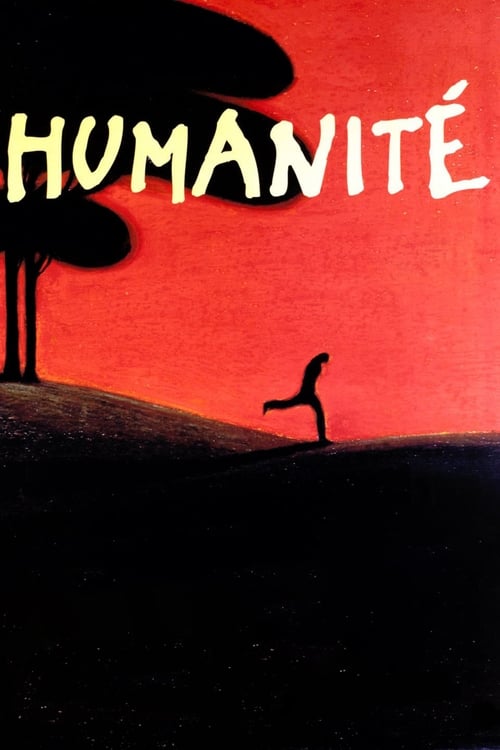
Humanité
1999 · Bruno Dumont
For when you want to be challenged, not entertained — a film to sit with in silence and argue about for days. Absolutely not comfort viewing; save it for a patient, serious evening.
What it's about
In a small town in northern France, a police superintendent named Pharaon — gentle, halting, almost childlike — investigates the rape and murder of an eleven-year-old girl. The procedural is only the surface: the film really follows Pharaon's strange, wide-open tenderness toward everyone around him, especially his neighbor Domino and her boyfriend, as he absorbs the town's pain like weather. It's a crime story used as a doorway into much bigger questions about suffering and what people owe each other.
The experience
Slow, stark, and confrontational — long silences, blunt physicality, and a lead character you can't quite decode. It's demanding and sometimes uncomfortable, but it builds a strange compassion that few films even attempt.
Performances
Emmanuel Schotté, a nonprofessional actor, is unforgettable as Pharaon — a performance of pure presence rather than technique that won Best Actor at Cannes and remains one of the most divisive, haunting turns in French cinema.
The craft
Dumont shoots the flat Flanders landscape and ordinary human bodies with the same unblinking patience, in long fixed takes with no score to guide you. The plainness is the point: stripped of cinematic comfort, small gestures — a hand on a shoulder, a face held too long — land with unusual force.
Why it matters
Its Grand Prix and twin acting awards at Cannes in 1999 caused an uproar, cementing Dumont as one of European cinema's great provocateurs and a touchstone for austere, body-centered filmmaking.
Snapshot
L'Humanité is Bruno Dumont's second feature, a slow, severe, and deliberately provocative work that uses the skeleton of a rural murder investigation to stage a metaphysical inquiry into suffering, empathy, and the human body. Set in and around Bailleul, the small Flanders town where Dumont was born and raised, the film follows Pharaon De Winter, a police superintendent of fragile and almost childlike affect, as he moves through the investigation of the rape and murder of an eleven-year-old girl. The procedural is largely a pretext; the film's true subject is Pharaon's near-pathological openness to the pain of others and his inarticulate yearning for connection, registered through his relationship with his neighbor Domino and her boyfriend Joseph. The film won the Grand Prix at the 1999 Cannes Film Festival (jury presided by David Cronenberg), and, in a result that became one of the festival's enduring controversies, its two non-professional leads, Emmanuel Schotté and Séverine Caneele, took the Best Actor and Best Actress prizes. The dual award crystallized the debate that has followed Dumont ever since: visionary austerity or hollow provocation. L'Humanité is now widely regarded as a foundational text of the turn-of-the-millennium French art cinema sometimes grouped under the "New French Extremity" and as one of the most rigorous contemporary heirs to the transcendental tradition of Robert Bresson.
Industry & production
The film was produced by 3B Productions, the Paris-based company of Jean Bréhat and Rachid Bouchareb, which had also backed Dumont's 1997 debut La Vie de Jésus. That debut, made on a modest budget and built around non-professional actors from the Nord, had won the Caméra d'Or–related attention and the Prix Jean Vigo, establishing Dumont as a singular new voice and giving 3B the confidence to mount a second, more ambitious feature. L'Humanité was a French production drawing on the standard French art-cinema financing ecology of the period, which typically combined producer equity, distributor advances, regional support, and the soft-money apparatus of the CNC and television pre-sales; the precise financing breakdown is not something I can reconstruct from the public record with confidence, and I will not invent figures. What is clear is that the film was conceived and shot on the director's home ground in French Flanders, using local landscapes and locally cast unknowns, a method that kept the production rooted and comparatively economical while giving Dumont total control over tone. Its Cannes Grand Prix and twin acting awards transformed it from a small regional production into an international art-house event, securing festival travel and specialized distribution abroad, including a U.S. release through art-cinema channels.
Technology
L'Humanité was shot photochemically on 35mm film, the standard professional format for theatrical features of its moment, and it is emphatically a film of the pre-digital art cinema: there are no visual effects, no digital grading culture of the kind that would soon dominate, and no stylistic reliance on post-production manipulation. Dumont's technological choices are essentially subtractive. He favors available and naturalistic light, long lenses and static or minimally mobile camera setups, direct location sound, and a wide-screen frame that treats the flat Flemish horizon as a near-abstract compositional element. The film's "technology," in other words, is conventional capture deployed against the grain of convention: the apparatus is used to slow time, to hold on faces and bodies past the point of comfort, and to render landscape and flesh with a documentary materiality. I am not certain of the exact aspect ratio used and will not assert one; what matters stylistically is the emphatic horizontality of the framing, which subordinates the human figure to land and sky.
Technique
Cinematography
The cinematography is by Yves Cape, who shot both of Dumont's first two features and helped define their look. Cape and Dumont build the film from wide, often static compositions in which figures are small against the agricultural flatness of Flanders, alternated with unsparing close-ups that study faces in near-clinical detail. The palette is muted and overcast, drawn from the region's gray northern light; the camera tends to observe rather than dramatize, refusing the coverage and reaction-shot grammar of the conventional thriller. The film's most notorious image — the explicit, frontal shot of the murdered child's body that opens the investigation — is shot with the same flat, unflinching gaze as a field or a face, and its refusal of aestheticizing or discreet framing is precisely the source of its scandal and its argument: the camera will not look away from atrocity. Throughout, Cape's images convey a sense of the world as physically present and morally opaque, the landscape beautiful and indifferent.
Editing
The editing is slow, patient, and durational, holding shots well beyond narrative necessity so that dead time, waiting, and inarticulate presence become the film's primary rhythm. Scenes are allowed to run until discomfort sets in; the cutting refuses the propulsion of genre and instead produces a meditative, sometimes trying tempo that mirrors Pharaon's own becalmed, absorptive consciousness. The editor on Dumont's early work was Guillaume Saurel; if memory of the specific credit is imperfect here I flag it rather than overstate it, but the cutting sensibility is unmistakably of a piece with the director's transcendental project — elliptical about plot, expansive about contemplation.
Mise-en-scène / staging
Dumont's staging is built on non-professional bodies placed in real locations and directed toward a flat, anti-theatrical mode of behavior. Performers often stand or sit in long silences; gestures are awkward, halting, unperformed. The mise-en-scène repeatedly frames Pharaon in postures of helpless witness — bending close to the dead, embracing a suspect, sniffing or touching people and objects as if trying to absorb their essence. Recurrent motifs (the bicycle, the garden, the bedroom, the open field, the police station's banal interiors) anchor a world of provincial ordinariness against which the eruptions of sex, violence, and grief register as almost unbearable. The famous closing image — Pharaon seated and handcuffed, the camera holding on him in radical ambiguity — is a staging masterstroke that refuses to resolve whether he is guilty, scapegoated, or bearing the sins of others.
Sound
The film relies overwhelmingly on direct, naturalistic location sound — wind, birds, engines, the silences of empty rooms — and largely eschews the cushioning of non-diegetic score. Music is used sparingly if at all, and I will not assert a composer credit I cannot verify; the dominant aural experience is one of ambient quiet that amplifies every breath, footstep, and inarticulate utterance. This sonic austerity is integral to Dumont's realism and to the sense of a world stripped of consolation.
Performance
Emmanuel Schotté's Pharaon is one of the defining non-professional performances of modern art cinema: a near-affectless, open-mouthed, perpetually wounded presence whose blankness Dumont treats as a screen for the viewer's own projections. Séverine Caneele as Domino and Philippe Tullier as Joseph supply a raw, carnal counterweight, their sexuality filmed with the same unsmoothed frankness as everything else. The Cannes jury's decision to award both Schotté and Caneele acting prizes — over established professionals — became a flashpoint precisely because their work is anti-"acting" in the conventional sense: it is behavior, presence, and physiognomy rather than craft, exactly the Bressonian "model" ideal of the performer as found object rather than interpreter.
Narrative & dramatic mode
Structurally the film borrows the outline of a police procedural — a child is murdered, detectives investigate, a culprit is eventually identified — but it systematically drains that outline of suspense, clues, and resolution. The investigation proceeds in fragments and is frequently abandoned for long passages of domestic and emotional life. Dumont's dramatic mode is contemplative and phenomenological: the film privileges states of being (grief, desire, compassion, numbness) over events, and withholds the explanatory psychology and causal momentum on which genre depends. The result is a narrative that frustrates anyone seeking a whodunit and rewards a viewer willing to read it as a parable. Its central ambiguity — Pharaon as possible killer, possible saint, possible Christ-figure absorbing the world's guilt — is left structurally open, an interpretive provocation rather than a plot twist.
Genre & cycle
L'Humanité sits at the intersection of the art-film murder mystery and the transcendental/contemplative drama. It belongs to the broader late-1990s French cycle of confrontational, body-centered art cinema that critic James Quandt would later (and polemically) name the "New French Extremity" — a loose grouping including Gaspar Noé, Claire Denis, Catherine Breillat, and others whose work foregrounded explicit sex, violence, and bodily abjection. Within that cycle Dumont is the most overtly metaphysical and Bressonian figure: where Noé courts visceral shock, Dumont pursues a grave, almost liturgical seriousness. The film also belongs to a longer lineage of art-house films that hollow out the crime genre to philosophical ends.
Authorship & method
Dumont is the film's author in the fullest sense: he wrote and directed it and shaped every element toward a unified vision. A former philosophy teacher, he came to cinema with an explicitly conceptual program, often citing his interest in the relation between the body and the sacred and his debt to Bresson's idea of the non-professional "model." His method is consistent and now famous: cast untrained locals from the Nord, strip performance of psychology, shoot on home ground in real light, hold shots until duration itself becomes meaning, and refuse explanatory dramaturgy. His key collaborator on image was cinematographer Yves Cape, who realized the film's flat-light, wide-horizon aesthetic across Dumont's first two features. The film was edited in the durational style associated with Guillaume Saurel's work on Dumont's early period (noted with appropriate caution on the exact credit). Notably, Dumont named his protagonist Pharaon De Winter after a real nineteenth-century painter from Bailleul, a characteristic gesture binding the film to the specific cultural soil of his region.
Movement / national cinema
The film is a landmark of post-Nouvelle Vague French art cinema and specifically of a regional, working-class realism rooted in the Nord-Pas-de-Calais. It can be read alongside the contemporaneous social realism of the Dardenne brothers (whose Rosetta took the Palme d'Or at the same 1999 Cannes), with which it shares a commitment to non-professional actors and depressed post-industrial or rural margins — though Dumont diverges sharply toward the metaphysical where the Dardennes remain ethically and socially grounded. As a French national cinema product, it exemplifies the country's auteur-support system, which continued to enable uncompromising, non-commercial visions. It also extends a distinctly French line of transcendental and corporeal filmmaking descending from Bresson and Maurice Pialat.
Era / period
Made and released at the very end of the 1990s, L'Humanité is a turn-of-the-millennium film in both timing and temper. It arrived amid a wave of European art cinema reasserting slowness, the long take, and bodily confrontation against the accelerating tempo of mainstream film — a tendency later theorized as "slow cinema." Its 1999 Cannes triumph, in the same edition that crowned the Dardennes, marked a moment when austere, regionally rooted realism seized the festival's highest honors, signaling a critical appetite for cinema that rejected spectacle. The film's pre-digital materiality and its faith in real places and real faces also locate it firmly at the close of the photochemical era.
Themes
The film's governing theme is humanity itself — both as compassion and as the brute fact of embodied existence. Pharaon is a figure of almost unbearable empathy, a man who seems to physically absorb the suffering of those around him, and the film asks whether such radical openness is sanctity or pathology. Around this hub cluster Dumont's persistent concerns: the proximity of the sacred and the profane; the body as the site of both transcendence and degradation, where sex, violence, and grace are filmed with the same unflinching attention; suffering as a shared, almost communal substance; and the problem of evil, posed through a murder whose perpetrator matters less than the moral weight it places on the witness. The Christological reading — Pharaon as a figure who takes on the guilt of others, culminating in the handcuffed final image — is invited but never confirmed, leaving grace and damnation in unresolved tension. Underlying all of this is a Bressonian theology of materiality: the spiritual is reachable only through, never apart from, the physical world.
Reception, canon & influence
Reception was sharply, almost violently divided, and that division is part of the film's history. Its Cannes Grand Prix and the unprecedented double acting award for two unknowns provoked open derision in parts of the press, with some critics treating the prizes as a scandal and the film as pretentious, slow, and willfully provocative; others hailed it as a masterpiece and Dumont as the most important French director of his generation. This polarization has never fully resolved, and it remains the standard frame for discussing his work.
Looking backward, the film's influences are legible and acknowledged: above all Robert Bresson, whose use of non-professional "models," ellipsis, and pursuit of grace through the material world Dumont adapts wholesale; Maurice Pialat, for raw provincial realism; and the contemplative landscape cinema associated with figures like Andrei Tarkovsky. Dumont's background in philosophy clearly informs the film's conceptual armature.
Looking forward, L'Humanité consolidated Dumont's auteur identity and his template of regional casting and metaphysical realism, which he would extend through Twentynine Palms, Flandres (itself a later Cannes Grand Prix winner), Hadewijch, Hors Satan, and his later tonal swerve into deadpan comedy with the P'tit Quinquin series and Slack Bay. More broadly, the film became a touchstone for the international "slow cinema" and contemplative-art-film conversation and a key reference in the critical debate around the "New French Extremity." Its uncompromising fusion of crime-film scaffolding with spiritual inquiry, and its faith in the expressive power of untrained faces held in long, silent duration, continue to be cited as a high-water mark of turn-of-the-century European auteurism.
A Deleuzian reading
The gesture you keep is Pharaon bending to smell people.
The full Deleuzian reading of Humanité →
Reception
Booed and jeered at Cannes 1999 — where David Cronenberg's jury nonetheless handed it the Grand Prix plus both acting prizes, to open scandal — it's since been reappraised as one of the great slow-cinema works and arguably Dumont's masterpiece.
How Humanité was received, from release to now →
Influences: the films it descends from and the films it influenced
- Diary of a Country Priest (1951) — Establishes the Christological-suffering protagonist whose grace is read off an inexpressive face held in austere duration — the model-acting and ellipsis program Dumont adopts wholesale for Pharaon.
- Pickpocket (1959) — The blueprint for performance stripped of psychology and for redemption located in the body and hands, capped by the ambiguous spiritual final image Dumont echoes in his own held, unresolved endings.
- L'Enfance nue (1968) — Raw provincial realism cast with non-actors and refusing explanatory backstory — the regional working-class texture and anti-dramaturgical procedure Dumont relocates to the Nord.
- Ordet (1955) — Austere static framing of faces and bodies as the sacred breaks into the material world, the transcendental-miracle staging that underwrites Dumont's empathic levitations and ambiguous grace.
- Stalker (1979) — Durational long takes across a depopulated landscape where time itself becomes the metaphysical event — the contemplative-landscape duration Dumont strips down to flat-light Flanders.
- The Passion of Joan of Arc (1928) — Dumont casts nonprofessional actors specifically for their faces' capacity to hold suffering without theatrical mediation, constructs the film around extreme close-ups held in long duration, and explicitly cites Dreyer as his formal model for treating the face as a devotional object — the face in endurance rather than expression — under institutional scrutiny.
- The Enigma of Kaspar Hauser (1974) — Dumont holds extended long takes on non-professional Emmanuel Schotté's opaque physical presence without psychological explanation, treating the socially marginal body rather than the face as the site of meaning — adapting the Bressonian casting strategy Herzog consolidated with Bruno S. into a northern-French realist context.
- L'Argent (1983) — Adopts the non-professional 'model' cast for affectless neutrality and the frontal, undemonstrative framing of inexpressive faces directly out of Bresson's playbook.
- Mamma Roma (1962) — Dumont casts non-professionals whose faces are held in long, frontal contemplation and locates a wounded transcendence in the socially abject, an explicitly post-Pasolinian 'cinema of poetry.'
- Twentynine Palms (2003) — Dumont extends his own template — non-actors, wide static desert horizons, eruptive violence severed from motive — porting the method out of the Nord.
- Flandres (2006) — Returns to Nord regional casting and flat-light durational staging to fuse war-film scaffolding with metaphysical realism, directly continuing L'Humanité's procedure.
- Japón (2002) — Openly Dumont/Tarkovsky-debted: a non-professional cast in wide-static landscape where carnal embodiment and the sacred meet in long contemplative duration.
- Silent Light (2007) — Carries the Dreyer/Ordet transcendental miracle forward with non-professional Mennonite models and durational wide-static framing, the same grace-in-matter Dumont pursues.
- La Libertad (2001) — A hollowed procedural following a single laborer's tasks in real time and real light — Dumont's anti-dramaturgical durational observation of the non-professional body taken to a minimalist extreme.
- Once Upon a Time in Anatolia (2011) — A police investigation hollowed of genre resolution and stretched across a contemplative nocturnal landscape — the crime-scaffold-as-spiritual-inquiry structure Dumont pioneered here.
- Dogtooth (2009) — Dumont's non-professional actors sustain affective blankness across scenes of extreme emotional content — grief, sex, violence — with elliptical in-medias-res entries that refuse psychological preparation, anticipating the specific Lanthimos-Filippou dialogue system where hyperliteral speech replaces motivation.
- Sátántangó (1994) — Extends the same wide-static, durational long-take grammar over a bleak regional terrain populated by weathered non-professional faces, refusing genre payoff in favor of held time.
- Rosetta (1999) — Same-Cannes regional realism built on a non-professional lead and a hollowed procedural that withholds motive and backstory — the inverse (handheld) pole of Dumont's static naturalism.
- Somber (1998) — Core New French Extremity sibling: a serial-killer scaffold dissolved into sensory bodily dread, sharing Dumont's faith in the body over narrative explanation.
- Beau Travail (1999) — Anti-theatrical choreography of bodies in real light over psychological narration, resolving on a famously ambiguous final image kin to Dumont's withheld closure.
- In Vanda's Room (2000) — Durational observation of a real marginal community performing versions of themselves — the non-professional 'model' principle pushed toward documentary duration.
- Misericordia (2024) — Stages a northern-village killing through an opaque, near-affectless protagonist and wide frontal landscape framing, draining the police-procedural of catharsis in favor of bodily, near-mystical attention.
- Code Unknown (2000) — Dumont independently develops the forensic-observational long take with a mixed nonprofessional cast used for ethical texture rather than naturalistic authenticity, withholding explanatory psychological framework through the same Bressonian inheritance that grounds Code Unknown's performance discipline.
- Destiny (2006) — Non-professional actors deployed in a directly Bressonian mode — flat affect, behavioral precision, zero psychological explanation — with static framing and anti-expressive editing organized around accumulation rather than dramatic architecture; shares the specific Bressonian inheritance and the formal commitment to duration-as-meaning.
- The Wild Pear Tree (2018) — Anchors faith-and-doubt in a rural setting shot in natural light with non-professional, behaviorally naturalistic performance and durational stillness, a kindred austerity to Ceylan's.
Similar films
- The Child (2005) — shared sensibility
- The White Ribbon (2009) — shared sensibility
- Code Unknown (2000) — shared sensibility
- The Kid with a Bike (2011) — shared sensibility
- La Promesse (1996) — shared sensibility
- The Piano Teacher (2001) — shared sensibility
- Titane (2021) — shared sensibility
- Man Bites Dog (1992) — shared sensibility