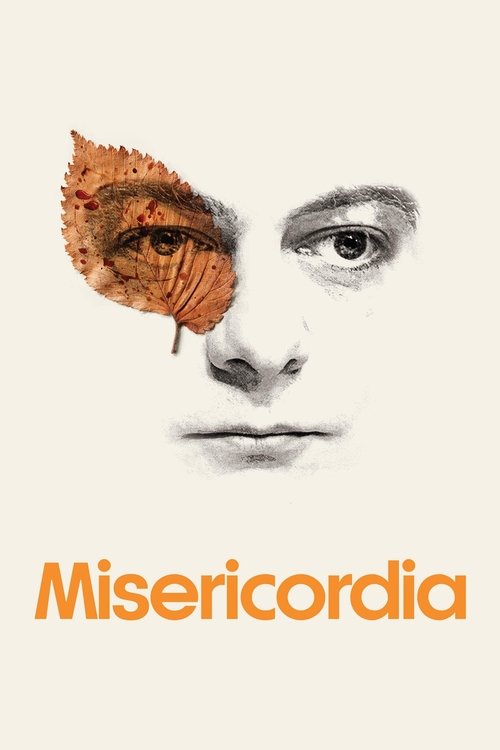
Misericordia
2024 · Alain Guiraudie
For when you want something sly and off-kilter — a wicked little village mystery that's equal parts suspense and deadpan comedy, best watched late at night. A treat if you like your thrillers strange; not for viewers who need clean moral lines.
What it's about
Jérémie comes back to the small Aveyron village of his youth for the funeral of his old boss, the beloved local baker, and decides to stay a few days with Martine, the widow. His lingering presence unsettles everyone — the dead man's hostile son, a watchful neighbor, a priest with agendas of his own — and when someone goes missing, the village closes around its secrets. Desire, guilt and mercy get tangled together in ways nobody, least of all Jérémie, can control.
The experience
A slow-burn thriller played completely straight-faced, which somehow makes it funnier and more unnerving at once. It keeps you off balance — creeping dread one scene, absurd comedy the next — and the mushroom-dark autumn atmosphere seeps into everything.
Performances
Félix Kysyl makes Jérémie a fascinating blank — polite, opaque, impossible to read — and Catherine Frot gives Martine a warmth with an unsettling undertow, so you're never sure who's fooling whom.
The craft
Alain Guiraudie's writing is the marvel: every conversation carries two or three meanings, and the plot tightens like a knot while barely raising its voice. The autumnal woods and nighttime village are shot with a hushed, sinister beauty that rewards watching in the dark.
Why it matters
Widely ranked among the best French films of its year, it brought Guiraudie's singular blend of rural noir, desire and dark comedy to his largest audience yet.
Snapshot
Misericordia (French: Miséricorde) is Alain Guiraudie's tenth feature, a sly, deadpan thriller-comedy of provincial guilt that takes its title — Latin and liturgical for "mercy" — entirely in earnest. Jérémie, a young former baker's apprentice, returns to the Aveyron village of his youth for the funeral of his old employer and lingers, ostensibly to comfort the widow, Martine, but in truth pulled back by an unspecified erotic and emotional attachment to the dead man and his world. Within days a violent confrontation with the baker's hostile son spirals into killing and concealment, and the film settles into a strange, becalmed register as a missing-person inquiry circles the village while a watchful local priest extends Jérémie not justice but something closer to grace. Built from Guiraudie's signature materials — rural southern France, frank and ambient homosexual desire, sudden death treated with almost comic flatness, and a forest that functions as both crime scene and dreamscape — the film fuses Hitchcockian suspense and Chabrolian village portraiture with an absurdist, fable-like calm. Premiering at the 2024 Cannes Film Festival and embraced as one of the year's strongest French films, it confirmed Guiraudie as a singular voice: a moralist without moralism, fascinated by the proximity of longing, violence, and forgiveness.
Industry & production
Misericordia was produced by Charles Gillibert's CG Cinéma, the Paris company whose output spans auteur cinema by Olivier Assayas, Mia Hansen-Løve, and others, with Guiraudie continuing the artisanal, mid-budget production model that has characterized his career since Stranger by the Lake (2013). Distribution in France was handled by Les Films du Losange, the venerable arthouse distributor-producer historically associated with Éric Rohmer and Michael Haneke — a fitting home for a film steeped in the provincial-crime tradition. Precise budget figures are not part of the public record, but the film's scale is plainly modest: a small cast, a single rural location, natural light and landscape, and no spectacle. This economy is not a constraint imposed from outside but a method, consistent with a body of work that finds the uncanny in ordinary places.
The film premiered at the Cannes Film Festival in May 2024, screening in the Cannes Premiere section rather than the main competition, and opened theatrically in France in October 2024 to strong reviews. It traveled widely on the subsequent festival circuit and through arthouse distributors abroad, building the kind of slow-burn critical reputation that has become Guiraudie's commercial signature — films that recoup through prestige, longevity, and the director's established festival standing rather than opening-weekend scale. Its awards reception in France was warm; among other honors it was recognized in the year-end French critical prizes and figured in the subsequent César nominations, though the precise tally of wins is best confirmed against the official record rather than asserted here. What matters industrially is the consolidation it represents: Guiraudie working within a stable, repeatable auteur-production framework that lets him make idiosyncratic films on his own terms.
Technology
Misericordia is technologically unassuming by design, and there is no evidence it pursued any novel capture or post-production innovation. It was shot digitally, in the naturalistic register Guiraudie and his collaborators have long favored, relying heavily on available and natural light — the flat overcast and golden low-angle sun of the Aveyron countryside — rather than elaborate rigs. The forest, the village lanes, and domestic interiors are rendered with a plain, almost documentary clarity that refuses stylization. If there is a "technology" worth naming, it is the discipline of restraint: a refusal of score, of visual effects, of coverage-heavy editing, so that the apparatus disappears and the viewer is left alone with bodies in landscape. This is an aesthetic position as much as a technical one, and it aligns the film with a strain of contemporary European art cinema that treats transparency of means as an ethical and formal value.
Technique
Cinematography
The photography — by Claire Mathon, Guiraudie's regular cinematographer on Stranger by the Lake and Staying Vertical and one of the most acclaimed French image-makers of her generation — is the film's most quietly expressive element. (Where the published technical record is thin on the exact crew credits, the long-running Guiraudie–Mathon partnership is the salient fact.) Mathon's work here is the opposite of her luminous, sun-struck lakeside compositions in Stranger by the Lake: it favors a grounded, earth-toned naturalism, the muted greens and browns of forest and village, light that is observed rather than sculpted. The framing is patient and frontal, often holding figures within wide rural vistas so that the human drama is dwarfed by terrain. The forest is shot as a genuinely ambiguous space — concealing, fertile, faintly menacing — and the recurring motif of bodies moving through underbrush (to gather mushrooms, to hide, to seek) gives the cinematography a tactile preoccupation with what the ground covers and yields. The camera's calm is itself a suspense device: it watches without judgment, withholding the reaction shots and emphases that would tell us how to feel.
Editing
The cutting is unhurried and elliptical, structured around the film's tonal gambit of treating shocking events with disconcerting evenness. Violence arrives abruptly and is dispatched without crescendo; the aftermath — the labor of concealment, the resumption of ordinary village rhythms — is given as much or more screen time than the act itself. This temporal flattening is the engine of both the comedy and the dread: by declining to spike at the obvious dramatic peaks, the editing keeps the viewer permanently slightly off balance, unsure whether to laugh or brace. Precise editorial credits are best confirmed against the official record; what is legible on screen is a sensibility that prizes the long, slightly-too-long take and the unsignposted scene transition over conventional thriller propulsion.
Mise-en-scène / staging
Guiraudie's staging is built on the friction between a placid surface and the currents of desire and violence beneath it. The village is rendered as a closed social world of a handful of recurring figures — widow, son, neighbor, priest, gendarmes — moving through a small set of locations: the bakery and its absence, Martine's house, the forest, the church, the lanes. Bodies are blocked with a frank physicality characteristic of the director: proximity, touch, and the awkward choreography of men circling one another carry erotic and threatening charge simultaneously. The forest functions as the film's primal stage, a space outside village law where killing, burial, cruising, and mushroom-gathering occur in the same uncanny clearing. Domestic interiors, by contrast, are arenas of surveillance and insinuation, where what is unspoken — who knows what about the disappearance — saturates every ordinary exchange.
Sound
In keeping with Guiraudie's long-standing practice — Stranger by the Lake famously dispensed with non-diegetic music entirely — Misericordia foregrounds the ambient sound of its rural world: birdsong, wind in trees, footsteps in leaf litter, the silences of a small village. The general absence or extreme sparseness of score (the soundtrack particulars are best verified against the credits) leaves the viewer exposed to environmental sound as the primary atmospheric medium, which intensifies both the naturalism and the suspense. Without music to cue emotion, ordinary noises acquire ominous weight, and the long quiet stretches become spaces in which guilt and desire reverberate unmediated.
Performance
The ensemble is anchored by Félix Kysyl as Jérémie, whose performance is a study in opacity — boyish, pliant, evasive, neither plainly sympathetic nor clearly malign, so that his motives remain productively unreadable. Catherine Frot, a major and beloved French screen actress, lends Martine a grounded warmth and ambiguity as the widow whose affection for Jérémie shades toward something less maternal. The most remarked-upon performance is Jacques Develay's as the village priest, whose serene, insinuating watchfulness and unexpected interventions on Jérémie's behalf give the film its title's moral and comic core; the role drew particular critical and awards attention. Jean-Baptiste Durand (himself a director) as the volatile son and David Ayala among the village men round out an ensemble that plays the material straight — never winking at the absurdity — which is precisely what makes the comedy land and the menace hold.
Narrative & dramatic mode
The screenplay, written by Guiraudie, operates in his characteristic mode: a genre armature (here the village murder-and-concealment thriller) inhabited by an art-cinema sensibility that suspends moral resolution. The narrative engine is classical suspense — a killing, a body to hide, an investigation that tightens — but Guiraudie systematically refuses the catharsis the form promises. There is no detective hero, no scene of reckoning, no restoration of order through punishment. Instead the dramatic question mutates from "will Jérémie be caught?" into something stranger and more theological: what would it mean to be forgiven rather than judged? The priest's interventions reroute the plot away from justice and toward grace, and the film's resolution withholds the moral closure of either condemnation or confession. The mode is finally that of the fable or parable — deadpan, slightly dreamlike, organized around a moral idea (mercy) rather than around guilt and consequence — with comedy and dread held in unresolved suspension throughout.
Genre & cycle
Misericordia sits at the crossroads of several traditions. Most obviously it belongs to the French provincial-crime lineage presided over by Claude Chabrol, with its anatomies of bourgeois and rural communities cracked open by a death and its suppressed appetites. It draws equally on the Hitchcockian suspense-of-concealment — the audience aligned with a guilty protagonist, complicit in the wish that he not be found out — and on the morally cool, desire-driven crime fiction of Patricia Highsmith, whose amoral, oddly likable killers it echoes. Within Guiraudie's own filmography it extends a coherent cycle: rural southern French settings, ambient queer desire, sudden death treated with flat affect, and the collision of the everyday with the uncanny, running from The King of Escape through Stranger by the Lake and Staying Vertical to Nobody's Hero. Misericordia is perhaps his most tonally balanced fusion of thriller mechanics and absurdist comedy, the genres held in a single unbroken register rather than alternated.
Authorship & method
Misericordia is an auteur work in the fullest sense: Guiraudie wrote and directed it, and its concerns are unmistakably his — the entanglement of desire, death, and rural place; the matter-of-fact presentation of homosexual longing as simply part of the social fabric; the genre frame repurposed for metaphysical and erotic inquiry. His method is one of patient naturalism shadowed by dream-logic: ordinary people in a precisely observed milieu behave in ways that gradually reveal an underlying strangeness, without the film ever breaking into overt surrealism. The authorship is, however, deeply collaborative within a stable team. The continuity with cinematographer Claire Mathon — whose naturalist eye and command of light and landscape have shaped the look of his major films — is central, as is the production partnership with CG Cinéma that gives these idiosyncratic projects their footing. Guiraudie's refusal of conventional scoring, his trust in ambient sound and long takes, and his casting of both established stars (Frot) and lesser-known or first-time faces are consistent authorial choices that subordinate every craft department to a unified vision of unhurried, faintly uncanny realism. Where specific below-the-line credits (editor, sound, any music) are concerned, the public record is thinner than for the headline collaborators, and those should be taken from the official credits rather than asserted.
Movement / national cinema
The film is a product of contemporary French art cinema and its robust auteur-production ecosystem — the world of CG Cinéma, Les Films du Losange, Cannes, and the César and Louis Delluc constellation that sustains directorial careers across decades. Guiraudie occupies a distinctive position within this landscape: regional rather than Parisian in setting and sensibility, rooted in the Occitan south, and openly engaged with queer experience in a way that is integrated rather than thematized as "issue." He belongs to no formal movement, but his work converses with a French tradition of provincial moral cinema (Chabrol above all) and with a broader contemporary European art cinema that prizes naturalism, restraint, and the genre film reimagined as auteur vehicle. The film's national-cinema significance lies partly in its vision of la France profonde — the depopulating rural village, its church, its gossip, its closed economy of relationships — rendered without nostalgia or condescension.
Era / period
Misericordia is a contemporary-set film of the mid-2020s, and it carries the texture of present-day rural France: the village in quiet decline, the small bakery whose closure leaves a hole, the gendarmerie procedural routine. But its temporal feeling is curiously timeless, almost folkloric — the forest, the priest, the questions of sin and mercy belong to an older moral universe that the modern setting only lightly disturbs. Produced and released in 2024, it arrives at a moment when French auteur cinema continues to thrive on the festival-and-prestige circuit even as theatrical economics tighten, and it exemplifies the survival strategy of that cinema: small, distinctive, festival-launched films built on directorial reputation and critical consensus rather than scale. It also reflects a contemporary art-cinema appetite for genre hybridity and tonal ambiguity, the thriller and the comedy and the parable folded into one another.
Reception, canon & influence
Misericordia was met with strong, often enthusiastic critical reception following its Cannes premiere, widely cited among the best French films of 2024 and praised for its tonal control, its deadpan wit, the ambiguity of Kysyl's performance, and Develay's beguiling priest. Critics consistently located it within the Chabrol–Hitchcock–Highsmith lineage while crediting Guiraudie with making something wholly his own from those materials, and it figured prominently in year-end French critical honors and the ensuing awards conversation; the exact list of prizes won is best taken from the official record. The dominant critical note was admiration for a film that sustains suspense and comedy and a genuine theological seriousness about mercy without letting any one of them collapse into the others.
Its influences run backward to Chabrol's provincial murder dramas, to Hitchcock's architecture of complicit suspense, to Highsmith's amoral protagonists, and — most directly — to Guiraudie's own prior cinema, particularly the death-haunted, desire-saturated Stranger by the Lake, of which Misericordia can be read as a warmer, more comic cousin. Forward, as a recent film its legacy is still forming, but its immediate significance is to consolidate Guiraudie's standing as one of the major contemporary French auteurs and to model a particular contemporary possibility: the genre thriller reclaimed as a vehicle for moral and erotic inquiry, played in a single unwavering deadpan. For a younger generation of filmmakers interested in tonal hybridity, queer everydayness, and the uncanny in the regional and ordinary, it is likely to stand as a touchstone — a film that proves how much disquiet, humor, and grace can be wrung from a small village, a forest, and a body that will not stay buried.
A Deleuzian reading
A man kneels in a forest clearing to gather mushrooms.
The full Deleuzian reading of Misericordia →
Reception
Cannes famously kept it out of the 2024 Competition — parked in the Cannes Première sidebar — and then Cahiers du Cinéma crowned it the best film of the year and it won the Prix Louis Delluc, making the snub look sillier by the month. By its 2025 US release through Sideshow/Janus it had become an arthouse sleeper and Guiraudie's biggest stateside hit.
How Misericordia was received, from release to now →
How to watch Misericordia: what to notice on a first viewing
- Listen for birdsong instead of any music score. Guiraudie works without a score, so wind, footsteps, and birdsong carry the film's whole atmosphere, and ordinary sound starts to feel loaded with meaning. With nothing telling you how to feel, ordinary noises start to sound like a warning.
- Watch how small people look against the wide rural land. Claire Mathon frames figures within wide, patient, frontal rural vistas, so the human drama keeps getting dwarfed by the terrain around it. The camera watches without judging, which leaves you deciding for yourself what you're looking at.
- Watch how often the story returns to the same forest clearing. The forest recurs as the film's main outdoor stage, a space where gathering mushrooms and everything else the village won't discuss can happen in the same uncanny ground. One patch of ground ends up holding everything the village keeps trying not to look at.
- Watch Félix Kysyl's face for what it refuses to give away. Kysyl plays Jérémie as boyish and evasive, never clearly sympathetic or clearly dangerous, so his motives stay unreadable scene after scene. You end up reading him the way the villagers do, guessing rather than knowing.
- Notice how evenly the film paces its calm and its tension. The editing declines to spike at obvious dramatic peaks, holding aftermath and ordinary village rhythm for as long as any confrontation, so nothing signals what to feel. The film keeps you permanently a little off balance, unsure whether to laugh or brace.
The whole guide to watching Misericordia, with the keys for a rewatch →
Influences: the films it descends from and the films it influenced
- Le Boucher (1970) — Establishes the template of the murderer woven seamlessly into a precisely observed provincial community, where killing erupts from — and is absorbed back into — the placid bourgeois rhythms of village life.
- La Cérémonie (1995) — Builds dread from social opacity and class friction in a rural household, letting violence arrive matter-of-factly rather than as melodramatic climax — the same refusal of cathartic punctuation Guiraudie inherits.
- I Confess (1953) — Makes a priest, bound by the seal of confession, the pivot of complicit suspense and moral entrapment — the direct architectural precedent for Misericordia's grace-dispensing, secret-keeping abbé.
- The Trouble with Harry (1955) — Plays deadpan comedy over a corpse that will not stay buried in a small rural community, fusing the macabre and the droll in exactly the flat, unruffled register Guiraudie sustains.
- Strangers on a Train (1951) — From Highsmith's premise, perfects the engineering of audience complicity with the wrongdoer, transferring guilt so that the viewer roots for the cover-up to hold.
- Plein Soleil (1960) — Renders Highsmith's amoral protagonist as a serene opaque figure who kills and calmly assumes the dead man's place, the suspense running on impunity rather than retribution.
- The Talented Mr. Ripley (1999) — Carries forward the Highsmith opaque killer driven by suppressed homoerotic desire who escapes punishment, braiding queer longing directly into the mechanics of the crime.
- Diary of a Country Priest (1951) — Anchors the rural-French drama of grace and mercy in austere naturalism, modeling the theological seriousness Misericordia smuggles inside its thriller frame.
- Stranger by the Lake (2013) — Guiraudie's own immediate precursor: shot by Claire Mathon in naturalist available light with no non-diegetic score, it fuses a cruising-ground of frank queer desire with a witnessed murder and a suspense that never resolves.
- Staying Vertical (2016) — Extends the same dream-logic naturalism over a rural French landscape, with frank bodily proximity and the forest/wilderness staged as a primal arena for desire and death.
- The King of Escape (2009) — Sets the comic key for Guiraudie's rural queer desire played dead straight, the deadpan-as-method that Misericordia tightens into thriller form.
- Portrait of a Lady on Fire (2019) — Shares cinematographer Claire Mathon's signature: scoreless, available-light image-making in which landscape and natural light do the expressive work conventionally handed to a music track.
- Atlantics (2019) — Another Claire Mathon collaboration deploying her naturalist available-light eye to let the precisely ordinary tip quietly into the uncanny — the tonal slippage central to Guiraudie's milieu.
- Li'l Quinquin (2014) — A contemporary rural-French murder investigation played in flattened deadpan, lodging the grotesque and uncanny inside ordinary regional life — the closest tonal cousin to Misericordia's village-crime comedy.
- L'humanité (1999) — Stages a northern-village killing through an opaque, near-affectless protagonist and wide frontal landscape framing, draining the police-procedural of catharsis in favor of bodily, near-mystical attention.
Similar films
- La Cérémonie (1995) — influence & lineage
- Diary of a Country Priest (1951) — influence & lineage
- The Butcher (1970) — influence & lineage
- Portrait of a Lady on Fire (2019) — influence & lineage
- On Becoming a Guinea Fowl (2024) — same viewing thread
- Goodbye Julia (2023) — shared sensibility
- The Stranger (2025) — shared sensibility
- Diary of a Chambermaid (1964) — shared sensibility
All the films related to Misericordia →
Watch it with: curated runs of related films
- Home for the Funeral — A run of return-to-the-village films where a death draws someone back to the family they left, and the days of mourning unearth what was buried — old secrets, forbidden desire, the true shape of who's gone.