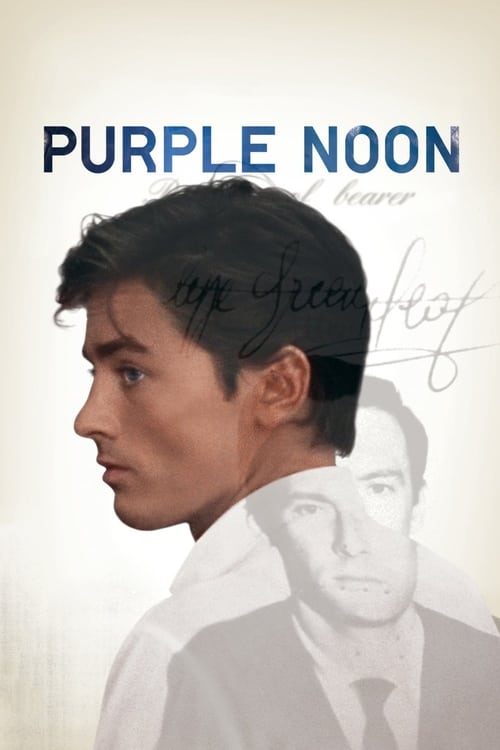
Purple Noon
1960 · René Clément
For when you want an elegant, sun-drenched thriller to savor — something wicked but beautiful, where you can pour a drink and enjoy being complicit. More seduction than scare; a comfortable watch about a very uncomfortable person.
What it's about
A young American of modest means and flexible morals is sent to Italy to fetch Philippe Greenleaf, a rich man's wayward son idling on the Mediterranean with his girlfriend and his sailboat. Tom Ripley — mimic, forger, gifted improviser — falls in love not with the man but with his life, and begins a dangerous game of borrowed identity that draws police, forged signatures, and his own nerve into a tightening knot. It's the first screen version of Patricia Highsmith's talented Mr. Ripley, played out on decks, harbors, and hotel rooms in blazing sunlight.
The experience
A thriller conducted entirely in broad daylight — no shadows to hide in, just glare, blue water, and a mounting dread that the next knock on the door is the one that ends it. It's slow-burn and sensuous at once: you catch yourself rooting for a man you know you shouldn't, and the suspense comes from watching him think.
Performances
Alain Delon, twenty-four and impossibly magnetic, became an international star with this role — his Ripley is all cool surface and flickering calculation, a face the camera can't stop searching for the lie underneath.
The craft
Henri Decaë's color cinematography is the film's signature move: it inverts the crime picture's usual murk into saturated Mediterranean light, so the tension lives in open air and open water. The sailing sequences and Italian coastal locations are gorgeous enough to double as a travel poster, which is exactly the trap the film sets — it rewards a big screen and a patient eye.
Why it matters
It launched Delon toward stardom, gave Highsmith's most famous creation his first screen life, and set the template every later Ripley adaptation has had to answer to. Its sunlit approach to suspense showed that a thriller doesn't need darkness to be sinister.
Snapshot
Purple Noon (Plein soleil, literally "Full Sun") is René Clément's 1960 French–Italian adaptation of Patricia Highsmith's 1955 novel The Talented Mr. Ripley, the first screen incarnation of her amoral con man. It transposes the book's chill unease into a Mediterranean world of relentless sun, launching the twenty-four-year-old Alain Delon toward international stardom. The film follows Tom Ripley, dispatched to Italy to retrieve the wealthy, dissolute Philippe Greenleaf (renamed from Highsmith's "Dickie"), who instead murders his host, assumes his identity, and improvises his way through a widening web of forgery and impersonation. Where much crime cinema of the period traded in shadow, Clément and cinematographer Henri Decaë built a thriller of glare and color — the horror conducted in broad daylight, on sun-struck decks and in whitewashed rooms. It stands as one of the most durable psychological thrillers of its era and the template against which every later Ripley has been measured.
Industry & production
Purple Noon was produced as a French–Italian co-production, a common financing structure of the period that pooled resources across the two markets and typically required location shooting and casting on both sides of the border; the film's Italian settings and its pairing of the French Delon with an international supporting ensemble reflect that arrangement. Rights to Highsmith's novel were secured for a director, René Clément, then near the peak of his prestige: an Academy Award–honored figure (for The Walls of Malapaga and the widely acclaimed Forbidden Games) working squarely within the established French industry rather than the emerging independent sector. The production drew on seasoned professional craft — an experienced screenwriter in Paul Gégauff, a sought-after cinematographer in Henri Decaë, and the Italian composer Nino Rota — assembling a picture that was, in its financing and personnel, a mainstream commercial venture rather than an experiment.
The casting proved decisive. Delon was a rising but not-yet-established screen presence; Purple Noon is routinely cited as his breakthrough, the role that fixed his image as a beautiful, opaque, faintly dangerous young man. Maurice Ronet, an established leading actor, took the role of the doomed Philippe, and Marie Laforêt played Marge, his girlfriend. Beyond these well-documented facts, the granular production record — precise budget, shooting schedule, and box-office returns — is not something I can state with confidence, and I will not invent figures.
Technology
The film was shot in color — Eastmancolor-era single-strip color stock was by 1960 the standard for such a production — a choice more consequential here than in most thrillers of the moment, since the genre's conventions still leaned heavily on black-and-white expressionist shadow. Color was not incidental decoration but the film's central technical wager: the drama unfolds in saturated blues, whites, and flesh tones under a punishing sun, so that menace is rendered through brightness rather than darkness. The production was also heavily location-based, shooting in Italy — Rome, the coast, and open water — which placed demands on the camera and lighting crews to control natural light rather than build it on a stage. The extended sequences aboard a sailing yacht at sea represent a genuine logistical and technical undertaking of the period, requiring the camera to operate in a confined, moving, sun-exposed environment. As was standard for French productions of the era, the film was post-synchronized, with dialogue and effects assembled in the sound stage rather than captured live.
Technique
Cinematography
Henri Decaë's photography is the film's signature achievement and the reason it is still studied. Decaë — a cinematographer central to both the older auteur cinema and the emerging New Wave, having shot for Jean-Pierre Melville, Louis Malle, and Claude Chabrol — brings to Purple Noon a lucid, sun-drenched palette that inverts thriller convention. The Mediterranean light is pushed toward glare; interiors are bright, whites are near-blinding, and the sea returns a hard, gleaming blue. The effect is to make the sunlight itself feel oppressive and exposing, a world with no shadow to hide in, which throws Ripley's furtive interior life into ironic relief. Decaë's handling of the yacht sequences — the confined geometry of the deck, the shifting relation of the three principals to one another and to the water — is among the film's most admired passages, using the boat as a floating stage on which the murder is prepared and executed in plain sight.
Editing
The editing, credited to Françoise Javet, serves a slow-burn suspense architecture rather than propulsive cutting. The film builds tension through duration and delay — lingering on Ripley's watchfulness, on the mechanics of a forgery, on the practical labor of concealing a crime — and the celebrated murder-at-sea sequence derives its dread from patient escalation rather than rapid montage. The cutting tracks the logistics of Ripley's improvisations, letting the audience follow, almost procedurally, how a lie is constructed and maintained.
Mise-en-scène / staging
Clément stages the film as a study in surfaces and appropriation. The world Ripley covets — Philippe's clothes, his money, his signature, his girlfriend, his life — is rendered in tangible, tactile detail: the objects of wealth and the physical acts of counterfeiting them (trying on the other man's jacket, practicing his signature, handling his passport). The staging repeatedly places Ripley as an observer at the edge of a life he means to enter, then dramatizes his methodical crossing of that threshold. The Italian settings — markets, cafés, apartments, the open sea — function less as travelogue than as an arena of desire, a sensuous plenty that motivates the crime.
Sound
Nino Rota's score is a crucial and slightly destabilizing element. Rota, the composer most associated with Federico Fellini and later with The Godfather, supplies music that leans toward the lyrical and even the wistful rather than the conventionally menacing, creating an ironic distance from the violence on screen. The film's post-synchronized soundtrack, typical of French production of the period, also foregrounds the ambient world — sea, wind, the noise of Italian streets — against which the drama's quiet is set.
Performance
Delon's performance is the film's engine and its enduring fascination. He plays Ripley as smooth, watchful, and unreadable, his beauty functioning as a kind of alibi — the audience, like the characters, is invited to trust a face that conceals a killer. Crucially, Delon withholds; he does not editorialize the character's guilt or pleasure, leaving the interior a controlled blank that viewers must fill. Maurice Ronet gives Philippe a careless, entitled charisma that makes both the seduction and the resentment legible, and Marie Laforêt's Marge supplies the emotional reality the two men manipulate. The interplay among the three — attraction, contempt, and rivalry braided together — carries an undercurrent of homoerotic tension that the film registers without underlining.
Narrative & dramatic mode
Purple Noon operates in the mode of the psychological suspense thriller organized around identification with a criminal protagonist. Its dramatic engine is not "will the crime be discovered?" in the abstract but the moment-to-moment question of how Ripley will improvise his way past each fresh threat — a suspicious friend, a hotel clerk, a signature that must match, a body that must vanish. The audience is maneuvered into complicity, rooting almost against its will for the impostor to succeed. The film's most significant departure from Highsmith lies in its ending. Where the novel lets Ripley get away with his crimes, Clément's film supplies a closing turn — the discovery of Philippe's body, dragged up entangled with the boat — that gestures toward Ripley's imminent exposure. This concession to a "crime does not pay" resolution, consonant with the moral expectations and censorship climate of the period, is the single most-discussed structural difference between book and film, and it reshapes the meaning of the whole: Highsmith's vision of triumphant amorality becomes, on screen, an ironic near-miss.
Genre & cycle
The film sits at the intersection of the crime thriller and the psychological character study, adjacent to the broader mid-century vogue for stylish continental crime cinema and to the policier tradition in France. It is also part of a distinct lineage of Highsmith adaptations that begins, on screen, with Alfred Hitchcock's Strangers on a Train (1951) — a body of work characterized by ordinary-seeming men drawn into guilt, doubling, and moral vertigo. Within Highsmith's own Ripley cycle, Purple Noon is the foundational film, the first to bring her serial anti-hero to the screen and thus the origin point of a small genre unto itself: the Ripley picture.
Authorship & method
The authorship of Purple Noon is best understood as a meeting of strong, distinct sensibilities. René Clément, the director, belonged to the generation of accomplished French filmmakers who preceded and overlapped the New Wave — a maker of prestige literary and humanist films such as Forbidden Games — and here he applied that craftsmanly control to genre material, producing a film more sensuous and morally cool than his reputation might predict. The screenplay, by Clément and Paul Gégauff, adapts Highsmith with significant restructuring, most notably the altered ending; Gégauff, a writer closely associated with Claude Chabrol, brought a feel for bourgeois cruelty and cool social observation that suits Highsmith's world. Henri Decaë's cinematography, discussed above, is arguably the film's dominant authorial signature, its sunlit palette the element viewers remember first. Nino Rota's score supplies an ironic lyricism, and editor Françoise Javet shaped the film's patient suspense rhythms. Delon's performance completes the authorship: the film's meaning is inseparable from the specific opacity he brings to Ripley.
Movement / national cinema
Purple Noon occupies an instructive position within French cinema of 1960. It appeared at the very moment the French New Wave was breaking — Truffaut, Godard, and Chabrol had just arrived — yet Clément himself was of the older, professional, studio-trained generation the New Wave critics often defined themselves against. The film thus reads as a bridge: an "establishment" auteur working in a polished, industry-standard mode, but employing a cinematographer (Decaë) who was simultaneously shaping the New Wave's visual language, and a co-writer (Gégauff) drawn from its orbit. As a French–Italian co-production shot largely in Italy, it also belongs to the transnational European commercial cinema of the period, in which national boundaries blurred in the service of financing and market reach.
Era / period
The film is a product of the turn from the 1950s to the 1960s, a moment of transition in both film style and cultural mood. Its embrace of color, location shooting, sensuous Mediterranean settings, and a morally ambiguous young protagonist registers a loosening of older conventions, even as its imposed comeuppance ending marks the continuing pressure of mid-century moral and censorship norms. The Italy it depicts — leisured, moneyed, sun-saturated — belongs to the postwar European imagination of the good life, against which Ripley's class resentment and appetite are set. Delon's ascendance here is itself an era marker, the emergence of a new kind of ambiguous male star.
Themes
The film's governing themes are identity, class envy, and the seductive labor of impersonation. Ripley is defined by lack — of money, of belonging, of a self he values — and by the desire to appropriate another man's life wholesale. The narrative treats identity as something that can be counterfeited like a signature, and it implicates the viewer in the pleasure of watching a self be forged. Class runs beneath everything: the crime is fueled by the gap between Philippe's careless inherited ease and Ripley's striving exclusion, and the film observes the objects and manners of wealth with an almost erotic attention. That eroticism is not only material; the charged, competitive intimacy between the two men carries a homoerotic undercurrent the film acknowledges obliquely. Finally, the picture is preoccupied with surface and concealment — with the terrible irony that a killer can operate in full sun, that beauty and daylight conceal as effectively as any shadow.
Reception, canon & influence
Purple Noon was received as a stylish, accomplished thriller and is credited above all with making Alain Delon a star; that consequence is the most secure fact of its reception history. Over subsequent decades it has been elevated into the canon of French crime cinema and repeatedly revived and restored, reaching new audiences through arthouse re-release and home-video editions. Patricia Highsmith is often reported to have admired Delon's embodiment of Ripley while remaining cooler toward the film's moralizing ending; that characterization is widely repeated, and I flag that the precise wording of her views is not something I can quote reliably.
Influences on the film (backward): It draws, most obviously, on Highsmith's source novel and on the broader Hitchcockian tradition of the guilt-ridden double, inaugurated on screen by Strangers on a Train. It also inherits the craft of the French tradition de qualité in which Clément was formed, even as it modernizes that idiom.
Legacy (forward): Purple Noon established the visual and tonal template for the Ripley character on screen and stands as the essential predecessor to Anthony Minghella's The Talented Mr. Ripley (1999), which returned to the same novel and to the sun-lit Italian setting Clément had made iconic. It is frequently invoked in discussions of subsequent Ripley adaptations and of the "elegant murderer" strain of thriller, and it has been cited admiringly by later filmmakers as a model of suspense conducted in daylight. Its most concrete legacy, though, is twofold: the enduring image of Delon's Ripley, and the demonstration that a crime film could derive its dread not from darkness but from the pitiless clarity of full sun.
A Deleuzian reading
A young man bends over a sheet of paper and writes another man's name.
The full Deleuzian reading of Purple Noon →
Reception
In 1960 Clément was exactly the kind of establishment French director the New Wave crowd loved to sneer at, so the film sat oddly between hit and passé; the 1996 US rerelease (presented by Martin Scorsese) and a later Criterion edition sealed its rise to sun-drenched classic.
How Purple Noon was received, from release to now →
How to watch Purple Noon: what to notice on a first viewing
- Notice how bright, almost blinding, the sunlight looks. Decaë pushes the Mediterranean light toward glare: whites go near blinding, interiors stay bright, and the sea returns a hard, gleaming blue, inverting the genre's usual shadow. The menace hides in full sun instead of shadow, so brightness itself starts to feel like exposure, not safety.
- Watch how the yacht's small deck holds three people. Clement uses the confined geometry of the boat as a stage, shifting the three characters around each other and the water. A small boat in bright sun leaves nowhere to hide, so every glance and shift of position counts.
- Watch Ripley practice Philippe's signature and wear his jacket. The film lingers on the tactile mechanics of appropriation: trying on another man's coat, copying his hand, handling his passport and papers. Identity here is something you can put on and copy, prop by prop, not something fixed inside a person.
- Watch Delon's face for what it refuses to show. He plays Ripley smooth and watchful, never letting guilt, pleasure, or panic surface, so his beauty becomes a kind of alibi. His unreadable calm, not any particular scheme, is what keeps you watching and half trusting him.
- Listen to Nino Rota's score during the tense scenes. Rota's music leans lyrical and wistful rather than menacing, running almost gently against what is actually happening on screen. The mismatch between music and action keeps you slightly off balance, with no cue telling you when to feel afraid.
The whole guide to watching Purple Noon, with the keys for a rewatch →
Influences: the films it descends from and the films it influenced
- Strangers on a Train (1951) — The first screen mining of Highsmith's guilt-transfer double, it hands Clément the template of a charming killer whose crime binds him to his victim in queasy complicity.
- Forbidden Games (1952) — Clément's own prestige-humanist control — patient framing and restrained cutting in service of moral discomfort — is the craftsmanly grammar he redirects here toward genre suspense.
- Le Silence de la mer (1949) — Henri Decaë's debut established his low-budget, available-light method of modeling opaque faces in real interiors, the exact naturalism he later floods with Mediterranean sun.
- Bob le flambeur (1956) — Decaë's location-shot, coolly observed crime naturalism here is the direct precursor to Purple Noon's choice to stage dread in actual sunlit streets and harbors rather than studio noir.
- Elevator to the Gallows (1958) — Decaë's high-contrast, natural-light lensing of a cool-blooded murderer proved the cinematographer could carry a whole thriller's tone, a proof-of-concept Purple Noon fully exploits.
- Les Cousins (1959) — Paul Gégauff's screenplay of bourgeois cruelty and class-inflected envy — shot by Decaë — is the writing sensibility Gégauff carries directly into restructuring Highsmith for Clément.
- Knife in the Water (1962) — Extends the yacht-as-floating-stage device — a confined boat turning class resentment and sexual tension into a three-hander pressure-cooker of psychological menace under open sky.
- Le Samouraï (1967) — Melville builds a whole film around the opaque, controlled blankness Delon first weaponized as Ripley, canonizing the impassive beautiful killer as a performance style.
- La Piscine (1969) — Reunites Delon's sun-drenched, sweat-sheened opacity with a body-of-water-as-stage (the pool), deriving suspense from languid daylight and complicit concealment exactly as Clément did.
- The American Friend (1977) — A direct Ripley adaptation (Ripley's Game) that inherits Clément's conception of Ripley as an elegant, self-inventing forger of identity, transposed to a colder European palette.
- The Talented Mr. Ripley (1999) — Returns to the same Highsmith novel and the same sunlit Italian coast Clément made iconic, consciously reworking the yacht murder and class-envy gaze as homage and revision.
- A Bigger Splash (2015) — Reworks La Piscine's sun-baked, pool-and-villa hothouse of desire and buried crime, inheriting Purple Noon's foundational idea that Mediterranean glare intensifies rather than relieves menace.
- Saltburn (2023) — Runs on undiluted Ripley DNA — a covetous outsider forging his way into wealth through class envy and homoerotic fixation, culminating in identity usurpation via murder.
- Ripley (2024) — Another adaptation of the same novel that pointedly inverts Clément's signature by rendering Ripley in stark monochrome, defining itself against Purple Noon's sun-drenched color as the reference point.
- Burning (2018) — Clément's visual grammar for the Highsmithian charming sociopath — Tom Ripley rendered luminous and menacing in warm Mediterranean natural light, class envy photographed as sensory beauty — is reproduced in Hong Kyung-pyo's staging of Ben's sun-drenched sequences, where his ease and affluence are rendered through the same hot ambient light that codes him as predator.
- Ripley's Game (2002) — The first screen Ripley, inventing the cinematic template of the elegant, sun-lit aesthete-killer whose taste and composure stand in for conscience — the 'taste replacing ethics' protagonist Malkovich inherits.
- Misericordia (2024) — Renders Highsmith's amoral protagonist as a serene opaque figure who kills and calmly assumes the dead man's place, the suspense running on impunity rather than retribution.
- Bad Education (2004) — Highsmith's Ripley blueprint of an impostor assuming a dead man's identity and life, staged as sunlit Mediterranean noir rather than shadow — the amoral, beautiful impersonator Bernal plays.
- The 400 Blows (1959) — Decaë's supple location work and natural-light realism for Truffaut runs in parallel with Purple Noon, marking Clément's film as the polished bridge between tradition de qualité and New Wave lensing.
- Breathless (1960) — Shot the same year by the same cinematographer (Decaë), it shares Purple Noon's handheld, sun-lit street immediacy while pushing the amoral-charmer protagonist toward New Wave abstraction.
Similar films
- The Talented Mr. Ripley (1999) — influence & lineage · same viewing thread
- The Swimming Pool (1969) — influence & lineage · same viewing thread
- Le Samouraï (1967) — influence & lineage
- Breathless (1960) — influence & lineage
- Bob le Flambeur (1956) — influence & lineage
- The American Friend (1977) — influence & lineage
- The 400 Blows (1959) — influence & lineage
- Le Doulos (1962) — shared sensibility
All the films related to Purple Noon →
Watch it with: curated runs of related films
- Elegant Betrayals — Watch these back-to-back for couples and beautiful people whose polished surfaces — a London flat, a Riviera villa, a spies' dinner party — hide a betrayal, a surveillance, and a body, each turning intimacy into a crime scene.