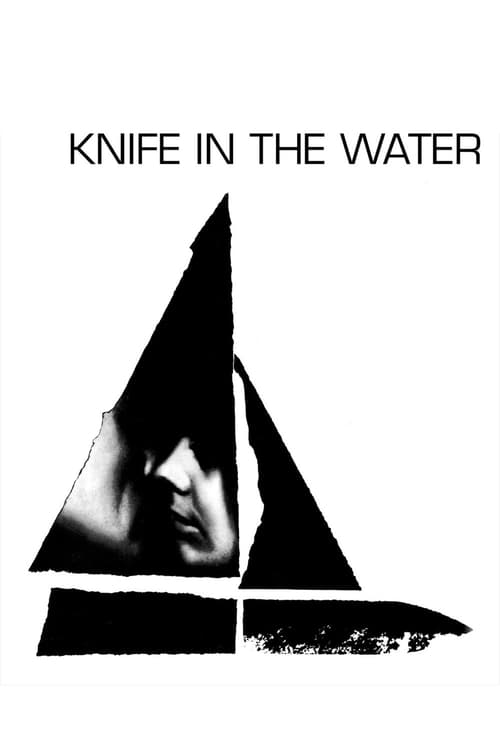
Knife in the Water
1962 · Roman Polanski
For when you're in the mood for slow-burn psychological tension rather than jump scares — a film to watch closely and argue about afterward, ideal for a focused, lights-off evening.
What it's about
A well-off Warsaw sports journalist and his younger wife, driving to their sailboat for a day on the lakes, nearly run down a young hitchhiker — and impulsively invite him aboard. Over the next day and night on the water, husband and stranger circle each other in an escalating contest of pride, class resentment, and sexual rivalry, with the wife watching from between them and the young man's switchblade glinting as the stakes rise.
The experience
Coiled and quietly menacing from the first minutes — nothing much 'happens' for long stretches, yet every glance and small humiliation tightens the screws. It's the kind of thriller that works on suggestion, leaving you tense and faintly implicated.
Performances
With only three actors on a boat, everything rests on the cast, and Leon Niemczyk's needling, self-satisfied husband is a masterclass in charm curdling into menace.
The craft
Polanski's debut is a marvel of economy — three characters, one boat, roughly one day — shot on real water with compositions that keep all three faces in the frame so you can watch every power shift live. Krzysztof Komeda's cool jazz score gives the menace an elegant, offhand swing.
Why it matters
It earned Poland its first Academy Award nomination for foreign-language film, landed Polanski on the world stage, and announced the obsessions — confinement, jealousy, the cruelty inside ordinary intimacy — that would define his career.
Snapshot
Knife in the Water (Nóż w wodzie) is Roman Polanski's feature debut, a taut three-hander staged almost entirely aboard a small sailboat on the Masurian Lakes of northern Poland. A bourgeois sports journalist, Andrzej, and his younger wife, Krystyna, pick up a hitchhiking student and impulsively bring him along for a day's sail; over the next eighteen hours the three are locked into a contest of masculine pride, sexual jealousy, and class resentment, the title's switchblade serving as both literal prop and a barometer of escalating threat. With only three speaking parts, a single confined location, and a near-continuous time scheme, the film is a model of dramatic economy. It announced Polanski's career-long preoccupations — confinement, psychological cruelty, the menace lurking inside ordinary intimacy — and became the first Polish film nominated for the Academy Award for Best Foreign Language Film, a breakthrough that put both the director and postwar Polish cinema on the international map.
Industry & production
The film was produced within Poland's state-controlled film system, where production was organized into semi-autonomous creative units (zespoły filmowe); Knife in the Water was made under the Kamera unit. This institutional context matters: every Polish feature passed through layers of approval, and a chamber drama with no war theme, no overt social message, and an unflattering portrait of a comfortable Communist-era professional class was an unusual proposition. Polanski had built his reputation through acclaimed shorts made at the Łódź Film School — notably Two Men and a Wardrobe (1958) — and the feature represented his bid to move from the avant-garde margins to mainstream production.
The shoot took place on location on the Mazurian Lakes, an environment that imposed real logistical hardship: cast and crew worked from boats, and the cinematographer at times operated from a raft or a second vessel to keep the confined deck in frame. The cast was deliberately small and partly non-professional — a budget-conscious and aesthetic choice that concentrated resources on performance and location rather than spectacle.
Politically, the film had a fraught reception at home. It is widely reported that Poland's Communist leadership, including Party head Władysław Gomułka, reacted with hostility to its apolitical, Western-facing sensibility, and the film was given limited domestic prominence even as it succeeded abroad. The international turn was decisive for Polanski's career: the Oscar nomination and a celebrated appearance on the cover of Time in 1963 helped open the path that soon led him to work in the West.
Technology
Knife in the Water is a black-and-white film shot on 35mm with the standard tools of early-1960s European production. Its technological interest lies less in novel equipment than in the discipline of shooting a dynamic, water-bound drama with conventional gear. Working on and around a moving sailboat demanded careful handling of an inherently unstable platform: keeping horizons, sails, and three bodies composed within a cramped deck while the vessel pitched and the light shifted across an open sky. The production leaned on natural light and the reflective, changeable conditions of the lake — bright glare, gathering cloud, fog, and night — as expressive resources rather than obstacles. The film's sound was post-synchronized in keeping with the era's Polish practice, a fact with consequences discussed below.
Technique
Cinematography
The photography is by Jerzy Lipman, one of the major Polish cinematographers of the period (he had shot Andrzej Wajda's A Generation and Kanał). His work here is the film's most celebrated craft achievement. Within the tiny space of the boat, Lipman and Polanski generate constant compositional invention: faces pressed into the extreme foreground while a second figure looms in the middle distance and a third recedes at the stern, so that the frame itself stages the shifting power triangle. Deep, layered compositions keep all three relationships legible in a single shot, and low angles set against the open sky lend the figures a monumental, trapped quality. The lake's weather becomes dramaturgy — the brightness of midday giving way to oppressive calm, squall, and an enveloping nighttime fog that mirrors the characters' moral disorientation. The camera's mobility, achieved despite the unstable platform, prevents the single location from ever feeling static.
Editing
The cutting serves the film's compression of time and space. Because the action unfolds in near-continuous real-ish time over a single voyage, the editing emphasizes continuity and the steady ratcheting of tension rather than elliptical montage. Cuts track the migration of advantage among the three characters — a glance, a chore, a small humiliation — and the rhythm tightens as the rivalry sharpens toward the overboard crisis. The withholding of a conventional climax, and the famously suspended final shot at a roadside, depend on editorial restraint as much as on the script.
Mise-en-scène / staging
The boat is the film's organizing principle: a stage roughly the size of a room, with masts, rigging, ropes, and a cramped cabin that function as a constantly reconfigured set. Polanski choreographs the three bodies around this apparatus so that ordinary nautical tasks — raising a sail, tying off, bailing — become tests of competence and dominance. Andrzej weaponizes his expertise to belittle the younger man; the student's clumsiness and then his physical ease become counters in the same game. The knife itself is staged as a recurring object of fascination and threat, passed between hands and games. The confinement is total and deliberate: there is almost nowhere for the characters, or the audience, to escape the pressure.
Sound
Sound is one of the film's defining elements, in two registers. First, the diegetic soundscape — wind, water, the creak of rigging, radio broadcasts — grounds the drama in a tactile physical world and amplifies the silences in which hostility festers. Second, and central to the film's identity, is the jazz score by Krzysztof Komeda, whose cool, plaintive saxophone-led music (most memorably a recurring ballad theme) supplies a modern, melancholy counterpoint to the suspense and lifts the film into an atmosphere of existential disquiet rather than mere thriller mechanics. Because the film was post-synchronized, the voice of the hitchhiker — played by Zygmunt Malanowicz — was dubbed by Polanski himself, a notable authorial intrusion into the soundtrack.
Performance
The three-person ensemble carries the film. Leon Niemczyk, the only established professional in the cast, plays Andrzej with a controlled, self-satisfied authority that curdles into insecurity. Jolanta Umecka, a non-professional reportedly discovered by Polanski, brings an opaque, watchful quality to Krystyna; her restraint makes the wife the film's quiet moral and observational center. Zygmunt Malanowicz, a young theater actor, gives the student a mix of sullen bravado and vulnerability, though — as noted — his vocal performance was supplied in post by the director. The acting is calibrated to the close, sustained scrutiny of the camera, where small shifts of expression register as dramatic events.
Narrative & dramatic mode
The film operates as a chamber drama compressed into a near-classical unity of time, place, and action: one day, one boat, three people. There is little plot in the conventional sense; the engine is psychological, a continuous duel of dominance and desire. Polanski refuses melodramatic payoff. The apparent catastrophe — the young man knocked overboard and presumed drowned — resolves not into tragedy but into a more corrosive ambiguity, and the film ends on a deliberately unresolved note, the couple stalled at a crossroads, unable to confront what has or has not happened between them and the student. The mode is observational and ironic, attentive to behavior and gesture, and committed to discomfort over catharsis.
Genre & cycle
Knife in the Water sits at the intersection of psychological drama and slow-burn thriller, with the suspense generated almost entirely from interpersonal pressure rather than external danger. It belongs to the lineage of the confined-space chamber thriller and the eternal triangle drama, and it inaugurates a recognizable Polanski cycle of claustrophobic, few-character studies of menace within enclosed settings that runs forward through Repulsion, Cul-de-sac, and beyond. Its restraint and ambiguity also align it with the broader European art-cinema turn of the early 1960s, in which genre frameworks were retained as scaffolding for psychological and existential inquiry.
Authorship & method
This is fundamentally a Polanski film, and it establishes his method: tight control of confined space, characters trapped together under mounting pressure, cruelty conducted through games and humiliations, and an ironic refusal of moral resolution. The screenplay was written by Polanski with Jakub Goldberg and Jerzy Skolimowski; Skolimowski, who would soon become a significant director in his own right, is often credited with sharpening the dialogue and contemporary edge of the younger character. Cinematographer Jerzy Lipman translated Polanski's spatial conception into the film's layered, deep compositions. Composer Krzysztof Komeda began here a crucial collaboration with Polanski that continued across several films until Komeda's death in 1969; his jazz idiom is inseparable from the film's tone. Polanski's hands-on authorship extends literally into the soundtrack through his dubbing of the hitchhiker's voice. The film's precision and confidence are striking for a feature debut and reflect the rigorous training of the Łódź school combined with Polanski's own command of the short form.
Movement / national cinema
The film emerged from Polish cinema during the fertile period that followed the post-1956 political thaw, the era associated with the so-called Polish Film School. Yet Knife in the Water is in important respects a departure from that movement's dominant concerns. Where the Polish School — exemplified by Wajda — was largely preoccupied with the trauma of the Second World War, occupation, resistance, and national history, Polanski turned resolutely to the present, the private, and the psychological, with no war, no patriotic frame, and an implicit critique of contemporary social aspiration. In doing so it pointed toward a more individualist, internationally legible art cinema and helped mark a generational shift in Polish filmmaking, even as it drew on the same pool of talent and institutions.
Era / period
Made at the turn into the 1960s, the film is contemporaneous with the high European new waves and modernist art cinema, and it shares their interest in ambiguity, behavioral observation, and the erosion of classical narrative closure. At the same time it registers a specific Eastern Bloc moment: a small comfortable elite — car, boat, leisure — within a nominally egalitarian society, and the frictions of class and generation that the official culture preferred not to dramatize. The film's cool jazz textures and modern visual style place it firmly in the international early-’60s moment while its social undercurrents are distinctly Polish.
Themes
The film's central theme is the struggle for dominance between men, played out as a contest of competence, virility, and pride, with the wife as both prize and judge. Class and generation are inseparable from this: the settled, propertied older man against the restless, unmoored young student, each contemptuous of the other's world. Sexual jealousy and desire run beneath every exchange, surfacing in glances and small transgressions rather than in overt drama. Confinement — physical, marital, social — is the governing condition, with the boat as a pressure vessel. And over it all hangs the threat of violence, embodied in the knife, which the film treats as latent potential more than realized act. The unresolved ending crystallizes a final theme: the impossibility of return to innocence once cruelty and possibility have been exposed within a marriage.
Reception, canon & influence
Internationally, the film was a critical success and a landmark for Polish cinema, earning the country's first Academy Award nomination for Best Foreign Language Film and bringing Polanski to wide attention, including a prominent feature in Time. (At the same award ceremony the prize went to Federico Fellini's 8½.) Its domestic reception was more constrained, given official displeasure with its apolitical, Westward-looking sensibility. Over time it has settled firmly into the international canon as a major debut and as the seed of Polanski's body of work; it has been preserved and reissued by prestige distributors and remains a fixture of art-cinema repertory.
Looking backward, the film absorbs several influences: the suspense architecture and psychological gamesmanship associated with Hitchcock; the chamber-drama tradition of confining a small group of characters to expose them; the modern observational ethos of contemporaneous European art cinema; and the cool sensibility of postwar jazz, channeled through Komeda. Looking forward, its legacy is substantial. It launched Polanski's career and prefigured the confined-space psychological menace of his later films. Its co-writer Skolimowski went on to a distinguished directing career, and Komeda's collaboration with Polanski became one of the notable director-composer partnerships of the 1960s. More broadly, the film stands as an influential template for the minimalist three-character thriller of dominance and desire — proof that a single boat, three people, and a knife could sustain a feature of lasting tension. Beyond these well-documented lines of influence, claims of specific direct borrowings by later filmmakers should be treated cautiously, as the record there is more a matter of shared sensibility than of attributable lineage.
A Deleuzian reading
A boat the size of a room, three people who can't get off it, and a switchblade that keeps changing hands.
The full Deleuzian reading of Knife in the Water →
Reception
Denounced at home — Poland's Communist leader Gomułka reportedly hated it, and the state press trashed it as decadent and un-socialist — it promptly became the first Polish film nominated for the Best Foreign Language Film Oscar (losing to Fellini's 8½). Now it's canon: one of the most acclaimed debut features ever made.
How Knife in the Water was received, from release to now →
Influences: the films it descends from and the films it influenced
- Lifeboat (1944) — Stages an entire feature within the physical confines of a single boat, the spatial-confinement template Polanski transplants onto the sailboat to trap his cast under continuous pressure.
- Rope (1948) — Builds a chamber thriller obeying the classical unities of time and place, sustaining tension through near-continuous staging rather than cutting away — the editing-as-pressure logic Polanski adopts.
- Rear Window (1954) — Derives suspense architecture from a single restricted vantage and voyeuristic power play, the Hitchcockian gamesmanship the dossier names as a direct influence.
- Citizen Kane (1941) — Pioneers deep-focus and low-angle compositions that hold foreground and background in simultaneous dramatic tension — the layered, low-angle-against-sky framing Jerzy Lipman echoes on deck.
- L'Avventura (1960) — Sets a yacht-and-island drama of bourgeois ennui with an unresolved ending and patient observational staging, modeling the modern European art-cinema ethos and refusal of resolution.
- Ashes and Diamonds (1958) — Shot by the same cinematographer Jerzy Lipman, whose Polish-school deep-staged, sky-tilted low-angle compositions and high-contrast natural light carry directly into the boat.
- Purple Noon (1960) — Extends the yacht-as-floating-stage device — a confined boat turning class resentment and sexual tension into a three-hander pressure-cooker of psychological menace under open sky.
- Summer with Monika (1953) — Takes the archipelago boat trip and makes it the entire film — three people, one hull, deep-focus staging in cramped water — extending Monika's discovery that a small craft on open water is the cleanest arena for class resentment and sexual challenge.
- Repulsion (1965) — Extends Polanski's confined-space psychological menace into a single apartment, distilling the trapped-character method this debut established.
- Cul-de-sac (1966) — Reprises the three-hander of dominance and humiliation in an isolated single location, the most direct restatement of the seed's narrative geometry.
- Rosemary's Baby (1968) — Continues the Polanski–Komeda director-composer partnership begun here and the slow-build confinement-paranoia of a closed domestic space.
- Death and the Maiden (1994) — Reduces to a three-character chamber thriller of shifting dominance bound to one house over a single night, a late return to the form.
- Carnage (2011) — Honors the classical unities in a single-room piece where social humiliation escalates among a handful of trapped characters, refusing tidy moral closure.
- Deep End (1970) — The co-writer's own direction extends the film's youthful, claustrophobic sexual tension, carrying forward the contemporary edge he sharpened in the screenplay.
- Dead Calm (1989) — Confines a three-hander of dominance and threat to a single yacht at sea, the boat-bound three-character thriller template proven viable here.
- Funny Games (1997) — Conducts cruelty through games, rules and humiliations imposed on a trapped group, sharing Polanski's ironic withholding of catharsis.
- The Swimming Pool (1969) — Three-person triangulation of desire and violence within a single sealed leisure space — a boat substituting for a pool — building through enforced proximity and pressurized-restraint editing to sudden violence is the nautical template La Piscine transposes precisely to the Riviera villa.
- Ivy (2015) — The confined-vessel three-hander of shifting dominance and class resentment, staging an ensemble psychodrama entirely aboard a boat with escalating, unlikeable power games.
- Shallow Grave (1994) — Three-hander blocking in which every shift of alliance is staged as a change in triangular geometry — two bodies close, one excluded in depth — so the power struggle is legible as composition before it is spoken.
- The Shout (1978) — Skolimowski co-wrote its closed three-hander in which an uninvited stranger converts a couple's private space into a duel of physical dares and withheld motive — the same dramaturgy of two men competing over a woman through demonstrations of power rather than argument.
- Elevator to the Gallows (1958) — Scores its modern unease with a cool, improvised postwar jazz idiom laid over the image — the same jazz-noir sensibility Komeda channels here in his first Polanski collaboration.
- Who's Afraid of Virginia Woolf? (1966) — Confines a tiny group across one night to a single setting where cruelty is conducted through escalating games and humiliations — the dominance-and-desire chamber dynamic in another key.
- Force Majeure (2014) — Pressure-tests masculine dominance and emasculation among a small group sealed in close quarters, the chamber study of a man's authority unraveling.
Similar films
- Repulsion (1965) — influence & lineage · often watched together
- Cul-de-sac (1966) — influence & lineage
- L'Avventura (1960) — influence & lineage
- Lifeboat (1944) — influence & lineage
- Rosemary's Baby (1968) — influence & lineage
- Funny Games (1997) — influence & lineage
- Macbeth (1971) — often watched together
- The Tenant (1976) — often watched together
All the films related to Knife in the Water →
Watch it with: curated runs of related films
- The Paranoid and the Obsessed — A run of stylish thrillers about lone men consumed by a hidden pattern, a betrayal, or a truth they can't stop chasing — each staged with more virtuosity than the plot strictly needs.