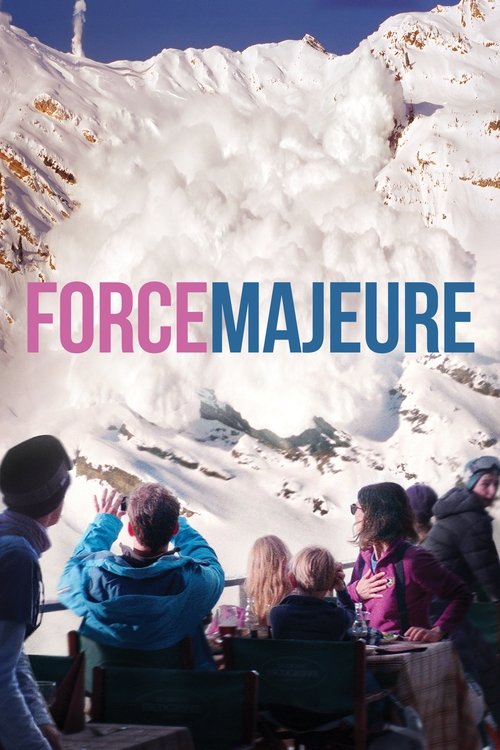
Force Majeure
2014 · Ruben Östlund
Two-time Palme d'Or winner (The Square, Triangle of Sadness) whose eat-the-rich satires get accused of being smug about smugness; the vomiting-yacht sequence became a cultural shorthand. Loved and resented in roughly equal measure — which is the point.
For when you want something to chew on and argue about — a razor-sharp, uncomfortable watch that turns 'what would you have done?' into the whole evening's conversation. Choose it for a sharp night, not a soothing one.
What it's about
A picture-perfect Swedish family is lunching on a ski-resort terrace in the French Alps when a controlled avalanche seems, for a few seconds, to be coming straight for them — and the father grabs his phone and runs, leaving his wife and kids at the table. No one is hurt. But over the next five days of the holiday, the marriage cracks open around what he did and what he refuses to admit.
The experience
Excruciating and very funny at the same time — a comedy of squirm where every dinner-party conversation becomes a minefield. You'll laugh, wince, and possibly start an argument with whoever you watch it with.
Performances
Johannes Kuhnke is painfully good as a man dismantled by his own denial, and Lisa Loven Kongsli matches him as the wife who can't stop pressing the bruise — two performances of escalating, exquisitely calibrated discomfort.
The craft
Ruben Östlund composes the resort in cold, immaculate wide shots — long, static takes that trap the family in frame and let the awkwardness ripen — with the mountain's booming avalanche cannons punctuating the nights. The precision is the comedy: it's staged like a lab experiment on a marriage.
Why it matters
A Cannes prizewinner that broke Östlund internationally and spawned an American remake, it set the template for his career of social-squirm cinema and became shorthand for a certain kind of masculinity in crisis.
Snapshot
A Swedish family on a luxury ski holiday in the French Alps witnesses a controlled avalanche that briefly appears to threaten their terrace lunch. In that moment, the father, Tomas, grabs his phone and flees, leaving his wife Ebba and their two children behind. The avalanche dissipates harmlessly. No one is physically harmed. The rest of the film is the aftermath: five days in which Ebba cannot reconcile what she saw with who her husband is supposed to be, and Tomas cannot admit — even to himself — that anything happened at all.
Force Majeure (Swedish title: Turist) is a chamber drama staged with the precision of a thought experiment. It is, at its core, a film about the distance between social performance and instinctive behavior, and about the institutional fictions — marriage, masculinity, the bourgeois family — that social performance is required to sustain. Cannes gave it the Un Certain Regard Jury Prize in 2014. It became one of the most discussed European films of the decade.
Industry & Production
The film was produced by Erik Hemmendorff through Plattform Produktion, the Swedish production company that has served as the institutional home for Östlund's mature work. Co-production credits involved European partners including the French company Coproduction Office, overseen by Philippe Bober, who has backed demanding auteur projects (notably Michael Haneke's late films). This co-production structure gave Force Majeure a pan-European footprint at the financing stage that matched its thematic terrain — the anxieties of prosperous, secular Northern European liberal society — and helped secure theatrical distribution across European markets.
The shoot took place primarily at Les Arcs ski resort in the Savoie département of the French Alps. Östlund and his crew were working in genuinely extreme conditions: high altitude, sustained cold, blinding reflected light, and the logistical complexity of coordinating cameras and cast on groomed ski runs. The hotel interiors were purpose-chosen for their clean, almost clinical modernism — glass, steel, white — which the film uses as architectural expression of its themes. The choice to film on location rather than construct sets is consistent with Östlund's method of forcing his actors into real physical environments that they cannot fully control.
The film was Sweden's official submission for the Academy Award for Best Foreign Language Film at the 87th ceremony (2015). It did not receive a nomination, though it circulated extensively in the awards conversation and achieved wide art-house release in North America through Magnolia Pictures.
Technology
Force Majeure was shot digitally, consistent with the production practices of high-end European auteur cinema by the mid-2010s. The cinematographer Fredrik Wenzel has noted the technical challenges of exposing for snow: white Alpine surfaces compress dynamic range and demand careful calibration to avoid blown-out highlights while retaining shadow detail in faces. The film's visual palette — cold whites, slate grays, the blue hour of late afternoon alpine light — is achieved through a combination of controlled exposure and restraint in the color grade, which refuses to warm or glamorize the landscape.
The film makes extensive use of static wide-angle compositions, which places unusual demands on focus and depth of field: figures must remain sharp across considerable distance from the lens. The controlled avalanche sequence that triggers the film's central crisis required coordination with resort safety teams; the rolling white cloud advancing on the terrace is captured from a distance that emphasizes its sublime scale without the manipulation of digital compositing. The documentary-style remoteness of that shot — held, watching, not cutting away — is itself a form of technology in service of meaning.
Technique
Cinematography
Fredrik Wenzel's work on Force Majeure is defined by withdrawal. The camera observes from a distance, typically in wide shot, and rarely moves. Characters are often filmed in the corridors of the hotel from the far end of the hallway, their approach or recession constituting the action. Conversational scenes that in conventional filmmaking would be covered in shot-reverse-shot are here held in a single, unbroken two-shot or wider, forcing the viewer to read both faces simultaneously rather than being editorially directed toward one.
This observational distance has two effects. First, it approximates the perspective of a social scientist or behavioral researcher watching a specimen — an analogy Östlund has explicitly acknowledged in interviews as informing his method. Second, it prevents the audience from emotionally identifying with any single character and instead positions them as judges, which is precisely the uncomfortable role the film's thematic content demands. You watch the avalanche scene from across the terrace, at the same remove as the family, and you watch Tomas flee; you cannot pretend you would have done otherwise, but you also cannot escape the judgment.
The Alpine landscape is used as a formal counterpoint: vast, indifferent, geometrically perfect in its groomed whiteness. When Östlund cuts to the mountains — slow, nearly abstract shots of powder-coated slopes and mechanical lifts — the effect is less postcard than existential. The world does not register the drama occurring in the hotel.
Editing
The film was edited by Jacob Secher Schulsinger, who has collaborated with Östlund across his mature work. The editing strategy mirrors the cinematographic one: duration is weaponized. Scenes run longer than narrative economy would require, particularly the scenes in which Tomas is confronted by Ebba and — worse — by other couples who have heard the story. The embarrassment is not resolved by a cut; the camera sits with it, and the viewer sits with it, until the social situation becomes physically uncomfortable to watch. This is a deliberate technique: Östlund and Schulsinger use editorial duration not to develop interiority but to generate anxiety about social norms.
The film is structured in five titled chapters, each corresponding to a day. This chapter structure imposes a formal frame on what is otherwise a tightly confined drama, lending it a pseudo-clinical quality, as though we are reading case notes rather than watching a story. Chapter headings appear in clean sans-serif type, matching the hotel's aesthetic.
Mise-en-scène / Staging
Östlund's staging is meticulous and, in several key scenes, choreographic in its precision. The dinner table scenes — in which Ebba first publicly raises the question of what Tomas did — are staged so that every shift in posture, every glance toward a witness, every attempt to change the subject registers as social information. The other couple at the table functions as an audience-within-the-film, their discomfort mirroring ours, their attempts to defuse or ignore the situation illustrating the social machinery that such confrontations threaten.
The hotel corridor recurs as a significant space: long, symmetrical, impersonal, it literalizes the film's interest in domesticity stripped of domesticity's comforts. Characters walk these corridors at odd hours, smoke on balconies in the dark, sit in the kind of anonymous luxury that provides no emotional resource. The mountain as backdrop — always visible through glass, always immense — enforces scale. The family is very small; the landscape does not care.
Sound
The sound design is among the film's most distinctive elements. Östlund and his sound team use Vivaldi's The Four Seasons — specifically passages from "Summer" — at several charged moments, deployed not as ironic commentary but as something closer to formal punctuation. The choice of Baroque music against Alpine modernity creates a disjunction that is tonal rather than humorous: it elevates the domestic drama to a kind of operatic pitch without sentimentalizing it.
The ambient sound of the resort is as carefully designed as the score: the mechanical groaning of ski lifts, the pneumatic hiss of artificial snowmaking, the particular silence of deep snow, which is a different silence from ordinary quiet. When the controlled avalanche rolls toward the terrace, the sound design leads — the deep percussive rumble — before the visual effect fully registers. The family's screaming, Ebba's calling of the children's names, lands against the sound of the dissipating snow and feels, retrospectively, obscenely loud.
Performance
Johannes Kuhnke as Tomas and Lisa Loven Kongsli as Ebba give performances of careful physical precision. Östlund rehearses extensively and directs toward behavioral specificity rather than emotional expression: what matters is not that Tomas feels shame but that he performs the social motions of non-shame, the slight over-animation, the over-insistence, the conspicuous busy-ness that signals avoidance to anyone watching. Kuhnke renders this with unnerving accuracy. Kongsli's Ebba is colder and more methodical — she watches, she waits, she tests, she does not offer comfort she doesn't feel.
The children (played by Clara Wettergren and Vincent Wettergren) are used sparingly but effectively: their baffled witness to adult dysfunction is a recurring note, and their loyalty to their father — which the film refuses to interrogate — adds a further layer of ethical complexity to Ebba's position.
Narrative & Dramatic Mode
Force Majeure belongs to a dramatic tradition of extreme behavioral compression: a single incident, a small group, an enclosed space. The film is not interested in plot in any conventional sense — nothing happens, externally, after the first ten minutes. What the film tracks instead is the social and psychological work required to not-resolve what happened, to maintain the performance of normalcy under pressure.
The dramatic mode is Ibsenite in structure: a secret, a social surface maintained over the secret, a series of scenes in which the surface is probed and yields. But Östlund does not provide the melodramatic eruption that Ibsen's model eventually requires. When Tomas does break — in a scene of protracted, embarrassing weeping that feels more childlike than cathartic — Ebba's response is ambiguous enough to refuse the audience the release of earned reconciliation. The film ends on notes of contingency and unresolved tension that read as more honest than comfort.
Genre & Cycle
The film occupies an identifiable sub-genre of European art cinema: the bourgeois couple under strain, examined with maximum cool and minimum sentimentality. Its immediate cycle includes Haneke's Caché (2005) and Amour (2012), Joachim Trier's early Norwegian films, and — further back — Ingmar Bergman's Scenes from a Marriage (1973), to which comparisons were made immediately and persistently upon the film's release. The comparison to Bergman is apt in terms of structural economy and emotional subject matter, though the generational and cultural distance between Bergman's psychologically dense, talky drama and Östlund's behavioral, sociological method is worth maintaining.
The film also participates in a cycle of what might be called Nordic social autopsy: films that apply cold formal intelligence to the pathologies of comfortable Scandinavian liberalism. Roy Andersson is a predecessor here, though Andersson's surrealism is entirely foreign to Östlund's naturalist surfaces.
Authorship & Method
Ruben Östlund was born in Styrsö, Sweden, in 1974. He studied film at the Göteborg Film School. His early features — The Guitar Mongoloid (2004) and Involuntary (2008) — established the central preoccupations of his mature work: social embarrassment, the gap between social performance and instinctive behavior, the comedy and tragedy of people caught in norms they cannot inhabit. Play (2011), which depicted a group of boys systematically humiliating and robbing other children, was his most controversial work before Force Majeure, and generated significant critical and ethical debate in Sweden.
Force Majeure was the film that achieved his international breakthrough. It was followed by The Square (2017), which won the Palme d'Or at Cannes, and Triangle of Sadness (2022), which also won the Palme d'Or — making Östlund only the fifth director to win the Palme twice, and the first Swede.
His method is research-adjacent: Force Majeure reportedly originated from Östlund reading accounts of incidents in which adults had abandoned children during moments of mortal danger, and from a broader interest in the sociology of male self-preservation. He tends to script scenes in behavioral terms — what the character does — rather than psychological or emotional ones. His collaborative relationship with cinematographer Fredrik Wenzel has produced a consistent visual grammar across multiple films.
The film was written by Östlund alone.
Movement / National Cinema
Swedish cinema has a distinguished auteurist tradition anchored by Bergman, and Force Majeure inherits that tradition's interest in the couple as the unit of social and psychological drama. But the national cinema context is less important to the film's reception than the broader European art-house frame within which it circulates. Sweden's high production values, its film funding infrastructure (support from the Swedish Film Institute is credited), and its tradition of state-supported auteur production give films like this a structural basis for international distribution that smaller or less well-funded national cinemas cannot match.
The film's Swedish identity is nevertheless thematically load-bearing: the particular flavor of its masculinity crisis is a Nordic one, set against Sweden's historical self-presentation as a progressive, gender-equal society. Tomas's failure reads differently — more charged, more specifically indicting — within that cultural self-image than it would within, say, Italian or American cultural contexts. Several critics noted this explicitly.
Era / Period
Force Majeure arrives in 2014 at a moment when European art cinema was experiencing a sustained critical revival, with festivals — Cannes in particular — providing institutional support for formally rigorous, commercially challenging work. The film's attention to masculinity and its performance was broadly timely; its questions about male instinct, social expectation, and the performance of courage became more pointed after 2017, in the context of the cultural conversations accompanying the #MeToo movement. Several retrospective assessments in 2017–2018 read it as prophetic about the gap between men's professed values and their behavior under pressure. Östlund has resisted overly schematic political readings while acknowledging the film's engagement with gender politics.
Themes
The central thematic concern is the distance between the self one performs and the self one discovers in extremity. Tomas does not decide to flee; he flees. The film is interested in this pre-cognitive action as a revelation — not necessarily a moral condemnation, but an empirical fact about who Tomas is that his social persona had concealed, including from himself.
Surrounding this central problem are several related concerns: the marriage as a social contract that presupposes a fiction of mutual knowledge; the performance of masculinity as protective provider in Nordic liberal society, where the explicit ideology has largely abandoned traditional gender roles but the affective expectations have not; the role of witness in social judgment (other couples function as mirrors, reflecting the Jonsson family's dysfunction back at amplified pitch); and the institution of the family holiday as a site that stages bourgeois happiness as an obligation.
The mountains function as a thematic register: the landscape's indifference, its capacity for sudden lethal force, its resistance to human meaning-making. The avalanche is not malicious; it is simply a release of accumulated material following the laws of physics. The film implies a parallel: Tomas's flight is also, at one level, simply a release of accumulated animal instinct following its own laws. The moral horror lies in what that reveals about the architecture of the self.
Reception, Canon & Influence
Critical reception was strongly positive. The Un Certain Regard Jury Prize at Cannes 2014 conferred immediate prestige, and the film benefited from the kind of critical conversation — in which reviewers disagree about its sympathies and its moral position — that sustains a film's life beyond its initial release. Some critics found its treatment of Tomas too severe; others found it insufficiently severe; still others argued Ebba's character was underwritten. The disagreement itself testified to the film's genuine ambiguity. A. O. Scott in The New York Times praised its formal rigor; the British press was largely enthusiastic.
Influences on the film (backward): Bergman's Scenes from a Marriage is the most frequently cited precursor — the couple in an enclosed environment, examined without comfort. Haneke's formal severity, particularly Caché and The Piano Teacher, inflects Östlund's methods: the static camera, the refusal of conventional emotional release, the audience's implication in social judgment. Roy Andersson's influence is discernible in the attention to social embarrassment as subject matter, though Andersson's visual grotesquerie is absent. Eric Rohmer's moral tales — philosophical comedies about social behavior, filmed with similar intimacy — are a less frequently cited but arguably important precursor.
Legacy and influence (forward): The most direct measure of the film's commercial reach is the American remake Downhill (2020), directed by Nat Faxon and Jim Rash, starring Will Ferrell and Julia Louis-Dreyfus. Downhill was received as a significant diminishment of the original — broader, more conventionally resolved, less willing to maintain the original's discomfort — and the comparison itself served to consolidate Force Majeure's canonical status by contrast.
The film's influence on subsequent European art cinema is harder to trace with specificity, as is appropriate for a work that achieves its effects through restraint rather than stylistic spectacle. Its behavioral precision and its interest in social performance under pressure can be felt in a number of subsequent relationship dramas, though attributing specific debts requires more documentation than the record currently provides. More certain is its role in establishing Östlund as a major figure of European cinema: The Square and Triangle of Sadness would not have been made, or made on those terms, without Force Majeure's international success. In that sense, its forward influence runs first through its director, who became a model and champion of a particular kind of formally rigorous, socially engaged, darkly comic European auteurism.
A Deleuzian reading
Watch the phone.
The full Deleuzian reading of Force Majeure →
Reception
An instant arthouse hit — it took the Un Certain Regard Jury Prize at Cannes 2014 and became a word-of-mouth sensation as 'the avalanche movie' — and its standing has only climbed since, now viewed as the film that launched Östlund's run toward two Palmes d'Or.
How Force Majeure was received, from release to now →
Influences: the films it descends from and the films it influenced
- Scenes from a Marriage (1973) — Originated the Ibsenite couple-drama template Östlund directly inherits: the long-take chamber scene in which marital social performance collapses not through confession but through behavioral evasion, with characters talking past each other across a table until the gap between performed role and felt truth becomes unbearable.
- Caché (2005) — The static wide shot held past the point of emotional comfort — Haneke's discipline of parking the camera at observational distance so the audience cannot take refuge in close-up empathy — is the direct model for Östlund's avalanche aftermath sequence and the dinner confrontations, where the frame refuses to editorialize.
- The Piano Teacher (2001) — Behavioral performance observed with sustained fixed-camera distance — Huppert inhabiting rather than demonstrating interiority — models the approach Östlund takes with his actors: Kongsli's Ebba does not explain her emotional state through reaction shots but enacts it in real time, and the camera simply watches.
- Songs from the Second Floor (2000) — The Nordic social autopsy delivered through fixed-camera tableau in transitional spaces — corridors, lobbies, stairwells — where characters perform embarrassment without editorial rescue; Östlund borrows this staging logic for the ski resort's corridors and the restaurant scene, where the frame treats social disaster as specimen.
- You, the Living (2007) — Extended fixed-frame takes in which mundane social failure plays out to its full uncomfortable duration — the refusal to cut away being itself the moral observation — gives Östlund the grammar for his prolonged cringe-comedy scenes where a shorter cut would be mercy the film withholds.
- Ma Nuit chez Maud (1969) — The Moral Tale structure — bourgeois characters confined by Alpine weather, forced into extended dialogue that is really philosophical negotiation about ethics and self-image — is the architectural template Östlund applies: the ski resort as Rohmer pressure cooker, Tomas as a man whose stated values and revealed instincts refuse to align.
- The Celebration (1998) — Established the Scandinavian tradition of the family gathering as social-performance rupture site: the enclosed group setting where behavioral specificity and chapter-like scene architecture expose the gap between performed domestic roles and instinctive responses under pressure — Force Majeure inherits this social grammar entirely.
- Involuntary (2008) — Östlund's direct precursor established his core method — the fixed-frame long take in which characters navigate social embarrassment in real time across multiple parallel vignettes — including the chapter structure and the thematic engine: people caught between instinctive behavior and social norm, with no resolution offered.
- The Discreet Charm of the Bourgeoisie (1972) — Östlund's static-camera ensemble staging of bourgeois self-deception — characters insisting on their own social coherence while behaving absurdly — directly extends Buñuel's comedy of collective ironic naturalism in the deadpan European tradition.
- Through a Glass Darkly (1961) — Östlund inherits Bergman's specific staging method: figures placed at precise architectural distances that enact emotional unavailability, the bourgeois family's psychological fracture made legible through blocking and framing rather than dialogue, deploying the Swedish chamber-drama tradition of spatial arrangement as moral exposure.
- Autumn Sonata (1978) — Östlund adopts the two-hander confrontation structure with precision: a single incident of revealed cowardice destabilizes a marriage across a series of sustained confrontation scenes in which the camera holds on faces until the social performance of the marriage collapses, the hotel room functioning as Autumn Sonata's domestic threshold.
- The Exterminating Angel (1962) — Confined Alpine resort setting used for anthropological dissection of bourgeois family performance under duress; deadpan ensemble observation of social codes collapsing in real time mirrors Exterminating Angel's sustained exposure of social pretense.
- The Square (2017) — Extends Force Majeure's chapter-structured anatomy of bourgeois social performance into art-world institutional critique — same static wide shots, same behavioral comedic discomfort held at observational distance — scaling the enclosed couple drama outward to the museum as the ski resort's institutional equivalent.
- Triangle of Sadness (2022) — Carries Force Majeure's fixed-camera observational grammar and chapter structure into class satire — the dining-room vomit sequence and the toilet confrontation deploy the identical technique of holding a shot through social and physical collapse past the point where convention would cut, now with a larger ensemble and a more explicitly schematic social allegory.
- Downhill (2020) — The American remake preserves the chapter structure and incident architecture of the original while systematically abandoning the static wide-shot discipline, extended-duration commitment, and ambient sound design — functioning as an involuntary control experiment that isolates precisely which formal choices generate Force Majeure's moral discomfort rather than its plot.
- Dream Scenario (2023) — The clinical-naturalist framing of male social humiliation, holding wide static compositions on a man's collapse of status until it becomes excruciating comedy.
- The Drama (2026) — The static, symmetrically framed long take that pins a couple in place through an escalating social rupture until the comedy curdles into humiliation — Borgli's core discomfort grammar.
- Amour (2012) — Haneke's fixed-camera extended-duration couple drama in an enclosed domestic space — same grammar of observational distance, ambient sound design foregrounded over score, refusal of musical sentimentality — runs directly parallel to Force Majeure's methods, situating both films in a shared formal project of watching bourgeois couplehood under pressure without blinking.
- A Separation (2011) — Bourgeois couple drama structured around a moral ambiguity that neither character resolves by the final frame — behavioral specificity in performance, extended scenes without close-up emotional anchoring — producing the same audience position of suspended moral judgment that Östlund achieves through different national cinema means.
- The Hunt (2012) — Nordic social autopsy using behavioral performance and observational camera to examine how a community's social performance and instinctive reactions diverge under accusatory pressure — the male protagonist's crisis of social belonging and the gap between his self-image and others' perception mirrors Force Majeure's thematic core exactly.
- Toni Erdmann (2016) — German art cinema parallel using extended improvisation-rooted behavioral scenes and a fixed observational camera to anatomize bourgeois social performance and familial power dynamics — same refusal of conventional comedic resolution and same willingness to sustain a scene past comfort until the social mask cracks — arriving at Force Majeure's methods from a different national tradition.
- Kontinental '25 (2025) — Pursues the parallel project of clinically dissecting middle-class moral cowardice through observational frontal staging and excruciating dialogue scenes of self-justification.
- Dogtooth (2009) — Östlund uses static wide-angle tableau framings and behavioral absurdism to expose bourgeois male identity performance — characters behaving according to social scripts that have catastrophically misfired — sharing Dogtooth's proscenium logic of placing rule-governed behavior in naturalistic domestic space without tonal editorializing.
- Creepy (2016) — Extended-take observation of social interaction under pressure that reveals professional masculine competence as performance concealing structural failure; Östlund's inheritance of Haneke's observational distance applied to domesticity runs in direct parallel with Kurosawa's.
- The Killing of a Sacred Deer (2017) — Östlund independently deploys the same formal vocabulary — metronomic pacing, symmetrically staged wide framings, performance as social mask — in a cold dissection of bourgeois family self-exposure under existential pressure, demonstrating a convergent pan-European formal development.
- Loveless (2017) — Cold Scandinavian diagnostic-thriller mode applied to marital collapse through a single crisis event, using static long-take framing and anti-redemptive social dissection to expose the contractual rather than affective basis of modern couplehood — the same anatomy Loveless performs through prolonged parental absence.
- The Guilty (2018) — Östlund's cool palette, locked-off framings, and subject — a male professional whose self-image collapses under a revealed moral failure he cannot explain away — runs directly parallel to Möller's method and thematic architecture, representing the Scandinavian social-drama strand feeding the same craft tradition.
- Bugonia (2025) — Clinical wide-angle staging of bourgeois crisis with deadpan performances that withhold emotional resolution; the camera-as-ethnographer methodology that treats class behavior as specimen rather than subject, parallel to Lanthimos's anthropological staging.
- Anatomy of a Fall (2023) — The European marital autopsy format: a single contested act deconstructed through extended dialogic scenes in which each partner constructs a self-serving account; the scene pressed past its obvious endpoint as a formal instrument of pressure on the viewer's allocation of blame.
Similar films
- Triangle of Sadness (2022) — influence & lineage · same viewing thread
- The Celebration (1998) — influence & lineage · same viewing thread
- The Square (2017) — influence & lineage · same viewing thread
- Funny Games (1997) — same viewing thread
- Wild Tales (2014) — same viewing thread
- Anatomy of a Fall (2023) — shared sensibility
- Funny Games (2008) — shared sensibility
- A Man Called Ove (2015) — shared sensibility
All the films related to Force Majeure →
Watch it with: curated runs of related films
- When Everyone Finally Snaps — A run of films where an ordinary scene — a birthday dinner, a small town, a quiet house, a man at the end of his patience — gets pushed past its breaking point until the whole social order detonates.