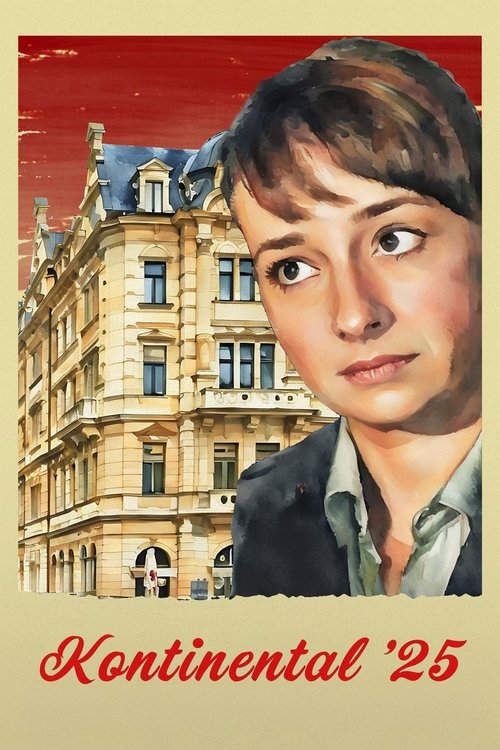
Kontinental '25
2025 · Radu Jude
The arthouse shitposter: Bad Luck Banging won the Berlinale, Do Not Expect Too Much from the End of the World skewered gig-economy Europe, and his AI-assisted Dracula trolled everyone — prolific, abrasive, and beloved by critics for exactly that.
For when you want a film to argue with — something sharp, morally knotty and bitterly funny that you'll be chewing on for days. Definitely challenge over comfort, but the humor keeps it alive.
What it's about
Orsolya is a bailiff in Cluj, Transylvania's booming main city, and evictions are simply her job — until the routine removal of a homeless man from a cellar ends in tragedy. Legally she did nothing wrong, and everyone keeps telling her so; morally she can't stop turning it over. The film follows her through the days after, as friends, family, priests and colleagues offer consolations that reveal more about a gentrifying, self-satisfied Europe than about her guilt.
The experience
Deadpan and talky in the best way — long, squirm-funny conversations where every reassurance Orsolya receives is also a small indictment. It's a comedy that keeps catching in your throat, unhurried and quietly devastating.
The craft
Radu Jude shot it fast and cheap, largely on an iPhone, and turns that rawness into a virtue: the film feels ripped straight from the present, its real-estate billboards and hotel developments doing satirical work in the background of nearly every frame. The writing is the star — essayistic, digressive, and razor-edged.
Why it matters
Another dispatch from one of Europe's most fearless working directors, it sharpened Jude's reputation for making urgent, formally loose films about complicity faster than anyone else can react to the news.
Snapshot
Kontinental '25 is Radu Jude's chamber-scaled moral fable about Orsolya, an ethnic-Hungarian bailiff in Cluj-Napoca whose routine eviction of a homeless man from a cellar ends in his death — and whose subsequent crisis of conscience the film follows with deadpan, essayistic patience. The title openly invokes Roberto Rossellini's Europa '51, in which Ingrid Bergman's bourgeoise is plunged into a spiritual reckoning by a death she feels complicit in; Jude transposes that template into the gentrifying, real-estate-fevered Transylvania of the present, where the "Kontinental" of the title attaches to a hotel/development scheme and, more broadly, to the idea of a European liberal conscience that cannot reconcile its comforts with its costs. Shot quickly and cheaply — by Jude's own account on an iPhone — the film premiered in competition at the Berlin International Film Festival in early 2025, where it won the Silver Bear for Best Screenplay. It belongs unmistakably to Jude's recent mode: discursive, joke-laden, politically caustic, and formally restless, yet here pared back to something closer to a sustained ethical dialogue than the maximalist collage of his immediately preceding features.
Industry & production
The film is a product of Romania's auteur-driven, festival-oriented art-cinema economy, in which modest budgets, public film-fund support, and European co-production financing underwrite directors with strong international track records. Jude is among the most reliably festival-placed of contemporary European filmmakers, and Kontinental '25 fits the pattern of a fast, low-cost project mounted between or around larger ones. The production is associated with Jude's long-standing Romanian production base — Ada Solomon and the microFILM milieu have produced much of his work — though I would not state the exact producer and co-producer credits as settled fact without confirmation, given how recent the film is and how thin the detailed production record remains in general circulation.
What is clear is the economic logic embedded in the film's making: a deliberately lightweight shoot using consumer-grade equipment, enabling speed and freedom rather than spectacle. This is consistent with Jude's repeated insistence that contemporary cinema need not be expensive to be ambitious, and with a broader European tendency to fund directors of proven festival value at the small scale where they can work most often. The film's commercial life runs along the standard art-house circuit — festival premiere, European theatrical and specialist distribution, streaming afterlife — rather than any wide release; concrete box-office figures are not something I can responsibly cite.
Technology
The defining technological fact, by Jude's own account, is that Kontinental '25 was shot on an iPhone. This is not a gimmick but a poetics. The smartphone's depth of field, latitude, and unobtrusiveness allow long, talky scenes to be captured in real locations with minimal crew, lighting, and disruption — a practical enabler of the film's documentary-adjacent texture and its rapid production. The choice places the film within a now-substantial lineage of phone-shot features (Sean Baker's Tangerine being the best-known antecedent), but Jude's interest is less in proving the format's slickness than in accepting its plainness: the image carries information and speech rather than gloss. The technology also dovetails with the film's thematic preoccupation with mediation — the way contemporary life is filtered through screens, phones, and digital chatter — though Kontinental '25 is more restrained on this front than the screen-saturated Do Not Expect Too Much from the End of the World.
Technique
Cinematography
The cinematography is functional, observational, and frontal in the manner Jude favors: locked or lightly handheld setups, natural light, and a preference for letting scenes play in extended takes rather than carving them into coverage. The phone-camera origin yields a flat, unglamorous palette and a slightly democratic flatness of focus, in which background and foreground compete for attention. Jude has worked repeatedly with cinematographer Marius Panduru, and the recent films bear his rigorous, deadpan framing; I am not certain whether Panduru shot this particular phone-based project, so I will not assert the camera credit. Whoever operated, the visual strategy is consistent: the camera watches Orsolya as a social and ethical specimen, framing her against the actual textures of Cluj — its courtyards, cafés, offices, and construction sites — so that the city's gentrifying surfaces become part of the argument.
Editing
The editing is patient and dialectical. Jude's habitual editor is Cătălin Cristuțiu, who has cut his major recent features and whose rhythm shapes the way Jude's films stage ideas through juxtaposition; the assembly here favors long scenes broken by abrupt transitions and the occasional intertitle or digression. Where Bad Luck Banging or Loony Porn and Do Not Expect Too Much from the End of the World foreground montage as essayistic shock, Kontinental '25 is comparatively linear, organizing itself as a series of conversations Orsolya has in the aftermath of the death. The cutting's restraint is itself meaningful: it forces the viewer to sit inside each exchange long enough to feel the discomfort, the evasions, and the self-justifications accumulate.
Mise-en-scène / staging
Staging is built around the two-person conversation. Orsolya moves through a sequence of encounters — with family, colleagues, friends, clerics, functionaries — each of whom offers her a different rationalization, consolation, or deflection for the death she caused. The locations are real and specifically Transylvanian, and the mise-en-scène insists on the ordinariness of the spaces in which moral catastrophe is metabolized into small talk. The compositions tend to be theatrical in the best sense: actors placed and held, allowed to speak at length, the frame a stage for argument. This dialogic architecture is the film's structural backbone and the clearest sign of its kinship with Rossellini's mid-century "moral" cinema.
Sound
The soundscape is naturalistic and location-bound, in keeping with the lightweight production: ambient city sound, overlapping speech, the texture of rooms. Jude typically eschews scored emotional underlining in favor of diegetic sound and pointed musical interjections; I cannot confirm the specifics of any composed score or song cues for this film, so I will leave that open rather than invent a credit. The dominant sonic material is talk — the film is, fundamentally, a film of voices reasoning, excusing, and failing to console.
Performance
The film rests on its lead, Eszter Tompa, an actress rooted in Cluj's Hungarian-language theater, as Orsolya. The casting is pointed: Orsolya's ethnic-Hungarian identity in a Romanian-majority city is woven into the film's texture of belonging and difference, and Tompa's grounded, interiorized performance carries the moral weight without melodrama. The surrounding roles are conceived as interlocutors more than fully rounded characters — each is a position in an argument as much as a person — and the performances are calibrated to that essayistic function: plausible, lived-in, often comic, never showy. The acting register is recognizably that of the Romanian school, with its naturalism, its tolerance for awkward silence, and its mistrust of catharsis.
Narrative & dramatic mode
The narrative is a single moral aftermath stretched into structure: an inciting catastrophe (the eviction and death) followed by a procession of conversations through which the protagonist seeks — and is offered — absolution, explanation, or escape. This is the "crisis of conscience" mode of post-war humanist cinema, here inflected with Jude's irony. The dramatic engine is not plot but ethical attrition: the steady revelation that everyone around Orsolya has a ready-made discourse to dissolve her guilt, and that these discourses (religious, therapeutic, economic, nationalist, liberal-progressive) are themselves the problem. The film's comedy is the comedy of bad faith — the gap between what people say to feel good and what their lives actually rest upon. It is a tragicomedy of liberal conscience that refuses both the consolation of redemption and the cheap exit of cynicism.
Genre & cycle
Nominally a comedy-drama, the film sits in the contemporary European tradition of the social-satirical moral tale — the lineage of Rossellini's neorealist-humanist films updated through the Romanian New Wave's mordant realism and through Jude's own essay-film practice. It participates in a recognizable current of 2010s–2020s art cinema preoccupied with gentrification, precarity, complicity, and the hollowing of European liberal self-image (one might think of Ruben Östlund's satires as a tonal cousin, though Jude is drier and more bookish). Within Jude's filmography it forms a loose cycle with his other present-tense state-of-Romania pictures, taking the contemporary city as a diagnostic site.
Authorship & method
Jude is the film's clear author, and Kontinental '25 extends a method he has refined across the last decade: cinema as argument, built from talk, citation, and juxtaposition, indifferent to conventional polish, and explicitly in dialogue with film and literary history. His signatures are all present — the Brechtian distancing, the comic erudition, the willingness to let characters become mouthpieces for ideologies the film then dismantles, the embedding of Romanian/Transylvanian history and ethnic politics into seemingly small stories. The Rossellini reference in the title is characteristic: Jude works by openly building atop prior films and texts, treating the canon as raw material.
Among collaborators, the most stable and identifiable is editor Cătălin Cristuțiu, central to the rhythm of Jude's recent work. Cinematographer Marius Panduru has been Jude's frequent image-maker, though the phone-based shooting here makes the exact camera authorship something I won't assert. The screenplay — credited to Jude, whose writing won the Berlinale's Silver Bear for Best Screenplay — is the film's primary authorial instrument; its achievement is precisely the construction of a moral comedy out of conversation. Lead Eszter Tompa functions almost as a co-author of the film's tone. Where I lack confirmed credits (composer, producers in detail), I prefer to flag the gap rather than fill it.
Movement / national cinema
The film is a late, mutated outgrowth of the Romanian New Wave — the movement that, from the mid-2000s (Cristi Puiu, Cristian Mungiu, Corneliu Porumboiu, and Jude himself), brought international attention to Romanian cinema through austere realism, long takes, bureaucratic settings, and dark social comedy. Jude has progressively pushed beyond that movement's observational orthodoxy toward the essay film and political collage, and Kontinental '25 represents a partial return to dialogue-driven realism within that evolved sensibility. Crucially, the film is also a work of Transylvanian specificity: by centering an ethnic-Hungarian protagonist in Cluj, it foregrounds the multi-ethnic, contested character of the region and complicates any tidy notion of a singular "Romanian" national cinema.
Era / period
Kontinental '25 is emphatically a film of its moment — the mid-2020s — and reads the present directly: post-pandemic urban transformation, a real-estate and tourism boom reshaping Central European cities, deepening inequality, and the ideological exhaustion of European liberalism. The year-stamped title insists on this contemporaneity even as it points back to 1951, framing the present as both echo and degradation of post-war humanism's hopes. It is, in period terms, a portrait of Europe's uneasy 2020s conscience.
Themes
The governing themes are guilt and complicity; the violence of property and eviction; gentrification and the commodification of the city; the bad faith of liberal and progressive self-justification; class and homelessness; and the layered ethnic identities of Transylvania (Hungarian, Romanian, and beyond). Running beneath these is a meta-theme of consolation — the question of what, if anything, can honestly absolve a person who has done harm within a system designed to launder that harm into legality and routine. Jude refuses easy answers: the film neither condemns Orsolya as a monster nor lets her (or the viewer) off the hook, locating the scandal in the ordinary machinery that makes a fatal eviction merely a job done correctly.
Reception, canon & influence
Critical reception out of the 2025 Berlinale was strong, crowned by the Silver Bear for Best Screenplay; the film was widely read as a more concentrated, "classical" Jude after the sprawling provocations of Bad Luck Banging or Loony Porn (Golden Bear, 2021) and Do Not Expect Too Much from the End of the World (2023), with critics noting its Rossellinian armature and its scalpel-sharp dissection of liberal conscience. As the film is very recent, any account of its longer reception remains provisional, and I won't manufacture a consensus that history hasn't yet settled.
Influences on the film (backward): the decisive reference is Rossellini's Europa '51 and, behind it, the neorealist-humanist tradition of the moral crisis film; the Romanian New Wave's realism and bureaucratic dark comedy; the European social-satire current; and Jude's own essayistic, citation-driven practice. Brechtian dramaturgy and a literary, dialogic sensibility shape the screenplay.
Legacy / what it shaped (forward): too early to assess with any authority. Its most plausible contribution lies in reinforcing two tendencies — the legitimacy of phone-shot, low-cost art cinema at the highest festival level, and the viability of the talk-driven moral fable as a vehicle for present-tense political critique. Within Jude's own trajectory it marks a consolidation: proof that he can compress his concerns into a leaner, more intimate form without surrendering their bite. Whether it becomes a reference point for other filmmakers, as his Golden Bear winner has, is a question only the coming years can answer.
A Deleuzian reading
A woman sits across a café table from a friend, and the friend is explaining — kindly, fluently — why the death wasn't really her fault.
The full Deleuzian reading of Kontinental '25 →
Reception
It premiered in the Berlinale 2025 competition and won Jude the Silver Bear for Best Screenplay — his third bear after Aferim! and Bad Luck Banging — and in the year since it's settled into a split verdict: 'minor Jude' to some, one of his most quietly devastating to others.
How Kontinental '25 was received, from release to now →
How to watch Kontinental '25: what to notice on a first viewing
- Watch the camera hold on two people talking, unbroken. Jude stages the film around a sequence of two-person encounters, actors placed and held at length, the frame turned into a stage for argument. The staging refuses to let anyone off the hook by cutting away from an uncomfortable exchange.
- Watch Orsolya mostly listen instead of defending herself. Eszter Tompa plays her grounded and interior, a woman who has done something she cannot undo and now has no action available that answers it. She has been made to watch her own life with no lever left to pull.
- Listen for each person offer a ready-made excuse for her. Family, colleagues, a priest, a functionary each arrive with a fluent phrase, religious, therapeutic, economic, that is meant to dissolve her guilt. Every comforting sentence you hear has clearly been used a thousand times before, on someone else.
- Watch the flat, unglamorous look of every location. Shot on a phone with natural light and locked or lightly handheld setups, the image has a democratic flatness where nothing is dressed up for you. There is no visual gloss for anyone in the film, including Orsolya, to hide behind.
- Notice the construction sites and cafes she moves through. The film uses real Cluj locations, courtyards, offices, construction sites, so the city's gentrifying surfaces become part of the film's actual argument. The background of every scene is quietly making the same case as the dialogue.
The whole guide to watching Kontinental '25, with the keys for a rewatch →
Influences: the films it descends from and the films it influenced
- Europa '51 (1952) — Supplies the film's structural armature — and its title — by routing a bourgeois woman's moral awakening through neorealist observation rather than plot, letting conscience emerge from witnessed encounters with the dispossessed.
- Germany, Year Zero (1948) — Models the practice of staging an individual's ethical collapse against actual post-catastrophe locations, using the city itself as moral evidence rather than constructed sets.
- Voyage to Italy (1954) — Pioneers the interiorized, near-documentary performance register — feeling registered through small behavioral observation during drifting, essayistic movement through a place — that Jude asks of Eszter Tompa.
- The Death of Mr. Lazarescu (2005) — Founds the Romanian New Wave grammar Jude inherits: real-time observational long takes and deadpan bureaucratic tragicomedy that indicts institutions through patient duration.
- 4 Months, 3 Weeks and 2 Days (2007) — Codifies the frontal, fixed-frame long take under natural light, withholding cutaways so that a two-person crisis plays out in unbroken, morally implicating real time.
- Police, Adjective (2009) — Builds a conscience drama almost entirely from talk and the parsing of language and definitions, proving the talk-driven moral fable as a Romanian form Jude here refines.
- Tout va bien (1972) — Provides the Brechtian template of letting characters become explicit mouthpieces for ideological positions the film then dismantles through distanciation and essayistic address.
- Certified Copy (2010) — Shares the device of sustaining a feature-length moral-philosophical argument through two-person walking-and-talking dialogue, where the conversation itself is the dramatic event.
- Sieranevada (2016) — Extends the same craft of the long-take, single-location talk chamber, mining extended naturalistic conversation for political and ethical fault lines among the bourgeoisie.
- Force Majeure (2014) — Pursues the parallel project of clinically dissecting middle-class moral cowardice through observational frontal staging and excruciating dialogue scenes of self-justification.
- The Square (2017) — Runs the same scalpel over liberal conscience and complicity, satirizing an educated protagonist's gap between professed values and conduct toward the poor.
- Aferim! (2015) — Jude's own earlier method of embedding Romanian/Transylvanian ethnic politics and historical guilt into a deceptively small story, treating the past as present-tense indictment.
- I Do Not Care If We Go Down in History as Barbarians (2018) — Establishes Jude's essayistic, citation-driven confrontation with national complicity, staging ideology as argument between characters who quote texts at one another.
- Bad Luck Banging or Loony Porn (2021) — Crystallizes the Brechtian, lecture-and-juxtaposition essay structure and the willingness to let a moral comedy double as direct political critique of present-day Romania.
- Do Not Expect Too Much from the End of the World (2023) — Immediate precursor in its embrace of phone-captured, low-cost image-making and talk-saturated, citation-heavy construction as legitimate festival-grade art cinema.
- Tangerine (2015) — Established the precedent Jude capitalizes on — iPhone-shot narrative cinema accepted at the highest festival tier — validating the phone as an aesthetic choice rather than a budgetary apology.
Similar films
- Do Not Expect Too Much from the End of the World (2023) — influence & lineage · same viewing thread
- The Death of Mr. Lazarescu (2005) — influence & lineage · same viewing thread
- 4 Months, 3 Weeks and 2 Days (2007) — influence & lineage · same viewing thread
- Rotting in the Sun (2023) — shared sensibility
- Graduation (2016) — shared sensibility
- Misericordia (2024) — shared sensibility
- The Voice of Hind Rajab (2025) — shared sensibility
- Yellow Letters (2026) — shared sensibility
All the films related to Kontinental '25 →
Watch it with: curated runs of related films
- Behind the Iron Curtain — A run of Eastern Bloc films where one ordinary person — a hobbyist filmmaker, a cabaret singer, a drifter, a student — is quietly ground down by the machinery of the communist state.