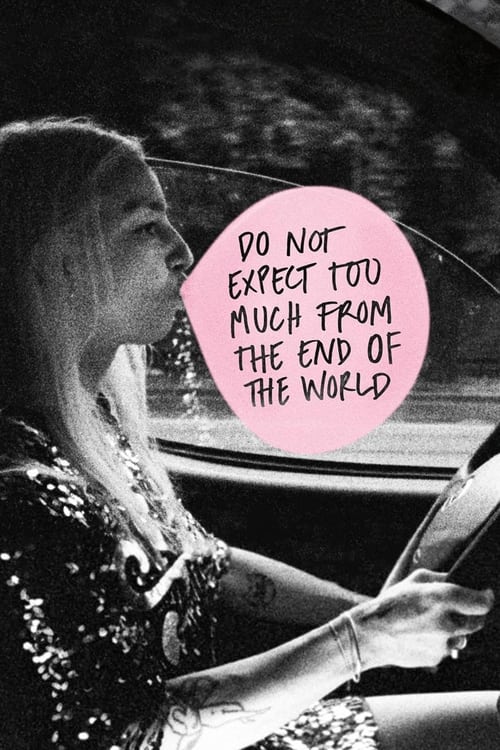
Do Not Expect Too Much from the End of the World
2023 · Radu Jude
The arthouse shitposter: Bad Luck Banging won the Berlinale, Do Not Expect Too Much from the End of the World skewered gig-economy Europe, and his AI-assisted Dracula trolled everyone — prolific, abrasive, and beloved by critics for exactly that.
When you're in the mood for something furious and funny that has real teeth — a film to argue about afterward, not a comfort watch. Pure challenge, and worth it.
What it's about
Angela, an overworked production assistant, spends a brutal workday driving across Bucharest for a multinational company, pre-interviewing workers injured in on-the-job accidents to cast one in a corporate 'safety at work' video. Between errands she vents her exhaustion into her phone as a filtered, foul-mouthed male alter-ego for social media. It's a portrait of the gig economy at the end of its rope — one woman, one car, sixteen-hour days, and a company that wants her to film someone else's misfortune as PR.
The experience
Abrasive, hilarious, and exhausting by design — a firehose of profanity, dead time, and razor-sharp satire that makes you feel the grind in your bones while laughing at the absurdity of it. It's long and it wants you to feel that; the payoff is a final stretch of jaw-dropping audacity.
Performances
Ilinca Manolache is ferocious as Angela — she carries almost every frame, toggling between bone-tired professionalism and her leering online alter-ego with a comic energy that never lets you settle.
The craft
Radu Jude shoots the present in harsh black and white and braids in recolored footage from a 1981 Romanian film about another woman driver named Angela, so two eras of labor rhyme across four decades. The editing is provocative, essayistic, and formally fearless — including one extended shot that becomes the film's whole argument. Nothing about it looks or moves like a normal comedy, which is exactly the point.
Why it matters
Widely hailed as one of the defining films of the 2020s art cinema, it cemented Jude's status as European film's most fearless satirist and became a touchstone for how movies can talk about gig work, screens, and exploitation.
Snapshot
Radu Jude's Do Not Expect Too Much from the End of the World is a sprawling, formally combative comedy about labor and its representation in contemporary Romania. Its protagonist, Angela (Ilinca Manolache), is an overworked production assistant crisscrossing Bucharest for a multinational firm, scouting and pre-interviewing workers maimed in on-the-job accidents so the company can cast one in a corporate "safety at work" video. Around this thin errand Jude builds a maximalist essay-film: a punishing, black-and-white portrait of gig-economy exhaustion is braided with recolored footage from Lucian Bratu's 1981 Romanian feature Angela merge mai departe (Angela Moves On), while Angela vents into her phone as "Bobiță," a bald, misogynistic, Andrew Tate–style online alter-ego. The film premiered at the 76th Locarno Film Festival in August 2023, where it won the Special Jury Prize, and runs roughly 163 minutes. It arrived as the most ambitious statement yet from a director who had, two years earlier, taken the Berlinale's Golden Bear. Its central argument — that capital extracts even suffering as content, and that Romania's present rhymes cruelly with its socialist past — is delivered through collision rather than plot.
Industry & production
The film is a European co-production spanning Romania, Luxembourg, France, and Croatia, a financing structure typical of the auteur-driven art cinema Jude works within, where a single national market cannot underwrite a project of this scale. It was produced by Ada Solomon through her Bucharest company microFILM; Solomon has been the key producer behind much of Jude's recent output, including Aferim! (2015) and the Golden Bear–winning Bad Luck Banging or Loony Porn (2021), and the continuity of that partnership is central to understanding how Jude sustains such formally uncommercial work. (Readers should treat the precise roster of co-producing entities across the four countries as something to verify against the film's official credits rather than my summary.)
The production belongs to a recognizably lean, fast, low-budget model. Jude has spoken publicly of shooting quickly and cheaply, and the contemporary sections' digital black-and-white handheld shooting is consistent with that economy. The film's festival trajectory — a Locarno competition slot and prize, followed by wide circulation on the festival and specialty circuit — is the standard distribution pathway for this kind of cinema. In the United States it was released by the streaming and theatrical distributor Mubi, whose curatorial model has become an important channel for Romanian and European art films of exactly this profile.
Technology
Technologically the film is defined by a deliberate stratification of image formats, each carrying a different historical and material charge. The 2023 material is shot on digital video in stark, often high-contrast black and white — a format at once cheap, immediate, and slightly degraded-looking, appropriate to a story about precarious labor filmed on the fly in real Bucharest traffic. Against this, Jude embeds substantial passages lifted from Bratu's 1981 Angela merge mai departe, presented in faded color; the collision of a grainy socialist-era color film with crisp contemporary monochrome is itself a technological argument about time and reproduction.
The most pointed technological motif is the smartphone and its face-altering software. Angela's Bobiță persona is generated through a real-world social-media filter that gives her a bald head, heavy brow, and coarsened features — a piece of consumer AR that Jude treats as a genuine cultural object, not a gag prop. The film thus stages the phone screen, the video call, and the algorithmic filter as the native technologies of present-day work and speech, set against the analog film stock of the past.
Technique
Cinematography
Marius Panduru, Jude's frequent cinematographer, shoots the contemporary material, and the visual strategy is one of controlled abrasiveness. Much of the film unfolds in the front seat of Angela's car in long, jostling handheld takes as she drives, phones, and curses through Bucharest — a mobile, documentary-inflected framing that traps the viewer inside her fatigue. The black-and-white palette flattens the modern city into a punishing gray continuum of traffic, billboards, and construction. This is set against, and periodically interrupted by, the softer color grammar of the 1981 footage, so that the film's look is fundamentally dialectical: two image regimes arguing across four decades.
Editing
Editing, by Jude's regular collaborator Cătălin Cristuțiu, is where the film's essayistic method lives. Rather than smoothing the narrative, Cristuțiu and Jude cut between registers — the road movie, the archival extract, the vertical phone videos, and interstitial intertitle cards bearing quotations and aphorisms. The result is closer to montage-as-argument than to conventional continuity. The film's most notorious structural gambit is its climax: an extended, near-static long take of the corporate video shoot, held far past the point of comfort, in which the editing all but stops and duration itself becomes the subject. The contrast between the earlier restless cutting and this final immobilization is the film's boldest editorial gesture.
Mise-en-scène / staging
Staging swings between the real and the theatrical. The driving sequences use the actual, unbeautified geography of Bucharest — its roadworks, roadside crosses marking traffic deaths, corporate campuses, and residential blocks — as a found set. The climactic shoot, by contrast, is staged as a single deep, wide composition in which a whole apparatus of production (crew, corporate representatives, the injured worker and his family) is arranged within the frame and left to grind through take after take. Jude repeatedly foregrounds the machinery of filmmaking and messaging, so that mise-en-scène becomes a way of exposing how images of labor are manufactured.
Sound
The soundtrack is dense with speech — Angela's monologues, phone calls, radio, and the profane Bobiță rants — and Jude favors direct, unglamorous location sound that keeps the city's ambient churn present. In keeping with his broader practice, the film leans on found and source music and on the verbal texture of language rather than on an orchestrated emotional score; a scored, composer-driven soundtrack is not the film's mode. (Whether the film carries a formally credited composer is a detail I would flag as thin and worth checking against the credits rather than asserting.)
Performance
The film rests on Ilinca Manolache, whose Angela is a tour de force of exhaustion, gallows humor, and coiled anger, and whose Bobiță performances — vulgar, reactionary, cathartic — required her to embody a grotesque online masculinity. The performance was widely singled out as a breakout. Around her, Jude deploys a mix of registers: the German actress Nina Hoss appears as a corporate representative of the client company (a character positioned, in one of the film's literary jokes, as a Goethe descendant), lending an icy transnational-managerial note; the veteran Romanian actress Dorina Lazăr, who played Angela in Bratu's 1981 film, is folded into the new film, binding the two eras through a single body. Jude also casts the German-Canadian director Uwe Boll as himself, a piece of stunt casting that extends the film's meta-commentary on cinema and reputation.
Narrative & dramatic mode
Structurally the film is an essayistic road movie rather than a plotted drama. Its dramatic engine is an errand — find and pre-screen accident survivors for a safety video — but Jude treats that errand as a frame on which to hang digressions, arguments, quotations, and archival counterpoint. The dominant mode is satirical and dialectical: scenes are set against one another (1981 vs. 2023, on-screen politeness vs. Bobiță's obscenity, corporate PR vs. lived injury) so that meaning emerges from friction. The long, near-real-time climax abandons montage for endurance, forcing the viewer to sit inside the ethical compromise the whole film has been circling — the spectacle of a real victim coached, edited, and instrumentalized for a corporate message. It is comedy built on structural irony, with the drama located in the gap between what is filmed and what is true.
Genre & cycle
Nominally a comedy-drama, the film sits inside the essay-film and political-satire tradition while borrowing the shape of a road movie. It belongs to a cycle of Jude's own recent work — alongside Bad Luck Banging or Loony Porn — that fuses vulgar contemporary comedy, archival montage, and moral-historical inquiry. More broadly it extends the black-comic, socially diagnostic strain of the Romanian New Wave into an overtly experimental, collage-based register, and it converses with the international essay-film lineage (Godardian montage, the found-footage critique associated with filmmakers like Harun Farocki) in which images are interrogated rather than merely deployed.
Authorship & method
Radu Jude wrote and directed the film, and it is a concentrated expression of his authorial method: the citation-heavy, dialectical, deliberately impure cinema he has been building across Aferim!, "I Do Not Care If We Go Down in History as Barbarians" (2018), and Bad Luck Banging. His signature moves are all present — the intertitle as argument, the archival document set against the present, the willingness to be crude and erudite in the same breath, the refusal to let a story stay clean of history. His most inspired structural decision here is the appropriation of Bratu's 1981 Angela Moves On, which lets him rhyme a socialist-era working woman with a capitalist-era one and indict both systems' treatment of labor.
His key collaborators recur from film to film: cinematographer Marius Panduru, editor Cătălin Cristuțiu, and producer Ada Solomon form the stable creative core enabling this work. On the music side, Jude's method tends toward curation of existing material rather than commissioned scoring, consistent with his collage aesthetic. The screenplay is his alone, and the film's density of literary and philosophical reference reflects an authorship that treats cinema as an intertextual, essayistic form.
Movement / national cinema
The film is a landmark of contemporary Romanian cinema and a self-conscious reckoning with the Romanian New Wave that put that cinema on the world map in the 2000s (Cristian Mungiu, Cristi Puiu, Corneliu Porumboiu, and Jude among them). Where the classic New Wave favored austere long-take realism, Jude here pushes the national cinema toward overt experiment and archival montage while keeping its core preoccupations: bureaucracy, moral compromise, the unfinished business of the communist past, and the disillusionments of the post-1989 transition. The incorporation of Bratu's 1981 film literally sutures Romanian film history into the work, making the movie a commentary on the country's cinematic as well as social memory.
Era / period
Made and set in the early 2020s, the film is saturated with the textures of its moment: gig-economy overwork, algorithmic social media, Andrew Tate–style online misogyny, foreign-capital corporate campuses, and the vast infrastructural churn of contemporary Bucharest. It captures a post-pandemic European labor landscape in which precarity is normalized and a worker's very injury can be repackaged as content. By yoking this present to a 1981 artifact from late-socialist Romania, the film makes period itself a subject — arguing that the extraction of labor persists across radically different political economies, changing costume but not substance.
Themes
The film's governing theme is labor and its exploitation: the punishing hours of the production assistant, the maimed workers whose accidents become raw material for PR, and the corporate machinery that converts suffering into a "safety" message. Adjacent to this is a critique of representation and image-making — the ethics of who gets to film whom, and how truth is coached, cropped, and instrumentalized. Class and transnational capital run throughout, embodied in the Western corporate figures who commission the video. The Bobiță filter opens a theme of online toxicity and the coarsening of public speech. And beneath it all lies historical continuity and memory: the 1981/2023 rhyme insists that the indignities of work outlast regimes. The title's aphoristic pessimism — a warning against expecting deliverance — colors the whole as a work of exhausted, clear-eyed comedy about a world that does not improve.
Reception, canon & influence
Critically, the film was one of the most acclaimed art films of its year, widely praised as a major work by a director at the height of his powers, with particular admiration for Jude's formal audacity and for Ilinca Manolache's performance; its Special Jury Prize at Locarno 2023 anchored its festival standing. It featured prominently on year-end and critics' lists and consolidated Jude's reputation as one of the essential political filmmakers working in Europe.
Its influences run backward to the essayistic, montage-driven political cinema of Jean-Luc Godard and the image-critique of documentarists concerned with how labor and violence are pictured, as well as to the realist tradition of the Romanian New Wave that Jude both extends and detonates. Most concretely, it draws directly on Lucian Bratu's Angela merge mai departe (1981), which it quotes, recolors, and reanimates. Looking forward, the film's legacy is best understood as a demonstration — an argument that a low-budget, digitally shot, citation-rich collage can still be first-order cinema — and as further proof of concept for the hybrid essay-comedy mode Jude has been advancing. Because the film is recent, claims about its long-term canonical placement and its influence on other filmmakers remain provisional; that story is still being written.
Reception
It stormed out of Locarno 2023 (Special Jury Prize) already tagged a masterpiece, then topped a pile of 2024 year-end critics' lists — less a reappraisal arc than an instant coronation, with 'best film of the 2020s so far' claims attaching to it almost immediately.
How Do Not Expect Too Much from the End of the World was received, from release to now →
How to watch Do Not Expect Too Much from the End of the World: what to notice on a first viewing
- Watch the whole film ride in the front seat of her car. Panduru shoots long, jostling handheld takes from inside Angela's car as she drives, phones, and curses through Bucharest traffic. The camera traps you inside her fatigue instead of showing it to you from outside.
- Watch the film switch from black and white into color. The contemporary material stays in a punishing gray continuum, periodically interrupted by the softer color of footage borrowed from an older Romanian film. Two different image regimes are arguing with each other across four decades, right there in the color.
- Watch the same actress play two completely different people. Ilinca Manolache plays exhausted Angela and her vulgar online alter ego Bobita, filtered bald and coarsened, venting into her own phone. One woman playing her own toxic alter ego makes exhaustion and rage into the same performance.
- Watch the film cut between the road, archives, and phone video. Cristutiu cuts between the road movie, an old archival extract, vertical phone footage, and intertitle cards instead of smoothing everything into one register. The cutting argues with itself instead of telling one smooth story.
- Notice the roadside crosses marking traffic deaths. The driving sequences use the real, unbeautified geography of Bucharest, roadworks, memorial crosses, corporate campuses, as a found set rather than a designed one. The city itself becomes evidence, not just backdrop, for what the film is arguing.
Influences: the films it descends from and the films it influenced
- Weekend (1967) — The lateral car-tracking long take and the intertitle-as-rupture that halts narrative to deliver a political argument are the direct model for Jude's handheld car-interior driving passages and his montage-as-argument.
- Ici et ailleurs (1976) — Its method of cutting archival propaganda against present-day footage to interrogate how struggle and labor are pictured is the dialectical image-critique Jude reuses when he recolors and juxtaposes Bratu's 1981 material with 2020s Bucharest.
- Man with a Movie Camera (1929) — The associative/dialectical montage and self-reflexive framing of the worker-and-camera underwrite the 'Godardian montage' Jude inherits second-hand — editing that builds meaning by collision rather than continuity.
- Sans Soleil (1983) — The first-person essay-film voice threading heterogeneous footage into an argument, plus image-processing (the Zone synthesizer) as commentary, prefigures Jude's essayistic narration and his smartphone-AR-filter defamiliarization of the face.
- Images of the World and the Inscription of War (1989) — Its reading of archival images against the grain — analyzing how photographs picture labor, surveillance and violence — is the documentarist image-critique the dossier names as Jude's forebear.
- Angela merge mai departe (Angela Moves On) (1981) — The literal source text: Jude appropriates, recolors and reanimates Bratu's socialist-era woman-driver footage, rhyming that laborer with the capitalist-era gig driver to indict both systems.
- The Death of Mr. Lăzărescu (2005) — Established the Romanian New Wave grammar Jude both extends and detonates — handheld long takes inside moving vehicles, direct location sound and unglamorous real interiors as the baseline realist register.
- Police, Adjective (2009) — Its deadpan static long takes and interrogation of language and bureaucracy as a dialectic (the dictionary scene) model the Romanian New Wave essayistic realism Jude pushes toward outright essay-film.
- 4 Months, 3 Weeks and 2 Days (2007) — The sustained real-time extended long take in natural light and found locations is the New Wave formal device Jude keeps for his own extended takes even as he interrupts them with montage.
- Aferim! (2015) — Jude's own black-and-white historical road movie — the wide, deep-focus landscape composition and journey structure recur here, transposed from period Wallachia to the gig-economy car.
- "I Do Not Care If We Go Down in History as Barbarians" (2018) — Sets an archival historical document against a present-day restaging to force a reckoning with erased violence — the same document-vs-present dialectic and intertitle argumentation as the seed.
- Uppercase Print (2020) — Recontextualizes Securitate files and period state-TV archival clips as a montage-argument, the collage-of-found-footage method Jude carries directly into the recolored Bratu material.
- Bad Luck Banging or Loony Porn (2021) — The tripartite dialectical essay-comedy structure, handheld walk through pandemic Bucharest streets, and the middle 'dictionary' montage of images make it the immediate formal sibling of the seed's essay-comedy mode.
- Le Livre d'image (The Image Book) (2018) — A contemporary collage of degraded, recolored and re-saturated archival fragments assembled as pure montage-argument — the same treatment of appropriated footage Jude applies to Bratu, arriving from the same Godardian source.
- Tabu (2012) — A hybrid essay-fiction that reanimates a colonial past in academy black-and-white with stylized sound, extending the same impure mode that mixes reanimated archival texture with present-tense commentary.
- State Funeral (2019) — Reassembles and recolors archival footage of a political ritual into a critical montage that indicts a regime by the arrangement of its own images — a parallel practice of curated found material over commissioned narration.
- Kontinental '25 (2025) — Immediate precursor in its embrace of phone-captured, low-cost image-making and talk-saturated, citation-heavy construction as legitimate festival-grade art cinema.
Similar films
- 4 Months, 3 Weeks and 2 Days (2007) — influence & lineage · same viewing thread
- Weekend (1967) — influence & lineage
- Kontinental '25 (2025) — same viewing thread
- The Death of Mr. Lazarescu (2005) — same viewing thread
- Toni Erdmann (2016) — shared sensibility
- Souleymane's Story (2024) — shared sensibility
- Titane (2021) — shared sensibility
- Rotting in the Sun (2023) — shared sensibility
All the films related to Do Not Expect Too Much from the End of the World →
Watch it with: curated runs of related films
- Behind the Iron Curtain — A run of Eastern Bloc films where one ordinary person — a hobbyist filmmaker, a cabaret singer, a drifter, a student — is quietly ground down by the machinery of the communist state.