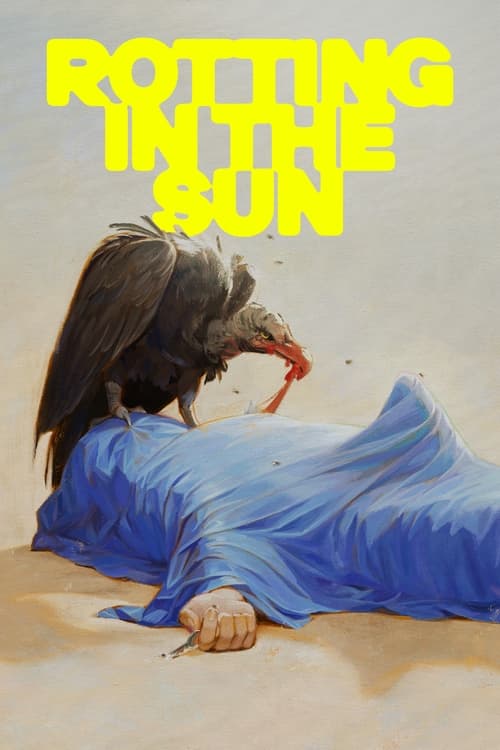
Rotting in the Sun
2023 · Sebastián Silva
For when you want something transgressive and alive — a film to watch with a strong drink and a friend who won't flinch. Definitely a challenge, not a comfort; misanthropy required, rewarded.
What it's about
A depressed filmmaker named Sebastián — played by director Sebastián Silva as a version of himself — drifts through Mexico City numbing his despair, until a trip to a gay nudist beach throws him together with Jordan Firstman, a relentlessly upbeat social media comedian also playing himself. Firstman badgers him into collaborating on a show about his life; then one of them vanishes, and the search falls to people wildly unequipped to conduct it.
The experience
Abrasive, explicit, and very funny in a way that dares you to laugh — then it hard-pivots into a squirming comic thriller where the suspense comes from watching ordinary people make everything worse. You leave rattled, amused, and slightly implicated.
Performances
Catalina Saavedra is the film's secret weapon as Señora Vero, the housekeeper whose panicked, deadpan scrambling becomes its moral center. Jordan Firstman is fearless playing an unflattering version of himself, and Silva commits fully to his own self-portrait of despair.
The craft
Silva shoots with a jittery, handheld candor that makes the autofiction feel caught rather than staged, and the mid-film swerve from hangout comedy into missing-person thriller is executed with real nerve. The class dynamics between employer, influencer, and housekeeper are built into every frame's staging.
Why it matters
One of the boldest entries in the recent wave of autofiction and influencer satire — a film that turns internet celebrity and creative self-loathing into thriller fuel, and cemented Silva's reputation as an unsparing provocateur.
Snapshot
Rotting in the Sun is Sebastián Silva's most abrasive and most self-implicating film: an autofictional black comedy that mutates, at its midpoint, into a Hitchcockian missing-person thriller. Silva plays "Sebastián," a depressed filmmaker in Mexico City who numbs himself with ketamine and E. M. Cioran's The Trouble with Being Born while fantasizing about suicide. Dispatched to the gay nudist beach at Zicatela, he collides with Jordan Firstman — the real Instagram comedian, also playing "himself" — who badgers him into collaborating on a series about Firstman's life. Then Sebastián disappears, and the film hands itself over to two unlikely co-protagonists: Firstman, conducting a narcissist's investigation, and Señora Vero (Catalina Saavedra), the housekeeper who knows exactly what happened. Premiering at the 2023 Sundance Film Festival and released by MUBI that September, the film became one of the year's most argued-about American-adjacent independent releases — for its wall-to-wall male nudity and graphic sex, for its contempt-laced portrait of influencer culture, and for the formal gall of killing off its author halfway through. It is simultaneously a comedy of digital-age self-absorption, a class study in the lineage of Silva's The Maid, and a genuinely bleak meditation on whether life is worth documenting at all.
Industry & production
The film sits at a now-characteristic intersection of Latin American auteur cinema and the American festival economy. Silva, a Chilean director long based between Santiago, New York, and Mexico City, wrote the film with Pedro Peirano, his collaborator since The Maid (2009), and shot it in Mexico — principally in Mexico City and at Playa Zicatela on the Oaxacan coast, whose real clothing-optional gay beach scene the film documents with quasi-ethnographic frankness. The production was small-crewed and low-budget in the mode of Silva's American independent work (Crystal Fairy, Nasty Baby, Tyrel), built around locations from Silva's actual life: the protagonist lives, as Silva then did, in a Mexico City apartment building under perpetual renovation, and Silva's own dog, Chima, appears as himself.
The industrial story of the release belongs to MUBI. The streamer-distributor acquired the film out of Sundance 2023 and gave it a limited theatrical run in early September before its streaming debut — part of the same 2023 slate (alongside Ira Sachs's Passages, another sexually explicit queer festival title) with which MUBI announced itself as a serious specialty distributor willing to release unrated, explicit work that studio-adjacent indies would not touch. Rotting in the Sun went out unrated in the United States; meaningful box-office figures were never a relevant metric for a release designed to drive festival conversation and subscriptions, and the public record on its theatrical grosses is thin. The casting economics are also worth noting as industry history: Firstman, who became famous through pandemic-era Instagram "impressions" videos, represents the film industry's ambivalent absorption of platform-native celebrity — a real influencer imported into an art film precisely so the film can vivisect what he represents, with his participation.
Technology
Rotting in the Sun is a digital-native object in two senses. First, it was shot digitally with a light footprint, in a deliberately unglamorous register — available light, handheld operation, a grainy, sun-scorched texture at the beach and a flat, grayish one in the city — the technology of small-crew independent production used to signal candor rather than polish. (Detailed technical documentation of camera package and format is sparse in the published record, and the film's credits circulate less widely than its controversies; this dossier does not attribute the cinematography to a named director of photography for that reason.)
Second, and more importantly, the film incorporates the technologies it satirizes. Phone screens, Instagram grids, DMs, voice notes, and Firstman's actual social-media content are woven into the fabric of the movie, not as the sterile screen-life interfaces of films like Searching but as ambient clutter — the way phones actually sit inside contemporary attention. The plot itself turns on device dependency: access to a dead man's phone, unread messages, the difference between a person and their account. In this respect the film belongs to the 2020s cohort of works trying to solve the old problem of how cinema photographs the internet, and its solution — treat the phone as a prop and social media as a character flaw — is one of its most influential aspects.
Technique
Cinematography
The camerawork is nervous, voyeuristic, and pointedly unbeautiful. At Zicatela, long lenses and searching pans place the viewer in the position of a cruiser scanning the beach; the frame is casually saturated with full-frontal male bodies, photographed neither pornographically nor coyly but with a flattening matter-of-factness that becomes its own joke — Sebastián reads Cioran on annihilation while the composition fills with penises. Snap zooms and abrupt reframings give the comedy a documentary jitteriness. Back in Mexico City, the palette drains: dusty interiors, scaffolding, half-poured concrete. The film's visual argument is carried by this opposition — sunstruck hedonism versus entombing construction site — and the second half tightens into closer, more suspenseful framing on Saavedra's face as Vero's concealment becomes the drama. It is camerawork in the Silva house style: improvisation-friendly, reactive, prioritizing behavioral accident over pictorial control.
Editing
The structure is the film's boldest technical gambit. Silva's regular editor Sofía Subercaseaux — his collaborator across several previous features — cuts the first half as a loose, digressive hangout comedy, then administers the mid-film rupture with shocking bluntness: the protagonist's death is neither foreshadowed with genre cues nor lingered over, and the edit simply keeps going, stranding the audience with the two characters least equipped to process it. Thereafter the cutting reorganizes around thriller logic — cross-cutting Vero's improvised cover-up against Firstman's escalating investigation, wringing suspense from mundane ellipses (a mopped floor, a phone left charging, a bag of cement). The pacing shift itself is the meaning: languor curdles into procedure, and the comedy keeps intruding at exactly the moments dread should be pure.
Mise-en-scène / staging
Silva stages the film in found and lived-in spaces whose semiotics do heavy lifting. The unfinished apartment building is the master image — a home that is also a hazard, a renovation that doubles as a tomb, with jackhammers, rebar, and open drops literalizing the protagonist's suspension between building a life and ending one. The beach sequences are staged as immersive crowd scenes among real nudists and partiers, with reportedly unsimulated sexual activity at the margins of frames; the staging refuses the discreet choreography with which even most queer cinema handles group sexuality. Class is spatialized throughout: Vero moves through service corridors, kitchens, and rooftops while the creative-class characters sprawl across the spaces she maintains — a staging grammar Silva and Peirano refined in The Maid and here push toward crime fiction.
Sound
The sound design is dominated by the diegetic noise of a city that will not let anyone rest: construction din, traffic, dogs, and — the film's signature aural motif — the incessant pings, voice memos, and autoplaying videos of phones. Silence is almost unavailable to these characters, which is the point; Sebastián's longing for nonexistence plays against a soundscape of compulsory stimulation. Music is used sparingly and often ironically against the material rather than as continuous scoring; the published record on the score credit is thin, and the film's sonic identity rests far more on design than on composition. In the second half, sound carries the thriller mechanics — what Vero overhears, what a phone announces to a room — in a manner that owes something to classical suspense construction.
Performance
The performance scheme runs on three registers deliberately rubbed against each other. Silva plays "Sebastián" with affectless, mumbling misery — an anti-performance that makes his suicidal ideation both funny and genuinely uncomfortable. Firstman gives one of the era's most self-lacerating celebrity self-portrayals: his "Jordan" is needy, horny, monetizing every feeling in real time, and the performance's queasy power comes from the audience's inability to locate the line between satire and confession. Anchoring the film is Catalina Saavedra, whose Vero is its moral center and finest creation — a working-class woman whose panic, guilt, pragmatism, and wounded dignity are conveyed in a largely reactive, physical performance. Critics widely read her work here as a deliberate reprise-in-a-new-key of her celebrated maid Raquel in Silva's The Maid, and she again supplies the human gravity the surrounding satire needs.
Narrative & dramatic mode
The dramatic architecture is a bait-and-switch inherited from Psycho: establish a protagonist, invest the audience in his interiority, kill him at the midpoint, and transfer the narrative to characters implicated in the aftermath. Silva compounds Hitchcock's move with autofiction — the murdered protagonist is the film's actual author, so the film enacts, structurally, the suicide its first half contemplates. The first movement is a picaresque hangout comedy in the Rohmer-via-mumblecore register Silva has worked in since Crystal Fairy; the second is a Patricia Highsmith scenario — an ordinary person concealing a death, an amateur detective closing in — played simultaneously for suspense and for class-conscious sympathy, since the audience's allegiance settles firmly with the "guilty" Vero rather than the truth-seeking influencer. Dramatic irony is the engine throughout: we always know more than Jordan, and the comedy of his grief-as-content is inseparable from the tension of the cover-up. The mode, finally, is moral black comedy: the film withholds both punishment and absolution, ending on ambivalence about what, and who, survives a death in the attention economy.
Genre & cycle
Generically the film is a hybrid: autofiction comedy, cringe comedy, and domestic-noir thriller, with a documentary substrate in its beach material. It belongs identifiably to three contemporary cycles. First, the 2020s wave of social-media narcissism satires — alongside Sick of Myself (2022), Not Okay (2022), and Dream Scenario (2023) — of which it is arguably the most formally radical entry, since it casts a real influencer as himself. Second, the post-Shortbus lineage of festival films using explicit, sometimes unsimulated sex as both realism and provocation (Travis Mathews's and João Pedro Rodrigues's work, Passages the same year), a cycle in which Rotting in the Sun's specifically comic deployment of mass nudity stands out. Third, the long Latin American cycle of employer–domestic worker dramas — The Maid, La Ciénaga, Roma, The Second Mother — which it converts into thriller material. The Hitchcock/Highsmith inheritance supplies the genre spine on which these cycles are threaded.
Authorship & method
Silva is a consummate small-ensemble auteur: painter and musician by training, director of eight features by 2023, and a filmmaker whose method depends on shooting quickly with friends, real locations, improvisation around a firm structural spine, and versions of himself or his intimates on screen (Nasty Baby had already cast him as a Brooklyn artist named "Freddy"; here he drops the pseudonym). His authorship is legible in the recurring elements: drugs as bad epiphany machines (Crystal Fairy), social discomfort escalating to violence (Magic Magic, Tyrel), queer creative-class self-critique (Nasty Baby), and the servant's-eye view of bourgeois life (The Maid, Old Cats).
The key collaborators define the film's poles. Co-writer Pedro Peirano, the essential dramaturgical partner of Silva's Chilean period, is plausibly the source of its disciplined class architecture. Editor Sofía Subercaseaux, Silva's longtime cutter (and later the editor of Sean Wang's Dìdi), executes the tonal hairpin on which the whole design depends. Catalina Saavedra functions here as more than an actor — she is an intertext, importing the entire meaning of The Maid into the new film. Jordan Firstman must be counted a collaborator in authorship as well, having lent his persona, his feed, and his reputation to his own evisceration. On the craft credits behind the camera — cinematography and score — the secondary literature is unusually sparse for a film this discussed, and this account declines to name credits it cannot verify.
Movement / national cinema
Silva emerged from the Chilean cinema renaissance of the late 2000s — the generation of Pablo Larraín, Sebastián Lelio, Alicia Scherson, and Fernanda Urrejola-era production — with The Maid as one of that movement's international breakthroughs. But his trajectory since 2013 has made him a genuinely transnational figure: half his filmography is American independent cinema (often with Michael Cera and Sundance backing), and Rotting in the Sun adds a third national coordinate, Mexico. The film participates knowingly in Mexico City's contemporary status as a haven for expatriate creatives, and its sharpest national-cinema gesture is to view that phenomenon partly through Mexican working-class eyes — placing it in dialogue with Roma while refusing Cuarón's lyricism. There is also a Buñuelian ghost here: a European-accented director in Mexico making corrosive comedy about bourgeois self-regard and the servants who witness it. The film is thus best located not in one national cinema but in the festival-circulated space where Chilean authorship, Mexican location and labor, and American platform culture intersect — which is, in a sense, its subject.
Era / period
The film is aggressively of 2022–23: post-pandemic party culture, ketamine as the era's numbing agent of choice, the mainstreaming of influencer celebrity (Firstman's fame was itself a lockdown phenomenon), digital-nomad gentrification of Mexico City, and the exhaustion of a creative class that survived the streaming boom only to face its contraction — Sebastián's despair is partly professional, a director who can no longer see the point of making things for platforms. It also belongs to the moment when "sex is back in cinema" became a critical talking point; 2023, the year of Passages, Femme, and All of Us Strangers, saw explicit queer sexuality re-enter specialty distribution, and Rotting in the Sun was that conversation's most extreme data point. Its Cioran-quoting nihilism, meanwhile, ties it to a broader era mood — irony-poisoned, doom-scrolling, joking about not wanting to exist — which the film takes seriously enough to be genuinely unsettling.
Themes
The film's themes braid tightly. Existential despair and the ethics of suicide, filtered through Cioran, are treated with rare comic honesty: the film neither romanticizes Sebastián's death wish nor dismisses it, and its structure grants it. Narcissism and self-documentation form the counter-theme — Jordan's inability to experience anything, including grief, except as content, posed against Sebastián's inability to see the point of documenting anything at all; the film suggests these are two poses of the same sickness. Class and invisible labor constitute the moral core: Vero, underpaid, half-ignored, and structurally disposable, is the only character for whom the death is a material catastrophe rather than a narrative, and the film's suspense is really about whether the attention economy will notice, blame, or simply overlook her. Around these run supporting motifs: the body as commodity and memento mori (all that flesh on the beach, rotting in the sun of the title); construction and incompletion as images of a life; the phone as afterlife, since the dead persist as accounts; and the gap between queer liberation's pleasures and its loneliness. The film's refusal to resolve sympathy — for the suicidal artist, the odious influencer, or the lying housekeeper — is itself thematic: everyone here is guilty of turning other people into material, the director most of all.
Reception, canon & influence
Critical reception was largely strong and conspicuously polarized in tone: reviewers out of Sundance and the fall release praised the film's nerve, its structural audacity, Saavedra's performance, and Firstman's fearlessness, while a dissenting strand found it smug, punishingly unpleasant, or hollow beneath the provocation — a split the film openly courts. It appeared on a number of critics' year-end lists for 2023 and quickly became a reference point in essays about sex on screen and about cinema's influencer problem. It received no major awards traction, which is unsurprising for an unrated film this confrontational; its canonization, such as it is, is happening through cinephile and queer-film discourse rather than institutions.
Backward, its influences are unusually legible: Hitchcock's Psycho for the midpoint protagonist-swap; Highsmith for the sympathetic concealment plot; Buñuel's Mexican-period class comedy; Silva and Peirano's own The Maid, which the film quotes through Saavedra's casting; the autofiction lineage running from 8½ through Adaptation and Larry David's self-play to Caveh Zahedi's confessional projects; the hangout naturalism of Silva's mumblecore-adjacent American films; and the explicit queer realism of Shortbus and its festival descendants. Cioran functions as a literary influence credited on screen, in the character's hands.
Forward, the legacy is necessarily provisional — the film is recent — but three lines of influence are already traceable. It became a landmark case in MUBI's emergence as a distributor of uncompromising work, a strategy the company escalated in subsequent years. It set a benchmark for how fiction can use a real platform celebrity as both actor and object of critique, a move increasingly imitated as filmmakers metabolize influencer culture. And within queer cinema it pushed the boundary of casual, non-euphemistic nudity in comedy, demonstrating that explicitness could be a tonal register rather than an event. Whether it endures as a canonical text or a period artifact of the mid-2020s internet will depend on how its central anxiety ages; the film itself would bet, cheerfully, on oblivion.
Reception
It landed at Sundance 2023 as the festival's designated shock-comedy talking point, and after MUBI put it out the conversation didn't fade — it settled in fast as a modern queer cult item rather than a one-weekend provocation.
How Rotting in the Sun was received, from release to now →
Influences: the films it descends from and the films it influenced
- Psycho (1960) — The engine Silva steals wholesale: kill the presumed protagonist at the structural midpoint and force the audience to transfer identification onto a survivor left to manage a body — Silva swaps Firstman for Saavedra exactly as Hitchcock swaps Marion for Norman.
- Strangers on a Train (1951) — Highsmith's signature move — suspense built not from whodunit but from the dread of a sympathetic concealer trying to keep a body and a lie contained — is the exact grammar of Saavedra's second half.
- The Exterminating Angel (1962) — Buñuel's Mexican-period tactic of trapping the bourgeoisie inside a single domestic space until class relations curdle into farce and horror underwrites Silva's use of the apartment/renovation site as a bourgeois trap.
- The Maid (2009) — Silva imports Saavedra's own prior role as an intertext — her casting drags the servant's-eye class study of The Maid into the new film, so the domestic worker's interiority is pre-loaded before a scene plays.
- 8½ (1963) — The foundational autofiction gambit: a blocked creator stages a barely-disguised version of himself and his creative-class milieu as the film's subject, the template Silva applies by playing 'Sebastián' directing his own crisis.
- Adaptation (2002) — Casting a real writer's fictionalized self as protagonist and letting the film's making become its plot — the self-implicating meta-move Silva repeats by putting himself and Firstman on screen as themselves.
- I Am a Sex Addict (2005) — Zahedi's confessional first-person cinema — the director narrating and re-enacting his own compromising sexual life to camera — is the explicit-autofiction register Silva channels into queer self-critique.
- Shortbus (2006) — Establishes unsimulated sex among non-porn actors as an ambient, comic, everyday texture rather than a shock event — the precise tonal license Silva takes with casual full-frontal nudity.
- Nasty Baby (2015) — Silva's own prior self-casting (as the artist 'Freddy') plus the signature swerve from hangout queer comedy into sudden violence is the structural rupture Rotting in the Sun escalates.
- Crystal Fairy & the Magical Cactus (2013) — Silva's method of shooting fast with a small ensemble, improvising around a firm structural spine with drugs as the bad-epiphany catalyst, is the production grammar carried directly into this film.
- Not Okay (2022) — Metabolizes influencer culture by making a self-promoting content creator the protagonist-to-be-punished, part of the wave of post-2023 filmmaking that follows Silva's benchmark for weaponizing a media persona against itself.
- Stranger by the Lake (2013) — Fuses explicit, unsimulated gay cruising with a Hitchcockian concealed-body thriller in which a witness protects a killer — the same marriage of hardcore queer realism and suspense mechanics Silva attempts.
- Ingrid Goes West (2017) — Builds a thriller out of Instagram-influencer narcissism, treating the feed and the follower-economy as the actual antagonist — the attention-economy satire Silva sharpens by casting a real influencer as himself.
- Zola (2020) — Weaves social-media texture (notification sounds, platform vernacular, a story sourced from a real feed) into the film's formal fabric, the same ambient-clutter treatment of phones Silva uses as a sound and staging motif.
- Spree (2020) — Casts platform-native performance and livestream self-branding as both style and murderous subject, extending the fiction-uses-a-real-influencer-as-object-of-critique move to comparable satirical ends.
- Dìdi (2024) — Cut by Sofía Subercaseaux, Silva's longtime editor, it shares her handling of screen-mediated adolescent life and tonal modulation — the same cutting sensibility that executes Rotting in the Sun's midpoint hairpin.
Similar films
- Jim Queen and the Quest for Chloroqueer (2026) — same viewing thread
- Fresh (2022) — shared sensibility
- A Poet (2025) — shared sensibility
- Teenage Sex and Death at Camp Miasma (2026) — shared sensibility
- Triangle of Sadness (2022) — shared sensibility
- Strange Darling (2024) — shared sensibility
- Kontinental '25 (2025) — shared sensibility
- Basic Sanitation, the Movie (2007) — shared sensibility
All the films related to Rotting in the Sun →
Watch it with: curated runs of related films
- Comedies That Torch the Genre — A run of comedies that each grab a familiar genre — the teen sex romp, silent slapstick, the blaxploitation conspiracy thriller, queer sci-fi satire — and cheerfully detonate it from the inside.