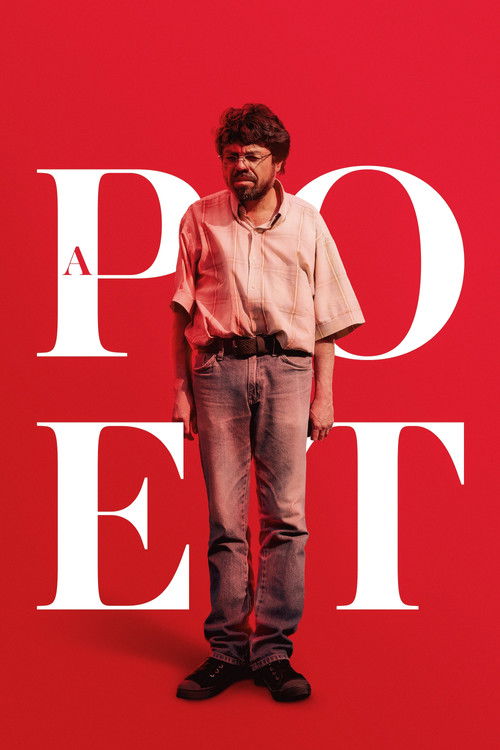
A Poet
2025 · Simón Mesa Soto
For when you want a smart, wry character study rather than plot — the kind of film to chew on afterward, ideal if you're in the mood for humane comedy about creative failure and unlikely mentorship.
What it's about
In Medellín, an aging poet who has devoted his life to verse — with no recognition and little dignity to show for it — finds a flicker of purpose when he takes on a protégée: Yurlady, a gifted teenager from a poor family. Mentoring her rekindles something in him, but dragging her into the small, self-regarding world of the poetry scene may be the worst thing he could do for her.
The experience
Bitterly funny and quietly sad at the same time — an absurdist comedy about failure that never mocks its characters cheaply. It makes you wince, laugh, and feel a real tenderness for people who love an art form that doesn't love them back.
Performances
Ubeimar Rios, a non-professional lead, is remarkable as the poet — self-mythologizing, exasperating, and touching all at once — and Rebeca Andrade brings an unforced naturalness to Yurlady that keeps the mentorship story honest.
The craft
Simón Mesa Soto pivots from austere social realism into an absurdist, tragicomic register while keeping a documentary-like texture: real Medellín locations, largely non-professional actors, and a script that finds comedy in humiliation without cruelty. The tonal balancing act is the craft — it's funny and melancholy in the same breath.
Why it matters
It premiered in Un Certain Regard at Cannes 2025 and won the section's Jury Prize, confirming Mesa Soto as one of Colombian cinema's leading voices and part of a wider flowering of Latin American auteur filmmaking.
Snapshot
A Poet (Un poeta) is Colombian filmmaker Simón Mesa Soto's second feature, a 124-minute tragicomedy that premiered in the Un Certain Regard section of the 2025 Cannes Film Festival on 19 May 2025, where it won the section's Jury Prize. It follows Oscar Restrepo (Ubeimar Rios), a middle-aged, self-mythologizing poet in Medellín whose lifelong devotion to verse has yielded no recognition and little dignity, and whose flagging sense of purpose is briefly rekindled when he takes on Yurlady (Rebeca Andrade), a gifted teenager from a poor family, as a protégée. The film is best understood as a deliberate pivot for its director: after building a reputation on austere social realism, Mesa Soto here works in an absurdist, bitterly funny register while retaining the documentary-adjacent texture — real locations, largely non-professional performers — that has defined his work. Critics received it enthusiastically (it recorded universal-acclaim aggregate scores) and singled out Rios's central performance; it went on to represent Colombia in the international feature Oscar race and to secure Independent Spirit and Goya nominations. As an atlas entry, A Poet sits at a crossroads of Latin American social cinema, the international-arthouse "portrait of the failed artist," and the festival co-production economy that increasingly underwrites both.
Industry & production
A Poet is a Colombia–Germany–Sweden co-production, a configuration that has become the default financing shape for auteur cinema from the Global South seeking a festival premiere. The principal Colombian producers were Ocúltimo and Medio de Contención Producciones, with Mesa Soto himself credited among the producers alongside cinematographer Juan Sarmiento G. and Manuel Ruiz Montealegre. The German partner ma.ja.de Filmproduktion (with public-broadcaster involvement from ZDF and Arte) and the Swedish partners Momento Film and Film i Väst rounded out the coalition — a spread that explains the film's Scandinavian musical contributions and its access to European post-production and distribution infrastructure. The film was shot in Medellín, the director's home city and the setting of essentially all his work, in Spanish. Its selection for Un Certain Regard, and its subsequent Jury Prize there, gave it the launch platform such films depend on: a Colombian theatrical release followed in late August 2025, a Toronto International Film Festival berth in September, and further festival play (including AFI Fest and Tallinn Black Nights). International sales were handled by Luxbox. The public record on budget is thin, and no verified figures are available; the modest scale is implied by the production model and the reliance on non-professional casting rather than stated in any authoritative source.
Technology
Detailed technical specifications — capture format, camera system, lenses — are not documented in the public record for A Poet, and I will not invent them. What can be said responsibly is that the film belongs to the contemporary digitally-originated arthouse tradition: a modestly resourced production whose aesthetic priorities run toward available light, real interiors and streetscapes, and unobtrusive coverage rather than toward technological spectacle. The Colombia–Germany–Sweden structure implies European post and grading facilities, consistent with the polished-but-naturalistic look reviewers described. In the absence of confirmed data, any claim about specific hardware or workflow would be speculation.
Technique
Cinematography
Cinematography is by Juan Sarmiento G., a Colombian director of photography based in Europe and a close creative partner of Mesa Soto — his dual role as co-producer signals a collaboration deeper than a single hire. Reviewers credited Sarmiento with "framing the bittersweetness" of the material, capturing the tragic and the comic in a single register rather than lighting the film as either a straight drama or a broad comedy. The observable strategy, consistent with Mesa Soto's realist lineage, is to hold the camera at a sober, observational distance from Oscar — letting his indignities and small vanities play out in the frame without editorial nudging — so that the absurdity emerges from the situation rather than from the camera's commentary. Granular shot-level analysis (lens choices, movement grammar) is not something the current public record supports in detail, and I flag that as a genuine gap.
Editing
The film was cut by Ricardo Saravia to a running time of roughly 124 minutes. Critics characterized the picture as dialogue-driven and, at moments, deliberately meandering — a structure that mirrors its protagonist's own dishevelled, digressive nature. That suggests an editorial approach willing to let scenes breathe and to accept a certain shagginess as expressive rather than lax, prioritizing the accumulation of behavioral and tonal detail over tight momentum. The tragicomic balance the film is praised for is, in large part, an editing achievement: the modulation between mortification and tenderness lives in how long a beat is allowed to run and where a scene is cut.
Mise-en-scène / staging
Mesa Soto stages A Poet in the actual textures of Medellín — its apartments, cafés, schools, and the small, faintly ridiculous rooms where a provincial poetry "scene" convenes. The mise-en-scène is built around social embarrassment: the gap between Oscar's self-image as an artist and the shabby, indifferent world that surrounds him is expressed spatially, in unglamorous settings that puncture his romantic self-conception. The casting of largely non-professional performers drawn from the local milieu is itself a staging choice, grounding the fiction in recognizable faces and speech rhythms. The mentor–pupil dyad of Oscar and Yurlady is framed as the "somber heart" of the film, and their scenes appear to be staged for intimacy and asymmetry — an adult's need meeting a teenager's talent, with the ethical unease of that exposure never fully resolved.
Sound
The score is credited to the Swedish composer Matti Bye — long associated with silent-film accompaniment and a delicate, melancholic pianistic sensibility — together with Trio Ramberget, reflecting the film's Nordic co-production ties. That pairing suggests a musical palette tuned to wistfulness and irony rather than to comedy's usual cueing, reinforcing the film's refusal to play its humiliations for simple laughs. Specific details of the sound design and mix are not documented in sources I can verify, so I will not characterize them beyond the score's authorship and its likely tonal function.
Performance
Performance is the film's most consistently praised element. Ubeimar Rios, a non-professional, anchors the picture as Oscar; critics described him as "compelling," singling out his physical presence, his voice, and his "distinctive facial expressions" as the instruments through which both the noble and the "intolerable" facets of the character emerge. The achievement is that Oscar is neither sentimentalized as a misunderstood genius nor flattened into a figure of ridicule — Rios holds both readings at once. Rebeca Andrade, as Yurlady, provides the counterweight: the film's tenderness and its ethical charge run through her. The surrounding ensemble (Guillermo Cardona, Allison Correa, Margarita Soto, Humberto Restrepo) extends the naturalistic surface, in keeping with Mesa Soto's documentary-inflected casting method.
Narrative & dramatic mode
The dramatic mode is character-study tragicomedy organized around a mentor–protégée relationship. Its engine is not plot mechanics but the slow revelation of a personality and its social predicament: Oscar's failure is a given from the outset, and the film's tension comes from whether his investment in Yurlady represents genuine generosity, self-serving vicariousness, or an outright ethical hazard — exposing a talented minor to a compromised adult "scene." Reviewers noted the film's occasionally meandering, digressive shape, which functions as a formal analog for a life without direction. The absurdist comedy operates by placing a man of sincere (if untalented, or merely unrecognized) romantic conviction inside a world that has no place or patience for him; the humor is one of mortification, and it shades continually into pathos. That doubleness — "satisfyingly tragic and hilarious," in one critic's phrase — is the film's defining mode.
Genre & cycle
A Poet participates in the durable arthouse cycle of the "portrait of the failed or minor artist" — films about the chasm between artistic self-conception and worldly indifference. It joins a broad contemporary current of tragicomedies about middle-aged creative disappointment, and its absurdist bent invites association with the deadpan-humiliation strain of European art cinema. Within Latin American filmmaking it also belongs to a lineage of socially attentive dramas about marginal figures. What distinguishes it within these cycles is the deliberate tonal migration: Mesa Soto imports the ethnographic realism of his earlier work into a comedic frame, so the film reads simultaneously as social observation and as fable. Reviewers repeatedly reached for the word "fable," underscoring that the film aims past naturalism toward a parable about the cost of trying to live an artistic life.
Authorship & method
Simón Mesa Soto (b. Medellín) is the film's writer, director, and co-producer, and A Poet is legible as a personal, possibly self-implicating work about the vanity, dignity, and futility of the artistic vocation. His method is consistent across his filmography: he shoots in Medellín, casts non-professionals, and builds fiction from observed social reality. His breakthrough was the short Leidi (2014), which won the Short Film Palme d'Or at Cannes; he returned to Cannes with the short Madre (2016) and made his feature debut with Amparo (2021), which screened in Critics' Week. A Poet marks his most pronounced tonal departure — a turn toward comedy and absurdism — while retaining his commitment to place and to unprofessional performers.
His key collaborators reinforce the sense of a settled authorial team and a strategic international one. Juan Sarmiento G. serves as both cinematographer and co-producer, the clearest marker of a sustained partnership. Editor Ricardo Saravia shaped the film's loose, behavior-forward rhythm. The score by Swedish composer Matti Bye with Trio Ramberget brings a melancholic, silent-cinema-inflected sensibility that both flows from the Swedish co-production and productively cuts against the comedy. The producing coalition — Mesa Soto and Sarmiento with Manuel Ruiz Montealegre, and the German and Swedish partners — represents the method by which such a regionally rooted vision reaches a global platform.
Movement / national cinema
The film is a significant recent entry in Colombian cinema, part of a wave of Colombian and broader Latin American work that has gained festival traction in the 2010s and 2020s by pairing local specificity with European co-financing. Coverage of the 2025 Cannes lineup framed A Poet as a flagship for Colombia's presence at the festival. Mesa Soto's cinema is Medellín cinema first and foremost — his subject is that city's social fabric and its overlooked lives — and his practice of non-professional casting connects him to a long Latin American tradition of neorealist-descended filmmaking. At the same time, the tri-national production model situates the film within a transnational European-arthouse system, so it is at once national cinema and a product of the festival economy that circulates it.
Era / period
A Poet is a mid-2020s film, and it reflects the period's dominant art-cinema condition: modestly budgeted, digitally made, festival-launched, and dependent on multi-country co-production to exist at all. Its concern with the marginalization of unremunerative art, and with a society that has "no place" for the uncommercial or the eccentric, reads as a period statement about the pressures of commercialization on creative life — a preoccupation reviewers foregrounded. The film's afterlife is likewise characteristic of its moment: a Cannes sidebar prize converting into a national theatrical release, an Oscar submission, and precursor-season nominations, all within a single year.
Themes
The film's governing themes cluster around the vocation of art and its social cost. Chief among them: the humiliation and stubborn dignity of the unrecognized artist; the commercialization of culture and the way it "stifles" non-commercial expression; the marginalization of alternative or eccentric voices; and a society's failure of compassion toward those who do not fit its productive norms — one critic called it "a damning portrait of a spiritually impoverished society." Braided through these is the ethically charged theme of mentorship: the mentor–pupil bond between Oscar and Yurlady is both the film's tenderest thread and its most uneasy, raising questions of influence, vicarious ambition, and the vulnerability of a young talent introduced to a compromised adult world. Class runs beneath all of it — Yurlady's "humble roots," Oscar's genteel poverty — as does the gap between romantic self-image and material reality.
Reception, canon & influence
Critical reception was strongly positive. The film registered universal-acclaim aggregate scores (a 100% critics' rating across dozens of reviews on one aggregator and a Metacritic score in the mid-80s), with praise concentrated on its tonal control and, above all, Ubeimar Rios's lead performance, variously described as darkly funny and genuinely affecting. Its most important institutional endorsement was the Un Certain Regard Jury Prize at Cannes; it subsequently became Colombia's submission for the international feature Academy Award (ultimately not nominated) and earned nominations at the Independent Spirit Awards (Best International Film) and the Goya Awards (Best Ibero-American Film).
The influences on the film (backward) are best traced through its maker: the Latin American realist tradition of non-professional casting and location shooting, filtered through the deadpan, humiliation-driven comedy of contemporary European art cinema, and grounded in Mesa Soto's own prior Cannes-honored work (Leidi, Madre, Amparo). Its thematic ancestor is the broad international genre of the failed-artist portrait.
Its forward legacy is still forming — the film is barely a year old — but two markers are already legible. First, it consolidates Mesa Soto's standing as a leading figure of contemporary Colombian cinema and strengthens Colombia's festival profile. Second, and more concretely, an American remake has been reported in development with director Nathan Silver and co-writer C. Mason Wells, an unusually rapid signal of the original's resonance and a rare instance of a Latin American arthouse comedy attracting a U.S. remake so soon after its premiere. Any assessment of its lasting canonical position would be premature; what can be said is that it has entered the conversation with strong critical backing and institutional recognition.
Reception
Premiered quietly in Un Certain Regard at Cannes 2025 and walked off with the Jury Prize — then kept snowballing all year, sweeping festival awards (San Sebastián's Horizontes Latinos, El Gouna, Melbourne) and becoming the top-grossing Colombian film of 2025 at home.
How A Poet was received, from release to now →
How to watch A Poet: what to notice on a first viewing
- Watch Ubeimar Ríos hold both dignity and absurdity in his face. Ríos, a non-professional, plays Oscar through physical presence and expression rather than dialogue alone, so you can never fully settle into mocking him or admiring him. The performance holds both readings at once, which is harder than choosing either one.
- Notice the camera's sober distance from Oscar's indignities. Sarmiento holds back from close-up commentary, letting Oscar's small vanities and embarrassments play out in the frame without the camera nudging you toward a reaction. You get to decide for yourself when to laugh and when to wince.
- Watch the shabby, unglamorous rooms where the poetry scene meets. Mesa Soto shoots in real Medellín apartments, cafés, and schools, letting the gap between Oscar's self-image and his actual surroundings show up in the location itself. The rooms puncture his romantic self-conception before a single character gets the chance to.
- Listen for the melancholic piano under the comedy. Matti Bye's score leans wistful and ironic rather than broadly comic, refusing to cue easy laughs at Oscar's humiliations. The music keeps telling you this is sadder than the scene alone would let on.
The whole guide to watching A Poet, with the keys for a rewatch →
Influences: the films it descends from and the films it influenced
- Amparo (2021) — Mesa Soto's own feature debut established the working method A Poet extends: fiction built in Medellín from observed social reality with non-professional leads shot in real locations and available light.
- Leidi (2014) — His Palme d'Or short set the observational-distance grammar—patiently trailing one street-cast non-professional through the city with digressive, behavior-forward pacing rather than plot.
- Bicycle Thieves (1948) — The neorealist template A Poet openly inherits: a non-actor lead, real streets, and available-light shooting that turns a single man's small humiliations into the film's whole structure.
- Umberto D. (1952) — Supplies the dignity-in-decline character study—unsentimental observational distance held on a marginal, faintly absurd protagonist whose pride is repeatedly punctured.
- Rodrigo D: No Future (1990) — The founding text of Medellín cinema's street-casting practice, where non-professionals play near-versions of themselves—the direct regional precedent for Mesa Soto's casting.
- La vendedora de rosas (1998) — Extends the Medellín neorealist method with untrained performers and location shooting, cementing the Colombian lineage of building narrative from lived local milieu.
- The Phantom Carriage (1921) — The Swedish silent-cinema idiom—and specifically the live-accompaniment tradition Matti Bye works in—that A Poet's melancholic silent-film score draws on to cut against its comedy.
- Inside Llewyn Davis (2013) — The failed-artist portrait as cyclical humiliation: deadpan comedy layered over real pathos, following a genuinely talented figure whose gift never converts into recognition.
- Barton Fink (1991) — Models the puncturing of the artist's vanity and self-mythology—the futility and pretension of the creative vocation played as absurdist tragicomedy.
- The Match Factory Girl (1990) — Source of the deadpan, humiliation-driven comic register: minimalist static framing and stoic non-reaction that wring comedy from a downtrodden protagonist.
- Songs from the Second Floor (2000) — The deadpan absurdist tableau of failure and thwarted dignity that feeds the contemporary European art-comedy sensibility filtered into A Poet's tone.
- Los reyes del mundo (2022) — Contemporary Colombian street-cast realism carrying the Medellín non-professional tradition forward, using real locations and untrained youth to build fiction from social reality.
- Paterson (2016) — A parallel observational portrait of a poet whose work stays unrecognized, structured by quotidian digressive rhythm rather than dramatic incident.
- The Square (2017) — Shares the deadpan satire of cultural institutions and the commercialization of art, staging the humiliation of a self-serious cultured man as escalating social comedy.
- Toni Erdmann (2016) — A long, loose, behavior-forward character study whose comedy and feeling are generated entirely through escalating awkwardness and social humiliation—the same digressive editing logic.
- Between the Temples (2024) — Improvisatory, awkward intergenerational-mentor comedy grounded in behavior-forward realism; Silver's tapping for the U.S. remake confirms the shared humiliation-comedy method.
Similar films
- Bitter Christmas (2026) — same viewing thread
- Poetry (2010) — shared sensibility
- Biutiful (2010) — shared sensibility
- Endless Poetry (2016) — shared sensibility
- Sing, Lola, Sing! (2023) — shared sensibility
- On Becoming a Guinea Fowl (2024) — shared sensibility
- The Mysterious Gaze of the Flamingo (2025) — shared sensibility
- The Currents (2025) — shared sensibility
All the films related to A Poet →
Watch it with: curated runs of related films
- Funny Because It Aches — A run of tender, deadpan dramedies where love, grief, and the panic of becoming yourself all get metabolized through jokes — watch these when you want to laugh and cry in the same scene.