Endless Poetry
2016 · Alejandro Jodorowsky
For when you want cinema that's alive and strange — a night to be dazzled rather than soothed, and to come away wanting to make something. More challenge than comfort, but a joyful one.
What it's about
Alejandro Jodorowsky restages his own young adulthood in 1940s–50s Santiago: a young man defies his authoritarian father's demand that he become a doctor and declares himself a poet instead. He plunges into the city's bohemian underground — cafés, cabarets, and the artists and eccentrics of Chile's literary scene — and the film follows his messy, ecstatic self-invention. It's autobiography staged as carnival, with the director's own sons playing versions of his family.
The experience
Flamboyant, funny, and unashamedly sincere — one moment a circus, the next a raw family wound. It moves like a fever dream but the emotions underneath are simple and piercing: a son who wants his father's blessing and refuses to need it.
Performances
Jodorowsky's sons anchor it: Adan Jodorowsky plays the young poet with open-hearted abandon, and Brontis Jodorowsky is ferocious as the father — a casting choice that turns the whole film into an act of family therapy performed in public.
The craft
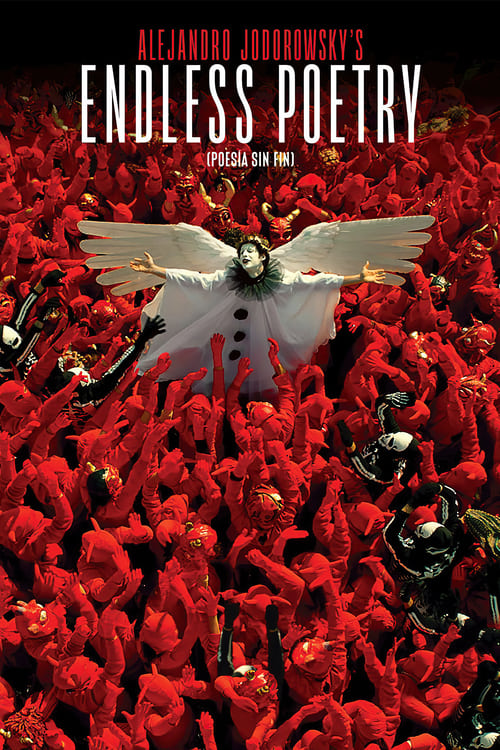
Every frame is staged like theater — saturated color, painted backdrops, crowds of masked figures, memories literally carried on and off stage by black-clad hands. Made in his mid-eighties, it has the visual confidence of a director with nothing left to prove and everything left to say.
Why it matters
A late-career triumph that returned Jodorowsky — a founding figure of midnight-movie surrealism — to festival acclaim, and the boldest entry in his ongoing cinematic autobiography.
Snapshot
Endless Poetry (Spanish: Poesía sin fin) is the second installment in Alejandro Jodorowsky's projected multi-part cinematic autobiography, following The Dance of Reality (2013). Where the first film reconstructed his childhood in the northern Chilean mining town of Tocopilla, Endless Poetry advances the chronology into the director's late adolescence and young adulthood in Santiago during the 1940s and early 1950s, dramatizing the decision that organized his entire life: to reject his father's demand that he become a doctor and instead become a poet. The film is at once a coming-of-age narrative, a family melodrama, and an ecstatic staging of bohemian awakening, populated by figures drawn from real Chilean literary history. Made when Jodorowsky was in his mid-eighties, it is a late-career work of remarkable vitality, financed in part through a public crowdfunding campaign after decades in which the director completed very few features. It premiered in the Directors' Fortnight (Quinzaine des Réalisateurs) at the 2016 Cannes Film Festival. Its defining stylistic gambit is the presence of the elderly Jodorowsky himself, appearing within the frame to console, instruct, and argue with his younger self — a self-consciously theatrical device that makes the film's status as remembered, reconstructed, and reconciled autobiography its explicit subject.
Industry & production
Endless Poetry was produced as an international co-production with Chilean and French participation, continuing the funding model Jodorowsky had used to return to filmmaking after his long hiatus following The Rainbow Thief (1990). A significant and well-documented feature of its financing was a crowdfunding campaign, through which the director directly solicited support from admirers of his work; this was consistent with his broader late-career posture of framing filmmaking as a communal, almost devotional act rather than a commercial one. The producers associated with the project include figures connected to his family and to the Mexican and French backers who had enabled The Dance of Reality. I should note plainly that the precise corporate structure — the full list of production and distribution companies and their respective stakes — is the sort of granular industrial detail I cannot reconstruct with confidence here, and I will not fabricate it.
What can be said with confidence is that the film was conceived as part of a larger multi-film autobiographical project, which shaped its production logic: recurring cast, recurring crew, and a continuity of design vocabulary with The Dance of Reality. It received festival distribution in the art-house circuit following its Cannes launch, with theatrical runs in specialty markets in Europe, Latin America, and North America. It was not a mass-market release and should be understood within the economics of auteur-driven, festival-anchored international cinema rather than commercial exhibition.
Technology
The film was shot digitally, which is worth noting because Jodorowsky's stylistic sensibility was formed in the era of celluloid and his most famous works (El Topo, The Holy Mountain) are emphatically photochemical objects. Digital capture here serves a director working with an experienced modern cinematographer to achieve high color saturation, flexible handheld mobility, and controllable low-light interiors without the constraints of film stock. The technology is largely invisible in service of a deliberately artificial, painterly image — Jodorowsky is uninterested in digital "realism" and instead uses contemporary tools to build a frankly constructed, tableau-like world. Enlarged period photographs are used as backdrops for Santiago's streets, a low-tech theatrical solution that the digital image accommodates smoothly. In this sense the film's "technology" is less about capture format than about the marriage of modern digital flexibility to a pre-cinematic, stage-derived aesthetic.
Technique
Cinematography
The cinematography is by Christopher Doyle, the celebrated director of photography best known for his work with Wong Kar-wai (Chungking Express, In the Mood for Love). His participation is one of the film's most consequential creative facts. Doyle brings a restless, sensuous, color-drenched handheld style that suits Jodorowsky's carnivalesque material: the camera moves with the bodies of dancers and revelers, colors are pushed toward the vivid and the emotionally symbolic, and the image frequently favors expressive intensity over classical composure. The pairing of Doyle's fluid romanticism with Jodorowsky's frontal, tableau-based staging produces a distinctive tension — moments of theatrical stillness giving way to swirling movement. The result is among the most visually opulent films of Jodorowsky's career.
Editing
The editing was handled by Maryline Monthieux, an editor with experience in French and international art cinema. The cutting supports Jodorowsky's episodic, memory-structured narrative, moving between naturalistic scenes and overtly staged set-pieces, and accommodating the film's recurring device of the elderly director intruding upon the action. The rhythm is generous rather than aggressive, allowing performances and mise-en-scène to breathe; the film favors the duration of the tableau over rapid montage. Transitions frequently exploit the seam between "real" and "staged" space, and the editing must hold together shifts in register — from operatic melodrama to slapstick to lyrical reverie — that are central to the film's tone.
Mise-en-scène / staging
Staging is the heart of Jodorowsky's method, and Endless Poetry foregrounds theatrical artifice as an aesthetic and philosophical principle. Scene changes and prop movements are performed by black-clad stagehands visible within the frame, a device explicitly borrowed from the traditions of puppet theater (the Japanese bunraku convention of the visible operator). Period Santiago is evoked with painted or photographic backdrops rather than seamless location realism, insisting on the film as a reconstruction of memory rather than a documentary of the past. Crowds, costumes, and choreography are organized into frontal, symmetrical, frieze-like compositions punctuated by grotesque and carnival imagery. This anti-illusionist staging is not incidental decoration; it is the film's argument that the past is a theater we build in order to reconcile with it.
Sound
The sound design and, above all, the music carry a heavy expressive load. The mother, Sara, delivers her dialogue entirely in operatic soprano — a device continued directly from The Dance of Reality and performed by Pamela Flores. This transforms domestic exchanges into arias and marks the maternal presence as mythic. The original score is by Adan Jodorowsky, the director's son, who also performs. Music functions less as underscore than as a parallel emotional text, binding the film's bohemian and familial worlds together in a heightened, quasi-liturgical register.
Performance
The performances are deliberately pitched between naturalism and theatrical exaggeration. The adult Alejandro is played by Adan Jodorowsky (the director's son), while Brontis Jodorowsky (another son) plays the authoritarian father Jaime, reprising the role he held in The Dance of Reality. Pamela Flores plays a strikingly doubled role: both the operatic mother Sara and the flame-haired poet Stella Díaz — a doubling that makes explicit the Oedipal and creative entanglement at the film's core. The casting of the director's own children as versions of himself and his father collapses the boundary between biography and performance, so that the film's acting is itself a form of familial ritual and reconciliation.
Narrative & dramatic mode
The dramatic mode is confessional autobiography rendered as surrealist pageant. The narrative is loosely chronological — the young Alejandro breaks with his family, moves into a bohemian household, discovers poetry and the artistic underground, experiences love and sexual initiation, and forms the friendships that will define his sensibility — but it is organized less by causal plotting than by symbolic episode and emotional crisis. The recurring appearance of the aged director within the frame establishes a dual temporality: the film is simultaneously the story being lived and the story being narrated, judged, and forgiven from old age. This is autobiography as therapy, consistent with Jodorowsky's own concepts of "psychomagic" and "psychogenealogy," in which reenacting and re-staging the family past is a curative act. The dramatic stakes are internal and mythic rather than external and plot-driven.
Genre & cycle
Nominally classed as fantasy and drama, the film is better understood as belonging to the genre of poetic autobiographical cinema — the lineage of Fellini's Amarcord and 8½, of memory-films in which the remembered world is frankly reimagined. It is the second film in Jodorowsky's own autobiographical cycle, and its meaning is deepened by its relationship to The Dance of Reality: the two form a diptych of childhood and youth, sharing cast, aesthetic, and thematic preoccupations. It also draws on the traditions of the carnival film, the surrealist reverie, and the Künstlerroman (the artist's coming-of-age). Its fantasy is not that of world-building spectacle but of interior symbolism made visible.
Authorship & method
Endless Poetry is a near-total expression of Jodorowsky's authorship: he wrote and directed it, cast his own sons in central roles, drew its narrative from his own life, and appears within it as himself. The method fuses several strands of his career — the ceremonial theater of the Panic Movement he co-founded in the 1960s with Fernando Arrabal and Roland Topor; the tarot symbolism and mystical cosmology of his esoteric practice; and his therapeutic doctrines of psychomagic. Yet this is not solitary auteurism. The film's texture depends decisively on collaborators of the first rank: cinematographer Christopher Doyle, whose sensibility softens and enriches Jodorowsky's frontal staging; composer Adan Jodorowsky, whose score sustains the operatic register; editor Maryline Monthieux; and the ensemble of family and non-professional performers. The authorial method is thus paradoxical — intensely personal in content, communal and ceremonial in execution.
Movement / national cinema
The film sits at an intersection of national cinemas rather than within any single one. It is, by subject, a Chilean film — set in Santiago, populated by real figures from Chilean letters, and concerned with the country's mid-century bohemia. But Jodorowsky is a lifelong exile who worked chiefly in Mexico and France, and the film's production and creative team are international, giving it the character of a transnational, diasporic work. Aesthetically its lineage runs through surrealism and the avant-garde theater of Europe (the Panic Movement) as much as through any Latin American film tradition. It is best located within the tradition of the international art-house auteur film and within Jodorowsky's singular, self-authored body of work, which has always resisted national categorization.
Era / period
The film is set in the 1940s and early 1950s, in the Santiago of Jodorowsky's youth — a period reconstructed through enlarged period photographs, painted backdrops, and theatrical costume rather than archival realism. The bohemian milieu it depicts corresponds to a real and historically significant moment in Chilean literature, the circle around poets such as Nicanor Parra, Enrique Lihn, and Stella Díaz Varín, all of whom appear as characters. The film thus doubles as a stylized homage to a specific literary generation. It was made and released in 2016, and its meaning is inseparable from that late-career vantage: an octogenarian artist reconstructing his youth, with the historical past filtered through more than sixty years of memory and myth.
Themes
The film's governing themes are the birth of the artist, rebellion against the father, and reconciliation with the past. Poetry is figured as both vocation and liberation — a means of escaping the mercantile, authoritarian world of the father into a life of beauty, risk, and love. The mother, sung and doubled with the poet-lover, embodies the entanglement of maternal and erotic desire that Jodorowsky treats as the source of creative energy. Death, mortality, and forgiveness pervade the film, given weight by the director's advanced age and by the recurring on-screen dialogue between old and young selves. Underlying all of it is Jodorowsky's conviction that life must be lived as poetry — that art is not decoration but the very act of becoming oneself — and that healing the wounds of family and history is possible through symbolic reenactment.
Reception, canon & influence
Critical reception was warm, particularly from admirers of The Dance of Reality, who received Endless Poetry as an even richer and more emotionally direct continuation of the autobiographical project; the collaboration with Christopher Doyle was frequently singled out as elevating the film's visual splendor. Some critics found the surrealist excess and sentimentality characteristic of Jodorowsky either exhilarating or overwrought, reflecting the polarized responses his work has always drawn. It was broadly regarded as one of the strongest films of his late career. I should note that I am characterizing the general critical consensus rather than citing specific figures or awards, and I will not invent particular reviews or box-office numbers.
Looking backward, the influences on the film are legible and largely self-declared: Fellini's autobiographical and carnival films; the anti-illusionist theater of the Panic Movement and of surrealism; the traditions of puppet theater; the tarot and esoteric symbolism of Jodorowsky's mystical practice; and, most directly, the real Chilean poetic culture of the 1940s–50s and Jodorowsky's own remembered life. It is also, crucially, in dialogue with its predecessor The Dance of Reality, from which it inherits cast, method, and philosophy.
Looking forward, the film's influence is bound up with the renewed visibility of Jodorowsky in the 2010s — a period in which his earlier cult films, the documentary Jodorowsky's Dune (2013), and this autobiographical diptych together restored him to critical conversation and introduced his sensibility to a younger generation of filmmakers and cinephiles. As part of an unfinished, ongoing autobiographical cycle, its ultimate place in his oeuvre and its longer legacy remain, appropriately, open-ended — a fitting condition for a film whose title promises poetry without end.
A Deleuzian reading
Black-clad figures walk into the shot, pick up the furniture, and carry it off.
The full Deleuzian reading of Endless Poetry →
Reception
Warmly received at its Cannes Directors' Fortnight premiere in 2016 as a late-career triumph, and it's only grown into that reputation — often called Jodorowsky's warmest, most accessible film, a surprise from the man who made El Topo. For a director long filed under 'midnight-movie madman,' the tenderness read as its own kind of shock.
How Endless Poetry was received, from release to now →
How to watch Endless Poetry: what to notice on a first viewing
- Watch the black-clad stagehands moving furniture during scenes. Borrowed from Japanese bunraku puppet theater, these visible operators carry props and set pieces in full view while the actors ignore them completely. Jodorowsky refuses to hide that this is a constructed memory, not a filmed record of one.
- Listen for the mother singing every line in full opera. Sara delivers her entire dialogue in operatic soprano, turning ordinary domestic exchanges into arias rather than conversation. You cannot talk back to an aria, which tells you something about what it was like to be her son.
- Notice how far the colors push past ordinary realism. Christopher Doyle's restless, saturated camera pushes hues toward the vivid and the emotionally symbolic, especially whenever dancers and revelers fill the frame. The color is telling you how a moment felt, not just what it looked like.
- Watch for the elderly Jodorowsky walking into his own memories. The director, now in his eighties, appears inside scenes of his own youth to console, argue with, and simply stand beside the boy playing his younger self. Two versions of the same man share the frame, and neither one is clearly the real one.
The whole guide to watching Endless Poetry, with the keys for a rewatch →
Influences: the films it descends from and the films it influenced
- El Topo (1970) — Establishes Jodorowsky's own frontal, procession-based tableau staging and ceremonial mise-en-scène that Endless Poetry inherits and softens through Doyle's camera.
- The Holy Mountain (1973) — Introduces the anti-illusionist device of the director appearing within his own frame and the alchemical/tarot symbolic vocabulary that Endless Poetry reprises as autobiographical ritual.
- Santa Sangre (1989) — Pioneers his family-casting method (son Axel in the lead) and psychodrama-as-therapy staging that Endless Poetry systematizes with sons Adan and Brontis in central roles.
- The Dance of Reality (2013) — Direct predecessor supplying the same dual-temporality device — the aged Jodorowsky stepping into the past to console his younger self — plus cast, autobiographical method, and psychomagic reconciliation.
- Amarcord (1973) — Supplies the model of carnivalesque autobiographical memory rendered as episodic tableaux with grotesque caricatured townsfolk, which Endless Poetry transposes to 1940s Santiago bohemia.
- 8½ (1963) — Founds the Künstlerroman-of-the-director in which the artist's real life, fantasy, and creative crisis fuse into a single self-reflexive parade — the formal template for Jodorowsky's poet-becoming narrative.
- The Blood of a Poet (1930) — Ancestral poet's-self-mythology film using theatrical trompe-l'oeil and hand-made surrealist devices, the lineage of literalizing metaphor onstage that Endless Poetry extends with bunraku stagehands.
- Un Chien Andalou (1929) — Founding Spanish-language surrealist grammar of the shocking associative image, the movement whose anti-illusionist logic Jodorowsky openly claims as inheritance.
- The Mirror (1975) — Ancestral model of nonlinear autobiographical cinema fusing memory, poetry, and dual temporalities with a doubled actor spanning generations — the formal permission for Jodorowsky's time-collapsing structure.
- Roma (2018) — Later autobiographical reconstruction of a director's remembered city and household staged with meticulous period tableau and deep-focus long takes, extending the memoir-as-choreographed-tableau craft.
- Pain and Glory (2019) — Extends the aging-artist Künstlerroman in which the director confronts his own past and reconciles with the father/mother figure, using a doubled autobiographical surrogate as Jodorowsky does.
- Viva la muerte (1971) — Work of his Panic Movement co-founder applying the same ceremonial cruelty and surrealist theater-of-provocation to autobiographical childhood trauma and rebellion against authority.
- In the Mood for Love (2000) — Showcase of Christopher Doyle's saturated, expressive color and sensuously mobile handheld camera — the very cinematographic sensibility Doyle imports to enrich Jodorowsky's frontal staging.
- Rabbit-Proof Fence (2002) — Another instance of Doyle applying his painterly, atmosphere-first lensing to a director outside his Hong Kong milieu, demonstrating the collaborator method that shapes Endless Poetry's look.
- The Colour of Pomegranates (1969) — Parallel non-naturalist life-of-a-poet built entirely from frontal, static emblematic tableaux with objects and stagehands manipulated in view — the same theatrical-duration editing rhythm.
- Poetry (2010) — Contemporary Künstlerroman treating the making of a poem as a moral and existential vocation, a sibling meditation on poetry-as-transfiguration-of-life rather than sci-fi/violence resemblance.
Similar films
- El Topo (1970) — influence & lineage
- The Holy Mountain (1973) — influence & lineage
- Santa Sangre (1989) — influence & lineage
- 8½ (1963) — influence & lineage
- Pain and Glory (2019) — influence & lineage
- Poetry (2010) — influence & lineage
- A Poet (2025) — shared sensibility
- Pastoral: To Die in the Country (1974) — shared sensibility