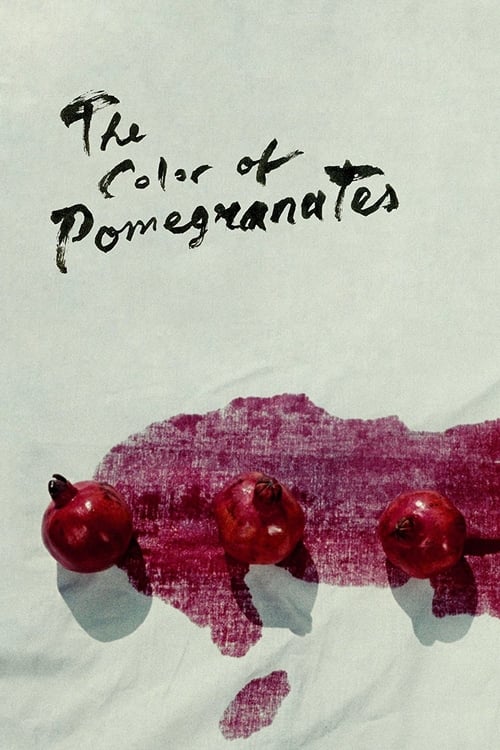
The Color of Pomegranates
1969 · Sergei Parajanov
For when you want pure images — a meditative, art-gallery state of mind rather than a story. One of cinema's great challenges and great rewards; not a casual pick, but unforgettable if you meet it halfway.
What it's about
The life of Sayat-Nova, the eighteenth-century Armenian troubadour-poet, told not as biography but as a procession of living paintings — childhood among books and dyed wool, youth at court, years in a monastery, old age, death. There is almost no dialogue and no conventional story; his life passes as a sequence of ritual images: pomegranates bleeding onto cloth, spinning carpet-dyers, angels, animals, and the poet's own verses.
The experience
Like walking slowly through an illuminated manuscript — hypnotic, strange, and gorgeous, with each frontal, near-static tableau composed like an altarpiece. It asks you to stop expecting narrative and simply look; give in and it becomes genuinely transporting.
The craft
Every element is handmade and symbolic: real Armenian churches, carpets, costumes, and ritual objects arranged in flat, frontal compositions of astonishing color — the pomegranate reds alone justify the title. It rewards the biggest screen and most patient attention you can offer; this is filmmaking as tapestry-weaving.
Why it matters
Suppressed and recut by Soviet authorities, it survived to become a touchstone of poetic cinema, revered by filmmakers worldwide and cited constantly as proof of how far film can move from storytelling toward pure visual art. It also cemented Parajanov's reputation — and his persecution.
Snapshot
The Color of Pomegranates (Armenian: Sayat-Nova) is Sergei Parajanov's hermetic, image-driven life of the eighteenth-century Armenian ashugh (troubadour-poet) Sayat-Nova, rendered not as biography but as a succession of living tableaux. Abandoning narrative causality almost entirely, the film organizes the poet's life into chapters — childhood, youth in the carpet-dyers' world, the monastery, the court, old age, death — each built from frontal, near-static compositions of bodies, textiles, ritual objects, animals, and architecture. It is among the most radically anti-illusionist works ever produced inside a state film industry, and its survival in altered form is itself part of its history: the version most viewers know is not the cut Parajanov approved. Widely regarded as a landmark of poetic cinema and one of the supreme achievements of Soviet film, it remains a touchstone for filmmakers drawn to the tableau, to ethnographic spectacle, and to cinema conceived as a sequence of charged still images rather than a told story.
Industry & production
The film was produced at Armenfilm, the Armenian SSR's state studio in Yerevan, within the centralized Soviet system in which Goskino and the studio apparatus controlled financing, approval, and distribution. Parajanov came to the project having already broken with Socialist Realism in Shadows of Forgotten Ancestors (1964), made at the Dovzhenko Studio in Ukraine, whose international success gave him the standing to mount an even more uncompromising work in his ancestral Armenia.
Production was contentious from the start. The film's avowed subject — a canonical national poet — offered a measure of institutional cover, but its execution alarmed authorities who expected a recognizable biopic. The picture was completed around 1968–69 but its release was obstructed. Parajanov's cut was deemed too obscure and was withheld; the celebrated Russian filmmaker Sergei Yutkevich was brought in to re-edit the film into a more legible form, reordering material and adding intertitle "chapter" cards, for wider Soviet distribution in 1969–71. The original title Sayat-Nova was changed to the more abstract The Color of Pomegranates, partly to defuse claims that the film misrepresented the historical poet. Precise figures on budget and box office are not part of the reliable public record and should not be invented here; what is documented is that the film circulated narrowly and that Parajanov's relationship with the authorities deteriorated sharply in its aftermath — he was imprisoned in the mid-1970s on charges widely understood to be politically motivated, effectively halting his career for years. The existence of multiple versions — the Yutkevich Soviet cut, an Armenian-archive variant, and later restorations — is central to any account of the film, and no single "definitive" director's cut survives uncontested.
Technology
The film was shot on 35mm color stock within the constraints of late-1960s Soviet film technology, which lagged Western color processes; the resulting palette is rich but distinctively muted and slightly unstable, a quality later restoration work has had to reckon with. Parajanov turned these limitations into an aesthetic, building set-piece tableaux around saturated reds, golds, and earth tones drawn from Armenian and Persian manuscript illumination and carpet design rather than naturalistic color. In 2014 the World Cinema Project (the Film Foundation, with Cineteca di Bologna's L'Immagine Ritrovata laboratory) completed a major 4K restoration drawing on surviving original camera negative and other elements, work overseen with reference to Parajanov's collaborator Mikhail Vartanov's circle; this restoration is the version through which the film reached a new global audience and stabilized its image and color for the first time. The technological story of Pomegranates is therefore double: a film made with modest, sometimes improvised means, and an object whose modern life depends on photochemical-to-digital restoration.
Technique
Cinematography
The cinematography, credited to Suren Shahbazyan (with other camera personnel involved across the troubled production), is built almost entirely on a frontal, planimetric aesthetic: the camera faces its subjects squarely, framing them against shallow backdrops as if they were figures in a frieze or an illuminated page. Camerawork is predominantly static — the "largely still camerawork" noted in the synopsis is precise — with movement supplied by the performers, objects, and small mechanical actions within the frame rather than by pans or tracking. Depth is deliberately suppressed; compositions read as flattened planes layered with texture. The effect is anti-perspectival, closer to medieval manuscript art, Persian miniature, and Armenian religious imagery than to the moving-camera grammar of mainstream cinema. Light is used to model textiles, faces, and metalwork with an almost tactile specificity.
Editing
Editing is paratactic — image follows image by association, rhythm, and visual rhyme rather than by cause and effect or continuity. The film proceeds in discrete tableaux, often held long enough to register as composed pictures, separated into chapters that mark stages of the poet's life. Crucially, the editing history is inseparable from interpretation: Yutkevich's re-cut reorganized and labeled the material, so the sequence and intertitling of the widely seen version reflect a second hand. The associative montage descends from the Soviet montage tradition but inverts its dialectical, kinetic energy into something contemplative and iconic.
Mise-en-scène / staging
Mise-en-scène is the film's true medium. Each shot is densely art-directed with culturally specific objects — pomegranates bleeding onto cloth, opened books drying on a monastery roof, looms and dyed wool, daggers, censers, sea-shells, embroidered vestments, slaughtered and living animals. Figures are posed and frieze-like, performing ritualized, often repeated gestures. Staging draws explicitly on Caucasian and Near Eastern visual traditions: Armenian khachkars and church architecture, carpet patterns, manuscript miniatures, and Orthodox iconography. The frame functions as a reliquary or a page, and meaning is carried by the arrangement and symbolism of objects far more than by action.
Sound
The soundtrack is non-synchronous and constructed, layering Armenian liturgical chant, folk music, instrumental passages, ambient and ritual sounds, and recited verse against the silent, posed images. Because dialogue and lip-sync are essentially absent, sound operates as a parallel poetic stream — incantatory, looped, sometimes abruptly cut — reinforcing the film's quality of ceremony. The recitation of Sayat-Nova's poetry (and verse evoking his sensibility) threads through the film as voice rather than as dramatized speech.
Performance
Performance is anti-naturalistic and emblematic. The Georgian actress Sofiko Chiaureli famously plays multiple roles, including both the young poet and his muse — a casting choice that dissolves the boundary between artist and beloved and underlines the film's interest in androgyny, doubling, and identification. Performers hold poses, repeat stylized gestures, and direct their gaze frontally toward the lens; they are figures in a composition rather than psychological characters. The acting register is closer to liturgical pantomime, tableau vivant, and ritual than to dramatic embodiment.
Narrative & dramatic mode
The film all but refuses conventional narrative. There is no dramatized conflict, no scene-level cause and effect, and little dialogue; the "story" is the symbolic distillation of a life — childhood awakening to texture and word, sensual and spiritual maturation, monastic withdrawal, age, and death — conveyed through emblem and association. Its mode is lyric and iconographic rather than dramatic: it asks to be read like a poem or a sequence of illuminated pages, with motifs recurring and accreting meaning. The chapter structure (sharpened by the imposed intertitles) gives a loose biographical spine, but causality is replaced by metaphor. This places the film squarely in the tradition of "poetic cinema," a category Parajanov, alongside Tarkovsky, came to define for international audiences.
Genre & cycle
Nominally a biographical and historical drama, the film belongs far more to an art-cinema lineage of non-narrative, ritualistic, image-centered filmmaking. Within Parajanov's own work it forms the heart of a loose cycle of ethnographic-poetic features rooted in the cultures of the Caucasus — preceded by the Ukrainian-Hutsul Shadows of Forgotten Ancestors (1964) and followed, after his imprisonment, by The Legend of Suram Fortress (1985, Georgian) and Ashik Kerib (1988, Azerbaijani/Lermontov). Across this cycle Parajanov treats the folk and sacred traditions of a region as cinematic material, building each film as a mosaic of tableaux. Pomegranates is the cycle's most extreme and purest realization.
Authorship & method
The Color of Pomegranates is an auteur work in the fullest sense: Parajanov wrote, directed, and designed it, functioning as much as a visual artist — collagist, set-dresser, iconographer — as a director. His method was to compose the film image by image, treating each shot as an autonomous artwork dense with culturally specific symbolism, and to subordinate story to plastic and poetic effect. He drew on his own background straddling Armenian, Georgian, and broader Caucasian cultures, and on a lifelong practice of collage and assemblage that is legible in the film's object-laden frames.
Key collaborators include cinematographer Suren Shahbazyan, who realized the frontal, static photographic style; actress Sofiko Chiaureli, whose multi-role performance is structurally central; and Sergei Yutkevich, whose externally imposed re-edit shaped the released version and remains a contested authorial intrusion. The composer Tigran Mansurian is associated with the film's music, set against extensive use of Armenian liturgical and folk material. Documentarian Mikhail Vartanov, a close ally, championed and theorized the film — the synopsis's reference to it being "hailed as revolutionary by Mikhail Vartanov" points to his role as its most ardent early interpreter and to his own film The Color of Armenian Land. Because of the production's disruptions and the multiple versions, attributing precise creative decisions to individual hands is sometimes uncertain, and the honest record acknowledges that ambiguity.
Movement / national cinema
The film is a central monument of Soviet and specifically Armenian national cinema, and of the broader "poetic cinema" tendency that flourished at the Soviet republics' studios in the 1960s–70s as an alternative to Moscow-centered Socialist Realism. It is inseparable from a project of cultural recovery: Parajanov mobilizes Armenian liturgy, architecture, manuscript art, carpet-making, and the figure of the national poet to assert a distinct cultural identity within — and implicitly against — the homogenizing pressures of the Soviet center. At the same time the film is transnationally Caucasian, drawing on Georgian and Persianate traditions and made by a director whose own identity spanned those cultures. It belongs to the same moment as Tarkovsky's early features, with which it is often paired as the twin peak of late-Soviet poetic film.
Era / period
Produced at the end of the 1960s, the film sits in the long shadow of the Khrushchev Thaw's contraction under Brezhnev, when the relative openings of the early 1960s were closing and ideological oversight tightened. Its suppression, re-editing, and limited release exemplify the period's constraints, and Parajanov's subsequent imprisonment marks the era's intolerance of nonconformist art. The film both belongs to and resists its moment: formally it is avant-garde and backward-looking at once, reviving pre-modern, sacred, and folk visual traditions at a time when official culture demanded legible, optimistic realism. Its full international recognition came later, accelerating after the Soviet collapse and culminating in the 2014 restoration.
Themes
The film's governing themes are art, the body, and the sacred. It is a meditation on the poet's vocation — the transmutation of sensual experience (color, texture, music, desire) into verse — and on the continuity between erotic and spiritual longing. Recurrent motifs braid these together: the pomegranate as fruit, blood, and Armenian emblem; books as living, breathing objects; textiles and dyeing as figures for making and for life's coloring; animals as sacrificial and symbolic presences. Androgyny and doubling (the muse and the poet sharing a face) explore identity, desire, and the artist's identification with the beloved. Mortality and ritual frame the whole, the film moving toward death as ceremony rather than tragedy. Above all it is about cultural memory — the preservation of an Armenian and Caucasian world through its images, objects, and sounds.
Reception, canon & influence
At home the film met official incomprehension and obstruction; its narrow Soviet release in the Yutkevich version, and its withholding in Parajanov's preferred form, meant it reached audiences slowly and partially. Internationally it accrued a devoted following over decades as prints and later restorations circulated, and it is now routinely ranked among the greatest films ever made, appearing on major critics' and filmmakers' lists and celebrated as a singular fusion of cinema and the visual arts.
Its influences run backward into traditions outside film history as much as within it: Armenian and Persian manuscript illumination, Orthodox iconography, Caucasian carpet and folk art, religious ritual, and the poetry of Sayat-Nova himself. Within cinema it extends the Soviet montage inheritance and stands in dialogue with the poetic cinema of Dovzhenko and the contemporaneous work of Tarkovsky, who admired Parajanov.
Forward, its legacy is broad and continuing. It is frequently cited as a foundational reference for the tableau aesthetic and for "moving-painting" cinema, and its imagery has been invoked by directors and artists ranging across world cinema; it is a recurrent touchstone in discussions of filmmakers who build films from frontal, composed, object-rich images. Its visual language has also permeated music video and fashion imagery, a measure of how thoroughly its tableaux entered the wider visual culture. The 2014 World Cinema Project restoration, and Mikhail Vartanov's earlier advocacy, secured its canonical standing and brought it to new generations. Where popular accounts attach specific later works or artists to its influence, those claims vary in reliability and are best treated with care; what is not in doubt is the film's status as one of cinema's most original and imitated visual achievements.
A Deleuzian reading
Three pomegranates lie on white cloth, and a stain spreads beneath them in the rough shape of a kingdom.
The full Deleuzian reading of The Color of Pomegranates →
Reception
Soviet authorities were baffled and hostile — the film was re-edited without Parajanov's consent for its limited release, and he was imprisoned a few years later. Decades on, aided by a 2014 restoration backed by Martin Scorsese's Film Foundation, it's routinely called one of the most beautiful films ever made.
How The Color of Pomegranates was received, from release to now →
Influences: the films it descends from and the films it influenced
- Earth (1930) — Founds the Soviet poetic-cinema lineage Parajanov extends — lyrical agrarian image-sequences strung paratactically so plastic rhythm and emblematic close-up supersede plot causality.
- October (1928) — Supplies the intellectual/associative montage grammar — meaning generated by colliding emblematic objects rather than continuity — which Parajanov freezes into juxtaposed static tableaux.
- Ivan the Terrible, Part II (1958) — Models hieratic frontal staging and frozen graphic poses derived from icon and fresco, the pictorial-arrest principle behind Parajanov's planimetric compositions.
- The Passion of Joan of Arc (1928) — Pioneers anti-naturalistic faces isolated against neutral frontal grounds, reducing performance to iconic stillness that Parajanov's actors reprise as living portraits.
- Shadows of Forgotten Ancestors (1965) — Parajanov's own immediate precursor — his pivot to Caucasian folk ritual and saturated symbolic color, here still kinetic before he locks the camera down into tableaux.
- Andrei Rublev (1966) — Contemporaneous Soviet recovery of Orthodox icon-painting as a cinematic surface, treating the screen image as devotional artwork rather than window onto action.
- The Legend of Suram Fortress (1985) — Parajanov's own resumption of the grammar — static camera, frontal tableau-vivant staging and object-crammed frames built shot-by-shot as autonomous artworks.
- Ashik Kerib (1988) — Extends the planimetric folk-tale tableau and non-synchronous sound, narrating a poem through composed frontal panels rather than dramatized scenes.
- The Holy Mountain (1973) — Builds the film from symbol-dense frontal tableaux, each frame an autonomous emblematic assemblage in the object-collage manner Parajanov made cinematic.
- The Draughtsman's Contract (1982) — Frontal, symmetrical, planimetric compositions treating the static frame as a painting to be read — cinema as picture-making over storytelling.
- Caravaggio (1986) — Stages tableaux vivants of paintings in static, lit-as-canvas frames, the 'moving-painting' aesthetic Pomegranates canonized for art-cinema.
- Orlando (1992) — Carries the multi-role androgyny and gender-crossing portraiture (à la Chiaureli) across composed frontal tableaux that address the camera directly.
- Songs from the Second Floor (2000) — Makes the locked-off frontal planimetric tableau the basic unit of the film, each deep-staged static shot a self-contained pictorial composition.
- The Fall (2006) — Constructs narrative from frontal, object-and-costume-rich 'moving-painting' images, foregrounding plastic tableau over psychological scene.
- Mirror (1975) — By the admirer of Parajanov — extends non-synchronous sound and associative, paratactic image-montage where memory-images cohere poetically rather than causally.
- Dry Leaf (2026) — Parajanov's Caucasian folk-tableau — frontal, ritualized, fairy-tale imagery treated as living miniature — is the regional magic-realist pictorial tradition behind Dry Leaf's single-miracle fable mode.
- A Pigeon Sat on a Branch Reflecting on Existence (2014) — Frames built as static, frontal living paintings where the immobile tableau itself, not cutting or camera movement, delivers the meaning of the shot.
- The Green Knight (2021) — Source of the centered, flattened frieze-framing and tableaux built from symbolic emblem-motifs presented as theatrical artifice rather than naturalistic space — Lowery's static emblem compositions descend from it.
- Medea (1969) — Parallel 'cinema of poetry' — non-professional hieratic faces in frontal devotional framings borrowed from religious painting, ritual privileged over narrative drive.
- The Color of Armenian Land (1969) — Documentary that theorizes and mirrors Parajanov's image-method, refracting his frontal object-laden compositions into ethnographic-poetic montage.
- Theorem (1968) — Paradjanov independently develops the strategy of staging human figures as painted icons in shallow-focus tableaux with no psychological characterization, denying spatial depth in favor of surface contemplation — a parallel arrival at Pasolini's 'cinema of poetry' through Armenian visual tradition rather than Italian neo-realism, treating the filmed body as a hieratic object rather than a legible subject.
- House (1977) — Parallel commitment to frontal, storybook tableau staging where meaning arrives through emblematic composition rather than dramatic continuity.
- The Hourglass Sanatorium (1973) — Composed frontal, near-static tableaux where arranged textiles, objects and bodies function as living still-lifes instead of dramatic action — a parallel Eastern-bloc rejection of narrative motion for pictorial density.
- This Is Not a Burial, It's a Resurrection (2020) — Frontal, tableau-flat compositions and densely saturated liturgical iconography that render a life as a sequence of sung stanzas rather than dramatized scenes.
- Daisies (1966) — Its frontal, flattened tableaux and openly artificial staging pursue the same anti-psychological, non-illusionist framing Daisies uses to refuse depth and realism.
- Pastoral: To Die in the Country (1974) — Parallel poet's-cinema that translates verse into static, frontal living-picture tableaux populated by emblematic archetypes rather than psychological characters — the same conversion of poetry into flattened emblem-staging.
- Endless Poetry (2016) — Parallel non-naturalist life-of-a-poet built entirely from frontal, static emblematic tableaux with objects and stagehands manipulated in view — the same theatrical-duration editing rhythm.
- The Night of Counting the Years (1969) — Paradjanov's static, frontal, frieze-like tableaux that turn national cultural heritage into a sequence of living icons is the direct formal twin of Abdel Salam's monumental-static compositions made the same year.
- The Eccentrics (1974) — Flat, planar tableaux vivants composed from folk iconography, with figures arranged frontally like living primitivist paintings — the same storybook-tableau and frontal staging built from naïve-art sources.
- The House Is Black (1963) — Builds the whole film from acknowledged frontal arrangements played to a flat plane, chaptered like a manuscript and carried by post-dubbed recitation of a poet's verse — poetry as the load-bearing structure rather than accompaniment, the seed's antiphonal principle extended to feature length.
Similar films
- Andrei Rublev (1966) — influence & lineage · same viewing thread · often watched together
- Shadows of Forgotten Ancestors (1965) — influence & lineage · same viewing thread
- Mirror (1975) — influence & lineage · same viewing thread
- The Turin Horse (2011) — same viewing thread · often watched together
- The Sacrifice (1986) — same viewing thread
- Koyaanisqatsi (1983) — often watched together
- The Passion of Joan of Arc (1928) — influence & lineage · often watched together
- The Holy Mountain (1973) — influence & lineage · often watched together
All the films related to The Color of Pomegranates →
Watch it with: curated runs of related films
- Transcendental Style — A run for when you want cinema as prayer — faith, ritual, and the turning of seasons rendered in long takes and painterly stillness, where time itself becomes the subject rather than the story.