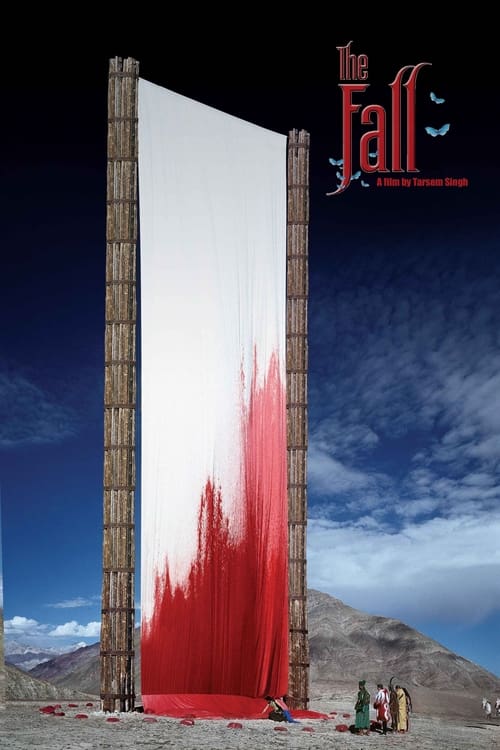
The Fall
2006 · Tarsem Singh
For when you want pure visual astonishment — the biggest screen you can find — with a real emotional undertow. A film to surrender to rather than analyze.
What it's about
In a hospital outside 1920s Los Angeles, an injured movie stuntman befriends a five-year-old immigrant girl with a broken arm and begins telling her an epic tale of five mythical heroes. Her imagination supplies the pictures — vast deserts, blue cities, impossible palaces — but the storyteller has motives of his own, and the line between his tale and his despair keeps thinning.
The experience
Ravishing and strange: one of the most visually overwhelming films ever made, anchored by something achingly intimate — a broken man and a trusting child negotiating over a story. It swings between wonder and heartbreak, and the wonder never feels hollow.
Performances
Lee Pace holds the film's darkness with quiet control, but the miracle is little Catinca Untaru, whose semi-improvised scenes — she often didn't know she was acting — give the spectacle its beating heart.
The craft
Tarsem Singh largely self-financed it and shot piecemeal over four years in more than twenty countries — Rajasthan's stepwells, Namibian dunes, the blue city of Jodhpur — using no digital landscapes: every impossible vista is a real place, dressed in Eiko Ishioka's sculptural costumes. It may be the strongest possible argument for practical location shooting.
Why it matters
Dismissed by many critics on release, it has been steadily reappraised as a cult classic and a landmark of what obsession and real locations can put on screen outside the studio system.
A bedridden Hollywood stuntman in 1920s Los Angeles spins an epic yarn for a five-year-old Romanian girl with a broken arm, and her imagination furnishes the visuals — which is how Tarsem Singh justifies one of the most extravagant productions ever mounted outside the studio system. Largely self-financed and shot piecemeal over four years in more than twenty countries — Rajasthan's stepwells, Namibian dunes, the blue city of Jodhpur — the film uses no digital landscapes; every impossible vista is a real place, dressed by Eiko Ishioka's sculptural costumes. Singh directed the child, Catinca Untaru, in semi-improvised scenes she often didn't know were fiction, and her unguarded performance keeps the spectacle tethered to something achingly human: a story told by a broken man who may not want to survive it. Dismissed by many critics in 2006 and championed by David Fincher and Spike Jonze, it spent years nearly impossible to see before a 2024 restoration returned it to cinemas. The gulf between its initial reception and its current standing is now one of the era's great critical corrections.
Reception
It premiered at Toronto in 2006 to a split house, sat two years without a US distributor, and flopped on release in 2008 despite Roger Ebert's rapturous four-star defense — then spent a decade out of print, its unavailability turning it into a holy-grail object until MUBI's 2024 4K restoration completed the flop-to-classic arc.
How The Fall was received, from release to now →
Influences: the films it descends from and the films it influenced
- The Adventures of Baron Munchausen (1988) — Builds an epic fantasy out of a tall-teller's embellished narration realized in physical sets and in-camera spectacle rather than optical trickery — the template of the unreliable storyteller whose lies become the film's imagery that The Fall inherits.
- The Cell (2000) — Tarsem's own debut established his tableau-vivant compositional grammar and his partnership with costume designer Eiko Ishioka, whose sculptural garment-as-architecture look The Fall carries directly forward.
- Bram Stoker's Dracula (1992) — Eiko Ishioka's Oscar-winning costume design here — clothing built like load-bearing sculpture with saturated symbolic color — is the exact method she reprises for the bandit, the Indian, and the mystic in The Fall.
- Mishima: A Life in Four Chapters (1985) — Eiko Ishioka's stylized, color-coded theatrical set design that stages imagined narrative worlds as artificial jewel-box tableaux prefigures the palette-per-realm logic of The Fall's fantasy.
- The Wizard of Oz (1939) — The frame device in which people from the invalid protagonist's real world reappear transfigured as heroes and villains inside the fantasy is the structural DNA of Roy's story casting the hospital's inhabitants.
- The Princess Bride (1987) — The bedside frame story — an adult spinning an adventure to a bedridden child who interrupts, negotiates, and shapes the telling — is the narrative engine The Fall rebuilds around Roy and Alexandria.
- Baraka (1992) — Non-narrative cinematography assembled entirely from real global locations shot on large format establishes the practical, no-CGI, travel-the-world aesthetic that The Fall's 20-plus-country location shoot extends into narrative.
- The Saragossa Manuscript (1965) — Its nested, recursive frame-tales told by unreliable narrators — stories folding into stories — model the interpenetration of teller and tale that The Fall exploits when Alexandria's misunderstandings rewrite Roy's plot.
- The Thief of Bagdad (1940) — Arabian-Nights fantasy achieved through practical spectacle, real vistas, and vivid Technicolor design is the pre-digital lineage of exotic in-camera wonder that Tarsem consciously revives.
- The Red Shoes (1948) — Its expressionist, hyper-saturated color and staged dream-ballet sequences — where an imagined interior world erupts into designed spectacle — anticipate The Fall's shift from muted hospital to chromatic fantasy.
- Big Fish (2003) — A dying man's tall tales are dramatized as lavish spectacle by an unreliable storyteller, and the listener must reconcile fabulation with reality — the same storyteller/listener tension that drives The Fall's frame.
- Dreams (1990) — An anthology of standalone dream-vignettes, each given a distinct constructed pictorial palette and tableau composition, carrying forward the 'each segment is its own painted world' logic.
- Immortals (2011) — Extends Tarsem's frieze-like, painterly staging and continued Eiko Ishioka costume collaboration, treating each frame as a composed classical tableau exactly as The Fall does.
- Mirror Mirror (2012) — Carries forward the sculptural-costume-driven fairy-tale mode and features Eiko Ishioka's final costume work, a direct continuation of the design language perfected in The Fall.
- The Grand Budapest Hotel (2014) — Deploys a Russian-doll frame narration handed teller-to-teller across time, foregrounding storytelling's mediation and unreliability in the same self-aware way The Fall nests its telling.
- Life of Pi (2012) — An unreliable frame narrator recasts a survival ordeal as a more bearable fable, dramatizing imagination-as-survival and daring the listener to choose the better story — The Fall's thematic core given a later blockbuster form.
- A Monster Calls (2016) — A grieving child and an adult figure trade told stories that become stylized visual set-pieces, using narrative invention as a survival mechanism — a direct thematic and structural heir to Roy and Alexandria's exchange.
- The Secret Life of Walter Mitty (2013) — Globe-spanning real-location spectacle deployed as the literal geography of a character's imagination — actual landscape standing in for the interior fantastical.
- Tumbbad (2018) — A story-within-a-story narrated to a listener in which production design and one dominant hue per location carry the exposition — the Tarsem grammar critics reached for in Tumbbad's palette-locked chapters.
- Pan's Labyrinth (2006) — Released the same year, it cuts a child's self-authored fantasy against a brutal real world, using imagination as refuge from suffering — the identical dual-register structure and imagination-as-survival theme, told through a young naturalistic lead.
- The Science of Sleep (2006) — Contemporaneous handmade-fantasy film that insists on practical, tactile in-camera effects to render an interior imaginative world rather than digital compositing, sharing The Fall's craft-over-CGI ethos.
Similar films
- Pan's Labyrinth (2006) — influence & lineage · often watched together
- Big Fish (2003) — influence & lineage
- Resurrection (2025) — same viewing thread · often watched together
- The Adventures of Baron Munchausen (1988) — influence & lineage · same viewing thread
- It's Such a Beautiful Day (2012) — same viewing thread · often watched together
- The Red Shoes (1948) — influence & lineage · often watched together
- Life of Pi (2012) — influence & lineage · often watched together
- Pather Panchali (1955) — often watched together
All the films related to The Fall →
Watch it with: curated runs of related films
- Dream Logic, Made by Hand — A run for when you want films where imagination doesn't just appear onscreen but rebuilds the world — stories nested inside stories, daydreams that leak into daylight, realities that quietly dissolve.