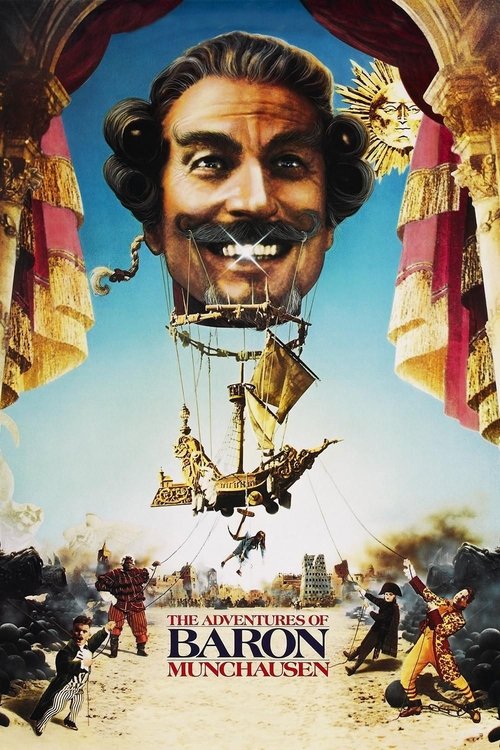
The Adventures of Baron Munchausen
1988 · Terry Gilliam
For when you want pure imagination — a big, strange, gorgeous adventure to get lost in, ideally on the largest screen you have. Family-friendly in spirit but rich enough for grown-ups who miss being astonished.
What it's about
In a European city under siege, an aged storyteller interrupts a stage play about his own legendary exploits to insist the truth is even wilder — and sets off with a stowaway young girl to find his scattered band of superpowered servants and lift the siege himself. The journey runs from a hot-air balloon stitched out of ladies' underwear to the surface of the moon, the belly of a sea monster, and the forge of the gods, with the line between the Baron's tall tales and reality gleefully impossible to draw.
The experience
A maximalist fever dream — every frame stuffed with painted skies, impossible machines, and handmade spectacle. It's chaotic, funny, and occasionally melancholy underneath, moving at the headlong pace of a bedtime story told by someone who refuses to let it end.
Performances
John Neville is wonderful as the Baron, courtly and ridiculous at once, aging and de-aging with his own belief in himself. A very young Sarah Polley grounds the whole circus as his skeptical companion, and Eric Idle and a luminous Uma Thurman shine in the supporting menagerie.
The craft
Gilliam's design imagination runs at full extravagance: vast physical sets, ornate practical effects, and a storybook-baroque look that predates digital spectacle and beats most of it. Its notoriously troubled, budget-devouring production is legend, but the money is all on screen — this is craftsmanship as excess, and it rewards a big screen enormously.
Why it matters
The capstone of Gilliam's informal 'trilogy of imagination' and a famous cautionary tale about visionary filmmaking versus studio finance — a box-office disaster reclaimed as a cult treasure.
Snapshot
The Adventures of Baron Munchausen is the third and most extravagant panel of Terry Gilliam's loosely conceived "trilogy of imagination" — following Time Bandits (1981) and Brazil (1985) — and the film that nearly ended his career as a studio-financed director. Adapted freely from the eighteenth-century tall tales attached to the historical Hieronymus Karl Friedrich von Münchhausen (1720–1797), and from the literary embellishments of Rudolf Erich Raspe and Gottfried August Bürger, the film follows an aged Baron (John Neville) who interrupts a theatrical performance of his own exploits in a war-besieged European city, then sets out with a young girl, Sally Salt (Sarah Polley, in her first major screen role), to reassemble his scattered servants and lift the Turkish siege.
The film is at once a picaresque, a meditation on mortality, and a defense of imagination against the accountancy of the Age of Reason. It is also inseparable from its own production history: a runaway shoot at Cinecittà that became one of the most notorious budget catastrophes of the 1980s, culminating in a release so narrow that the film could not plausibly recover its costs. What survives is a work of extraordinary physical craft — arguably the last major fantasy epic built almost entirely without digital imagery — and a case study in how the economics of a production can foreclose a film's reception for decades before critical opinion catches up.
Industry & production
The production is the central fact of the film's history, and it is well documented — most thoroughly in Andrew Yule's book-length account Losing the Light: Terry Gilliam and the Munchausen Saga (1991), which drew on extensive on-set access and remains the standard source. Financing came principally through Columbia Pictures, with European co-production money; shooting took place largely at Cinecittà in Rome, with Spanish locations, beginning in autumn 1987.
The difficulties compounded from several directions at once. The budget approved at greenlight was substantially below what the script's demands actually required, and the shortfall was never closed. Personnel changes at Columbia during production — the studio was in a period of ownership and executive turbulence in the late 1980s, shortly before its sale to Sony — meant that the executives who had championed the film were not the ones supervising its completion. Gilliam's working method, which favored building and shooting practical spectacle rather than compromising the design, collided with a schedule that slipped badly. Casting churned: Gilliam had originally sought other actors for the Baron before settling on John Neville, a distinguished British stage actor with comparatively little film profile, and Sarah Polley was cast as Sally at roughly nine years old, working under conditions — cold, water, explosives, long hours — that she has since publicly described as harmful, most extensively in her 2022 essay collection Run Towards the Danger. That account has become an important part of how the film is now discussed, and it complicates any purely romantic reading of the shoot as heroic overreach.
The final negative cost is usually cited in the vicinity of $46 million against an original figure roughly half that, though precise numbers vary between sources and Gilliam has disputed some of the reporting; the safest statement is that the film went very substantially over budget and that the overage was public knowledge before release. Columbia's distribution of the film in the United States was extremely limited — a small number of screens, minimal marketing — and the domestic gross was a fraction of the negative cost. The film's commercial failure was therefore overdetermined: it did not fail in the marketplace so much as it was never really placed in one.
The consequences for Gilliam were immediate and lasting. His next film, The Fisher King (1991), was a director-for-hire assignment on someone else's screenplay, made at a fraction of the scale — a deliberate demonstration of fiscal reliability. The Munchausen experience also became the reference point for the later collapse of The Man Who Killed Don Quixote, documented in Lost in La Mancha (2002), and cemented Gilliam's industry reputation as a director of magnificent, dangerous ambition.
Technology
Munchausen sits at a precise technological hinge. It was made in the last years before computer-generated imagery became a practical option for feature-scale fantasy — The Abyss (1989) and Terminator 2 (1991) would shortly change the calculus — and it therefore represents something close to the terminal state of the pre-digital effects tradition applied to unconstrained fantasy.
Nearly everything on screen is physical or optical: full-scale and miniature sets, matte paintings, forced perspective, wirework, mechanical creatures, in-camera compositing, and optical printing. The moon sequence, the Vulcan's-forge interior beneath Mount Etna, the sea monster's belly, and the balloon assembled from women's undergarments are all achieved through construction and photographic trickery rather than simulation. Richard Conway supervised the physical and visual effects work, with the production drawing on Italian craft labor at Cinecittà — a workforce with deep experience in the traditions of cinema in costume and of Fellini's own studio-built worlds.
This is worth stating precisely because it explains both the film's cost and its durability. Every image had to be made, at scale, once; there was no iterative cheapness available. The resulting textures — visible seams, painted skies, the palpable weight of built objects — have aged far better than the early digital work that displaced them, and are a substantial part of why the film's reputation has risen.
Technique
Cinematography
Giuseppe Rotunno photographed the film, and the choice is not incidental: Rotunno had shot Satyricon (1969), Amarcord (1973), and Casanova (1976) for Fellini, along with Visconti's The Leopard (1963). His presence imports the entire Italian studio-fantastical tradition directly into Gilliam's frame. The film is lit with a painterly, high-contrast palette — burnished golds and lamplight for the theater and the Sultan's court, chalky silvers and blues for the moon, sulfurous oranges for Etna — that reads as a deliberate sequence of picture-book plates rather than a continuous naturalistic world.
Gilliam's signature grammar is present throughout: wide-angle lenses that bow the edges of frames and exaggerate depth, low camera positions that monumentalize architecture and diminish figures, and compositions that pack the frame edge-to-edge with incident. The effect is baroque in the strict sense — dynamic diagonals, ceilings that recede into vertiginous perspective, bodies caught mid-gesture. Where Brazil used this vocabulary for claustrophobia, Munchausen uses it for plenitude: the frame is crowded not with ducts and paperwork but with wonders.
Editing
Peter Hollywood edited the film. The cutting has to solve a structural problem specific to the tall tale: each episode is self-contained, spatially discontinuous from the last, and internally implausible. The film handles this by treating transitions as deliberate ruptures — a leap from besieged city to Sultan's court to lunar landscape occurs without connective travel, mirroring the logic of oral storytelling where "and then" carries all the burden of causation. Within episodes, coverage is fairly classical, which is a necessary counterweight: the images are strange enough that spatial legibility must come from somewhere.
The film also runs long for its comic register, and some contemporary criticism identified pacing slack in the middle stretches — a fair charge, though it is partly the price of the episodic form the source material dictates.
Mise-en-scène / staging
This is where the film's argument lives. Dante Ferretti's production design and Gabriella Pescucci's costumes — Pescucci won the Academy Award for Best Costume Design; Ferretti was nominated for Art Direction, along with nominations for makeup and visual effects — construct a world that is simultaneously eighteenth-century and frankly theatrical.
The framing device is doing conceptual work: the film opens on a stage, inside a theater, during a performance of the Baron's adventures, and the Baron's intrusion into that performance collapses the boundary between the tale and its telling. Thereafter, nearly every environment retains a proscenium quality. The moon is a stage set with a painted void behind it; Vulcan's forge is a mechanical spectacle; the Sultan's court is a series of tableaux. The film never pretends to be documenting a world. It insists that it is staging one, and that the staging is the point — a position Gillian holds consistently against the besieged city's Age-of-Reason bureaucrat, Horatio Jackson (Jonathan Pryce), for whom nothing that cannot be verified may be permitted to exist.
Sound
Michael Kamen composed the score, having previously worked with Gilliam on Brazil (1985) — where his handling of the Ary Barroso standard "Aquarela do Brasil" was central to the film's tone. For Munchausen Kamen writes in a full late-Romantic symphonic idiom, with a martial swagger for the Baron and lyrical material for Sally, unembarrassed by grandeur. It functions as the connective tissue the editing deliberately withholds: the score asserts continuity of tone across episodes that share no continuity of place.
The sound design supports the constructed quality of the image world — mechanical clanks in the forge, the thin acoustic of the lunar exteriors, the crowded ambience of siege and court. Berthold's supernatural speed, Adolphus's marksmanship, and Gustavus's destructive breath are all sold substantially through sound.
Performance
John Neville's Baron is the film's anchor and its most delicate achievement. Neville plays him not as a comic buffoon but as an aging man of genuine dignity whose truthfulness is unfalsifiable and who is, in a literal sense, dying of disbelief — his vitality visibly returning when he is believed and draining when he is not. The performance carries real melancholy, and it is the reason the film's sentiment lands rather than cloys.
Around him, the register is deliberately broad. Eric Idle as Berthold brings Python-trained physical comedy; Oliver Reed's Vulcan is volcanic in both senses, a performance of enormous bad temper played against Uma Thurman's Venus, introduced in a direct visual quotation of Botticelli's The Birth of Venus — one of the film's most reproduced images and Thurman's breakthrough appearance. Jonathan Pryce, reuniting with Gilliam after Brazil, plays Jackson as a bland, polite functionary, which is precisely the film's point about rationalism: it is not villainous, merely fatal. Robin Williams appears uncredited (as "Ray D. Tutto") as the King of the Moon, in an improvisatory turn whose detachable-head conceit was substantially reworked from the original, more elaborate mechanical design when budget forced compromise.
Sarah Polley's Sally is the film's audience surrogate and its moral center — the child who believes, and whose belief materially sustains the Baron. The performance is unfussy and clear-eyed, which makes the subsequent knowledge of the shooting conditions harder to set aside.
Narrative & dramatic mode
The film operates in the mode of the unreliable marvelous: a narrative that does not merely include impossible events but foregrounds the question of whether its own telling can be trusted, and then refuses to resolve it. The structure is nested and recursive. A theater company performs the Baron's adventures; the Baron interrupts to correct them; his correction becomes the film; within it, he narrates further episodes; and the final movement returns to the besieged city, where the lifting of the siege is presented as accomplished and then framed as, possibly, another tale.
This is the picaresque form — episodic, driven by a protagonist who moves through discrete worlds rather than developing through a causal plot — inflected by a metafictional frame. The stakes are therefore epistemological rather than conventional. The Baron is not principally trying to survive; he is trying to be believed, because in the film's logic belief is literally life-sustaining. Death appears repeatedly as a winged figure who can be evaded only so long as the Baron's story continues to be told.
The dramatic engine is thus a wager: that a story sustained is a life sustained. The child believes, and the Baron lives. The bureaucrat disbelieves, and the Baron ages toward death. This is unusually pure allegory for a big-budget fantasy, and it is stated with almost no irony — a rarity in the late 1980s.
Genre & cycle
Munchausen belongs to the late-1980s cycle of large-scale, practically-built fantasy features aimed at a family-plus audience: Legend (1985), Labyrinth (1986), The Princess Bride (1987), Willow (1988). Nearly all of these underperformed on release relative to their budgets, and most have since acquired durable followings — a pattern that suggests the theatrical market of the moment could not reliably monetize the form, whatever the audience's eventual appetite.
Within Gilliam's own work it completes the imagination trilogy by pairing a child protagonist with a fantastical guide, as Time Bandits had, while carrying forward Brazil's antagonism toward administrative rationality. Kevin (in Time Bandits) and Sally are structurally cognate; Horatio Jackson and Brazil's Ministry of Information are cousins.
It also belongs to a much older lineage: the cinematic tall tale and the trick film. Its truest generic ancestors are Georges Méliès's A Trip to the Moon (1902) and the tradition of studio-built fantastical spectacle running through Fritz Lang, through Alexander Korda's The Thief of Bagdad (1940), through Karel Zeman.
Authorship & method
Gilliam co-wrote the screenplay with Charles McKeown, who had also co-written Brazil and who appears in the film as Adolphus. The collaboration follows Gilliam's habitual method: the design and the writing develop together, so that the script is in part a specification for images. Gilliam's own background as the animator of Monty Python's cut-out collages is directly legible — the film's visual logic of juxtaposed, incongruous, frankly two-dimensional wonders is animation logic executed at production scale.
The key collaborators are unusually consequential here. Rotunno brings Fellini; Ferretti, who had worked with both Fellini and Pasolini and would go on to a long association with Martin Scorsese, brings a specifically Italian conception of the studio as a place where a world is built rather than found. Pescucci's costumes operate as characterization and as spectacle simultaneously. Kamen supplies emotional continuity. Hollywood's editing manages the episodic joins. The film is, in this sense, less a solitary auteur's vision than a European craft assembly directed by an American-born Anglophile animator — which is part of why it looks like nothing else in the 1980s American studio system.
Gilliam's method also produced the film's problems. His unwillingness to reduce the scale of the conception in the face of budget reality is the same disposition that produced the images; the two are not separable. This is the honest form of the auteur argument in his case, and Gilliam has himself been fairly candid about it in subsequent interviews.
Movement / national cinema
The film resists national classification, which is itself significant. It is American-financed, British-directed, largely Italian-crewed, shot in Italy and Spain, drawn from German literary sources, and set in a fictionalized Ottoman-besieged European city. It belongs most naturally to a transnational European art-industrial tradition — the Cinecittà mode of studio-built fantasia — rather than to any national cinema.
Its nearest kin are Fellini's studio films, particularly Satyricon and Casanova, with which it shares a cinematographer, a soundstage, and a conviction that artifice is more truthful than location work. It also connects to the Central European fantastical tradition: Karel Zeman's Czech features, especially Baron Prášil (1961), Zeman's own Munchausen adaptation, which fused live action with animated engravings in a manner that clearly prefigures Gilliam's sensibility. Josef von Báky's German Münchhausen (1943), made for UFA's twenty-fifth anniversary under Nazi-era production conditions in Agfacolor, is the other major prior screen version and the most lavish.
Era / period
1988 is late in the cycle of director-driven, practically-built studio spectacle that the New Hollywood generation had made possible and that the blockbuster economics of the 1980s were closing down. The film arrived as studios were consolidating toward franchise logic and toward tighter budgetary supervision; Columbia itself was in the final phase before its sale to Sony in 1989. A film with no pre-existing audience, an eighteenth-century setting, a British stage lead, and a budget in the mid-forties of millions was an anomaly even at the time.
It is also positioned exactly at the threshold of the digital transition. Everything about the film's making would be different five years later — cheaper in some respects, and unmistakably different in texture. Munchausen is therefore legible now as a kind of endpoint: the practical fantasy epic at full stretch, immediately before the tools changed.
Themes
The film's governing opposition is between imagination and rationalism, but it is more specific than that formulation suggests. Horatio Jackson is not a tyrant; he is an administrator who executes a soldier for excessive heroism because exceptional performance disrupts the orderly conduct of the siege. The film's target is not cruelty but the bureaucratic flattening of the extraordinary — a continuation of Brazil's critique into an eighteenth-century Enlightenment key.
Second: storytelling as survival. Death pursues the Baron and is repeatedly deferred by narration. The film literalizes the Scheherazade structure — a tale told to postpone an ending — and attaches it to a specific claim about audiences: the Baron revives when Sally believes him. Belief is not passive reception but a life-giving act.
Third: age and vitality. The Baron oscillates visibly between decrepitude and youth depending on the credence extended to him, which makes the film unusually direct about artistic obsolescence — a theme with obvious resonance for a director whose own capacity to work depended on being believed by financiers.
Fourth: the child as the last competent audience. Sally is the only character in the besieged city with an undamaged relationship to wonder, and her sustained belief is what enables the plot. The film's implicit account of adulthood is that it is chiefly a process of losing the ability to be told things.
Reception, canon & influence
Contemporary reception was mixed-to-positive in the notices and irrelevant at the box office. Roger Ebert was among the more enthusiastic American reviewers, praising the film's visual invention, while others found it exhausting or structurally slack; the near-universal framing device in the coverage, however, was the budget. The production narrative overwhelmed critical assessment, and Columbia's minimal release meant most American audiences had no practical opportunity to form a view. The film received four Academy Award nominations — Art Direction, Costume Design, Makeup, and Visual Effects — winning for Pescucci's costumes.
Influences on the film (backward). The literary line runs from the historical Münchhausen through Raspe's English Baron Munchausen's Narrative (1785) and Bürger's German expansion. Cinematically, the debts are to Méliès's trick films, to Korda's The Thief of Bagdad (1940) for the mode of colored Orientalist fantasy, to von Báky's Münchhausen (1943), and above all to Zeman's Baron Prášil (1961), whose engraving-derived visual world is the closest antecedent to Gilliam's collage sensibility. Behind all of it sits Gilliam's own Python animation practice and the Doré–Grandville tradition of nineteenth-century illustration. Fellini is the immediate stylistic presence, mediated through Rotunno and Ferretti.
Legacy (forward). The film's influence has been slow and largely reputational rather than directly imitative. Its clearest inheritance runs to filmmakers working in built, tactile fantasy against digital defaults — the practical-effects revivalism visible in Guillermo del Toro's work, in Wes Anderson's frankly theatrical staging, and in the general critical reappraisal of pre-CGI craft. The Fall (2006) and Gilliam's own The Imaginarium of Doctor Parnassus (2009) both revisit the frame-story-as-defense-of-imagination structure explicitly.
Institutionally, Munchausen became a cautionary tale that shaped how studios approached director-driven spectacle for the remainder of the era, and it fixed Gilliam's public persona as the great imperiled visionary — a persona that has cut both ways, generating sympathy and, in Lost in La Mancha, an unusually intimate record of production collapse.
The film's standing has risen considerably. Home video, then the Criterion Collection's release, allowed it to be seen apart from the coverage of its cost, and its practical craft now reads as an achievement rather than an extravagance. The one thing that has complicated the rehabilitation is Polley's account of the shoot, which asks viewers to weigh the images against what was required to obtain them — a question the film's own defense of imagination does not answer, and which should not be resolved too comfortably in the artwork's favor.
A Deleuzian reading
A hot-air balloon sewn out of women's underwear rises over a city under siege.
The full Deleuzian reading of The Adventures of Baron Munchausen →
Reception
In 1989 it was a punchline — a legendarily runaway production that Columbia barely released, grossing about $8 million against a budget that had roughly doubled to ~$46 million. Decades later it's been warmly reclaimed as the gorgeous capstone of Gilliam's 'Trilogy of Imagination' with Time Bandits and Brazil.
How The Adventures of Baron Munchausen was received, from release to now →
How to watch The Adventures of Baron Munchausen: what to notice on a first viewing
- Watch the old man stand up during the play. The film opens mid-performance of The Adventures of Baron Munchausen in a besieged city. A man in the audience says the actors have it wrong and that he is the Baron. Everything after is his correction. You are watching a man tell his own story against a rival version playing in the same building.
- Notice that nobody ever travels between the episodes. Peter Hollywood cuts from besieged city to Sultan's court to the moon with no connecting journey. And then carries all the causation, the way it does when somebody tells you a story aloud. Inside each episode the coverage stays conventional, so the strangeness sits in the joins rather than the shots.
- Watch the edges of the frame bow outward. Gilliam shoots wide and low. Ceilings rush away, architecture towers, people shrink under it, and the frame is packed edge to edge with incident. Rotunno shot Fellini before this. Brazil used this lens for claustrophobia. Here the same distortion delivers plenty, more to see than you can take in.
- Look for the painted backdrop behind the moon. Nearly every place keeps a proscenium: the court as tableaux, the forge as mechanical spectacle, a void behind the lunar set that is plainly painted. Ferretti built worlds rather than pretending to find them. The seams are not mistakes. The film records real objects that are frankly fake, and the record is honest.
- Watch Neville's Baron get older and younger by scene. Neville plays him with dignity rather than buffoonery. Vitality returns when somebody believes him and drains away when nobody does. Sarah Polley's Sally is the one who keeps believing. Belief works as a life-support system here. Watch the body and you can tell who is listening.
The whole guide to watching The Adventures of Baron Munchausen, with the keys for a rewatch →
Influences: the films it descends from and the films it influenced
- Le Voyage dans la Lune (1902) — Establishes the trick-film grammar Gilliam revives wholesale — substitution splices, painted flats read frontally from a fixed proscenium seat, and a leering man-in-the-moon face that Munchausen's lunar sequence restages as a full-scale practical set rather than a citation.
- The Adventures of Prince Achmed (1926) — Articulated cut-out silhouette figures hinged at the joints are the exact animation technique Gilliam adopted for the Python interstitials, and Munchausen is that flat, jointed, frankly two-dimensional logic executed at production scale in built sets and costumes.
- The Thief of Bagdad (1940) — Vincent Korda's saturated Orientalist fantasy solved flight, giants and genies with forced perspective, hanging miniatures and traveling mattes shot in Technicolor — the in-camera compositing playbook Gilliam follows for the Sultan's court and the balloon ascent.
- Münchhausen (1943) — The direct prior adaptation: it fixes the episodic tall-tale architecture (cannonball ride, Turkish court, lunar excursion) as discrete set-pieces joined by the Baron's narration, and stages the cannonball flight as an in-camera Agfacolor effect Gilliam reproduces practically.
- Beauty and the Beast (1946) — Enchantment achieved entirely on the set — reversed film, human arms as candelabra, wire-assisted drift — establishing the principle that the marvelous must be physically present in front of the lens, which is Munchausen's governing production rule.
- Baron Prášil (1961) — The closest antecedent: live actors composited against Doré-style hatched-engraving backdrops so the frame reads as an illustrated page in motion, which is precisely Gilliam's collage sensibility translated from optical printing into built décor.
- Fellini Satyricon (1969) — Rotunno's wide-angle grotesque faces and frescoed frontal tableaux, strung as an unrepaired episodic picaresque with deliberate narrative lacunae between fragments — the lighting and structural model Rotunno carried directly into Munchausen.
- And the Ship Sails On (1983) — Rotunno and Ferretti build the ocean out of rippling plastic sheeting on a gimballed Cinecittà stage and then pull back to expose the crew — the declared-artifice studio grammar Gilliam hires both men to reproduce.
- Time Bandits (1981) — Gilliam's own template of a child audience-surrogate dragged through disconnected historical episodes, with scale gags (the forced-perspective giant, the ogre's ship) solved by lens and set construction rather than optical work.
- Brazil (1985) — Charles McKeown's co-writing method — script drafted as a specification for images — plus the 14mm wide-angle barrel distortion that bends interiors around the protagonist, both carried into Munchausen with Rotunno executing the distortion in anamorphic.
- The Fabulous World of Jules Verne (1958) — Gilliam, who publicly credits Zeman, composites live figures into painterly engraving-derived Victorian backdrops and stages action in deliberately flat storybook planes.
- Jabberwocky (1977) — Scales up the Bruegelian crowded plane and hand-built creature work, still preferring in-camera layering — foreground rubbish, mid-ground business, painted depth — over composite effects.
- The City of Lost Children (1995) — Khondji's extreme wide-angle grotesquerie and the entirely built retro-fantastic port carry forward Munchausen's rule that a fantastic world is fabricated at 1:1 scale and photographed with a lens that curves it, not assembled in post.
- Big Fish (2003) — Inherits the unreliable-marvelous ending device exactly: the tall tales are validated when the story's impossible figures — giant, conjoined twins, witch — turn up as physical, practically-realized bodies in the teller's ordinary world.
- The Fall (2006) — Rebuilds the frame-story-as-defense-of-imagination — an injured teller spinning an episodic epic for a child who reshapes it — and honors Munchausen's terms by shooting the fantasy in real locations across two dozen countries with no digital augmentation.
- Pan's Labyrinth (2006) — Places a child at the hinge between brutal historical reality and the marvelous, and insists the marvelous be an actor in a foam-latex suit with cable-actuated animatronics on a built set — the practical-creature ethic Munchausen anchors.
- The Imaginarium of Doctor Parnassus (2009) — Literalizes Munchausen's opening conceit: a traveling stage-wagon proscenium whose painted mirror is a portal, so the theatrical frame and the fantasy it advertises become physically continuous within the same shot.
- Hugo (2011) — Ferretti, Munchausen's own designer, builds Méliès's glass studio and automaton workshop as standing sets — the same Italian conviction that a world is constructed rather than found, applied to canonizing the trick-film tradition Munchausen descends from.
- The Grand Budapest Hotel (2014) — Nests unreliable raconteurs three deep and stages the result in flat, frontal, proscenium-framed compositions with hand-built miniatures and matte paintings shot in-camera — Munchausen's theatrical framing and declared artifice turned into a formal system.
- The Fisher King (1991) — Gilliam's immediately prior imagination-versus-reality film, built on a lunatic fabulist whose conviction physically reshapes the world, the engine he disciplines into Parry's quest.
- Pirates of the Caribbean: At World's End (2007) — Models the maximalist, tonally-reckless fantasy density — grotesque design piled on digression — that defines At World's End's overstuffed operatic excess.
- Interview with the Vampire (1994) — Dante Ferretti's proscenium-as-world design — a theater stage whose painted illusion bleeds into the diegesis and whose audience is implicated in the spectacle — is the direct blueprint for the Théâtre des Vampires.
- The Princess Bride (1987) — Builds the same interruptible frame: a teller narrates an implausible adventure to a skeptical child whose objections cut into the tale, so the film's suspense is about whether the listener will accept the story, not whether the hero survives.
- Orlando (1992) — Shares Sandy Powell's early-career maximalist costume-as-argument approach, where garments carry the era's ideology rather than mere authenticity — the design logic she extended in Orlando.
Similar films
- The Fall (2006) — influence & lineage · same viewing thread
- Time Bandits (1981) — influence & lineage
- Brazil (1985) — influence & lineage
- The Princess Bride (1987) — influence & lineage
- The City of Lost Children (1995) — influence & lineage · same viewing thread
- Son of the White Mare (1981) — same viewing thread
- The Fabulous World of Jules Verne (1958) — same viewing thread
- Monty Python and the Holy Grail (1975) — shared sensibility
All the films related to The Adventures of Baron Munchausen →
Watch it with: curated runs of related films
- Dream Logic, Made by Hand — A run for when you want films where imagination doesn't just appear onscreen but rebuilds the world — stories nested inside stories, daydreams that leak into daylight, realities that quietly dissolve.