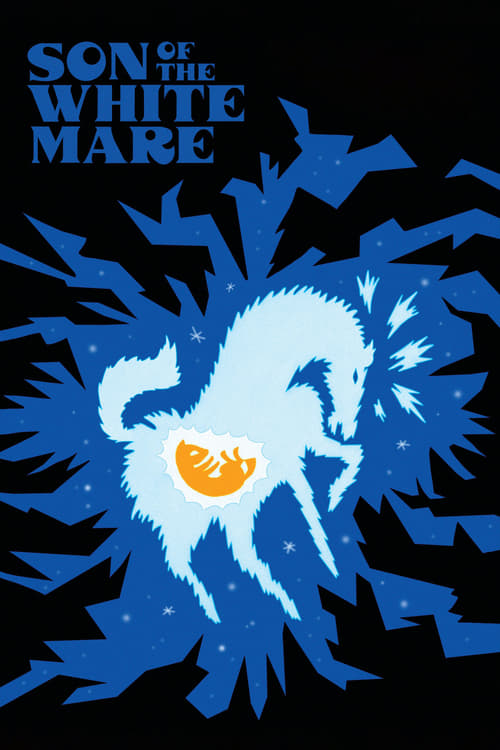
Son of the White Mare
1981 · Marcell Jankovics
For when you want your eyes blown open — a late-night, lights-off, surrender-to-it watch. Not a kids' cartoon despite the fairy-tale bones; reach for it when you're craving something genuinely unlike anything you've seen.
What it's about
A horse goddess gives birth to three sons of superhuman strength, and the youngest — nursed on his mother's milk until he can uproot trees — descends into the Underworld to battle three many-headed dragons, free three captive princesses, and win back his ancestors' lost kingdom. It's a Hungarian folktale told straight, but drawn like nothing else: a hero's journey rendered as pure flowing shape and color.
The experience
Hypnotic is the honest word — the screen never stops transforming, figures melting into landscapes into cosmic diagrams, all pulsing with psychedelic color. It's less like watching a cartoon than being pulled through a myth while half-dreaming; the story is simple, the imagery overwhelming.
The craft
Jankovics animates the folktale as continuous metamorphosis — no cuts where a transformation will do — drawing on steppe art and shamanic cosmology so every shape carries symbolic charge. The saturated, flat-color style demands the biggest, brightest screen you can find; it's one of the most visually radical animated features ever made.
Why it matters
Long a cult treasure of Hungarian animation, its reputation exploded after restoration brought it to new audiences, and it's now regularly named among the greatest animated films — a touchstone for animators chasing abstraction inside narrative.
Snapshot
Fehérlófia — literally "Son of the White Mare" — is a feature-length Hungarian animated film directed by Marcell Jankovics and produced at Budapest's Pannónia Film Studio. Running roughly eighty minutes, it adapts one of the best-known tales in the Hungarian folk canon: a hero born of a white mare, nursed to superhuman strength, who descends into the Underworld to defeat three multi-headed dragons, free three captive princesses, and reclaim a lost ancestral kingdom. What distinguishes the film from any plot summary is its visual conception. Jankovics treats the folktale not as a story to be illustrated but as a cosmological diagram to be animated, rendering it in a continuously metamorphosing graphic style saturated with symbolism drawn from Eurasian steppe art, shamanic cosmology, and the imagery of the world tree. The result is among the most formally radical feature animations of its era — long neglected outside Hungary, then rediscovered internationally after a 4K restoration late in the 2010s and now widely regarded as a landmark of European animation.
Industry & production
The film was made within Hungary's state-socialist film economy, at Pannónia Filmstúdió, the country's central animation house and the only significant producer of animated features and shorts in Hungary at the time. Pannónia had already given Jankovics the platform for his first feature, János vitéz (Johnny Corncob, 1973), the first Hungarian animated feature film, and had built a distinctive national school of animation known for graphic invention rather than Disney-style naturalism, operating under the economic logic of a subsidized studio rather than a commercial marketplace.
Precise production budgets and schedules for Fehérlófia are not reliably documented in the public record, and — because it was a state-studio production rather than a market release — meaningful box-office figures effectively do not exist; any specific numbers should be treated with suspicion. What is clear is that the film was an intensely labor-intensive undertaking: its fluid, transformation-heavy animation demanded enormous quantities of hand-drawn work, and Jankovics functioned as both director and principal visual designer, exercising unusually tight authorial control over the film's look. This concentration of creative authority in a single artist-director is characteristic of the auteur-driven wing of the Pannónia studio and of the broader Central and Eastern European animation tradition, where individual graphic vision was prized.
Technology
Fehérlófia is a work of traditional, pre-digital cel animation, produced with the standard apparatus of the analog studio era: hand-drawn artwork photographed frame by frame under a rostrum camera onto film. There is no computer-generated imagery. The film's technological interest lies not in novel hardware but in the extraordinary demands its aesthetic placed on conventional tools. Because forms in the film are perpetually transforming — a hand becoming a flame, a landscape resolving into a face, a circular motif blossoming into a figure — the animation could not rely on the labor-saving conventions of held cels and limited movement that many television-era studios used. Instead it required continuous, drawn metamorphosis, closer in spirit to the "straight-ahead" animation of experimental cinema than to the pose-to-pose economy of commercial cartoons.
Color was a central technological and expressive concern. The film exploits the flat, high-chroma capabilities of cel painting to build compositions from bold fields of red, blue, gold, black, and white, used symbolically rather than descriptively. The restoration undertaken in the late 2010s (the 4K digital restoration associated with the film's international re-release) is itself a significant technological chapter, since it recovered the intensity of these colors for contemporary audiences and precipitated the film's belated global recognition.
Technique
Cinematography
"Cinematography" in a fully drawn animation is a matter of designed framing and camera movement executed on the rostrum stand rather than photographed reality, and the individual camera credits for the film are not well documented in accessible sources. What can be described with confidence is the film's spatial language. Jankovics composes for a flat, graphic picture plane, frequently organizing the frame around circles, spirals, and radial mandala-like structures rather than the receding perspectival space of live-action cinema. The "camera" often behaves less like an observer moving through a world than like an eye contemplating an unfolding pattern. Movements into and out of these designs — zooms that reveal a shape nested inside another shape — substitute for conventional coverage, so that visual scale and transformation carry much of the film's momentum.
Editing
The editing logic is governed by metamorphosis as much as by cutting. Rather than joining discrete shots of a stable world, the film frequently dissolves one image into another through drawn transformation, so that transitions happen within the animation rather than at cut points. This produces a dreamlike continuity in which time and space flow rather than snap. Where hard cuts do occur, they tend to punctuate the narrative's episodic, folktale rhythm — the successive dragon combats, the descent and return — giving the film a repetitive, incantatory structure appropriate to its oral-tale source. Individual editorial craft credits are not something the public record specifies clearly, and I won't guess at them.
Mise-en-scène / staging
This is the film's richest dimension. Jankovics stages the folktale as a symbolic cosmos. The imagery draws visibly on the decorative vocabulary of Eurasian steppe and Scythian goldwork — interlaced animals, coiling tendrils, solar rosettes — and on Hungarian folk ornament, reorganized into a psychedelic register of flowing, biomorphic forms. Figures are stylized and emblematic rather than individuated; landscapes and monsters are built from the same ornamental DNA as the hero, underscoring a worldview in which everything is a transformation of everything else. The Underworld descent and the three dragons are staged as escalating cosmic events, coded through color and geometry (the world-tree / axis-mundi motif recurs as an organizing image). The staging consistently privileges symbolic legibility and graphic rhythm over spatial realism.
Sound
The soundtrack pairs the archaic folktale with a distinctly modern, electronic-tinged score; the music is generally credited to István Vajda. The synthesizer-inflected sound is one of the film's most striking anachronistic gestures, wrapping an ancient myth in a contemporary sonic texture and reinforcing the psychedelic, otherworldly atmosphere. Dialogue is sparse and functions in the declarative, formulaic manner of oral storytelling; sound effects are stylized to match the graphic action rather than to reproduce naturalistic acoustics. I'd flag that detailed technical documentation of the sound design is thin, so beyond the score attribution and the general character described here, specifics should be treated cautiously.
Performance
As a fully animated film, "performance" resides in drawn movement and vocal work rather than embodied acting. The character animation is expressive but non-naturalistic: the hero and his companions move with an emphatic, almost heraldic physicality suited to their status as archetypes — the strongman, the dragon, the maiden — rather than psychologically shaded individuals. Voice performances serve the tale's formulaic register. The film's emotional force comes less from character interiority than from the sheer kinetic and chromatic intensity of the imagery.
Narrative & dramatic mode
The narrative mode is that of the wonder-tale or Märchen: episodic, patterned, and driven by repetition-with-escalation rather than by psychological causality. The hero is defined by his origin (born of the white mare, nursed to prodigious strength) and by his function (to descend, to fight, to rescue, to return), not by an inner arc of change. Threes structure everything — three companions or brothers, three princesses, three dragons of increasing monstrousness. The dramatic engine is the quest-descent-return pattern of heroic myth, and the film leans into the folktale's inherent abstraction rather than smoothing it into a modern character drama. This fidelity to the oral-tale mode is deliberate and is inseparable from Jankovics's interpretive project, which reads the story as a solar-hero myth of cyclical death and rebirth.
Genre & cycle
Nominally an adventure-fantasy, the film belongs most precisely to the tradition of the mythological/folkloric animated feature — animation used to visualize a national legendarium. Within Hungarian and Central European cinema it sits in a small cycle of ambitious, author-driven animated features that treat folklore and literature as serious material for adult and family audiences alike, a lineage that includes Jankovics's own Johnny Corncob and looks forward to his later monumental adaptation of Imre Madách's The Tragedy of Man. Internationally it can be placed alongside other art-animation features that reimagine myth in non-commercial visual idioms, though its specific fusion of steppe iconography and psychedelic metamorphosis is close to unique.
Authorship & method
Fehérlófia is emphatically an auteur work. Marcell Jankovics (1941–2021) was not only its director but its guiding designer and interpreter, and the film is inseparable from his lifelong scholarly interest in mythology, symbolism, and solar cosmology — a preoccupation reflected across his career in his writing and in projects like the folk-animation series Magyar népmesék (Hungarian Folk Tales). His method was interpretive as much as illustrative: he approached the Fehérlófia folktale (a tale long established in the Hungarian canon and associated with nineteenth-century folklore collection) as an encoded myth of cosmic and solar renewal, and designed the film to make that reading visible through recurring symbols — the world tree, the sun disc, the serpent-dragon.
Among key collaborators, the composer István Vajda supplied the electronic-leaning score that is one of the film's signatures. Beyond this, the reliably attributable individual craft credits — a dedicated director of photography, editor, or sole screenwriter distinct from Jankovics — are not clearly established in the accessible record, in part because so much of the film's authorship was concentrated in Jankovics himself and executed by the collective animation apparatus of Pannónia. I'll say plainly that where such credits are thin, I am declining to assign names rather than risk invention.
Movement / national cinema
The film is a product of the Hungarian, and more broadly Central and Eastern European, school of animation that flourished under state sponsorship in the postwar decades. This school — with major centers in Hungary, Poland, the former Yugoslavia (the Zagreb school), and Czechoslovakia — was defined by its rejection of Disney naturalism in favor of graphic experimentation, symbolic economy, and artistic individualism. Pannónia Film Studio was Hungary's flagship institution in this movement, and Fehérlófia stands as one of its most fully realized statements. The film also participates in a specifically Hungarian cultural project of the period: the recuperation of national folklore and pre-Christian, "Eastern" (steppe/Eurasian) heritage as a source of identity, which Jankovics's imagery — steeped in Scythian and shamanic motifs — foregrounds.
Era / period
Made and released in 1981, the film belongs to the late-socialist era of Hungarian culture, a period of relative liberalization within the Eastern Bloc that allowed considerable artistic latitude in animation. Its psychedelic idiom also registers the visual afterlife of the 1960s–70s counterculture, filtered through the studio art tradition; the pairing of an ancient myth with a synthesizer score is very much of its moment. Yet the film's deep material — steppe mythology, oral folktale — reaches past its immediate period toward the archaic, and this tension between the contemporary surface and the archaic substrate is central to its effect.
Themes
The governing themes are heroic initiation, the descent into and return from the Underworld, and cosmic renewal. Jankovics's interpretive frame turns the hero into a solar figure whose journey enacts a cycle of death and rebirth; the recurrent world-tree and sun imagery insist that the adventure is also a map of the cosmos. Related themes include the triumph of order over chaos (the dragons as devouring, entropic forces), the reclamation of a lost patrimony or ancestral kingdom, and the continuity of a mythic-national heritage rooted in a pre-Christian, Eurasian past. The film's pervasive metamorphosis carries a thematic charge of its own: in a world where every form flows into every other, the boundaries between hero, monster, and cosmos dissolve, dramatizing a unified, animate universe.
Reception, canon & influence
On release the film earned Jankovics recognition as one of Hungary's foremost animators, but for decades it remained comparatively little known outside Hungary and specialist animation circles — a common fate for Eastern Bloc art animation with limited Western distribution. It did accrue a serious critical reputation among animation connoisseurs over the years; it is frequently cited as a high point of European animated cinema, and it has appeared on curated lists of the most important animated films (its selection in international animation retrospectives of the 1980s is often noted, though readers should verify the specifics of any such honor rather than take a precise citation on faith).
Influences on the film (backward): the Hungarian Fehérlófia folktale and the broader nineteenth- and twentieth-century tradition of Hungarian folklore collection; the decorative art of the Eurasian steppe (Scythian, Hun, Avar goldwork) and Hungarian folk ornament; shamanic and solar-myth cosmology, which Jankovics studied and theorized; and the graphic-experimental ethos of the Pannónia studio and the wider Eastern European animation school. A stylistic affinity with the flowing, psychedelic feature animation of the late 1960s (the mode popularized by Yellow Submarine) is often observed, though this should be understood as a shared visual climate rather than a documented direct influence.
Legacy (forward): within Hungary the film consolidated Jankovics's stature and fed directly into his later, even more ambitious mythological and literary adaptations. Internationally, its most consequential afterlife came with the 4K restoration and re-release of the late 2010s, which introduced Fehérlófia to a new generation of critics, animators, and festival audiences and cemented its canonization as a rediscovered masterpiece of world animation. Its distinctive fusion of folk-mythic content with metamorphic, ornament-driven design has become a touchstone for discussions of what non-commercial, culturally rooted animation can achieve, and it is regularly invoked as evidence of the artistic seriousness of the Eastern European tradition. Tracing precise, film-to-film lines of stylistic descent is difficult and largely undocumented; the film's clearest influence has been as an inspiring model and rallying point for artists and advocates of hand-drawn, author-driven animation.
Reception
Barely seen outside Hungary for decades, it was rescued by a 2019 4K restoration from Arbelos that turned a half-forgotten folk-psychedelic curio into an international cult sensation and a Letterboxd darling almost overnight.
How Son of the White Mare was received, from release to now →
How to watch Son of the White Mare: what to notice on a first viewing
- Watch one shape melt directly into the next shape. Jankovics dissolves each image into the next through drawn transformation instead of cutting between stable scenes, so the picture never stops changing. The technique makes transformation the film's basic unit, not just a plot event that happens to the hero.
- Notice the frame built around circles and spirals. Jankovics composes flat, graphic images organized around mandala-like radial patterns rather than true-to-life depth, and the camera often zooms into a shape nested inside another. The geometry turns looking itself into a kind of meditation on pattern rather than on space.
- Watch the color pulse and shift without ever settling. Saturated color churns and cycles across every scene, coded to the steppe ornament and folk motifs the film draws its imagery from. The restless color keeps the world feeling alive and unfinished, like it is still being made.
- Listen for synthesizer tones under this ancient story. István Vajda's electronic-tinged score wraps the old folktale in a distinctly modern, anachronistic sound rather than orchestral grandeur. The mismatch keeps reminding you this is a myth being retold now, not a museum piece.
- Count the threes: three brothers, three princesses, three dragons. The wonder tale repeats and escalates in threes, each dragon and each rescue larger than the last, following the pattern of oral storytelling rather than plot logic. The repetition is the point. Myths build meaning by recurrence, not by surprise.
The whole guide to watching Son of the White Mare, with the keys for a rewatch →
Influences: the films it descends from and the films it influenced
- János vitéz (Johnny Corncob) (1973) — Jankovics's own first animated feature, made at Pannónia, where he first built a full-length narrative out of flat, folk-graphic figures and saturated color fields — the production grammar he then scaled up for the steppe world of Fehérlófia.
- Sisyphus (1974) — A single unbroken metamorphosing contour line straining and reshaping a lone figure — the continuous morph-as-editing device that becomes the core metamorphosis-transition idiom of Son of the White Mare.
- Küzdők (The Struggle) (1977) — Line, figure, and ground literally battle and transform into one another, prototyping the dissolve-through-transformation logic where combat and shape-shifting share the same animated stroke.
- The Adventures of Prince Achmed (1926) — The founding template of the folkloric animated feature as sustained decorative ornament — arabesque silhouette framing and pattern-driven staging that Jankovics recasts in Scythian goldwork terms.
- Yellow Submarine (1968) — Pop-psychedelic feature animation built from flat graphic planes, saturated non-naturalistic color, and metamorphic dissolves — the shared visual climate whose flowing transformation and design-forward flatness Fehérlófia absorbs.
- The Humpbacked Horse (Konyok-Gorbunok) (1947) — Soviet feature adaptation of a folk verse-tale that stages narrative through applied folk ornament and decorative border motifs, modeling the ornament-as-worldbuilding approach Jankovics turns toward Eurasian steppe design.
- The Snow Queen (1957) — Soyuzmultfilm's märchen quest-and-descent feature whose flowing, elemental figure movement and cyclical journey structure sit directly behind Fehérlófia's underworld-descent narrative armature.
- The Tragedy of Man (Az ember tragédiája) (2011) — His culminating literary-mythological feature that extends the Fehérlófia method of encoding a text as symbol-driven cosmology and shifting graphic styles across episodes of descent and renewal.
- The Secret of Kells (2009) — Builds a feature's entire visual language out of a national ornamental tradition (Insular manuscript spirals and interlace) exactly as Jankovics built his from Scythian goldwork, favoring flat decorative pattern and circular motifs over depth.
- Song of the Sea (2014) — Folk-mythic quest feature that renders transformation and passage into an otherworld through ornamental spiral-and-disc motifs and flowing metamorphic design, echoing Fehérlófia's sun-disc and world-tree symbol grammar.
- Wolfwalkers (2020) — Extends the same author-driven, folk-rooted hand-drawn program — deliberate flat linework, woodcut-and-ornament stylization standing in for realism — that Fehérlófia is now regularly invoked to authorize.
- Fantastic Planet (La Planète sauvage) (1973) — European auteur feature that makes hallucinatory, surreal metamorphosis and flat graphic tableaux the point of the film rather than a garnish — the same commitment to design-driven strangeness over illusionist realism.
- Belladonna of Sadness (1973) — Mythic-erotic art feature that unspools imagery as decorative scroll-like panels and ornamental metamorphosis, paralleling Jankovics's fusion of flat ornament with psychedelic transformation.
- Tale of Tales (1979) — Contemporaneous Eastern Bloc auteur animation whose poetic, memory-driven dissolves and refusal of commercial narrative define the same author-driven art-animation ethos Fehérlófia embodies within the Pannónia school.
- The Thief and the Cobbler (1993) — Islamic-miniature geometry translated into animation as radial, mandala-like compositions and interlocking ornamental space — the same instinct to derive framing from a decorative-art tradition that drives Jankovics's mandala staging.
- Magyar népmesék (Hungarian Folk Tales) (1980) — Jankovics's parallel folk-tale series applying the same flat, embroidery-and-ornament design vocabulary drawn from Hungarian folk art to national märchen, the small-scale twin of Fehérlófia's ornamental system.
Similar films
- Belladonna of Sadness (1973) — influence & lineage · often watched together
- The Adventures of Prince Achmed (1926) — influence & lineage · often watched together
- Alice (1988) — same viewing thread
- Guillermo del Toro's Pinocchio (2022) — often watched together
- Azur & Asmar: The Princes' Quest (2006) — often watched together
- Fantasia (1940) — shared sensibility
- Spirited Away (2001) — shared sensibility
- Satantango (1994) — shared sensibility
All the films related to Son of the White Mare →
Watch it with: curated runs of related films
- Dream Logic, Made by Hand — A run for when you want films where imagination doesn't just appear onscreen but rebuilds the world — stories nested inside stories, daydreams that leak into daylight, realities that quietly dissolve.