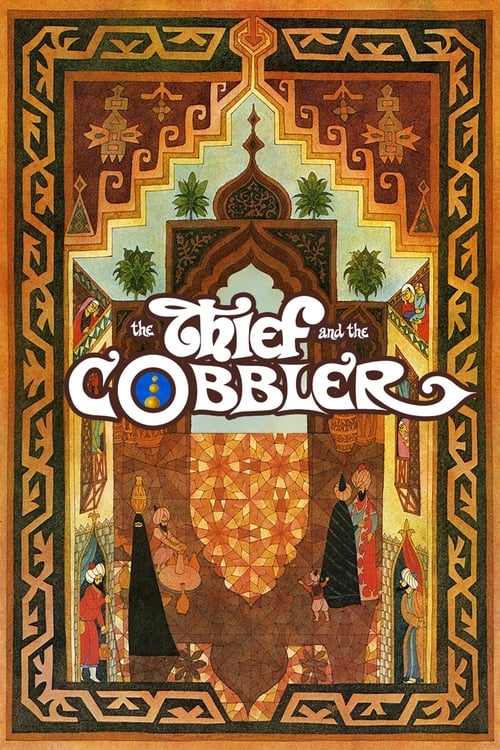
The Thief and the Cobbler
1993 · Richard Williams
For when you want pure visual astonishment — put it on when you'd rather gape than follow a plot, or when you want to show someone what hand-drawn animation can do at its absolute limit. Also essential viewing for anyone drawn to great unfinished works and their legends.
What it's about
In a storybook Golden City of the ancient Near East, a humble, nearly wordless cobbler named Tack is saved from execution by Princess Yum Yum — and when the golden orbs protecting the city are stolen, the two set out to recover them before the scheming vizier ZigZag and an army of one-eyed brigands can seize the kingdom. Scampering through every margin of the story is a nameless thief, silently, relentlessly pursuing anything that glitters.
The experience
Watching it feels like falling into an optical illusion — Escher-like architecture, impossible perspectives, geometric patterns that swallow whole scenes. The story is featherlight fairy-tale stuff; the images are dense enough to make your jaw hang, and the silent-comedy business of the thief is genuinely funny.
The craft
Richard Williams pursued this film by hand for roughly three decades, pushing character animation and perspectival illusion to a density arguably never matched — sequences here are studied frame by frame by professional animators. Know going in that the versions released in 1993 and 1995 were taken from Williams and recut against his wishes, with songs and narration grafted on; the astonishing animation survives even in compromised form.
Why it matters
Animation's most famous unfinished masterpiece: its troubled history is legend in the field, its imagery visibly influenced the era's biggest animated fairy tales, and fan reconstructions have kept Williams' original vision alive.
Snapshot
The Thief and the Cobbler is one of animation's great unfinished cathedrals — a hand-drawn feature that Richard Williams pursued across roughly three decades, only to have it wrested from him and released, in 1993 and again in 1995, in forms he disowned. Conceived as a wordless-adjacent fable set in a storybook Golden City of the ancient Near East, it follows Tack, a humble cobbler, and Princess Yum Yum as they confront the scheming Grand Vizier ZigZag and a horde of one-eyed brigands, while a nameless, larcenous Thief scampers through the margins in relentless pursuit of anything shiny. The plot is deliberately slight; the film's true subject is the image itself — perspectival illusion, geometric ornament, and character animation of almost unhinged density. Because no version released to the public reflects Williams's finished intentions, the film exists in a peculiar state: simultaneously a commercial footnote and, among animators, a revered lost masterwork. Any honest account must treat "the film" as a plural — Williams's incomplete workprint, the 1993 completion by producer Fred Calvert, and Miramax's 1995 Arabian Knight re-edit — rather than a single stable object.
Industry & production
The production history is the film's dominant fact, and it is genuinely tangled. Williams, a Canadian-born, London-based animator running his own commercial studio, began the project in the mid-1960s, originally tied to the Mulla Nasruddin stories associated with the writer Idries Shah; a falling-out and rights complications with the Shah circle led Williams to rebuild the material into an original tale. For years he financed the animation out of his studio's commercial and title-sequence income, treating it as a passion project worked on between paying jobs, and enlisting aging legends of the American golden age to animate scenes.
The decisive turn came after Williams served as animation director on Robert Zemeckis's Who Framed Roger Rabbit (1988), for which he received an Academy Award (a Special Achievement award for animation direction) and a BAFTA. That success gave him the credibility to secure a completion deal — reported in most accounts as a Warner Bros. arrangement backed by a completion-guarantee (bond) company — to finally finish the feature. When Williams fell behind schedule and over budget as the deadline approached in 1992, the completion bond company exercised its rights and removed the film from him. It was handed to producer Fred Calvert, who finished the missing animation quickly and cheaply and assembled a releasable cut, issued in 1993 (widely as The Princess and the Cobbler, through Allied Filmmakers/Majestic Films channels). Miramax subsequently acquired US rights and produced a further re-edit, Arabian Knight (1995), adding song numbers, additional voice work, and a narrator. Neither release performed notably; precise box-office figures are not something I can cite reliably, but the film is universally described as a commercial disappointment. The clean, chronological "who owned what when" is contested in places, and I flag that: several specifics of the financing circulate in slightly different forms across sources.
Technology
The film is a monument to traditional, camera-and-cel (and paper) animation executed almost entirely by hand, largely predating and deliberately resisting the digital pipeline that would dominate the 1990s. Williams pursued effects that pushed the physical medium to extremes: continuously morphing geometric fields, "impossible" architecture, and mechanical sequences with dozens of independently articulated moving parts. Much of this was achieved through sheer draftsmanship and multiplane-style layered photography rather than optical or computer trickery. The tragedy of the technology story is one of timing: Williams's decades-long, artisanal method collided with an industry moving toward faster, cheaper production, and the completion versions patched his unfinished sequences with visibly more conventional, lower-budget animation — a stylistic seam that is itself evidence of the two technological eras rubbing against each other. Later, fan restorer Garrett Gilchrist assembled "the Recobbled Cut," a digital reconstruction stitching together Williams's surviving workprint, pencil tests, and scattered finished footage — a preservation effort that used modern tools to recover, rather than replace, the handmade original.
Technique
Cinematography
"Cinematography" here means the designed camera of animation — how imagined space is framed, moved through, and revealed. The film's signature is flat, frontal, frieze-like staging derived from Persian and Mughal miniature painting, repeatedly ruptured by vertiginous, Escher-inflected perspective gags in which staircases, tiled corridors, and the Thief's escape routes fold impossibly back on themselves. Backgrounds by layout artists working in Williams's studio (Roy Naisbitt is associated with the intricate perspective work) construct spaces that read as ornament and as architecture at once. Camera moves tend to be either rigorously static tableaux or headlong tracking pursuits, with little of the naturalistic in-between — a formal choice that keeps the eye reading pattern.
Editing
Williams's own conception favored long, virtuosic set-pieces built for internal rhythm rather than rapid cross-cutting — sequences meant to be watched as sustained feats of movement. The released edits are precisely where the film was most compromised: the Calvert and Miramax versions rearranged material, inserted newly produced connective footage, and (in the Miramax case) cut to accommodate songs and narration. As a result, the editing one actually sees in distribution is not a reliable guide to Williams's intended pacing; the Recobbled reconstructions were undertaken largely to recover the original sequencing.
Mise-en-scène / staging
This is the film's glory. The frame is packed edge to edge with interlocking geometric pattern — tilework, textiles, filigree — so that figures and environment share a single decorative logic. Staging often arranges characters in shallow, planar compositions echoing miniature painting, then animates within that flatness with astonishing complexity. The famous war-machine climax is a staging tour de force: an enormous mechanical contraption of gears, hooks, and blades that the tiny Thief dismantles through slapstick accident, every component tracked in believable relation. Design DNA drawn from Bruegel-like crowd density and Islamic ornamental art gives the mise-en-scène a museum-grade specificity rare in commercial animation.
Sound
In Williams's conception the film leaned heavily on visual storytelling, with the Thief and Tack near-wordless and comedy carried by movement and effects rather than dialogue. The released versions altered the soundtrack substantially — the Miramax cut in particular added song numbers and a voiced-over interior monologue for the Thief (voiced by Jonathan Winters), fundamentally changing the film's aural character. The musical score for the completion versions is generally credited to Robert Folk; I note that because the "original" film had no comparable finished score, the music one hears is largely a post-Williams addition rather than an authorial element.
Performance
Vocal performance is dominated by Vincent Price as ZigZag, the rhyming, silken villain — one of Price's final roles, recorded across the long production and retained through the released versions, and widely regarded as the film's standout vocal turn. Anthony Quayle is associated with the doddering King Nod. The completion/Miramax versions added or foregrounded Matthew Broderick as Tack and Jennifer Beals as Yum Yum, plus Jonathan Winters as the newly talkative Thief. The more remarkable "performances," though, are drawn rather than spoken: the character animation of the Thief (much of it by Ken Harris, the veteran Warner Bros. animator from Chuck Jones's unit) is a masterclass in personality conveyed through pure motion, a silent-comedy sensibility rendered in ink.
Narrative & dramatic mode
The dramatic mode is fable and pantomime rather than psychological drama. The narrative machinery — stolen golden orbs atop the city's highest minaret, a prophecy that the kingdom falls if they are removed, a marauding army repelled at the last moment — is deliberately archetypal, a frame on which to hang spectacle. Conflict is externalized and moral in the fairy-tale sense: humble virtue (Tack, Yum Yum) versus grasping ambition (ZigZag) versus amoral appetite (the Thief). Two protagonists barely speak; comedy and suspense are staged as physical events. This makes the film closer to silent slapstick and to the wordless tradition of visual folklore than to the song-driven character-arc structure that defined the contemporaneous Disney Renaissance — a difference the Miramax version tried, awkwardly, to paper over by grafting on songs.
Genre & cycle
Nominally an animated fantasy-romance in an Arabian Nights register, the film sits inside the early-1990s cycle of feature animation drawing on Near-Eastern storybook settings — a cycle whose commercial apex was Disney's Aladdin (1992). The timing was cruel: Williams had been developing his one-eyed brigands, his palace intrigue, and his rhyming vizier for decades, but by the time anything reached screens, audiences read the material through Aladdin, and both released versions were widely perceived as derivative of a film they in fact long predated. Within the broader genre of the animated fairy-tale feature, The Thief and the Cobbler is the great outlier — a work of avant-garde formal ambition wearing the costume of a children's fantasy.
Authorship & method
This is an auteur project in the fullest sense — arguably to a fault, since Williams's perfectionism is inseparable from the film's non-completion. His method was to treat the feature as a lifelong laboratory and to recruit masters of the American golden age to animate for him, both to realize the work and to preserve their craft: Ken Harris (his lead animator on the project and mentor figure), with Art Babbitt (Disney's Goofy), Grim Natwick (a Snow White and Betty Boop animator), and Emery Hawkins among the veterans associated with the studio over the years. Design and early conceptual work drew on artists including Errol Le Cain; Roy Naisbitt is linked to the extraordinary perspective layouts; Williams's son Alex Williams worked on the intricate war-machine sequence. On the released versions, Fred Calvert functioned as the completing producer/director and Robert Folk as composer. The clearest window onto Williams's method is his later book The Animator's Survival Kit (2001), which distilled the principles — spacing, timing, weight — he had spent the Thief years refining. It is fair to say the film's authorship is doubled and in tension: Williams's authorship of the ambition, and others' authorship of the released compromises.
Movement / national cinema
The film belongs to no national school so much as to a personal, transatlantic craft lineage. Williams operated out of London, and his studio was a repository of émigré and expatriate golden-age talent — American animators of the 1930s–50s continuing their careers under his roof. Aesthetically the film reaches outside cinema entirely, to Persian and Mughal miniature painting, Islamic geometric ornament, and the graphic tradition of Northern European genre painting. It is best understood not within a movement but as a bridge between the classical Hollywood/Warner animation tradition and the independent, artisanal auteur-animation impulse — closer in spirit to the hand-crafted feature-as-art-object than to any studio house style.
Era / period
Its production spans an extraordinary arc, from the mid-1960s to the early 1990s, which means it belongs to several eras at once and fully to none. Begun in the era of hand-inked cels and the tail end of the golden-age animators' working lives, it was finished and released at the exact moment the Disney Renaissance and the dawn of computer animation (Pixar's Toy Story arrived in 1995) were redefining what a mainstream animated feature was. The film thus reads as a document of an ending — the last, maximalist gasp of purely handmade epic animation — released into a marketplace that had already moved on.
Themes
Beneath the fable, the recurring preoccupations are appetite, craft, and illusion. The Thief embodies pure acquisitive desire, forever grasping and never satisfied; ZigZag embodies ambition dressed in eloquence; Tack embodies patient, humble making — the cobbler whose modest competence, not heroics, ultimately saves the city. Read against its own history, the film becomes an unintended meditation on craft versus commerce and perfection versus completion: a work about the value of making things well, undone by the impossibility of ever finishing them. The pervasive optical illusions — spaces that cannot exist, objects that transform — press a further theme: the instability of appearances, the seductive unreliability of the beautiful surface. These readings are interpretive; the film wears its themes lightly, as a fable should.
Reception, canon & influence
Critical and popular reception of the released versions was muted to poor: reviewers found the Aladdin-shadowed story thin and the added songs and narration ill-fitting, even as many singled out the animation's beauty and Vincent Price's ZigZag. Commercially it made no significant mark. Backward, its influences are clear and openly held: Warner Bros. and Disney golden-age character animation via the veterans Williams employed; Persian/Mughal miniatures and Islamic ornament; the perspectival games of M.C. Escher; the crowded worlds of Bruegel; and the silent slapstick of comedians like Harpo Marx in the Thief's pantomime. Forward, its legacy is disproportionate to its box office. Among animators it circulates as a canonical object lesson — a benchmark of what hand-drawn animation can achieve and a cautionary tale about production and finance. Its afterlife has been sustained by the animation community itself: Garrett Gilchrist's fan-made "Recobbled Cut" reconstructions, and the wide circulation of Williams's workprint and pencil tests, turned a commercial failure into a studied text. And Williams's own The Animator's Survival Kit, born directly of this work, became a foundational teaching document for a generation of animators worldwide — so that the film's deepest influence flows not through the screen but through the craft it helped codify.
Reception
Barely released at all in any form Richard Williams approved — seized by its bond company in 1992, recut and dumped as 'The Princess and the Cobbler' and Miramax's 'Arabian Knight' — it's since been reclaimed as animation's great lost masterpiece, largely thanks to fan restorations of Williams's original vision.
How The Thief and the Cobbler was received, from release to now →
How to watch The Thief and the Cobbler: what to notice on a first viewing
- Watch the staircases and corridors fold back on themselves impossibly. The film keeps rupturing its flat, frieze-like staging with vertiginous perspective gags where architecture bends and loops in ways real buildings can't. The space itself is part of the joke, drawn to break the rules of geometry you'd trust in any other film.
- Notice how the tilework and patterns fill every inch of frame. Interlocking tile, textile, and filigree pack the image edge to edge, so the characters and their environment are drawn in the same decorative logic rather than standing apart from it. The world and the people in it are made of the same pattern, which is part of why every frame rewards a second look.
- Watch the Thief steal something without a single word of dialogue. His entire personality is built from pure motion, animated largely by Ken Harris in a silent-comedy tradition, so timing and gesture do all the work speech would do elsewhere. You come to know this character entirely through what his body does, never through a single line he speaks.
- Listen for ZigZag's lines landing in rhyme. Vincent Price voices the vizier in a silken, rhyming patter, one of his last screen roles and the film's most quoted vocal performance. His voice supplies the film's only real villainous menace, carried entirely through the sound of the words.
- Notice how rarely Tack or the Thief actually speak. Williams built his two central figures as near-wordless, letting movement, sound effects, and expression carry the comedy and suspense instead of dialogue. The quietest characters turn out to be the ones the film trusts you to understand without any explanation.
The whole guide to watching The Thief and the Cobbler, with the keys for a rewatch →
Influences: the films it descends from and the films it influenced
- Snow White and the Seven Dwarfs (1937) — Grim Natwick, who solved the fully-animated realistic human figure of Snow White, later animated for Williams — the full-animation human-character standard the Thief deliberately preserves.
- Pinocchio (1940) — Disney's multiplane-camera dimensional depth (the Pleasure Island descent) is the technique Williams elaborates in his own multiplane photography for the cavernous palace interiors.
- Fantasia (1940) — Art Babbitt's weight-and-timing acting in 'Dance of the Hours' set the principle of animated mass Williams chased — and Babbitt himself animated on the Thief.
- The Adventures of Prince Achmed (1926) — The first Arabian Nights animated feature told through near-wordless silhouette pantomime, prefiguring the Thief's dialogue-free fable structure and Islamicate ornament.
- The Thief of Bagdad (1940) — Its glass-shot matte painting, miniature framing and giant mechanical spectacle model the Thief's miniature-painting compositional framing and war-machine set-piece.
- Duck Amuck (1953) — Ken Harris, Jones's lead animator, became Williams's lead animator and mentor figure, carrying Warner Bros. spacing and comic timing directly into the film.
- A Christmas Carol (1971) — Williams's own Oscar winner established the crosshatched engraving line and roving perspectival camera he then pushed to Escher-like extremes in the Thief.
- Duck Soup (1933) — Harpo Marx's silent, larcenous pantomime is the openly-cited model for the Thief's wordless slapstick performance built through pure motion.
- Yellow Submarine (1968) — Heinz Edelmann's graphic ornamental density and perspective-warping pop-surreal spaces prefigure the Thief's crowded, geometrically patterned worlds.
- Aladdin (1992) — ZigZag's rhyming, zig-zagging verbal patter and angular villainy shadow Jafar and the Genie, and the released Thief cuts were re-tooled with songs to chase Aladdin's success.
- The Secret of Kells (2009) — Flattened illuminated-manuscript perspective and dense interlaced geometric ornament extend the Thief's Islamic-miniature ornament-density staging into a new tradition.
- Song of the Sea (2014) — Hand-drawn ornamental patterning and near-wordless folk-fable storytelling carry forward the last-handmade-epic ambition in defiance of CG economics.
- The Tale of the Princess Kaguya (2013) — Virtuosic expressive hand-drawn line and long passages of pure motion-driven character animation as spectacle answer the Thief's belief in drawing itself as the medium.
- Samurai Jack (2001) — Flat geometric-plane staging and long, near-wordless action set-pieces built on graphic composition echo the Thief's Escher-perspective, editing-light virtuoso sequences.
- The Iron Giant (1999) — The spacing, timing and weight principles Williams distilled from the Thief years into The Animator's Survival Kit inform the giant's convincing animated mass.
- Azur & Asmar: The Princes' Quest (2006) — Williams built his backgrounds from Persian miniatures and Islamic geometric tiling, using deliberately impossible flat/non-perspectival space—the same miniature-derived decorative flatness Ocelot adopts for Azur's palaces and gardens.
- Klaus (2019) — Williams's cult of meticulous, fully-rendered hand-drawn detail and complex drawn perspective is the maximalist 2D-craft tradition Klaus consciously revives against the CG default.
- Who Framed Roger Rabbit (1988) — Williams's own animation direction here codified the squash, weight and light-interaction he was simultaneously refining on the Thief — shared authorship, same craft laboratory.
- Howl's Moving Castle (2004) — Shares maximalist hand-drawn ornamental density and intricate mechanical-contraption animation as a display of draftsmanship for its own sake.
- Son of the White Mare (1981) — Islamic-miniature geometry translated into animation as radial, mandala-like compositions and interlocking ornamental space — the same instinct to derive framing from a decorative-art tradition that drives Jankovics's mandala staging.
Similar films
- The Thief of Bagdad (1940) — influence & lineage
- The Adventures of Prince Achmed (1926) — influence & lineage
- Aladdin (1992) — influence & lineage
- The Tale of The Princess Kaguya (2013) — influence & lineage
- The King and the Mockingbird (1980) — shared sensibility
- The Castle of Cagliostro (1979) — shared sensibility
- The Pied Piper (1986) — shared sensibility
- Time Bandits (1981) — shared sensibility