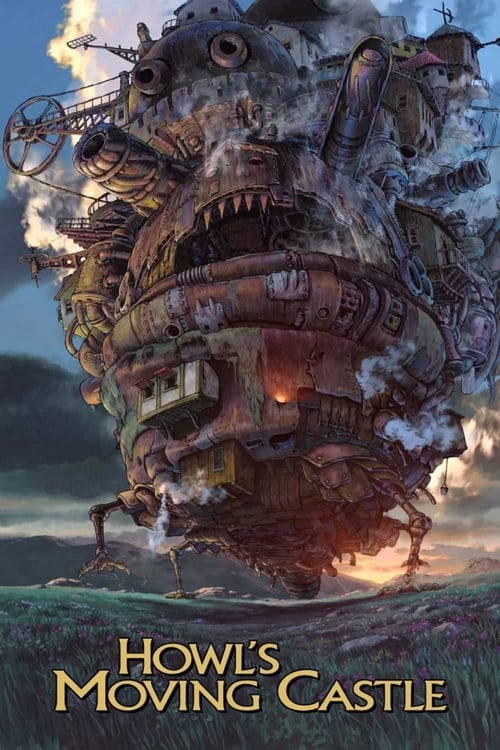
Howl's Moving Castle
2004 · Hayao Miyazaki
For when you want to be transported — a rainy-afternoon or cozy-evening film that works as pure comfort but leaves you with more to think about than comfort usually does.
What it's about
Sophie, a shy young hatmaker, is cursed by a jealous witch and transformed into a ninety-year-old woman. Unable to explain her condition to anyone, she walks into the hills and talks her way into housekeeping for Howl — a vain, gorgeous young wizard whose ramshackle castle strides across the landscape on spindly bird legs — just as a senseless war is pulling him toward the front. Inside the castle: a fire demon with a contract, a boy apprentice, and a door that opens onto four different places.
The experience
Enchanting and gently strange — it has the cozy, lived-in warmth of a fairy tale but keeps drifting somewhere sadder and more mysterious, with war smoldering at the edges. It rewards giving yourself over to its dream logic rather than demanding every rule be explained.
The craft
This is Studio Ghibli at its most opulent: the castle is a wheezing assemblage of turrets, pistons, and fish-scale plating drawn so densely it seems to breathe, and Joe Hisaishi's waltzing 'Merry-Go-Round of Life' theme has become one of the most instantly recognizable pieces of film music. The subtlest trick is that Sophie's age is never fixed — her body drifts older and younger from scene to scene depending on how she feels, animation doing what live action can't.
Why it matters
Made as the Iraq invasion unfolded, it became the most openly pacifist statement of Miyazaki's late career, and its castle and theme music have entered the permanent iconography of animation.
A milliner cursed into old age by a jealous witch walks into the hills and into the service of a vain young wizard, whose ramshackle castle strides the landscape on spindly bird legs. Hayao Miyazaki bent Diana Wynne Jones's novel toward his own lifelong obsessions — flight, transformation, the moral catastrophe of war — reshaping it, as the Iraq invasion unfolded, into the most openly pacifist statement of his late period. It is Studio Ghibli at its most opulent: the castle a wheezing assemblage of turrets, pistons and fish-scale plating, drawn so densely it seems to breathe, while Joe Hisaishi's waltzing 'Merry-Go-Round of Life' theme has entered the small canon of instantly recognizable film music. The craft's finest trick, though, is quieter. Sophie's age is never fixed: her body drifts older or younger from scene to scene as her confidence falters and returns — a character arc conducted almost entirely through the act of drawing itself.
A Deleuzian reading
An old woman climbs into the hills, and a house comes walking toward her on bird legs.
The full Deleuzian reading of Howl's Moving Castle →
Reception
On release it was widely framed as lesser Miyazaki — critics coming off Spirited Away called it gorgeous but muddled — yet two decades on it's arguably his most adored film online, a comfort-movie juggernaut for a generation that grew up on it.
How Howl's Moving Castle was received, from release to now →
Influences: the films it descends from and the films it influenced
- Castle in the Sky (1986) — Establishes Miyazaki's signature hand-drawn aerial-machine choreography and the walking/flying steampunk automaton whose weighty, plausible mechanical articulation Howl's ambulating castle directly extends.
- Nausicaä of the Valley of the Wind (1984) — Model for the pacifist-heroine-amid-total-war structure and the moral refusal to demonize either belligerent, a narrative armature Howl inherits wholesale.
- Spirited Away (2001) — Immediately preceding Ghibli feature sharing the transformation-as-body-horror device (Sophie's aging, No-Face/Haku's metamorphoses) rendered through subtle frame-by-frame character animation rather than dialogue exposition.
- Kiki's Delivery Service (1989) — Prototype for flight animated as felt physical labor and for a young female protagonist whose interiority is carried by posture and gait, the embodied-performance technique Sophie's aging body refines.
- Porco Rosso (1992) — Source of the European-interwar aeronautical design language and the enchantment-as-transformation-curse conceit (a man turned pig) that Howl's Central-European milieu and Sophie's curse echo.
- The Castle of Cagliostro (1979) — Miyazaki's debut feature that codifies the storybook-European castle as an animate mechanical playground of hidden gears and gravity-defying action staging.
- The Wonderful Wizard of Oz (MGM) (1939) — Template for the girl-transported-through-a-marvelous-mechanized-fairyland journey with a wizard whose power is theatrical illusion, a structure Diana Wynne Jones's source and Miyazaki both draw on.
- The Tale of the Princess Kaguya (2013) — Ghibli descendant pushing embodied-aging and transformation into a woman's compressed life-cycle, rendered in expressive hand-drawn line as emotional register.
- Howl's successor The Wind Rises (2013) — Miyazaki's late-period continuation of the anti-war-through-flight motif, where beautiful aircraft become instruments of catastrophe, extending Howl's ambivalence about the machines of war.
- Wolfwalkers (2020) — Cartoon Saloon feature inheriting Ghibli's insistence on hand-drawn animation and transformation-of-the-body as its central formal and thematic device.
- Arrietty / When Marnie Was There (2014) — Post-Miyazaki Ghibli work carrying forward the literary-adaptation method and the dense-detail miniature-world staging that treats environment as a fully articulated mechanism.
- Song of the Sea (2014) — Extends the Miyazaki lineage of gentle-fantasy transformation and flight animated as buoyant, weighted movement over a Hisaishi-like folk-orchestral score.
- Up (2009) — Sophie's visual aging by grief and obligation — rendered through posture, gait, and voice casting rather than exposition — directly anticipates Carl Fredricksen's design logic, where physical appearance externalizes interior emotional state and aging becomes a readable surface rather than a biographical fact.
- The Secret World of Arrietty (2010) — Yonebayashi key-animated it; it models Ghibli's practice of adapting a British children's novel and its intricately mechanized, densely detailed interior production design.
- Princess Mononoke (1997) — Companion anti-war epic using Joe Hisaishi's leitmotif orchestration and densely detailed, layered painterly backgrounds to weight ecological/martial catastrophe with elegiac gravity.
- Laputa / Whisper of the Heart (1995) — Ghibli stablemate demonstrating the studio's method of grounding fantasy in obsessively observed domestic detail, the same dense-detail realism that anchors Howl's magical interiors.
- The Thief and the Cobbler (1993) — Shares maximalist hand-drawn ornamental density and intricate mechanical-contraption animation as a display of draftsmanship for its own sake.
- The Secret of NIMH (1982) — Parallel commitment to lush, painterly hand-inked backgrounds and magic depicted through luminous traditional effects animation rather than graphic shorthand.
- Metropolis (anime) (2001) — Contemporary hand-drawn feature staging retro-futurist war machinery and towering mechanical architecture with the same detailed steampunk industrial design sensibility.
- Ponyo (2008) — The immediately prior late-Miyazaki film against which Ponyo is a deliberate 'return to first principles' — abandoning CG compositing for an almost entirely hand-drawn, crayon-textured aesthetic and colored-pencil backgrounds.
Similar films
- Kiki's Delivery Service (1989) — influence & lineage · same viewing thread · often watched together
- The Tale of The Princess Kaguya (2013) — influence & lineage · same viewing thread · often watched together
- Spirited Away (2001) — influence & lineage · same viewing thread
- Castle in the Sky (1986) — influence & lineage · same viewing thread
- The Castle of Cagliostro (1979) — influence & lineage · same viewing thread
- Porco Rosso (1992) — influence & lineage · same viewing thread
- Princess Mononoke (1997) — influence & lineage · same viewing thread
- My Neighbor Totoro (1988) — same viewing thread
All the films related to Howl's Moving Castle →
Watch it with: curated runs of related films
- The Studio Ghibli Canon — A run through the whole hand-drawn shelf of Miyazaki and Takahata — start with the childhood-wonder crowd-pleasers and drift toward the studio's quieter, adult, more elegiac corners.