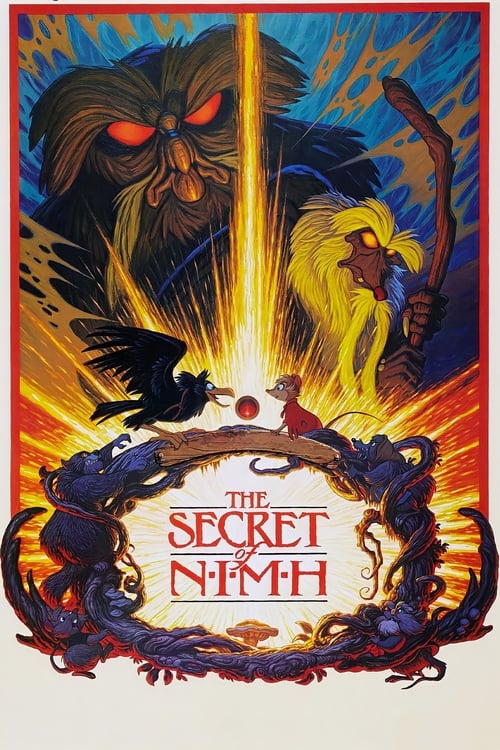
The Secret of NIMH
1982 · Don Bluth
For when you want family viewing with actual teeth — a nostalgic rewatch for anyone it spooked as a kid, and a revelation for kids raised on softer fare. Comfort food with a shiver in it.
What it's about
A widowed field mouse must move her family before the farmer's plow destroys their home — but her youngest son is too sick to travel. Her search for help leads her to a clumsy, lovesick crow, a terrifying owl, and finally to a hidden colony of escaped laboratory rats whose intelligence, and whose secrets, are far beyond anything she imagined.
The experience
Darker and more intense than you expect from a talking-animal picture — genuinely scary in places, glowing and mysterious in others, with real stakes hanging over every scene. It treats a mother's courage with total seriousness, then lets a goofy crow puncture the gloom at just the right moments.
Performances
Elizabeth Hartman's gentle, frightened, determined voice work makes Mrs. Brisby's ordinary-mother heroism land, and Dom DeLuise is pure delight as Jeremy the crow.
The craft
Don Bluth and his team of Disney defectors poured lavish hand-drawn craft into every frame: backlit glows, layered shadows, water and sparkle effects animated by hand, a palette that goes from candlelit amber to eerie violet. Jerry Goldsmith's soaring score does heavy emotional lifting. It's a showcase of what full classical animation looks like when nobody cuts corners.
Why it matters
The founding statement of the Bluth studio and the era's most credible artistic challenge to Disney, it proved American feature animation could be dark, ambitious, and hand-crafted at a moment when the mainstream had nearly given up on all three.
Snapshot
The Secret of NIMH is the feature that announced Don Bluth as classical animation's most conspicuous dissident. Adapted from Robert C. O'Brien's Newbery Medal–winning children's novel Mrs. Frisby and the Rats of NIMH (1971), it follows a widowed field mouse — renamed Mrs. Brisby for the screen — who must move her home and her sick son ahead of the farmer's plow, and who finds help among a colony of hyper-intelligent rats that escaped a laboratory. The film matters less for what it earned than for what it proved: that a splinter group of animators who had walked out of the Walt Disney studio could mount a hand-crafted, effects-heavy, unapologetically dark fantasy at a level of finish the American mainstream had all but abandoned. It became the founding document of the Bluth studio and the most credible artistic challenge Disney's animation department faced in the pre-Renaissance 1980s.
Industry & production
The film's origin is inseparable from a labor rupture. In September 1979 Don Bluth, together with Gary Goldman and John Pomeroy, resigned from Disney, taking a substantial cohort of animators with them — a walkout that disrupted Disney's production schedule (it is commonly credited with delaying The Fox and the Hound). The dissenters believed Disney had let its craft decay for reasons of cost and timidity, and they set out to prove the older methods still viable. Their new company, Don Bluth Productions, secured backing from Aurora Productions to make NIMH, with distribution through MGM/UA.
The budget was modest by studio-feature standards — figures in the neighborhood of six to seven million dollars are frequently cited, though I would treat the exact number as approximate rather than documented to the dollar. What is well established is that the money was stretched by unusual means: the principals reportedly took mortgages against their homes to keep the production solvent, and much of the crew worked long hours for comparatively little, motivated by the chance to revive techniques the industry had shelved. The result was a film whose visible richness far outstrips its financing.
Commercially, NIMH opened into one of the most crowded summers in Hollywood history — the season of E.T. the Extra-Terrestrial, Poltergeist, Blade Runner, and Star Trek II — and did not break out. It underperformed relative to its ambitions and did not, on its own, establish Bluth as a self-sustaining commercial force; that would come later through his partnership with Steven Spielberg's Amblin on An American Tail (1986) and The Land Before Time (1988). NIMH's importance is therefore best understood as artistic and strategic rather than financial.
Technology
The Secret of NIMH is a demonstration piece for traditional, pre-digital animation technology deployed at full stretch. Its most talked-about feature is the extensive use of backlit cel animation to produce glows, sparkles, fire, and translucency: Nicodemus's luminous eyes, the pulsing red stone of the amulet, candle and lamplight, the fiery collapse and the sinking of the cinder block into mud are all handled with light effects that require shooting elements separately and compositing them under the animation camera. This kind of effects work is labor-intensive and had been largely economized out of Disney's own output during the 1970s; Bluth's crew reinstated it aggressively.
The studio also emphasized older ink-and-paint craft, favoring hand-detailed line and color work over the flatter, more mechanized look that xerographic cel processing had encouraged since the early 1960s. Multiplane camera setups and layered backgrounds give the frame genuine depth. None of this is "new" technology — the point of NIMH was precisely the recovery of demanding analog techniques — but the film stands as one of the last major American features to marshal them so fully before the industry's turn toward computer-assisted and eventually digital production.
Technique
Cinematography
Within the vocabulary of hand-drawn animation, NIMH is notably "shot" for atmosphere. Its virtual camera favors low angles and deep, shadowed spaces that make the rodent world feel cavernous and the human world monstrously large. The rats' lair beneath the rosebush is staged with dramatic recessions and pools of colored light, closer to the imagery of gothic fantasy than to the bright, frontal presentation of contemporaneous television animation. Backgrounds carry weather and time of day as active elements — rain, mud, gloom, torchlight — and the compositions repeatedly dwarf Mrs. Brisby against forces larger than herself, visually encoding the story's theme of a small creature confronting overwhelming machinery.
Editing
The film's cutting is unhurried and classical, giving performance beats and effects setpieces room to register. Bluth allows scenes of quiet dread — Brisby's descent into the rats' world, her audience with Nicodemus, the encounter with the Great Owl — to build atmosphere rather than rushing to plot. The pacing has drawn the occasional criticism for density and for compressing O'Brien's plot mechanics, but the deliberate rhythm is central to the film's tone; it treats a children's story with the gravity of adult fantasy.
Mise-en-scène / staging
Production and character design push toward the ornate. The rats' civilization is imagined with wiring, machinery, and stolen technology that literalize their uplifted intelligence, and the amulet supplies a talismanic focal object around which the climax is composed. Character staging is expressive and weighty — Nicodemus is presented as a robed, almost sorcerous patriarch; Jenner is all sharp, scheming angularity. The overall design sensibility is markedly darker and more baroque than the family-animation norm of its moment, and that seriousness is the film's signature.
Sound
Sound design supports the film's horror-adjacent register: the mechanical hum and clank of the rats' world, the menace of the farm cat Dragon, the storm and the sucking mud of the finale. The mix privileges menace and scale, reinforcing the sense that Brisby is small in a dangerous, oversized world.
Performance
The vocal performances are pitched toward sincerity rather than gag comedy. Elizabeth Hartman gives Mrs. Brisby a soft, anxious tenderness that anchors the film emotionally; it was among her last screen roles. Derek Jacobi lends Nicodemus theatrical gravity, Peter Strauss gives Justin an earnest heroism, and Paul Shenar makes Jenner a genuinely sinister antagonist. Dom DeLuise's Jeremy the crow supplies the film's comic relief — DeLuise would become a recurring presence in Bluth's subsequent films. The cast also includes John Carradine as the Great Owl, Arthur Malet as Mr. Ages, and, in smaller roles, then-child performers Shannen Doherty and Wil Wheaton as Brisby's children.
Narrative & dramatic mode
The narrative mode is the quest-and-rescue fable inflected with mystery and science-fictional revelation. Its dramatic engine is maternal: an ordinary, un-magical mother must act with courage far beyond her station to save an ailing child. Around that domestic urgency the film layers a secret history — the National Institute of Mental Health experiments that made the rats intelligent — so that a homely story about moving house opens onto questions of consciousness, uplift, and moral responsibility. The mystery structure (what is NIMH? who was Brisby's late husband Jonathan? why do the rats revere him?) drives the second act, and the resolution turns on a talisman and an act of courage rather than on the more grounded ingenuity of O'Brien's novel — a shift toward overt fantasy that is the adaptation's most consequential choice.
Genre & cycle
NIMH sits at the crossroads of several genres its own poster lists — adventure, fantasy, mystery, family, and a strand of science fiction embedded in the laboratory backstory. Historically it belongs to the lineage of anthropomorphic animal fable in animation, but it deliberately breaks with the reassuring tone of that tradition. It is best placed within a small cycle of "dark" family animation that runs from Watership Down (1978) through Bluth's own subsequent work, films willing to frighten children and to treat mortality, cruelty, and grief directly. Within Bluth's authorial cycle it is the origin point, establishing the tonal template — peril, sentiment, elaborate effects — that recurs across An American Tail, The Land Before Time, and All Dogs Go to Heaven.
Authorship & method
The film is a strong authorial statement. Don Bluth directed and produced and is the guiding sensibility: a Disney-trained animator whose governing conviction was that the classical craft had been undervalued and could be restored. His close collaborators Gary Goldman and John Pomeroy — co-founders of the studio and, with Bluth, the creative core through the following decade — shared production and animation leadership. The screenplay is credited to Bluth with Goldman, Pomeroy, and Will Finn, adapting O'Brien's novel.
The single most important outside collaborator is composer Jerry Goldsmith, whose lush orchestral and choral score is frequently singled out as among the film's greatest strengths. Animated features were a rarity in Goldsmith's largely live-action career, and his contribution lends NIMH a symphonic seriousness that matches Bluth's visual ambition; the score is often cited as one of the elements that elevate the film above its budget. Bluth's method throughout was recuperative rather than innovative — the deliberate re-adoption of multiplane depth, backlit effects, and painstaking ink-and-paint — a craftsman's argument, made in images, against the industry's drift toward economy.
Movement / national cinema
As American commercial animation, NIMH is not part of an art-cinema movement in the European sense. Its significance to national cinema is institutional: it represents the first serious fracturing of the near-monopoly the Disney studio had held over prestige American feature animation, and the emergence of a rival house built expressly around the values Disney was seen to have compromised. In that sense the film is a document of a specifically American industrial moment — the early-1980s contest over who would carry the classical hand-drawn tradition forward.
Era / period
The film is a hinge object of its era. It arrives at the low ebb of Disney's own animation fortunes, a few years before the studio's late-1980s recovery, and at the dawn of the home-video age that would eventually give NIMH a durable second life with family audiences. It predates the computer-graphics revolution while embodying the apex of the analog craft that revolution would supersede. To watch it now is to see a tradition performed at nearly full capacity at the moment just before its technological ground shifted.
Themes
Its central theme is maternal courage — heroism located not in a warrior but in an ordinary mother acting under duress. Around that the film develops a cluster of concerns: intelligence and its moral burdens (the rats' uplift by NIMH raises the question of what enhanced minds owe the world and one another); the tension between progress and dependence, dramatized in the rats' resolve to stop stealing human power and live self-sufficiently; and legacy and grief, carried by the absent figure of Jonathan Brisby, whose sacrifice shadows the plot. Mysticism threads through it as well — Nicodemus's near-magical wisdom and the amulet's power push the story from the novel's rationalism toward faith in courage and inherited virtue.
Reception, canon & influence
Critically, The Secret of NIMH was received far more warmly than its box office suggested. Reviewers praised the ambition and quality of its animation and the darkness of its tone as a bracing corrective to complacent family fare, though some found the plot dense and the shift toward outright fantasy a dilution of O'Brien's grounded storytelling. Its craft credentials were quickly recognized within the animation community.
Looking backward, the film's influences are legible: the classical Disney tradition Bluth was trained in and sought to restore; O'Brien's source novel and the broader mid-century lineage of intelligent-animal fable; and the darker sensibility of contemporaneous animation such as Watership Down, which had shown that animal stories need not be gentle. Looking forward, its legacy is substantial. It established Don Bluth as the credible alternative to Disney and set the pattern for his run of successes across the 1980s, a rivalry often credited with helping spur Disney's own competitive resurgence. It gave Jerry Goldsmith one of his signature non–live-action scores. And through decades of home-video and television circulation it became a genuine cult classic, cherished by a generation of viewers for taking children seriously enough to unsettle them — a reputation that has only grown as the analog craft it showcases has passed into history. Its more direct commercial vindication came with the Bluth–Amblin collaborations that followed, but NIMH remains the film where the case was first, and most purely, made.
Reception
In summer 1982 it earned strong reviews but got flattened at the box office by E.T.; home video and cable turned it into a cult classic, and it's now routinely called the best non-Disney animated film of its era.
How The Secret of NIMH was received, from release to now →
How to watch The Secret of NIMH: what to notice on a first viewing
- Watch for glowing, backlit effects: Nicodemus's eyes, the red amulet. Bluth's animators hand-paint light sources directly onto the cels, sparkles, fire, translucency, giving certain objects and characters an inner glow nothing else in the frame has. The glow marks what carries power in this world before a word of dialogue explains it.
- Notice how low the camera sits in the rats' underground world. Low angles and deep shadowed spaces make the rodent world feel cavernous while the human world above looms monstrously large. The framing puts you at the scale of a creature who is small and in danger.
- Listen for the mechanical hum and clank under the rats' scenes. Goldsmith's score and the sound design lean into menace and scale wherever Brisby is small in a dangerous, oversized world. The sound tells you this is a fantasy willing to frighten you, not a gentle bedtime story.
- Watch how often Mrs. Brisby is framed small against something enormous. Compositions repeatedly dwarf her against the farmhouse, the plow, the owl, forces built at a scale she cannot match. The staging keeps reminding you that her courage has nothing to do with size or strength.
- Notice Jeremy the crow's fumbling, comic movement against everyone else's stillness. Dom DeLuise voices Jeremy for broad comic relief while the rest of the cast, Hartman, Jacobi, Shenar, is pitched toward sincerity, not gags. The contrast keeps the film's darker fantasy from tipping into either grimness or cartoon silliness.
The whole guide to watching The Secret of NIMH, with the keys for a rewatch →
Influences: the films it descends from and the films it influenced
- Pinocchio (1940) — The gold-standard multiplane-camera depth and layered dimensional staging that Bluth reverse-engineered shot-for-shot, treating its glassed-in atmospheric recession as the lost craft NIMH had to recover.
- Snow White and the Seven Dwarfs (1937) — Established the full ink-and-paint labor standard — cel-by-cel character weight and hand-painted line — that Bluth deliberately re-adopted against the industry's xerographed, cost-cut drift.
- Sleeping Beauty (1959) — Eyvind Earle's angular, gilded Gothic backgrounds and low-angle vertical staging are the direct model for NIMH's baroque production design and towering chiaroscuro interiors like the Rats' lair.
- Bambi (1942) — Its backlit multiplane forest and naturalistic study of small-animal locomotion set the template for NIMH's rendering of Mrs. Brisby's scale and its glowing, light-pierced woodland.
- Fantasia (1940) — Modeled the symphonic score as an equal narrative agent — the precedent for letting Jerry Goldsmith's lush orchestral-choral writing drive dramatic seriousness rather than merely accompany action.
- Watership Down (1978) — Proved an intelligent-animal fable could carry genuine menace, bloodshed and mortal stakes in a family register — the darker-tone permission NIMH takes further with its own peril-and-scale mix.
- The Rescuers (1977) — Bluth, Goldman and Pomeroy animated on it directly, and its diminutive-creatures-on-a-rescue-quest structure is the immediate narrative and character-scale prototype for Mrs. Brisby's mission.
- One Hundred and One Dalmatians (1961) — A descendant by repudiation — Bluth's defectors restored hand-inked colored lines, multiplane depth and backlit effects specifically to undo the xerographic house style that had governed Disney animation since 1961.
- An American Tail (1986) — Bluth's next feature extends the identical recuperative craft — backlit cel effects, multiplane depth and sincere-earnest voice acting — into the Amblin partnership that commercially vindicated NIMH's methods.
- The Land Before Time (1988) — Reprises NIMH's orphaned-innocent quest and its atmospheric multiplane vistas, again pairing painstaking analog depth with a menace-and-scale orchestral mix (James Horner) in the Goldsmith mold.
- All Dogs Go to Heaven (1989) — Pushes NIMH's chiaroscuro lighting and unsettling dark-family tone into overt afterlife nightmare imagery, sustaining Bluth's argument that animation should take children seriously enough to frighten them.
- Anastasia (1997) — Bluth's late-career apex of baroque production design and low-angle grandeur, applying the same layered-depth staging and villain-as-menacing-scale sensibility perfected on NIMH.
- The Iron Giant (1999) — Inherits NIMH's fusion of sincere, unironic voice performance with a large orchestral menace-and-scale score to make analog-drawn 2D animation carry adult dramatic weight.
- The Nightmare Before Christmas (1993) — Carries forward the dark-family-animation lineage NIMH legitimized — chiaroscuro Gothic design and a sweeping symphonic score foregrounding menace within a children's frame.
- Coraline (2009) — Extends NIMH's conviction that unsettling children is a legitimate aim, wedding meticulous hand-craft (stop-motion here) with mystery-structure dread and a maternal-peril fable.
- The Black Cauldron (1985) — Disney's darker, multiplane-heavy answer to the competitive threat Bluth posed — a studio riposte in the same dark-fantasy-for-families register NIMH opened.
- The Dark Crystal (1982) — Released the same year in the same wager — an elaborately baroque, genuinely menacing fantasy world built for a family audience, sharing NIMH's belief that children's fare could be ornate and unsettling.
- Howl's Moving Castle (2004) — Parallel commitment to lush, painterly hand-inked backgrounds and magic depicted through luminous traditional effects animation rather than graphic shorthand.
- The Plague Dogs (1982) — Released the same year, it likewise wraps richly naturalistic, painterly animation around laboratory animals fleeing scientific experimentation, with a darker tone explicitly repudiating Disney gloss.
Similar films
- Coraline (2009) — influence & lineage · same viewing thread
- Watership Down (1978) — influence & lineage
- The Nightmare Before Christmas (1993) — influence & lineage
- The Plague Dogs (1982) — shared sensibility
- My Neighbor Totoro (1988) — shared sensibility
- Guillermo del Toro's Pinocchio (2022) — shared sensibility
- How to Train Your Dragon 2 (2014) — shared sensibility
- ParaNorman (2012) — shared sensibility
All the films related to The Secret of NIMH →
Watch it with: curated runs of related films
- Handmade Animation's Dark Wonder — A run of painstakingly handcrafted animation — painted, stop-motion, watercolor — where childhood wonder keeps brushing up against loss and the adult dark.