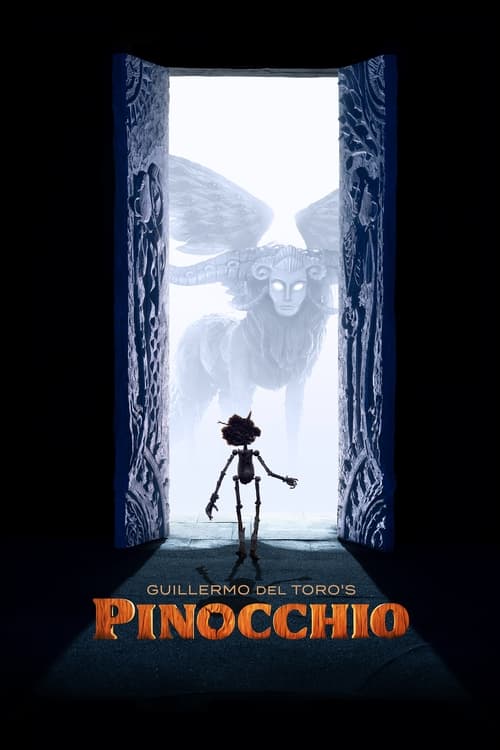
Guillermo del Toro's Pinocchio
2022 · Mark Gustafson
For a night when you want a beautiful film to feel something real — good for thoughtful older kids but built to wreck adults. Comfort viewing with a lump in the throat.
What it's about
In Mussolini's Italy, a grieving old woodcarver drunkenly builds a pine boy who comes to life — rough-hewn, exuberant, and unable to stay dead. As fascism tightens around their village, the wooden child who won't obey anyone collides with a world that demands obedience from everyone, while his father struggles to love the son he has instead of the son he lost.
The experience
Tender and dark in equal measure — a handmade fable that moves you to tears about grief and fathers and sons while never talking down to anyone. It's funny, macabre, and openly emotional, with songs that sneak up on you.
Performances
The voice cast is superb: Ewan McGregor's chatty cricket narrator, David Bradley's cracked, grieving Geppetto, and Gregory Mann's irrepressible Pinocchio give the puppets startling emotional life.
The craft
Every frame is stop-motion, animated by hand over years, and the carved, imperfect textures are the point — a story about a handmade boy told in a handmade medium. Alexandre Desplat's woodwind-led score and the tactile candlelit look reward a big, dark screen.
Why it matters
It won the Academy Award for Best Animated Feature and stands as a career-crowning argument — del Toro's own — that animation is filmmaking for everyone, not a genre for children.
Snapshot
Guillermo del Toro's Pinocchio is a stop-motion feature that transposes Carlo Collodi's 1883 novel The Adventures of Pinocchio into Mussolini's Italy, using the wooden boy's inability to die as the engine for a meditation on mortality, disobedience, and imperfect fatherhood. Co-directed by del Toro and the veteran stop-motion animator Mark Gustafson, released by Netflix in late 2022, it was the culmination of a project del Toro had pursued for well over a decade. Where Collodi's fable and Disney's 1940 adaptation frame Pinocchio's arc as a moral apprenticeship — learn to obey, earn your humanity — del Toro inverts the premise: disobedience is a virtue, and the boy is loved as he is, not as a reward for conformity. The film won the Academy Award for Best Animated Feature, along with the corresponding Golden Globe, BAFTA, and Annie awards, consolidating del Toro's standing as a mainstream auteur working in explicitly personal, dark-fantasy registers.
Industry & production
The film was produced by del Toro's Double Dare You, the Portland-based stop-motion house ShadowMachine, and The Jim Henson Company, financed and distributed by Netflix — a streaming-era arrangement that gave a labor-intensive, adult-leaning animated feature the runway that traditional studios had repeatedly declined to fund. Del Toro has spoken publicly about the long, frustrated development of the project; the record is consistent that he had been trying to mount it since the late 2000s and that the design was tied from early on to the American illustrator Gris Grimly, whose 2002 illustrated edition of Collodi gave del Toro the gnarled, expressionistic visual key. The animation was carried out principally at ShadowMachine in Portland, Oregon, with a significant production presence in Guadalajara, Mexico — a bi-national arrangement reflecting del Toro's own Mexican base and his interest in building stop-motion capacity there.
Stop-motion is among the slowest and most capital-intensive forms of filmmaking; a feature requires years of frame-by-frame shooting across dozens of simultaneous units. Netflix's involvement, and the parallel prestige it was cultivating in animation at the time, made a project of this scale and tonal seriousness viable in a way the theatrical marketplace had not.
Technology
The film was made in physical stop-motion — hand-built armatured puppets photographed one frame at a time against practical, sculpted sets — rather than the computer animation that dominates the feature market. This is a technological choice as much as an aesthetic one: del Toro and Gustafson placed the film in the lineage of tangible, artisanal animation, where the visible texture of wood, fabric, and hair carries meaning. Contemporary stop-motion houses combine traditional puppet fabrication with digital tools — rapid-prototyped (3D-printed) components for facial performance, digital rig removal, and compositing — and this production drew on that modern toolkit while keeping the performance itself frame-by-frame and hand-animated. Where the precise pipeline details are not something I can state with confidence, I won't reconstruct them; the essential and verifiable point is that the film's expressive surfaces were physically built and photographed, not synthesized.
Technique
Cinematography
Cinematography is credited to Frank Passingham, a director of photography with deep stop-motion experience (his prior work includes Tim Burton's stop-motion features and productions at Laika). In stop-motion, the cinematographer's craft lies in lighting and staging miniature sets so they read at human emotional scale — controlling depth, atmosphere, and the fall of light across small, textured surfaces. The film's palette moves between the warm, candlelit intimacy of Geppetto's home and church and the cold, hard geometry of the Fascist state and the war, a contrast that does much of the film's thematic work visually. The camera tends toward the classical and legible rather than the showily kinetic, giving the puppets room to perform.
Editing
Editing is credited to Ken Schretzmann and Holly Klein. Schretzmann brings a long background in feature animation editing. Cutting animation differs fundamentally from live action: because each shot is enormously expensive to produce, editorial decisions are effectively locked in pre-production through story reels and animatics, and the editors shape rhythm and performance within tightly pre-planned bounds. The finished film's pacing balances episodic incident — Pinocchio's serial misadventures inherited from Collodi's picaresque structure — against a steadily deepening emotional throughline between father and son.
Mise-en-scène / staging
The film's staging is where del Toro's authorship is most legible. The design language, keyed to Gris Grimly's illustrations, renders Pinocchio as a raw, unfinished thing — nails protruding, limbs asymmetrical, closer to a real branch than to Disney's rounded marionette. The Wood Sprite and her sister Death are conceived as chimerical, many-eyed creatures in del Toro's signature register, drawing on his lifelong iconography of benevolent monsters. Sets range from the intimate (the woodshop, the church interior with its looming crucifix that visually rhymes with Pinocchio) to the institutional and martial (a Fascist youth camp, a traveling carnival). The recurring visual pairing of the wooden boy with the carved Christ above the altar is one of the film's most pointed staging choices, aligning Pinocchio's "unnatural" body with sacred imagery and provoking the townspeople's suspicion.
Sound
The score is by Alexandre Desplat, reuniting with del Toro after their collaboration on The Shape of Water. Desplat also composed the film's original songs, with lyrics credited to del Toro and Roeben Katz; the most prominent, "Ciao Papa," functions as the film's emotional refrain. The musical texture leans toward chamber-scale, folk-inflected European sonorities appropriate to the period setting rather than the sweeping symphonic mode of Hollywood animation. Sound design contrasts the organic creak and knock of the wooden protagonist against the mechanized noise of the Fascist and wartime world.
Performance
Voice performance is central. Gregory Mann voices both Pinocchio and Geppetto's dead son Carlo, a doubling that underscores the film's grief-and-substitution theme. David Bradley plays Geppetto with weathered gravity; Ewan McGregor narrates and voices Sebastian J. Cricket, the film's rueful, put-upon conscience-figure. Christoph Waltz voices the exploitative showman Count Volpe, Ron Perlman (a longtime del Toro collaborator) the local Fascist official the Podestà, Cate Blanchett the monkey Spazzatura, Tilda Swinton the twin spirits of the Wood Sprite and Death, and Finn Wolfhard the Podestà's son Candlewick. The animators' craft is in translating these vocal performances into physical acting — the weight of a puppet's shifting posture, the timing of a glance — frame by frame.
Narrative & dramatic mode
Structurally the film retains Collodi's picaresque episode-chain — the boy is repeatedly led astray, exploited, and endangered — but reorganizes it around a tragic-redemptive family drama. The framing invention is that Geppetto carves Pinocchio in the throes of grief, having lost Carlo in the First World War; the wooden boy is thus born as a substitute for a dead child and must contend with being loved for the wrong reasons before he can be loved for himself. Del Toro's most consequential departure from every prior version is making Pinocchio effectively unable to die: he passes repeatedly through a liminal underworld and returns, which converts the story's stakes from "will he survive" into "what does it mean to love mortal things, and to be the immortal one who outlives them." The dramatic mode is fable braided with elegy — comic incident giving way to a genuinely somber reckoning with loss and war.
Genre & cycle
The film sits at the intersection of animated fantasy, adventure, and adult-oriented literary adaptation. It belongs to a small prestige cycle of stop-motion features made for grown audiences as much as children, and it arrived in a striking cluster of near-simultaneous Pinocchio adaptations — Robert Zemeckis's Disney live-action/CGI version was released the same year, and Matteo Garrone had made a live-action Italian Pinocchio in 2019. Against that field, del Toro's is the darkest and most authorial, positioning itself explicitly as a corrective to the Disney sentimentalization of Collodi.
Authorship & method
This is unmistakably a del Toro film — its monsters-as-innocents, its suspicion of authority, its Catholic imagery reworked toward heterodox ends, its fascination with fascism as the ultimate expression of coerced conformity all recur from The Devil's Backbone, Pan's Labyrinth, and The Shape of Water. But the credit is genuinely shared. Mark Gustafson was a seasoned stop-motion director whose prior credits include serving as animation director on Wes Anderson's Fantastic Mr. Fox; his craft expertise anchored the physical execution that del Toro, primarily a live-action director, was not himself going to hand-animate. The screenplay is credited to del Toro and Patrick McHale (creator of Over the Garden Wall), with story credit shared by del Toro and his longtime collaborator Matthew Robbins, adapting Collodi. Desplat's score, Passingham's cinematography, and Grimly's design contribution round out a method in which a strong authorial vision is realized through a deep bench of specialist collaborators — the norm for animation, but here bent firmly toward del Toro's sensibility.
Movement / national cinema
The film resists tidy national classification. It is a Mexican-American-authored, US- and Mexico-produced adaptation of an Italian literary classic, financed by an American streamer, set in Italy. It is best understood within the transnational auteur cinema del Toro exemplifies alongside his compatriots Alfonso Cuarón and Alejandro González Iñárritu — Mexican filmmakers working across borders and languages while retaining distinct personal signatures. It also belongs to an international stop-motion tradition that runs from the early European puppet-animation pioneers through the British and American studios working today.
Era / period
The film is set in the interwar and Second World War period of Fascist Italy, roughly the 1920s through the early 1940s, moving Collodi's timeless village fable into a specific, politically charged historical moment. This relocation is the film's central interpretive act: Pinocchio's lessons about obedience are staged against a regime that demands total obedience, so that the boy's stubborn refusal to conform reads as moral resistance rather than childish waywardness. Mussolini himself appears as a small, ridiculous caricature during a carnival sequence — a deliberate deflation of tyranny. Del Toro has been explicit in interviews that the film argues disobedience can be a virtue, which the period setting makes concrete.
Themes
The dominant themes are mortality and its acceptance; imperfect, conditional, and finally unconditional love between parent and child; grief and the danger of trying to replace what is lost; and disobedience as an ethical stance against authoritarianism. Pinocchio's immortality is the film's philosophical fulcrum — it is precisely because he can die and chooses the vulnerability of a mortal life that his arc resolves, reversing the usual Pinocchio wish to "become a real boy" into an embrace of finitude. Fascism, war, and the church operate as institutions demanding conformity, each interrogated through del Toro's characteristic sympathy for the outsider and the monstrous. The doubling of Carlo and Pinocchio keeps the theme of substitution and mourning present throughout.
Reception, canon & influence
Critical reception was strongly positive, and the film's awards run — capped by the Academy Award for Best Animated Feature — marked a high point for adult-oriented stop-motion and for del Toro's authorial standing within the animation field. (It was not the first stop-motion film to win that category, and I won't overstate its firsts; its significance lies in the seriousness and personal vision it brought to a form often condescended to as children's fare.)
Looking backward, the film's influences are richly documented: Collodi's original novel, deliberately restored to its darker register against the Disney softening; Gris Grimly's illustrations as the direct design source; del Toro's own body of work, especially the Spanish-Civil-War fantasy Pan's Labyrinth, whose braiding of childhood fable with fascist historical violence this film closely echoes; and the broader stop-motion lineage, mediated in part through Gustafson's grounding in the craft and his Fantastic Mr. Fox pedigree. The Catholic-inflected imagery and the benevolent-monster iconography are continuous with del Toro's whole career.
Looking forward, its legacy is best measured as reinforcement — of streaming platforms as patrons of ambitious, non-theatrical animation for adults, and of the argument that stop-motion remains a vital, expressive feature form rather than a nostalgic curiosity. Because the film is recent, claims about a durable downstream influence would be premature, and I'll flag that the record on what it has specifically shaped is still thin; what is clear is that it stands as one of the most fully realized statements of del Toro's authorship and as a landmark demonstration that a canonical children's story can be reclaimed as a somber, humane work about death and love.
A Deleuzian reading
A wooden boy walks into a church and the congregation turns on him.
The full Deleuzian reading of Guillermo del Toro's Pinocchio →
Reception
Fifteen years of development hell — del Toro pitched it around Hollywood for over a decade and nobody would fund it — then it landed at Netflix, swept the animation awards season, and won the Oscar. It went from 'the passion project that will never happen' to instant canon almost overnight.
How Guillermo del Toro's Pinocchio was received, from release to now →
How to watch Guillermo del Toro's Pinocchio: what to notice on a first viewing
- Notice the nails and rough asymmetry in Pinocchio's body. Gris Grimly's design keeps Pinocchio raw and unfinished, closer to a branch than a polished marionette, and the puppet's imperfections stay visible on screen. Deleuze's expressionism names objects charged with a life not organic; the wood itself carries feeling.
- Watch how the light shifts between candlelight and cold gray. Passingham lights Geppetto's home and church in warm candle tones, then shifts to hard, cold geometry wherever the Fascist state appears. The two temperatures separate love and coercion before a word of dialogue does it.
- Listen for one actor's voice playing both Pinocchio and Carlo. Gregory Mann voices Pinocchio and Geppetto's dead son Carlo, so every line the puppet speaks carries an echo of the boy who died. Deleuze's crystal-image is when a present thing and its double keep swapping places; here that happens through sound alone.
- Listen for wood creaking against the machinery of the regime. Desplat's sound design keeps the organic knock of the wooden boy distinct from the mechanized noise that surrounds Fascist and wartime scenes. The soundtrack keeps the boy's body and the state's machinery audibly at odds.
- Track how each episode ends by revealing a bigger trap. The carnival, the youth camp, and the war each start as an adventure and end by exposing a larger cage Pinocchio didn't see coming. Del Toro uses Collodi's chain of scrapes to keep uncovering how deep the coercion around Pinocchio actually runs.
The whole guide to watching Guillermo del Toro's Pinocchio, with the keys for a rewatch →
Influences: the films it descends from and the films it influenced
- Fantastic Mr. Fox (2009) — Gustafson served as its animation director, and Pinocchio inherits its deliberately handmade, fur-rippling, un-smoothed puppet performance aesthetic that leaves the craftsman's touch visible on camera.
- Coraline (2009) — Pioneered the rapid-prototyped 3D-printed replacement-face library for stop-motion, the exact facial-animation pipeline Pinocchio's nuanced expressions depend on.
- The Nightmare Before Christmas (1993) — Established the feature-length gothic stop-motion musical built on ball-and-socket armature puppetry and aimed past the nursery, the template for adult-facing puppet features.
- Pan's Labyrinth (2006) — del Toro's own blueprint of a child's dark fairy tale braided with fascist historical violence, including the disobedience-as-virtue moral structure Pinocchio reprises.
- The Devil's Backbone (2001) — Source of the benevolent-monster iconography and Catholic imagery bent toward heterodox ends against a fascist backdrop, del Toro's recurring authorial grammar.
- The Shape of Water (2017) — Model for the warm-versus-cold two-temperature palette and the Christ-rhyming, monster-as-innocent staging del Toro imports into the animated frame.
- Jason and the Argonauts (1963) — Ray Harryhausen's expressive character stop-motion — animating menace and wonder frame by frame — is the foundational performance craft the film descends from.
- Faust (1994) — Carries the Czech tradition of puppet-as-flesh and the tactile, Faustian-bargain materiality of hand-manipulated figures into somber adult allegory.
- Street of Crocodiles (1986) — Its miniature-scale, low-key lighting on decaying, uncanny puppet surfaces prefigures Passingham's intimate miniature-lighting scheme.
- King Kong (1933) — Willis O'Brien's armature-based stop-motion performance is the origin point of the emotionally legible animated creature the whole form builds on.
- Kubo and the Two Strings (2016) — Laika's push of 3D-printed facial animation and giant-scale rapid-prototyped puppetry represents the same replacement-face toolset Pinocchio deploys.
- Isle of Dogs (2018) — Extends the Fantastic Mr. Fox handcrafted-armature method into darker political allegory, and shares Desplat's folk-percussive chamber scoring approach.
- ParaNorman (2012) — Advanced the full-color 3D-printed replacement-face system for stop-motion, a direct sibling in the printed-facial-library technical lineage.
- Wendell & Wild (2022) — A contemporaneous Netflix-patronized, adult-leaning stop-motion feature, sibling proof of streaming-as-patron for non-theatrical puppet animation.
- Frankenweenie (2012) — Reclaims classic-horror monster iconography through black-and-white armature stop-motion, sibling in treating creation-and-death as puppet-form subject matter.
- Puss in Boots: The Last Wish (2022) — Contemporaneous fairy tale that stages a frank confrontation with mortality and a personified Death, its stop-motion 'on twos' cadence rhyming with the deliberately non-fluid, hand-posed motion Last Wish chases.
- Memoir of a Snail (2024) — Foregrounds mortality and grief for an adult audience through stop-motion, keeping a hand-carved wood-grain tactility on the puppets so the making stays visible — sibling in the 'mortality via tactile puppet' vein.
- Beetlejuice Beetlejuice (2024) — A high-profile argument for hand-built stop-motion armature fantasy as an explicit aesthetic refusal of synthetic/AI imagery — the same analog-craft stance the sequel stakes out.
Similar films
- Pan's Labyrinth (2006) — influence & lineage · same viewing thread
- Isle of Dogs (2018) — influence & lineage · often watched together
- Kubo and the Two Strings (2016) — influence & lineage
- The Nightmare Before Christmas (1993) — influence & lineage
- Mad God (2021) — influence & lineage
- The Devil's Backbone (2001) — influence & lineage · same viewing thread
- The Boy and the Heron (2023) — same viewing thread
- The Wolf House (2018) — same viewing thread
All the films related to Guillermo del Toro's Pinocchio →
Watch it with: curated runs of related films
- Where Children Meet the Dead — Watch these together and Coco's candlelit sweetness darkens by degrees into a run of folk fables where the dead won't stay buried and children bargain with mortality under the shadow of war and fascism.