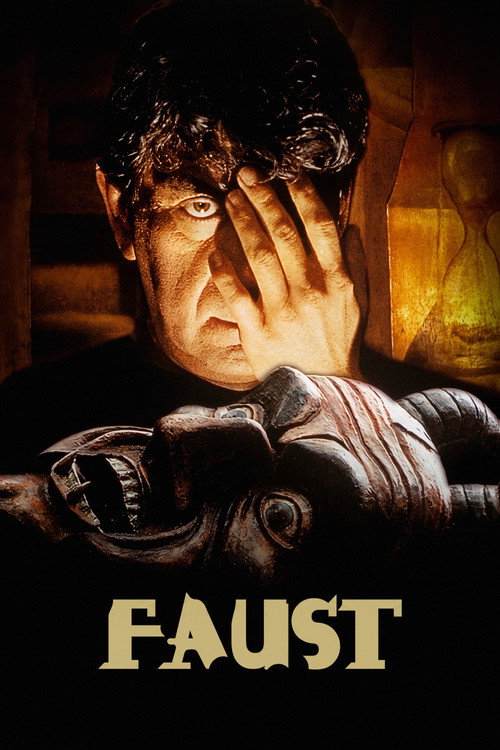
Faust
1994 · Jan Švankmajer
For when you want a film to chew on for days — something genuinely unlike anything else, best approached with patience and a taste for the uncanny. Not a casual watch; a rabbit hole.
What it's about
An ordinary middle-aged man in Prague is handed a mysterious map on the street. It leads him to a derelict building that turns out to be the backstage of a theatre, where he puts on Faust's costume, opens the script, and finds himself trapped inside a performance of the old legend — man sells soul to devil — stitched together from centuries of versions, with life-size marionettes, clay demons, and stage machinery that won't let him leave.
The experience
Deeply strange and quietly menacing, with flashes of deadpan black comedy — the film moves with dream logic, and the sight of giant wooden puppets acting alongside a live human gets under your skin in a way polished effects never could. It leaves you unsettled and turning it over afterward.
Performances
Petr Čepek anchors the whole film as the bewildered everyman, playing most of it opposite puppets and machinery with a weary, hangdog gravity that makes the absurdity feel fatal.
The craft
Jan Švankmajer fuses live action, stop-motion clay animation, and life-size marionettes into a single seamless nightmare, with tactile, handmade textures — wood, clay, flesh — doing the work of spectacle. The sound design of creaking stage machinery and clattering puppet limbs is half the spell; it rewards an attentive, undistracted viewing.
Why it matters
A landmark of Czech surrealist animation and one of Švankmajer's defining features, it cemented his reputation as cinema's great alchemist of puppetry and stop motion and influenced generations of animators drawn to the handmade and the grotesque.
Snapshot
Faust (Czech: Lekce Faust, "The Faust Lesson") is Jan Švankmajer's second feature, after Alice (Něco z Alenky, 1988). It is a live-action film with stop-motion clay animation, life-size marionettes and theatrical machinery. An ordinary middle-aged Prague man (Petr Čepek) is handed a map by two strangers on the street. The map leads him to an abandoned building that turns out to be the backstage of a theatre. There he puts on Faust's costume, opens the script, and is drawn into a performance he does not control. The text comes in pieces from Christopher Marlowe's Doctor Faustus, Goethe's Faust, the Czech folk puppet play of Doktor Johannes Faust, and Gounod's opera. These versions are spliced together until the man cannot tell rehearsal from damnation. The film is usually read in two ways. It is an allegory of free will and manipulation, a man who believes he chooses but is being played. It is also a post-1989 reflection on a society that had just traded one set of strings for another. It is among the most complete statements of Švankmajer's Surrealist method, and the main work in his long engagement with puppet theatre and the Faust legend.
Industry & production
Faust was made in the years after the Velvet Revolution, when state funding for Czech cinema had collapsed and the nationalised studio system was being privatised. Švankmajer had already made Alice with foreign money (Swiss, West German and British partners). Faust was financed in the same international way. The production centred on Athanor, the company Švankmajer founded with his long-time producer Jaromír Kallista. Partners included the British producer Keith Griffiths (Koninck Studios, also the producer of the Brothers Quay), French and German co-producers, and British television money. The credits list several companies, and the exact share of each is not well documented in English-language sources.
Shooting took place in Prague, in real locations and in studio spaces made up as the decaying theatre, dressing rooms and alchemist's workshop. The street scenes use real Prague: the metro exit, the passages and the parks. The film draws much of its unease from the contrast between those everyday city spaces and the closed, theatrical interior. Production was lengthy, as Švankmajer's always were, because of the animation work. The documentary record on specific schedules and budget is thin, and no reliable figures are published.
The film premiered in 1994 and showed on the international festival circuit, including Cannes. It was released in the UK and later in the US in limited arthouse distribution.
Technology
The film uses no new technology. Its interest lies in how it combines older, handmade techniques:
- Live-action photography on 35mm for the human scenes, both in the theatre and on location.
- Stop-motion clay animation. A clay head of Mephistopheles forms and dissolves on a table. A clay foetus or homunculus grows into a small skull-headed creature in Faust's laboratory. Clay faces erupt and deform throughout.
- Life-size and near-life-size marionettes. Wooden puppets play the folk-theatre roles: the clown figure, the devils, the angels, and Helen of Troy. Some are worked visibly by puppeteers. Elsewhere Čepek himself becomes a marionette, with strings attached to his limbs.
- Object animation. Everyday things (food, doors, props, a pair of shoes) are made to move by single-frame manipulation, a Švankmajer signature since the 1960s.
- Stage machinery. Trapdoors, painted backdrops, flying rigs and smoke effects are filmed as functioning theatre rather than hidden.
Švankmajer has said many times that he values the tactile, material presence of things over illusion. In Faust the seams between techniques are left visible on purpose. The cut from a live hand to a clay one, or from Čepek's body to a puppet double, is meant to be felt.
Technique
Cinematography
The film was shot by Svatopluk Malý, who also photographed Alice and later Conspirators of Pleasure (1996). The look is drab and naturalistic in the street scenes: grey Prague light, worn plaster and crowded trams. Inside the theatre it turns to deep, warm shadow. Švankmajer's trademark is the extreme close-up, and it runs through the film: a mouth chewing, a hand turning a key, a door handle, an egg breaking. These shots isolate objects and give them an obsessive, almost erotic texture. They are matched by fixed, frontal compositions of the stage, framed as if the camera were in the stalls. The camera alternates between these two scales, the tactile and the proscenium. In doing so it alternates between Faust's experience of the world and a view of him as a figure on a stage.
Editing
The film was edited by Marie Zemanová, Švankmajer's regular editor through this period. The cutting is abrupt and rhythmic. It often runs in short, percussive bursts that tie the gesture of a hand to the sound of an object. The narrative moves by sudden displacement, not continuity. Faust steps through a door in the theatre and comes out in a Prague street, or leaves a café and is back in the dressing room. These jump cuts in space remove any secure "outside" to the play. Inserts recur: a man carrying a severed leg, a woman knocking at a door, the two map-sellers. They work as motifs, not as plot information, and editorial repetition gives the film its circular, trap-like structure.
Mise-en-scène / staging
The central device is a theatre seen from behind. Faust wanders through dressing rooms, a prop store, a flytower and a backstage corridor. When he pushes through the curtain he is suddenly in front of an unseen audience. The staging deliberately mixes registers:
- The alchemist's laboratory is a set within a set, full of glassware, retorts and books, and is used for the creation of the homunculus.
- The folk-puppet scenes reproduce the crude, brightly painted look of Czech travelling marionette theatre, including the Faust play's comic servant figure and wooden devils with horns and tails.
- The opera passages draw on the gilded conventions of nineteenth-century grand opera, with stage clouds and fanfare.
- The street scenes are naturalistic and largely unadorned.
Švankmajer's collaborator and wife, Eva Švankmajerová, was involved in the visual and design work on his features of this period. Her contribution is credited, though the precise division of labour is not fully documented. The décor is full of the Kunstkammer-like accumulation of Švankmajer's own work: worn wood, peeling paint, jars, skulls and found objects.
Sound
The soundtrack is as important as the image. Švankmajer typically works with heightened, close-miked Foley: chewing, cracking and squelching, sounds pushed to a near-physical intimacy that matches the extreme close-ups. In Faust this layer sits beside fragments of Gounod's opera Faust (1859), which come and go as the film moves into its operatic register, and spoken text from the various literary sources. One celebrated choice is that the voice of Mephistopheles is Čepek's own. The devil speaks with Faust's voice, which makes him a projection or double of the protagonist rather than an outside tempter. Detailed credits for sound design and music arrangement are not widely discussed in the English-language literature.
Performance
Petr Čepek (1940–1994) was one of the most respected Czech stage and screen actors of his generation, and Faust was among his last films; he died in 1994. His performance is a study in passivity. His Faust is a tired, ordinary man in a raincoat whose curiosity carries him forward more than any desire. He reads lines he finds in a script, half-ironic, half-absorbed, and his growing commitment to the role is the film's real drama. Švankmajer's direction of actors tends toward the gestural and the deadpan, close to silent-film acting and puppet movement. Čepek's body is at several points literally replaced by a marionette, which makes visible the film's idea that the actor is already a puppet. The other live performers (the map-distributors, the theatre staff, the passers-by) are deliberately flat and enigmatic, closer to functionaries than characters.
Narrative & dramatic mode
The film is structured as a loop. It opens with crowds pouring out of the metro and two men handing out maps. It ends with a version of the same street, a new man picking up a discarded map, and the suggestion that the cycle will begin again. Between those two points, the "plot" follows the stations of the Faust legend: the scholar's despair, the conjuring of the devil, the pact signed in blood, the temptations, Helen, the fateful final hour, and damnation. These stations are not presented as one continuous drama. They arrive as pieces of different performances:
- passages of Marlovian and Goethean verse spoken by Čepek as he reads from the prompt-book;
- scenes from the Czech folk-puppet Faust, with their slapstick devils and comic servant;
- operatic tableaux;
- Švankmajer's own animated interpolations.
The dramatic mode is metatheatrical and Surrealist. It is less about whether Faust will be damned (the legend has already decided) than about who is pulling the strings. The man repeatedly tries to leave the theatre and finds himself drawn back. He is free to walk out, yet he always returns. Švankmajer has framed the film around the problem of free will and manipulation. Its tone combines dread with black farce: the devils are comic, the damnation is a stage effect, and the horror lies in the mechanism, not in hellfire.
Genre & cycle
Faust sits where several traditions meet:
- Literary adaptation, deliberately deformed. It belongs to the long line of screen Fausts, from Méliès's trick films through F. W. Murnau's Faust (1926) to Autant-Lara's Marguerite de la nuit (1955) and Alexander Sokurov's later Faust (2011). Yet it refuses the faithfulness of a heritage adaptation.
- The puppet film. It continues the Czech tradition of feature puppet cinema associated with Jiří Trnka and Karel Zeman. Its tone is quite different: harsher, more grotesque and less lyrical.
- Fantastic / dark fantasy. It is commonly catalogued as fantasy or horror-fantasy. Its home is the arthouse rather than genre cinema.
- Švankmajer's own literary-adaptation cycle. With Alice (Carroll) and later Little Otik (Otesánek, 2000, from a Czech folk tale), Faust belongs to a run of features that take a canonical text and "dream" it in Surrealist terms. His 1970 short Don Šajn, a version of the Don Juan legend performed by live actors in marionette costumes, is its most direct precursor in method and subject.
Authorship & method
Jan Švankmajer (b. 1934) trained in puppetry and stage design in Prague and worked in theatre (including with the Semafor theatre and Laterna Magika) before turning to film in the 1960s. He joined the Czech Surrealist Group in 1970 and has since described himself as a Surrealist rather than an animator or filmmaker. His principles are well established: the primacy of touch ("tactilism"), the animation of objects as bearers of hidden psychic content, a suspicion of rationalist and authoritarian systems, and an interest in childhood, the occult and alchemy. Faust gathers these concerns together, and it bears directly on his own background in puppet theatre. Early in his career he worked on Emil Radok's puppet film Johannes doktor Faust (1958), so the legend had accompanied him for more than three decades. Švankmajer wrote the screenplay himself, as he does for all his features, assembling it from the source texts.
Key collaborators:
- Svatopluk Malý (cinematography): the tactile close-ups and the pairing of a naturalistic city with a crepuscular theatre.
- Marie Zemanová (editing): the percussive, discontinuous rhythm.
- Eva Švankmajerová (artistic collaboration): a Surrealist painter and ceramicist whose sensibility runs through the couple's shared visual world.
- Jaromír Kallista (production): Švankmajer's producer from this period onward and co-founder of Athanor.
- Keith Griffiths (co-production): the British link that also connected Švankmajer to the Brothers Quay and to British arthouse and television audiences.
- Petr Čepek (lead): the film's human centre.
The animation team included Bedřich Glaser, a frequent Švankmajer animator. Full credits for the puppet makers and animators are available in the film's titles but are rarely discussed in detail in the critical literature.
Movement / national cinema
Švankmajer is the chief representative of Surrealism in Czech cinema. The Czech Surrealist Group has been active since the 1930s (Vítězslav Nezval, Karel Teige, and later Vratislav Effenberger), and Švankmajer belongs to its postwar generation. Faust draws on several distinctly Czech traditions:
- Puppet theatre, which in the Czech lands carries a strong national-cultural charge: travelling marionette players preserved Czech-language performance under Habsburg rule. The folk Doktor Johannes Faust is a staple of that repertoire.
- Prague as the city of alchemy and Rudolfine magic, with its legends of the Golem, Faust's house on Charles Square, and Rudolf II's court of astrologers and alchemists. Švankmajer has repeatedly drawn on this Mannerist, Arcimboldo-influenced Prague.
- Czech animation, from Trnka, Zeman and Hermína Týrlová onward, which had made Czechoslovakia one of the world centres of puppet and stop-motion filmmaking.
Švankmajer was a dissident figure who had been effectively barred from filmmaking for several years in the 1970s. That status sets him apart from the official Czech animation industry, even as his films use its craft.
Era / period
Faust was made in 1992–94, just after the fall of Communism and around the split of Czechoslovakia into the Czech Republic and Slovakia (January 1993). Critics have read its central allegory against that moment: a man walking freely through a newly opened city who nonetheless finds himself enlisted in a script written by others. Švankmajer has expressed scepticism toward both the old totalitarian system and the consumer capitalism that followed it, and the film is often taken to stage that ambivalence. The pact with the devil promises freedom and pleasure, and the reward is manipulation. Such readings are interpretive. The film offers no explicit political commentary.
Internationally, the early 1990s were a high point of interest in European auteur animation and puppet cinema. The Brothers Quay, who openly acknowledged Švankmajer as a master and made the homage The Cabinet of Jan Švankmajer (1984), had brought him to British attention. Channel 4 and BBC support, festival programming and video releases made Faust reachable for Western arthouse audiences in a way his earlier shorts had not been.
Themes
- Free will and manipulation. The puppet/actor/man equation is the film's governing figure. Faust believes he chooses, but the map, the script, the costume and the strings choose for him.
- The double. Mephistopheles speaks with Faust's voice and emerges from clay modelled on the table in front of him. The devil is a projection of the self, in keeping with Švankmajer's psychoanalytically informed Surrealism.
- Theatre as world. Backstage and street bleed into one another. The theatrum mundi conceit becomes literal and claustrophobic.
- Alchemy and creation. The homunculus sequence links the Faust legend to the Golem and to the animator's own act of breathing life into matter. It is a self-reflexive image of Švankmajer's craft.
- Appetite and the body. Close-ups of eating, mouths and food recur, as across Švankmajer's work. Desire is shown as compulsive and slightly disgusting rather than glamorous.
- Repetition and fate. The circular structure and recurring motifs (the leg-carrier, the knocking woman, the map-sellers) make damnation a mechanism that resets for the next man.
- The comic grotesque. The folk-puppet devils keep the legend close to carnival. Horror and slapstick coexist without resolution.
Reception, canon & influence
Critical reception. Faust was well received on the festival circuit and in the arthouse press, particularly in Britain, where Švankmajer already had a following. Critics praised its invention and its fusion of techniques. Some found it more cerebral and less immediately enchanting than Alice, and its fragmented, citation-heavy structure was seen by some as demanding. Over time its reputation has settled: it is generally ranked alongside Alice and Conspirators of Pleasure as one of Švankmajer's most important features, and often called his most ambitious. No reliable box-office figures are available. It was a specialist release.
Influences on the film (backward).
- The literary Faust tradition: Marlowe's Doctor Faustus, Goethe's Faust, and the Czech folk puppet play. Švankmajer is also often linked with Christian Dietrich Grabbe's Don Juan und Faust, though the extent of its use in the film is less clearly documented than Marlowe and Goethe.
- Gounod's opera Faust, quoted on the soundtrack and in the operatic tableaux.
- Czech puppet theatre and Emil Radok's Johannes doktor Faust (1958), on which Švankmajer worked.
- The Surrealist tradition: Breton, the dream-logic of Buñuel, and the Czech Surrealists' preoccupation with the object.
- Méliès's trick films (including his several Faust shorts), with their stage-machinery magic.
- Švankmajer's own earlier work, especially Don Šajn (1970) and the theatre-and-puppet aesthetics of his 1960s shorts.
- Mannerist and Rudolfine Prague, and the Arcimboldo-like composite imagery Švankmajer favours.
Legacy (forward).
- Within Švankmajer's career, Faust consolidated the feature-film model (live action mixed with animation, a canonical text dreamed through Surrealism) that he went on to use in Conspirators of Pleasure (1996), Little Otik (2000), Lunacy (Šílení, 2005) and Surviving Life (2010).
- It is a frequent reference point for filmmakers working in puppet and live-action hybrids and in dark stop-motion. Švankmajer's broader influence is openly acknowledged by the Brothers Quay and frequently cited by Terry Gilliam and other fantasists. Critics often invoke him in discussing later stop-motion work, from Henry Selick to the British and Eastern European independent animation scenes. Specific, documented lines of influence from Faust itself, as distinct from Švankmajer's work as a whole, are harder to establish.
- Among screen Fausts, it stands as the major late-century modernist variation. Later versions, notably Sokurov's Faust (2011), are often discussed alongside it as radical reworkings rather than faithful adaptations.
- It remains a key text in the study of puppetry on film, of Czech Surrealism, and of post-Communist Central European cinema. It is regularly included in retrospectives of Švankmajer's work and taught in courses on animation and on the Faust legend in the arts.
Influences: the films it descends from and the films it influenced
- Johannes doktor Faust (1958) — Švankmajer worked on this puppet adaptation of the Czech folk Faust play, and he took from it the device of putting the marionette-theatre Faust text, with its wooden Faust, Mephisto and comic servant, directly on screen. In Faust (1994) he uses that text as the play-within-the-film.
- La Damnation de Faust / Faust aux enfers (1898) — Méliès staged Faust's magic through stage machinery: trapdoors, flies, painted flats and substitution splices. Švankmajer's backstage Faust repeats this when devils come up through floor traps and scenery collapses into raw theatre carpentry.
- Un Chien Andalou (1929) — Buñuel's doorways open onto spaces that don't connect, and a match on action joins them anyway. Faust's spatial jump cuts work the same way, moving the hero from a Prague street to a dressing room to a cellar with no geographic logic.
- The Last Trick (Poslední trik pana Schwarcewalldea a pana Edgara) (1964) — Švankmajer's first film puts live actors in oversized papier-mâché puppet heads and mixes them with animated bodies. This is the start of the actor-as-puppet hybrid that Faust takes to feature length.
- Don Šajn (1970) — Actors perform a folk puppet-theatre Don Juan in life-size marionette shells, with visible strings and wooden joints. Faust reuses exactly this technique for its operatic and puppet-play scenes.
- The Hand (Ruka) (1965) — Trnka has the manipulator's live-action hand enter a puppet's world to force it into service, which turns the stringing of the puppet into the drama. Faust stages free will the same way, as Faust is literally hung on marionette strings.
- Dimensions of Dialogue (Možnosti dialogu) (1982) — This film set the clay-animation idiom that Faust uses for its homunculus and devil-head sequences. Two features carry over: the percussive, exaggerated foley of clay mashing and tearing, and its loop structure, where figures devour and regenerate in cycles.
- Alice (Něco z Alenky) (1988) — Alice is the first Švankmajer feature to mix a live actor with animated objects inside a Surrealist reading of a canonical text. Faust inherits its whole grammar from it: tactile extreme close-ups, close-miked foley and a single voice taking over other characters' speech, as with Alice's mouth narrating and Faust voicing Mephistopheles.
- Faust (1926) — Reworks the puppet-play and folk-legend roots Murnau drew on, foregrounding the marionette/constructed-artifice dimension latent in Faust's built world.
- The Cremator (1969) — Extends the tactile Czech surrealism Herz drew on (Švankmajer is a named influence) into the animate-grotesque, carrying forward the movement's object-fetish and match-cut morphology.
- Conspirators of Pleasure (Spiklenci slasti) (1996) — It keeps Faust's model of live action punctuated by object animation, and pushes the close-miked, amplified foley further. The fetish objects' sounds carry the drama in a film with no dialogue.
- Little Otik (Otesánek) (2000) — It turns Faust's homunculus scene into a whole feature. An animated stump, made with stop-motion inserts cut into naturalistic Prague flats, stands in for the clay child Faust conjures in his alchemy cellar.
- Lunacy (Šílení) (2005) — It extends Faust's method of collaging canonical sources, here Poe and de Sade. Animated meat and organs act as percussive interludes between live-action scenes, and Švankmajer's prologue to camera exposes the apparatus the way Faust's backstage frame does.
- Insect (Hmyz) (2018) — An amateur troupe rehearses the Čapeks' play while the camera shows makeup, rehearsal and behind-the-scenes footage. Faust's backstage metatheatre becomes the film's full structure, and the actors keep turning into what they play.
- Faust (2011) — Like Švankmajer, Sokurov takes the legend apart rather than illustrating Goethe. He builds a cramped, physically squalid Faust world where the tempter is a grotesque bodily presence, and he warps the frame with anamorphic lenses where Švankmajer used puppet theatre.
- The Imaginarium of Doctor Parnassus (2009) — Gilliam, who has said Švankmajer influenced him, stages a Faustian wager on a ramshackle travelling theatre. Stepping through the cheap proscenium sends characters into hand-made fantasy spaces, which echoes Faust's walk from backstage into the play.
- The Wolf House (La casa lobo) (2018) — It continues the Švankmajer line of in-camera material metamorphosis, with figures sculpted, painted over and rebuilt in a single continuous space. The film also uses Faust's circular, entrapping structure for a story of manipulation under an authoritarian 'father'.
- Mad God (2021) — Tippett mixes live actors with grotesque stop-motion in a descent through alchemical underworlds. He follows Faust's habit of using the visible handmade materials (clay, rags, viscera) as the horror itself and lets close-up foley carry a nearly wordless story.
- Guillermo del Toro's Pinocchio (2022) — Carries the Czech tradition of puppet-as-flesh and the tactile, Faustian-bargain materiality of hand-manipulated figures into somber adult allegory.
- Street of Crocodiles (1986) — The Quays openly credit Švankmajer, and both films build a theatre of manipulation. In each a human figure's strings are set loose or tightened by an unseen mechanism, filmed with macro lenses in dusty, worn Central European interiors.
- Institute Benjamenta (1995) — It came out the year after Faust and does the same thing in reverse, directing live actors in mechanical, puppet-like gestures inside theatrical spaces cut off from any real geography. Both films erase the line between performer and marionette.
- The Pied Piper (1986) — Extends the medieval-morality-fable-in-puppets tradition, mixing carved figures and rot to give an old legend contemporary moral charge, as Barta does with Dyk's novella.
Similar films
- Mad God (2021) — influence & lineage
- Valerie and Her Week of Wonders (1970) — often watched together
- Fantasia (1940) — often watched together
- The Pied Piper (1986) — shared sensibility
- Faust (1926) — shared sensibility
- Alice (1988) — shared sensibility
- The Painted Bird (2019) — shared sensibility
- A Midsummer's Night Dream (1959) — shared sensibility