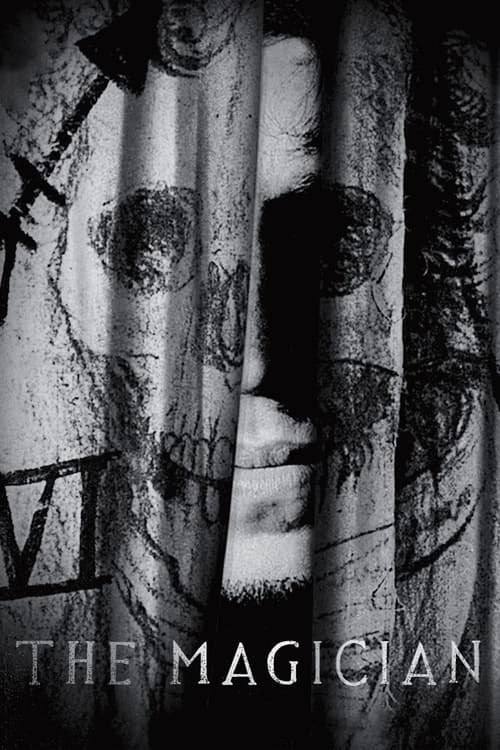
The Magician
1958 · Ingmar Bergman
When you want a film to chew on for days — an atmospheric black-and-white puzzle for a quiet, attentive night. Challenge over comfort, but a playful challenge.
What it's about
A traveling mesmerist and his ragged troupe roll into a Swedish town in the 1840s, where the authorities refuse to let them perform until a coldly rational health officer can inspect the act for fraud. Over one long night and morning, showman and skeptic circle each other in a duel over what's real, what's trickery, and who holds the power in the room.
The experience
A slippery, candlelit game that keeps changing shape — eerie one scene, slyly funny the next, with an undertow of menace throughout. It works like a magic act itself: you're never quite sure whether you're being moved or being had.
Performances
Max von Sydow is mesmerizing as the mostly silent magician, doing enormous work with just his eyes and bearing, while Gunnar Björnstrand's icy rationalist makes a perfect adversary.
The craft
Bergman shifts fluently between gothic horror, dark comedy, and philosophical drama, and the shadowy black-and-white photography turns attics and parlors into haunted spaces. The candlelit imagery is gorgeous on a good screen — this is atmosphere as an instrument.
Why it matters
Initially a modest release, it was quickly recognized as one of Bergman's major works and won a top prize at Venice — the sharpest statement of his lifelong argument between faith, art, and reason.
Snapshot
A traveling mesmerist and his troupe arrive in a provincial Swedish town circa 1846, seeking official permission to perform. What follows over a single night and morning is a prolonged, escalating confrontation between Albert Emanuel Vogler—the magician—and Dr. Vergerus, a coldly rationalist medical officer determined to expose the act as fraud. Neither man fully wins. The Magician (Swedish: Ansiktet, "The Face") is Bergman's most explicitly self-reflexive film, a sustained meditation on the artist's relationship to his audience, to skeptical authority, and to his own uncertain power. It moves fluently between dark comedy, Gothic horror, and philosophical drama, ending on an ironic fanfare that refuses consolation. Commercially modest on initial release, it was quickly recognized as a major work and received the Special Jury Prize at the Venice Film Festival in 1958—adding to the international momentum Bergman had built with The Seventh Seal and Wild Strawberries in the preceding eighteen months.
Industry & production
By the time Ansiktet went before cameras in the summer of 1958, Bergman occupied a position unique in postwar European cinema: he was a prestige auteur whose films were commercially viable enough to be produced on reasonable budgets by Svensk Filmindustri, the Stockholm-based studio that had been his institutional home since the mid-1940s. The studio system at SF allowed Bergman a largely stable company of actors and technicians, an arrangement closer to a repertory theater than to Hollywood's freelance model. The Magician was shot at the Råsunda Studios outside Stockholm, predominantly on interior sets designed by P.A. Lundgren, whose meticulous evocation of bourgeois mid-nineteenth-century interiors gives the film much of its period claustrophobia.
Bergman wrote the script rapidly—reportedly in a few weeks—in the afterglow of the international breakthroughs of 1957. The screenplay was one of the more personally confessional he had written to that point: Vogler, the magician who is stripped naked before hostile authority and forced to perform for approval while concealing a wounded pride, is widely understood as a self-portrait. Bergman made no strong effort to deny the identification. The film was shot in roughly four weeks, a compressed schedule consistent with Bergman's practice of intensive, well-rehearsed production.
Technology
The Magician was shot in black and white on 35mm, the standard Bergman format of the 1950s. Anamorphic widescreen was available but not used; the film employs the Academy ratio (approximately 1.37:1), giving it a slightly boxed, pressurized frame appropriate to its interior settings. The studio-bound nature of most of the film allowed for precise, artificial lighting control—an advantage that cinematographer Gunnar Fischer exploited fully. There are no special photographic processes of note. The period-appropriate material culture (carriages, oil lamps, mid-Victorian costume) was a craft production achievement, the result of careful collaboration between Bergman, Lundgren, and costume designer Mago (Max Goldstein), who dressed the company throughout much of this period.
Technique
Cinematography
Gunnar Fischer, Bergman's primary cinematographer throughout the 1950s, lit The Magician with a severity and chiaroscuro that is more Caravagesque than the outdoor harshness he achieved in The Seventh Seal. The opening sequence—the troupe's wagon emerging from a dense, fog-filled forest at dawn—establishes an atmosphere of spectral ambiguity that the film never entirely dispels. Fischer uses the available darkness of the inn's interior to keep characters half-hidden; Vogler in particular is often framed with deep shadow masking his upper face, his eyes reduced to glints or blots. This is not merely atmosphere: it is characterization rendered through light, echoing the film's preoccupation with concealment and revelation.
The most celebrated sequence cinematographically is the extended attic scene in the film's final act, in which Vergerus examines what he believes to be Vogler's corpse and is subjected to a harrowing series of apparent supernatural attacks. Fischer and Bergman shoot this nearly in real time, the camera moving with the increasingly terrified Vergerus through cramped, low-lit spaces. The sequence functions as a technical demonstration of how close-quarters handheld movement—unusual for Fischer's generally more composed work—can generate physical dread. Eyes appear where they should not; a hand moves; the editing rhythm accelerates. It is the most viscerally frightening sequence Bergman had made to that point, and one of the most sustained exercises in cinematic horror in Swedish film history.
Editing
Oscar Rosander, Bergman's longtime editor through much of this decade, cuts the film with a precision that matches its theatrical structure. The film divides roughly into acts—arrival, examination, performance, aftermath—and Rosander maintains a slow-burn pacing in the first two thirds before the attic sequence demands rapid intercutting. There is nothing formally experimental about the editing by the standards of 1958 European cinema; Bergman and Rosander were not interested in the jump-cut ruptures of the French New Wave, which was only just beginning. The film's formal control is conservative and deliberate, an editing style that trusts performance and mise-en-scène over montage to carry meaning.
Mise-en-scène / staging
Bergman's staging in The Magician reflects his theatrical background more nakedly than almost any other film in his canon. Much of the film unfolds as a series of confrontations in enclosed rooms, often with characters arranged in the kind of spatial geometry—faces angled toward and away from each other, bodies blocking exits—that characterizes proscenium dramaturgy. The troupe's wagon, the examination salon, the dining room, the attic: each space has a defined geometry that Bergman exploits for power dynamics. When Vergerus forces Vogler to unmask, the spatial humiliation is choreographed with the care of a stage director.
The decision to dress Manda Vogler (Ingrid Thulin) as a male assistant for the troupe's public identity adds a layer of disguise-within-disguise that Bergman stages as a series of partial revelations—the audience at multiple points knows what other characters do not, a classical dramatic irony deployed in a context of sustained uncertainty about what is real.
Sound
Erik Nordgren's score is restrained and used sparingly—Bergman was already moving toward the more interior, chamber-music approach that would define his 1960s films. The silence during the attic sequence is especially effective, broken only by ambient sound and the creak of floorboards. Diegetic sound—the wind outside the inn, the creak of the carriage—is given unusual weight throughout, a technique that grounds the Gothic atmosphere in the material world even as the narrative unsettles that grounding. The film predates Bergman's intensive collaboration with composer Käbi Laretei and others; Nordgren's contributions here are functional and intelligent without being transformative.
Performance
The ensemble is among the strongest Bergman assembled during any single production. Max von Sydow, still early in his collaboration with Bergman (having played the Knight in The Seventh Seal the previous year), performs Vogler as a sustained exercise in enforced silence and barely suppressed fury. Vogler speaks very little for the first half of the film, communicating almost entirely through physical presence and stillness. The choice to play the character as near-mute for so long is both a theatrical gamble and a thematic statement: the artist who refuses to articulate his defense is the artist at his most exposed. When Vogler does finally speak, in his own person rather than performance, the effect is unsettling.
Gunnar Björnstrand, as Dr. Vergerus, is Sydow's perfect antagonist—charming, precise, genuinely intelligent, and ultimately more frightened than he allows himself to know. Bergman gives Vergerus enough complexity that he cannot simply be the villain; he is a man who needs the magician to be a fraud and is disturbed to discover that his certainty is shakeable. Ingrid Thulin brings an androgynous severity to Manda; Naima Wifstrand, playing Vogler's ancient and apparently witch-like grandmother, embodies the folk-magic substrate that haunts the rationalist surface of the story.
Narrative & dramatic mode
The Magician is structured as a Socratic duel in Gothic wrapping. Its dramatic mode is what might be called a comedy of intellectual humiliation that tilts repeatedly toward horror. The confrontation between Vogler and Vergerus is the spine: two men who represent irreconcilable epistemologies—the irrational/artistic and the rational/scientific—testing each other to destruction. Neither is unambiguously right. The film's tone is consistently ambivalent, its ending—a royal summons arrives for Vogler to perform at court, rescuing him at the last possible moment—legible as either triumph or further subjugation. The artist survives, but only because power has found a use for him.
The narrative also sustains a subplot among the troupe's lower ranks and the inn's servants that functions as a comic counterpoint, grounding the philosophical combat in bodily appetite and practical survival. This double register—high and low, metaphysical and farcical—is characteristic of Bergman's dramaturgy in the late 1950s.
Genre & cycle
The Magician sits at the intersection of the theatrical comedy of manners (the provincial bourgeois household confronting unsettling outsiders), the Gothic tale (the traveling conjuror, the automaton, the horror in the attic), and the artist-drama. Its affinities with German Romanticism—specifically the tales of E.T.A. Hoffmann, with their mechanical dolls, mesmerists, and double identities—are unmistakable, and Bergman was certainly familiar with this literary tradition. The Faust archetype resonates throughout: the magician who has made a bargain, the question of whether his powers are real or theatrical.
The film belongs to the cycle of 1950s Bergman films organized around questions of faith, doubt, and the supernatural—a loosely grouped set that includes The Seventh Seal, Wild Strawberries, and anticipates the formal chamber plays of the early 1960s (Through a Glass Darkly, Winter Light, The Silence). The Magician is the most theatrical and generically impure member of this group; it is also the most explicitly about the artist's position, which gives it a different valence from the others.
Authorship & method
Ingmar Bergman (1918–2007) wrote, directed, and conceived The Magician as a deliberate personal allegory. His method at this stage was highly controlled: he rehearsed his actors extensively before shooting, often for periods that contemporary directors would consider luxurious, and expected a precision of gesture and expression that reflected his theatrical training. He was simultaneously artistic director of the Royal Dramatic Theatre in Stockholm during this period, moving between stage and screen with unusual fluency. His scripts were complete blueprints, not frameworks for improvisation.
Gunnar Fischer (1910–2011) had been Bergman's cinematographer since the late 1940s and brought a deep understanding of how to light for theatrical effect while maintaining photographic credibility. The Magician was among the last of their major collaborations; Sven Nykvist would begin taking over as primary cinematographer on The Virgin Spring (1960) and assume full partnership from Through a Glass Darkly (1961) onward.
Erik Nordgren (1913–1992) served as composer on several Bergman films of the 1950s and contributed a restrained, period-inflected score. His work here, as elsewhere with Bergman, supports rather than amplifies.
Oscar Rosander had been editing Bergman's films since the 1940s and was deeply embedded in the collaborative structure of Svensk Filmindustri. His editing sensibility—sober, structurally clear—suited Bergman's theatrical model of filmmaking.
Movement / national cinema
The Magician is a central work in the Swedish art cinema of the postwar era, the tradition that made Bergman the most internationally visible Scandinavian cultural figure of his generation. Swedish cinema had a distinguished silent-era tradition (Sjöström, Stiller) that Bergman was consciously inheriting and transforming. Svensk Filmindustri's institutional stability allowed Swedish directors a continuity of production largely absent from, say, Italian or French cinema, where funding crises were more chronic. Bergman's dominance of Swedish prestige cinema in the 1950s was so complete that it is difficult to discuss the national cinema of the period without his shadow falling across it.
The film also needs to be situated within the emerging international art-cinema circuit of the late 1950s, centered on film festivals (Venice, Cannes, Berlin), art-house distributors in France, the United Kingdom, and the United States, and a growing critical discourse in publications such as Cahiers du Cinéma and Sight & Sound. The Venice Special Jury Prize positioned The Magician within this network at exactly the moment when Bergman's reputation was consolidating internationally.
Era / period
The film was released in December 1958, in the final years of the decade that established European art cinema as a serious commercial and critical category. The French New Wave was months from its first major works. Italian genre cinema was at its height. American cinema was grappling with the breakdown of the studio system and the Production Code. In this context, Bergman's formally austere, philosophically ambitious, and sexually frank (by the standards of the time) films represented one pole of what serious cinema could be. The Magician arrived at the peak of this cultural moment, its baroque interiority and Gothic irony contrasting with but not oblivious to what was happening elsewhere in European filmmaking.
Themes
The film's core preoccupation is the artist's relationship to power and skepticism. Vogler cannot simply perform: he must submit to examination, justify his existence, prove he is not merely a fraud. That the magician's "powers" are shown to be a mixture of genuine psychological manipulation, theatrical trickery, and—in the attic sequence—something the film deliberately refuses to explain is Bergman's most sustained statement about the irreducibility of art to rational analysis. Vergerus can dissect the apparatus but cannot account for the experience it produces.
Closely related is the theme of identity as performance. Manda performs as a man; Vogler performs as a mute mystic; the grandmother performs as an ancient crone. The troupe's entire existence is structured around the maintenance of personas that diverge from whatever truth lies beneath. The film asks whether there is a truth beneath, or whether the performance is the self.
Faith and its erosion are present as they are throughout Bergman's late-1950s work, but here displaced into aesthetic rather than theological terms. The question is not whether God exists but whether art—the magician's art, the filmmaker's art—can reach across the gap between performer and audience and produce something real. The answer the film offers is deliberately incomplete.
Finally, The Magician is about humiliation and survival. Vogler is subjected to public stripping of his mystique, forced to eat below the salt, denied his dignity. He endures. The ending's ambiguous rescue is less a triumph than a confirmation that the artist must always depend on some form of patronage that will perpetually reduce him—and that he will continue anyway.
Reception, canon & influence
Critical reception. The film received strong notices in Sweden and consolidated Bergman's standing at Venice, where the Special Jury Prize recognized the formal rigor and intellectual ambition that had come to define his international image. Some contemporary critics found the film more willfully obscure than Wild Strawberries, less mythically resonant than The Seventh Seal; others considered its generic hybridity a weakness. Over subsequent decades, critical opinion has generally moved in the direction of regarding it as one of Bergman's most durable achievements—precisely because of, rather than despite, its self-reflexive complexity. It appears regularly on canonical lists of Bergman's essential works, typically in the company of Persona, The Seventh Seal, and Autumn Sonata.
Influences on the film. The literary debts are clear: E.T.A. Hoffmann's tradition of the automaton, the mesmerist, and the uncanny double runs beneath the narrative. The theatrical tradition of the strolling players—from commedia dell'arte through Molière to the nineteenth-century traveling troupe—provides the social context. Bergman's own anxious relationship with audiences and critics, extensively documented in his later memoir The Magic Lantern (1987), was evidently the emotional source. The film's debt to Carl Theodor Dreyer, particularly the use of the face as a site of revelation and concealment, is legible though not documented as direct influence. Some scholars have noted resonances with Georges Méliès's early cinema—the stage magician as prototype filmmaker—as a buried reference point.
Legacy. The Magician's most direct and widely acknowledged influence is on the discourse of cinema's self-understanding. The identification of the filmmaker with the magician—the one who creates illusions, who is simultaneously exposed and protected by the apparatus—became a recurring trope in film theory and in filmmakers' self-presentations in subsequent decades. Federico Fellini's 8½ (1963) works a cognate territory by different means (both films concern the artist as figure of crisis, though Fellini approaches it with warmth where Bergman approaches it with Gothic severity).
Woody Allen, who has cited Bergman as his most important cinematic influence, drew explicitly on The Magician's concerns in Stardust Memories (1980) and returned to the magician figure more directly in Magic in the Moonlight (2014). Andrei Tarkovsky, who named Bergman alongside Bach and Leonardo as figures of primary importance to him, absorbed the film's interest in the artist's suffering and survival into his own work.
The attic horror sequence has a separate afterlife in discussions of horror cinema, occasionally cited as an example of how non-genre filmmakers can produce more effective fear than genre specialists when they understand that dread arises from disrupted rationalism rather than from spectacle. Whether this influence was felt concretely by horror filmmakers of subsequent decades is difficult to document, but the sequence's reputation within serious film circles has been consistent.
The Magician does not have the immediate iconic legibility of The Seventh Seal—there is no image from it as culturally portable as the chess game with Death—but it has proved more generative for filmmakers and theorists interested in what it means to make art in the face of a hostile, demanding audience. In that sense it is Bergman's most enduring professional statement, the one that most directly asks what the magician is doing when the lights go up.
A Deleuzian reading
Start with the face, because Bergman did.
The full Deleuzian reading of The Magician →
Reception
Arriving right after The Seventh Seal and Wild Strawberries, it initially struck many critics as a puzzling, tonally lumpy detour — gothic chiller one minute, drawing-room comedy the next — but it's since been reappraised (helped by a Criterion release) as Bergman's sly, personal statement on the artist as charlatan.
How The Magician was received, from release to now →
Influences: the films it descends from and the films it influenced
- The Cabinet of Dr. Caligari (1920) — Provides the structural prototype for the mesmerist-performer dyad: just as Caligari commands the dissociated somnambulist Cesare, Vogler operates through the mute Aman/Grima with the controller-controlled boundary deliberately unstable, and the traveling show that disrupts bourgeois order is the direct generic and structural model Bergman inherits.
- Nosferatu (1922) — Murnau's Expressionist grammar of shadow as active moral substance — darkness that adheres to figures as psychological weight rather than mere atmosphere — is the specific lineage from which Gunnar Fischer draws the deep-black chiaroscuro defining The Magician's interior scenes.
- The Passion of Joan of Arc (1928) — Dreyer's innovation of the sustained extreme close-up as philosophical instrument — the face under institutional interrogation as the site where concealment and revelation fight for precedence — directly informs the Vergerus-Vogler confrontations, where Vogler's silence answers Vergerus's rationalist scrutiny in a sustained battle of faces.
- Vampyr (1932) — Dreyer's method of building Gothic dread through diffused, sourceless light and spatially disorienting mise-en-scène — fear accumulated through visual texture rather than monstrous spectacle — is the specific model for the attic horror sequence, where irrationality erupts into rationalist space without any overt supernatural image.
- Day of Wrath (1943) — Dreyer's staging of the inquisition as slow theatrical performance — where institutional power operates as formal ritual and both accuser and accused perform scripted roles — directly informs the Socratic structure of Vergerus's examination of Vogler: the interrogation as theater in which neither party fully controls the stakes.
- A Lesson in Love (1954) — Extends the Björnstrand archetype developed across the marital comedies — the professional male whose self-regard is methodically dismantled by a formidable antagonist in a confined setting — now through theatrical imposture rather than marital sparring, retaining the threshold-blocking and interior staging.
- 8½ (1963) — Extends The Magician's artist-as-illusionist premise into full self-portrait: the filmmaker simultaneously exposed and protected by his apparatus of illusion, in existential crisis before his audience; Fellini replaces Bergman's Gothic severity with carnivalesque excess but inherits the double-register of imagination and reality as the structural device through which the artist-drama is organized.
- The Silence (1963) — Takes the enforced silence of Aman/Grima — silence as withheld power, disguise, and weapon — and elevates it to structural principle: dialogue is reduced to a minimum and the sound design carries the weight of dread, directly extending The Magician's silence-as-horror facet into an entire film's formal architecture.
- Persona (1966) — The logical culmination of The Magician's disguise-within-disguise and enforced silence: Elisabet's vow of silence and the subsequent identity dissolution between two women extend Aman/Grima's gender masquerade to its limit, while the film-apparatus self-consciousness — the reel burning, the splice — makes explicit what The Magician's magician-as-filmmaker allegory had left as subtext.
- Hour of the Wolf (1968) — Returns to The Magician's Gothic horror of the creative artist under audience pressure, narrated from inside the psyche: the somnambulist-like apparitions haunting the painter Borg echo Aman/Grima's uncanny presence, and the traveling menagerie of aristocratic tormentors reprises the hostile reception scenario of The Magician's bourgeois officials as existential persecution.
- The Mirror (1975) — Tarkovsky, who named Bergman among his primary formal influences, absorbs The Magician's fragmented double-register structure and artist-self-portrait mode: personal memory and historical reality occupy the same ontological plane, and the slow-burn pacing and silence-as-weight Bergman developed are the formal inheritance Tarkovsky reworks into his own temporal grammar.
- Stardust Memories (1980) — Allen, who drew explicitly on The Magician's concerns, translates its core scenario into a neurotic-comic register: the filmmaker besieged by audience and critics while interrogating his own artistic worth, the Socratic duel in which evaluators hold institutional power the artist cannot override, and the double-register of performance and sincerity are all direct transpositions from Bergman's Gothic mode.
- Fanny and Alexander (1982) — Crystallizes The Magician's traveling theatrical company into its fullest Bergman expression: the Ekdahl troupe's proscenium-spatial-geometry, the double register of theatrical artifice and domestic reality, and the Gothic horror of the Bishop's household — where irrationalism shatters a rationalist authority structure — all descend directly from The Magician's formal and thematic architecture.
- The Seventh Seal (1957) — Shares cinematographer Gunnar Fischer, several cast members, and the Socratic duel as structural motor — the chess game with Death is the prototype for the Vogler-Vergerus confrontation — while the traveling company as social microcosm subject to existential scrutiny is the shared narrative architecture from which both films derive their form.
- Wild Strawberries (1957) — Made simultaneously with The Magician, shares the double-register mode — a protagonist who inhabits present tense and a dream-vision of self-examination simultaneously — and functions as a covert Bergman self-portrait, but in a realist-melancholic key where The Magician deploys Gothic theatrical artifice for the same interior project.
- Pickpocket (1959) — A near-contemporary that reaches analogous formal conclusions by independent means: Bresson's performer who cannot authentically communicate, the institutional interrogation as spiritual duel, and the reduction of gesture to minimum necessary expressiveness parallel Bergman's enforced-silence and face-as-concealment experiments without any documented influence in either direction.
- The Devil's Eye (1960) — Gunnar Fischer's chiaroscuro studio lighting applied to a systematic investigation of theatrical self-consciousness — performance versus reality as both subject and formal method — made two years prior, the two films jointly constitute Bergman's pre-Chamber Trilogy examination of illusionist artifice.
Similar films
- Hour of the Wolf (1968) — influence & lineage
- The Seventh Seal (1957) — influence & lineage
- The Cabinet of Dr. Caligari (1920) — influence & lineage
- Fanny and Alexander (1982) — influence & lineage
- Persona (1966) — influence & lineage
- The Silence (1963) — influence & lineage
- Wild Strawberries (1957) — influence & lineage
- Häxan (1922) — same viewing thread
All the films related to The Magician →
Watch it with: curated runs of related films
- Fever-Dream Horror — Watch these when you want horror that runs on dream logic — witches, circuses, crematoria and occult dread rendered as hand-crafted, hallucinatory nightmare rather than jump-scare.