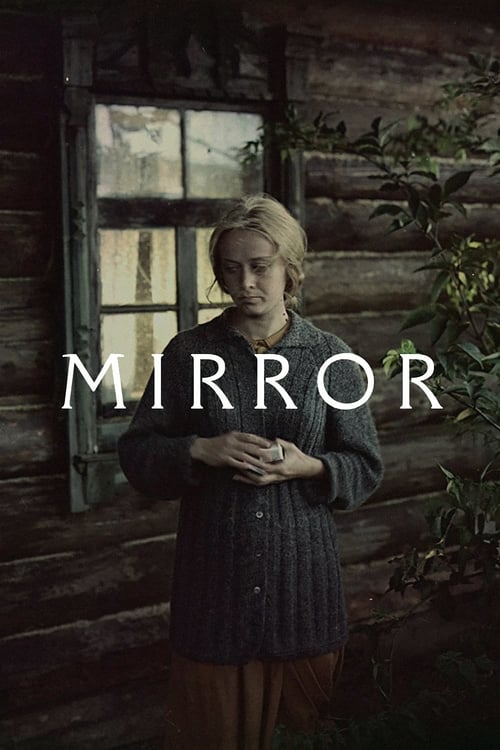
Mirror
1975 · Andrei Tarkovsky
For when you want a film to wash over you and stay for days — late night, phone off, no interruptions. This is challenge-viewing of the most rewarding kind: confusing on first contact, then suddenly, personally yours.
What it's about
A man in his forties, dying and unseen, lets his life pour out in fragments: a windswept childhood in the Russian countryside with his mother, the wartime evacuations, his own failing marriage, and newsreel images of the century's catastrophes drifting through it all. The same actress plays his mother and his wife, because in memory the two have fused. Less a plot than a consciousness — one man's attempt to make peace with everything he can't get back.
The experience
Hypnotic and dreamlike, moving to the logic of memory rather than story — images of wind moving through a field, rain indoors, a house in the woods that feel less watched than remembered. It asks for surrender rather than attention, and it can leave you quietly wrecked without your being able to say exactly why.
Performances
Margarita Terekhova, playing both the narrator's mother and his wife, gives an extraordinary double performance — luminous, guarded, and wounded — that makes the film's central confusion of the two women feel true rather than clever.
The craft
Some of the most beautiful images ever put on film: sequences slide between color, black-and-white, and sepia, dreams bleed into documentary footage, and single unbroken shots — wind crossing a field, a burning barn in the rain — carry the force of whole scenes. Poems read on the soundtrack, written and spoken by the director's own father, bind the fragments together. Demands the biggest, darkest screen you can find.
Why it matters
Baffling to Soviet authorities and rationed to few screens on release, it became one of the most revered films ever made, regularly near the top of all-time polls, and the touchstone for filmmakers trying to put memory itself on screen.
Snapshot
Tarkovsky's fourth feature film is the most nakedly personal work of his career and one of the most formally radical films ever made. Assembled from interlocking memory, dream, and documentary archival footage, Mirror refuses to separate private autobiography from collective Soviet history. A dying man — Alexei, the unseen narrator — drifts across three temporal registers: his own mid-century Russian childhood, his failing marriage in the present, and documentary images of catastrophes that scarred the century. His mother and his wife are played by the same actress, making visible the unconscious conflation of the two central women in a man's life. The film circulates around loss, guilt, and the impossibility of fully recovering the past — which is to say, it is about the same subject as memory itself.
Industry & production
Mirror was produced at Mosfilm, the dominant Soviet studio, under the supervision of Soviet state cinema bureaucracy Goskino. Its path through that system was fraught. Tarkovsky had been working toward an autobiographical film for years — provisional titles included Confession and White, White Day — and he submitted multiple screenplay drafts, co-written with writer Aleksandr Misharin, before receiving conditional approval. Goskino officials found the material formally impenetrable and ideologically insufficient: a private, introspective film about one man's memories offered no clear uplift or social utility by the criteria of Soviet cultural administration.
The film was shot across 1973–74 and released in early 1975 with a restricted third-category distribution, limiting its number of prints and the venues in which it could be shown. In a cinema system where first-category releases received mass distribution and advertising support, a third-category classification was effectively a form of suppression without outright banning. The film was not formally censored, but it was marginalized. Tarkovsky was stung by this treatment and deeply attentive to audience response: he reportedly collected and read letters from ordinary viewers, many of whom described a powerful sense of recognition in the film's rendering of private memory. This feedback — from viewers who found the film emotionally legible precisely where official culture found it obscure — became important to how Tarkovsky understood the film's purpose and its audience.
Internationally, Mirror circulated on the European art cinema circuit in the mid-to-late 1970s, where it was recognized as a singular achievement by critics and fellow filmmakers even as its Soviet domestic fate remained diminished.
Technology
The film was shot on 35mm, using Soviet Sovcolor film stock alongside standard black-and-white negative for sequences set in memory and dream. Archival documentary material — newsreel footage of the Spanish Civil War, Soviet troops crossing Lake Sivash during World War II, the Chinese-Soviet border conflict at Damansky Island, and footage relating to the atomic age — was incorporated directly, shifting aspect ratio and grain texture in ways that are visible and intentional. Tarkovsky does not smooth the seams between registers; the textural shift between the grainy archive and the luminous color photography of the present-day sequences is part of the film's argument about the different weights of personal and historical time.
Technique
Cinematography
Georgy Rerberg served as director of photography. His collaboration with Tarkovsky produced imagery of extraordinary sensory richness. The film's color sequences have a particular quality of refracted natural light — interiors are lit by windows and candles, rendering faces in chiaroscuro that recalls both Rembrandt and the photographic tradition of Soviet lyric cinema. The black-and-white sequences, primarily those of Alexei's childhood in a rural dacha during the late 1930s and the war years, carry a different emotional temperature: cooler, more diffuse, with a documentary immediacy that distinguishes memory from dream. Camera movement in Mirror is characteristically slow and lateral, with long takes that allow time and space to breathe. The famous shot of the mother levitating in a dream sequence — a single, unbroken image — is achieved through a combination of practical staging and the camera's patient, unflinching gaze that refuses to editorialize.
Fire, wind, water, and rain are constant presences in the frame: the burning barn, the rain falling through a ruined ceiling, the fog lifting off a field. These elemental phenomena are not decorative; Tarkovsky consistently staged his most emotionally charged material in proximity to unstable natural forces, as if time itself were made visible in their movement.
Editing
Lyudmila Feiginova edited the film in close collaboration with Tarkovsky. The editing logic is associative rather than narrative: sequences connect through rhyme, emotional resonance, or material echo — a texture, a color, a gesture — rather than through story causality. Time is not arranged chronologically but psychologically, following the drift of a dying man's consciousness. This created significant difficulties with Goskino, whose script readers could not map the film's structure onto conventional story breakdowns. The editing is, in effect, the film's primary formal argument: the cuts enact what the film is about, which is the involuntary, non-linear quality of memory and the way the past erupts into the present without warning.
Mise-en-scène / staging
The domestic spaces of Mirror — the dacha, the apartment, the long corridor — are rendered with a palpable material weight. Objects and settings recur across temporal registers, sometimes almost identically staged, so that the viewer gradually understands that the space of childhood and the space of the present are versions of the same psychological location. The casting of Margarita Terekhova in the dual role of mother (Masha) and wife (Natalia) is the single most important staging decision in the film: because the same face appears across different time periods, the visual system of the film enacts the unconscious logic by which we project the image of one loved person onto another.
Sound
The sound design of Mirror is among the most sophisticated in Tarkovsky's body of work. The voice of the adult Alexei is heard but his face is never shown; he exists as a presence in time rather than a body in space. The poetry of Arseny Tarkovsky — the director's father, a major Russian lyric poet — is read on the soundtrack in Arseny's own voice, giving the film a second authorial register: the son's images and the father's words in superimposition. The musical score draws extensively on Western classical tradition, including Bach and Purcell, alongside original music; the juxtaposition of Russian autobiographical material with German baroque and English baroque composition is one of the film's most quietly radical gestures. Wind and silence are deployed as structural elements; the film frequently withdraws from music altogether, leaving only ambient natural sound.
Performance
Margarita Terekhova's dual performance is one of the great achievements of Soviet screen acting. Without the anchor of a single defined character, she creates an emotional continuity across the two roles through physical carriage and a quality of fierce, contained anxiety that belongs to both Masha and Natalia. The child actors — Filipp Yankovsky as the young Alexei, Ignat Danilovsky as Alexei's son Ignat — are directed with the naturalism Tarkovsky prized, observed rather than instructed. Tarkovsky's practice was generally to work with performers over extended preparation periods, and to favour long takes that allowed behavior to accumulate organically within a scene rather than cutting between performed moments.
Narrative & dramatic mode
Mirror operates in a lyric mode. It has no traditional plot — no problem posed and resolved, no arc of character development in the conventional sense. Instead it proceeds by accumulation and return: images, voices, and emotional states are introduced, abandoned, and revisited in altered form. The film is structured around three temporal strands — the narrator's pre-war and wartime childhood; his adult present, including his relationship with his son; and a separate strand involving a woman at a printing press during the war years, whose connection to the narrator's family is gradually clarified — but these strands are woven together rather than sequenced. The documentary footage irrupts into the personal material without transition, insisting on the continuity between private experience and historical catastrophe. The film's mode is confessional and elegiac: it speaks from the position of someone who knows they are dying and who has not resolved what their life meant.
Genre & cycle
Mirror occupies a distinct position within the tradition of European autobiographical art cinema that developed across the 1960s and 1970s, a cycle that includes Bergman's Wild Strawberries (1957) and Persona (1966), Fellini's 8½ (1963), and Alain Resnais's explorations of memory and time. Within Soviet and Russian cinema, it stands in relation to the poetic tradition associated with Alexander Dovzhenko — lyric, image-driven, rooted in landscape and elemental experience. It is not a memoir film in the conventional documentary sense, nor a fiction film in the narrative sense; it occupies its own formal category that has been described variously as lyric cinema, the film-poem, and the cinema of memory.
Authorship & method
Tarkovsky's authorship of Mirror is unusually direct even by the standards of auteur cinema: the film is drawn from his own childhood, his relationship with his father's poetry, and his experience of marriage and fatherhood. The screenplay co-written with Misharin underwent extensive revision, but the emotional architecture of the film — the conflation of mother and wife, the absent father, the guilt of the narrator — is continuous with Tarkovsky's stated autobiographical concerns. His method on set was intensive and deliberate; shot ratios on his productions were reportedly high by Soviet studio standards, reflecting his willingness to wait for the right conditions of light, performance, and atmosphere. Rerberg's cinematography was an essential collaborator in establishing the visual grammar of the film, and the working relationship between director and DoP was by most accounts close and mutually exacting, though Tarkovsky and Rerberg did not collaborate after Mirror. Arseny Tarkovsky's contribution — the poems, read in his own voice — gives the film an unusual quality of generational dialogue: the son making a film in which the father's words are the only text.
Movement / national cinema
Mirror is a product of Soviet cinema during the Brezhnev period of political stagnation, a time when the relative artistic openness of the Khrushchev Thaw had contracted. Tarkovsky is the preeminent figure of Soviet art cinema — a tradition that runs from Eisenstein and Dovzhenko through the post-war generation — but his work sits uneasily within Soviet ideological frameworks. His interest in spiritual experience, private consciousness, and formal experiment placed him in recurring tension with Goskino throughout his career. Mirror is his most thoroughgoing confrontation of official Soviet cinema's demand for collective, historically legible narratives with the claims of private memory and lyric form.
Era / period
The film belongs to the high period of European modernist art cinema — roughly 1960 to 1980 — in which formal experiment with narrative, time, and subjectivity was embraced across multiple national cinemas. It also speaks to the specific Soviet experience of historical trauma, bearing within it the weight of collectivisation, World War II, and Stalinist repression as background presences in the narrator's childhood world. The era of its production — mid-1970s Soviet stagnation — is visible in the film's sense of accumulated loss and retrospective reckoning.
Themes
The central preoccupations of Mirror are memory, time, guilt, and the inadequacy of the self to its own experience. The narrator cannot resolve his feelings about his mother, his father's absence, his failed marriage, or his son's distance from him; the film does not offer resolution but rather the experience of consciousness circling these unresolved materials. The conflation of mother and wife through Terekhova's casting makes visible Tarkovsky's interest in the way early attachment shapes adult desire and perception. The documentary footage introduces a second thematic register: the relationship between private suffering and historical catastrophe, the question of what it means to be a person inside a history of mass violence. The mirror of the title operates multiply: as the reflective surface of memory, as the visual doubling of mother and wife, and as an implied address to the viewer — the film presents not one man's memories but a structure of recollection recognizable as one's own.
Reception, canon & influence
Backward: influences on the film. The shadow of Ingmar Bergman is present throughout — specifically the Bergman of Wild Strawberries and Persona, in the use of faces as landscapes of consciousness and in the representation of time as layered rather than sequential. Dovzhenko's lyric Soviet tradition is an enabling precedent for Tarkovsky's fusion of landscape and emotion. Bresson's asceticism — the withholding of conventional dramatic affect in favour of sensory attention — informs Tarkovsky's direction of performance. The Russian literary tradition, and specifically the lyric poetry of his father, provides the film's verbal texture and its sense of language as a carrier of time.
Reception. The Soviet critical and official reception was hostile or indifferent. Domestic distribution was suppressed at the third-category level. Among Soviet viewers who did see the film, the response was apparently polarized: some found it inaccessible; others, according to accounts Tarkovsky himself referenced, wrote to him describing an experience of profound personal recognition. International critical reception in the late 1970s was considerably more sympathetic, particularly in France and West Germany, where Tarkovsky's reputation as a major filmmaker had been established by Andrei Rublev (1966/1971) and Solaris (1972).
Forward: influence. Mirror became, in the decades following its release, a touchstone for filmmakers working with autobiography, memory, and non-linear form. Terrence Malick's The Tree of Life (2011) is the most frequently cited descendant, sharing Mirror's juxtaposition of childhood memory, parental figures, and cosmological scale — though whether this represents direct influence or convergent formal discovery is a matter of critical discussion rather than documented record. Aleksandr Sokurov, who studied under Tarkovsky's influence at the VGIK, developed a comparable interest in duration, elemental imagery, and the weight of Russian history. More broadly, Mirror established a formal permission: that a film could proceed entirely according to the logic of interiority, abandoning narrative causality for associative drift, and still constitute a work of rigorous artistic coherence.
In the 2022 Sight & Sound decennial poll of the greatest films ever made, Mirror ranked among the highest-placed films, confirming a critical consensus, decades in the making, that what Soviet distribution once suppressed as formally incoherent is among the supreme achievements of world cinema.
A Deleuzian reading
A woman sits on a wooden fence at the edge of a field, smoking, watching the road.
The full Deleuzian reading of Mirror →
Reception
Soviet film authorities were baffled — Goskino brass called it incomprehensible and elitist, gave it a limited release and no festival push. Half a century on it routinely lands in greatest-films-ever polls, with directors especially voting it near the top of Sight & Sound.
How Mirror was received, from release to now →
Influences: the films it descends from and the films it influenced
- Earth (1930) — Dovzhenko's elemental montage — wind-stirred grain, bodies in slow repose, rain arriving as epiphany — established the Soviet lyric cinema mode of image-as-feeling that Tarkovsky inherited as his formal baseline; the sustained, non-causal image sequences of pastoral and domestic space in Mirror are direct descendants of Dovzhenko's editing rhythm.
- Wild Strawberries (1957) — Bergman's structure of an aging man whose guilt-laden memories of past women erupt involuntarily into present consciousness — staged with the same photographic weight as the present and without narrative explanation — is Mirror's narrative architecture; the intrusion of a guilt-drenched past into a present journey is identical in both films.
- Hiroshima Mon Amour (1959) — Resnais's editing grammar of intercutting a private traumatic flashback with documentary footage of historical catastrophe — personal grief held against the ruins of Hiroshima — is the direct formal model for Mirror's juxtaposition of Alexei's childhood memories with archival newsreel of the Spanish Civil War and Lake Sivash.
- Last Year at Marienbad (1961) — Resnais's sustained lateral tracking shots through indeterminate domestic space as a figure for temporal ambiguity, and his refusal to adjudicate between memory and imagination, are absorbed into Mirror's own camera movement and narrative indeterminacy — both films deny the viewer a stable past/present distinction and make that denial their formal subject.
- Ivan's Childhood (1962) — Tarkovsky's debut established his own practice of intercutting dramatized wartime sequences with archival WWII documentary footage on mismatched film stocks, and of staging dream sequences with the same patient long-take camera as waking reality — both devices become structural pillars of Mirror a decade later.
- La Jetée (1962) — Marker's construction of a subjective past from still archival photographic images with offscreen voiceover narration established the use of documentary material as a memory-trace — the exact role that Soviet newsreel footage plays in Mirror's argument that personal and historical time are made of different substances.
- The Colour of Pomegranates (1969) — Paradjanov's biographical lyric film assembles the life of poet Sayat-Nova through symbolic tableau imagery and recited poetry rather than story causality — the exact formal mode Mirror applies to Tarkovsky's own autobiography; both films treat the lyric poem as the structural model for cinema rather than the dramatic scenario.
- The Magician (1958) — Tarkovsky, who named Bergman among his primary formal influences, absorbs The Magician's fragmented double-register structure and artist-self-portrait mode: personal memory and historical reality occupy the same ontological plane, and the slow-burn pacing and silence-as-weight Bergman developed are the formal inheritance Tarkovsky reworks into his own temporal grammar.
- Vampyr (1932) — Inherits the long, haunted duration and the slow camera drift through atmosphere-charged space, organizing the film by dream/memory logic rather than narrative sequence.
- Death in Venice (1971) — Tarkovsky's long held takes and flashback-interpolation of memory, where duration itself becomes meaning rather than plot delivery, advance the contemplative-mode Death in Venice validated.
- Sans Soleil (1983) — Marker extends Mirror's offscreen narrator device into a full epistolary structure — letters read aloud by an unnamed woman — deploying the same grammar of personal observation interlaced with documentary footage to track the erosion of memory across cultures and historical time.
- Wings of Desire (1987) — Wenders adopts Mirror's device of unseen observers reading inner thoughts as poetic voiceover, and incorporates archival black-and-white documentary footage of wartime Berlin into a color present — the same mixed-stock strategy Tarkovsky uses to differentiate temporal registers — making the divided city carry the same weight of private-versus-historical trauma.
- Distant Voices, Still Lives (1988) — Davies adopts Mirror's non-chronological memory structure, staging domestic trauma in static tableaux connected by emotional rhyme rather than story logic, and uses popular songs as temporal markers in the same way Tarkovsky uses Bach and Purcell — sound as the medium through which involuntary recall operates.
- The Long Day Closes (1992) — Davies's second memory film constructs a child's subjective experience of domesticity through sensory image sequences — natural light through windows, rain heard before seen, textures of wallpaper and fabric — rather than narrative events, extending Mirror's grammar of the lyric film-poem into a Liverpool working-class register.
- Uncle Boonmee Who Can Recall His Past Lives (2010) — Apichatpong extends Tarkovsky's staging principle — past and present coexisting in the same space with no ontological distinction and no editorial alarm — using patient long-takes and elemental environments (jungle canopy, firelight, cave water) as the medium through which temporal coexistence becomes sensory rather than conceptual.
- The Tree of Life (2011) — Malick directly extends Mirror's lyric film-poem structure — voiceover narration that evokes rather than explains, natural-light cinematography of childhood domestic space (Lubezki's work as Rerberg's inheritor), and associative temporal montage — integrating archival-scale cosmological imagery alongside private family memory in exact parallel to Tarkovsky's newsreel strategy.
- Roma (2018) — Cuarón embeds an intimate autobiographical domestic portrait within newsreel-scale historical events — political violence erupting into private life — shot in natural-light monochrome with a laterally drifting camera that refuses to separate personal and historical registers, transposing Mirror's structural argument into Mexican working-class autobiography.
- Resurrection (2025) — Durational memory-montage in which time is experienced rather than plotted models the metaphysical, non-causal logic binding Resurrection's episodes.
- The Ice Tower (2025) — Reflective doubling, the recurring motifs of water and cold, and a dilated, contemplative tempo that privileges sensory duration over plot.
- The Currents (2025) — Non-chronological 'flights of thought' structure threaded with wind-and-water ambient design as the very texture of memory — the recursive-editing model behind Killias's curling construction.
- Sound of Falling (2025) — The template for interleaving multiple generational timelines bound to a single rural house and landscape, joined by associative rather than causal cuts and threaded with hushed voiceover.
- Nostalgia (1983) — Tarkovsky and cinematographer Georgy Rerberg first develop the chromatic register-shift technique here — color for present, sepia and monochrome for memory — that Nostalgia directly transplants to partition Italian present from Russian recollection, establishing the chromatic-duality grammar as Tarkovsky's signature method for layering incompatible temporal states within a single film.
- Nostalghia (1983) — Tarkovsky transposes Mirror's long-take elemental staging — fire, water, and fog as temporal displacers — onto a Soviet exile in Italy; the single canonical shot of Gorchakov carrying a lit candle across a drained pool is the direct extension of Mirror's technique of achieving emotional weight through duration and spatial fact rather than editing.
- Dreams (1990) — Contemplative, unhurried long takes that compose dream and memory as painterly tableaux with diegetic-priority sound (wind, water, fire) doing the emotional work in place of score.
- The Seventh Continent (1989) — Shares the fragmentary, associative montage that withholds connective tissue, forcing the viewer to assemble meaning from elliptical domestic shards.
- Antichrist (2009) — The dedicatee of the film: its slow-motion, super-saturated reverie of wind, water and falling bodies in nature directly models Antichrist's monochrome prologue and the forest's animate, dream-logic landscape.
- Pain and Glory (2019) — Parallel innovation in autobiographical film-form: dissolving an ailing artist's present into non-chronological, sensory childhood memories of the mother, prioritizing associative image-logic over narrative causality.
- The Spirit of the Beehive (1973) — Shares the lyrical-associative construction of memory and warm, painterly natural light that dissolves plot into a chain of resonant childhood images.
- Eternity and a Day (1998) — Its associative, non-chronological drift and camera moves that slide from present into remembered space without a cut supply the lyric-associative, memory-saturated durational grammar of Eternity's flashbacks.
Similar films
- Ivan's Childhood (1962) — influence & lineage
- Sound of Falling (2025) — influence & lineage
- Hiroshima Mon Amour (1959) — influence & lineage
- Earth (1930) — influence & lineage
- Last Year at Marienbad (1961) — influence & lineage
- Uncle Boonmee Who Can Recall His Past Lives (2010) — influence & lineage · same viewing thread
- Andrei Rublev (1966) — same viewing thread
- The Sacrifice (1986) — same viewing thread
All the films related to Mirror →
Watch it with: curated runs of related films
- Transcendental Style — A run for when you want cinema as prayer — faith, ritual, and the turning of seasons rendered in long takes and painterly stillness, where time itself becomes the subject rather than the story.
Film essays and courses that include it
- What the Censor Invented: Forbidden Cinema from Stalin to Tehran
- Andrei Tarkovsky
- Radical Attention: A Century of Art Cinema
- Dialectics of the Soul: Russian Cinema from Eisenstein to Zvyagintsev
- The Grammar of Dreams: Cinema's Surreal Century
- The Architecture of Forgetting
- The Ones Who Stay to Watch: A Course in the Cinema of the Seer
- What Light Remains: The Impressionist Memory Film
- Sculpting in Time
- The Machine That Remembers