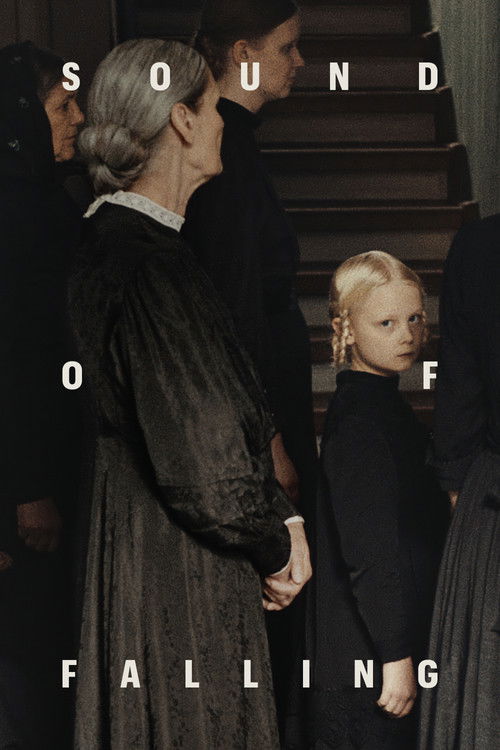
Sound of Falling
2025 · Mascha Schilinski
Sound of Falling's Cannes prize made her German cinema's new-formalist hope and a fixture in "the next European master" conversations of 2025.
When you want a film to chew on for days — something haunted, beautiful, and demanding that trusts you to feel the connections rather than have them explained. Firmly on the challenge end of the spectrum, and worth it.
What it's about
One farmhouse on a flat agricultural plain in eastern Germany, watched across roughly a hundred years through four adolescent girls who grow up there in different eras — the early 1900s, the war years, the East German decades, and today. Their lives never touch, but they rhyme: the same desires, the same dangers, the same secrets seeping through the same rooms. It's a family story told as a haunting, with the house as the thing that remembers.
The experience
Hypnotic and quietly unsettling — it drifts between decades on currents of sound and image rather than plot, and it gets under your skin slowly. Certain shots and sounds will still be with you days later; it leaves you unnerved in a way that's hard to name and hard to shake.
The craft
Schilinski builds the century out of echoes: non-linear editing that lets one era bleed into another, whispered voiceover, and a sound design so central it's in the title — this is a film to watch with good speakers or headphones. The camerawork keeps taking the girls' own vantage points, so the past feels seen from inside rather than reconstructed.
Why it matters
It shared the Jury Prize at Cannes 2025 and emerged as one of the most discussed films of the festival, vaulting Mascha Schilinski from the margins of German art cinema to the front rank of European directors.
Snapshot
Sound of Falling — released in German as In die Sonne schauen ("To Look Into the Sun") — is the second feature by German writer-director Mascha Schilinski, and the film that abruptly moved her from the margins of the German art-cinema scene to the front rank of European auteurs. Premiering in competition at the 2025 Cannes Film Festival, it shared the Jury Prize and emerged from the festival as one of the most discussed titles of the edition, topping or near-topping several of the critics' grids that circulate during Cannes. The premise is deceptively simple: a single farmhouse in the Altmark, a flat agricultural stretch of what is now Saxony-Anhalt in eastern Germany, observed across roughly a century through four adolescent girls — one in the early 1900s, one in the inter- and wartime years, one in the GDR era, and one in the present. The film declines to braid these strands into a conventional generational saga. Instead it treats the house, its bodies, and its recurring images — a missing limb, a held breath, a gaze met and returned — as a single resonating chamber in which time folds back on itself. The result is a work less interested in plot than in transmission: how trauma, desire, and the simple fact of being looked at pass through a place and its women across generations. Its closest critical reference points have been Tarkovsky, Reygadas, and the recent festival cinema of haptic, elliptical memory rather than anything in the German mainstream.
Industry & production
Sound of Falling is a German production, developed and financed through the country's regional-fund and public-broadcaster ecosystem that underwrites most ambitious German art cinema. As with the bulk of such films, the budget is modest by international standards, and the project's long gestation — Schilinski's first feature, Dark Blue Girl (Die blaue Mädchen / Dark Blue Girl, 2017), preceded it by some eight years — is itself a fact about the German funding model, in which directors without box-office leverage assemble support slowly across multiple bodies. The precise financing stack and budget figures are not something I can state with confidence, and I will not invent them; the relevant point is structural rather than numerical. The film was produced outside the orbit of the commercial German industry and conceived for the festival circuit from the outset.
Cannes selection in the main competition was the decisive industry event. Competition placement for a director's second feature is unusual and signals strong advocacy at the selection level; the Jury Prize that followed — an award shared, in the 2025 edition, with Oliver Laxe's Sirât — converted festival visibility into international distribution interest and positioned the film for the autumn art-house and awards season. Reports during and after the festival indicated that Germany selected Sound of Falling as its submission for the Academy Award for Best International Feature; I flag this as my recollection of the public record rather than something I can verify line-by-line here. What is clear is that the film traveled the standard route for a Cannes prize-winner: festival exposure first, specialized distribution second, with its commercial life subordinate to its critical one.
Technology
The film was shot digitally, in keeping with near-universal practice for German independent production at this budget level, and its images are built around naturalistic, often low and directional light — interiors lit as if by windows and lamps, exteriors keyed to the wide, pale skies of the north German plain. The most discussed technological-formal choice is the framing: the film works in a notably constricted, boxy aspect ratio rather than widescreen, a decision that presses the figures against the top and bottom of the frame and turns the farmhouse into a vertical, almost claustrophobic space. (I describe the effect with confidence; the exact ratio specification I would not want to state as a hard number without the technical credits in front of me.) This is a deliberate anti-spectacular use of the format — the boxy frame as a memory aperture rather than a window onto landscape. Beyond aspect ratio, the film's "technology" is largely a matter of restraint: available-light aesthetics, minimal visible apparatus, and a sound design (discussed below) that does more of the temporal and emotional work than any optical effect.
Technique
Cinematography
The cinematography, by Fabian Gamper, is the film's most immediately striking element and the engine of its reputation. Gamper's camera is tactile and proximate, favoring skin, hands, hair, the textures of wood and cloth and water, framed in close and often slightly off-kilter compositions that withhold the establishing geography a viewer expects. The lens treats the four time periods as a continuous visual field rather than color-coding them into distinct "looks"; period is signaled through costume, decor, and bodies rather than through a different photographic register, which is precisely how the film achieves its sense of times bleeding into one another. Light is low, directional, and frequently motivated by windows, giving interiors a painterly chiaroscuro. The recurrent motif of the gaze — characters looking directly toward the camera, or being caught looking — is constructed photographically, with eyelines that implicate the viewer in the act of watching these girls. Critics repeatedly reached for Tarkovsky and Carlos Reygadas as comparisons, and the reference is apt: the photography prizes duration, surface, and the charged everyday object over narrative legibility.
Editing
The editing is the film's structural argument. Rather than segregating the four eras into discrete blocks, the cutting interleaves them, rhyming a gesture in one period against an image in another so that the transitions feel associative and dreamlike rather than chronological. Match-cuts on movement, on water, on the body, and on the act of looking carry the viewer across decades without signposting. This elliptical, rhyme-driven assembly is what allows the film to propose its central idea — that the experiences of these girls are not merely parallel but somehow continuous — at the level of form rather than dialogue. I am not certain of the editor's screen credit and will not guess at a name; the technique, however, is unmistakably the product of editorial design as much as direction, and the film's roughly two-and-a-half-hour duration is shaped to accumulate resonance slowly rather than to drive toward incident.
Mise-en-scène / staging
The farmhouse is the film's organizing set and its protagonist. Schilinski stages almost everything within or immediately around it, treating its rooms, thresholds, stairs, and outbuildings as a fixed stage across which four sets of inhabitants pass. Furniture, walls, and agricultural implements persist or subtly mutate across periods, so that the space itself becomes the carrier of memory. Staging favors the partial and the glimpsed: bodies framed by doorways, action occurring at the edge of the frame or just out of view, children watching adults from thresholds. The recurring image of physical incompleteness — a missing or maimed limb is among the motifs that recur across the timelines — is staged as something half-seen and unexplained, a wound the film circles rather than narrates. The overall effect is of a haunted domestic interior in which the living and the dead, the past and the present, share the same rooms.
Sound
Sound is, by wide critical agreement, central rather than decorative — the title itself foregrounds it. The film builds a dense, often unsettling soundscape from breath, wind, water, animal and farm noise, and silence, using off-screen sound to suggest presences and events the image withholds. Sound bridges the eras as insistently as the cutting does, a noise begun in one period completing itself in another. Whispered and layered voice — interior, confessional, sometimes addressed directly to the listener — threads through the soundtrack as a connective tissue between the girls. I would not want to overstate the role of any conventional musical score; the film's aural identity rests more on designed, near-musical organization of concrete sound than on melody.
Performance
The performances are drawn primarily from young, in several cases non-professional or little-known actresses playing the four girls, and the film's emotional credibility depends on their unaffected physical presence rather than on dramatic set-pieces. Schilinski directs them toward stillness, watchfulness, and a charged blankness — faces that receive the camera's gaze and return it. Because the screenplay distributes its meaning across image and sound rather than dialogue, the acting is correspondingly interior and gestural. I am not confident enough in the specific cast attributions to name performers and roles here, and I decline to invent them; the salient critical point is that the ensemble of girls functions almost as a single distributed performance across time rather than as four separate star turns.
Narrative & dramatic mode
The film's dramatic mode is associative, elliptical, and non-linear — closer to a tone poem or a memory-structure than to conventional drama. There is no single protagonist and no resolved plot; instead there are four loosely sketched situations, each centered on a girl on the threshold of adolescence, that the film cross-cuts and rhymes until they read as variations on a shared condition. Causality is deliberately weakened: the viewer is invited to feel connections — of inheritance, of repetition, of trauma transmitted through a place — that the film never spells out as fact. This places Sound of Falling squarely in the lineage of "slow cinema" and the art-film memory mode, where mood, image, and duration carry the burden that plot carries in mainstream narrative. The drama, such as it is, lies in the accumulation of resonance and in the viewer's dawning sense that the house's history is a single recurring wound.
Genre & cycle
Nominally classed as drama (and, given the wartime strand, touched by the war film), Sound of Falling sits more accurately within the contemporary festival cycle of elliptical, place-bound, multi-generational memory films — works that use a single location across long stretches of time to meditate on inheritance and trauma. It belongs to a recognizable strain of recent European art cinema preoccupied with the haunting of landscape and house by history, and with childhood and female adolescence as sites where larger historical violence is registered obliquely. Within German cinema specifically, it reads as a refusal of both the heritage-drama mode of confronting the twentieth century through plotted history and the social-realist mode of the Berlin School; it metabolizes the German century through atmosphere and the body instead.
Authorship & method
The film is unambiguously an auteur work, authored by Mascha Schilinski as director and co-writer. Schilinski wrote the screenplay with Louise Peter, and the film's distinctive interlacing of four timelines is best understood as a writing-and-directing conception realized in collaboration with a small circle of key craftspeople. Fabian Gamper's cinematography is so integral to the film's effect that it is fair to call him a co-author of its sensibility — the proximate, tactile, gaze-conscious image is as much his signature as Schilinski's. The editing (whose credited author I will not guess at) is the other decisive contribution, since the film's meaning is constituted in the cut. On the music and composing credit I am genuinely uncertain and will not attribute it; what can be said is that the sound design carries more weight than any score, making the sound team central collaborators. Schilinski's method, on the evidence of the film and of the long gap since her debut Dark Blue Girl, appears to be one of slow development, formal precision, and a willingness to subordinate narrative clarity to sensory and associative coherence.
Movement / national cinema
Sound of Falling is a German film, but it does not sit comfortably within the dominant currents of recent German cinema. It is neither a Berlin School social-realist work nor a conventional historical heritage drama, the two modes that have largely defined Germany's art-house export profile in this century. Its affinities are transnational: the contemplative festival cinema associated with Tarkovsky's legacy, with Reygadas and the Mexican slow-cinema strain, and with a broader European art-film interest in haunted landscapes and the long durée of a single place. If it belongs to a movement, it is the loose international tendency of "slow" or sensory cinema rather than any national school. Its setting in the eastern German Altmark, and its traversal of the Imperial, Nazi, GDR, and post-reunification eras through one farmhouse, nonetheless make it a profoundly German engagement with the national past, conducted by atmospheric and bodily rather than expository means.
Era / period
The film is a product of the mid-2020s European festival landscape, and it engages a specific historical span: roughly the last hundred years of German history, from the early twentieth century through to the present, refracted through four adolescent girls. The four eras are evoked through costume, decor, and social texture rather than dated captions, and the film's project is precisely to dissolve the boundaries between them — to make the Imperial-era child and the present-day child inhabit the same continuous moment. As an artifact of its own moment, it reflects a contemporary art-cinema preoccupation with transgenerational trauma, with the unfinished reckoning of German and broadly European history, and with memory as something carried in places and bodies rather than archived in events.
Themes
The governing themes are the transmission of trauma across generations; the female body and female adolescence as the register on which historical violence is recorded; desire, shame, and sexual awakening observed at the threshold of childhood and adulthood; and, above all, the gaze — looking and being looked at, the violence and intimacy of the watched body, and the defiant return of the gaze. The motif of physical incompleteness or maiming threads through the timelines as a literalization of inherited wounding. Death and absence are constant, as the title's "falling" suggests, and the house functions as a thematic figure for memory itself — a structure in which the past is never past, only differently inhabited. The film insists that what happens to one girl, in one decade, is not finished with her: it persists, recurs, and reaches the next.
Reception, canon & influence
Critical reception at Cannes 2025 was strong and, in places, ecstatic; the film was among the most highly rated titles on the festival's critical grids and was widely described as a major discovery, with reviewers reaching for Tarkovsky and Reygadas to convey its register. The Jury Prize — shared with Sirât — ratified that enthusiasm at the institutional level and established Schilinski, on only her second feature, as a director of international consequence. Its reported selection as a national Oscar submission, which I note with appropriate caution, would mark a further step in its canonization.
The influences on the film run backward to the contemplative, sensory tradition of art cinema — Tarkovsky's image of memory and landscape, the haptic durational cinema of Reygadas and his peers, and a broader European lineage of haunted-house and haunted-land films. Its forward legacy is necessarily still unwritten so soon after release: it is too early to identify works it has shaped, and I will not pretend otherwise. What can be said is that its critical standing positions it as a likely reference point for subsequent festival cinema working in the multi-generational, place-bound memory mode, and as the film that announced Mascha Schilinski as a filmmaker whose future work will be watched closely. Its lasting place in the canon will depend on that future and on how the film weathers beyond the heat of its premiere — but its arrival was, by any measure, one of the events of the 2025 festival year.
A Deleuzian reading
A girl looks straight into the lens.
The full Deleuzian reading of Sound of Falling →
Reception
Declared a masterpiece within hours of its very first Cannes screening in May 2025, and the hype has actually held: a shared Jury Prize, a pile of year-end best-of placements, and Germany's Oscar entry within months. Barely a year old, it's already being talked about as the art film of the decade so far.
How Sound of Falling was received, from release to now →
How to watch Sound of Falling: what to notice on a first viewing
- Watch a girl look directly into the camera and hold it. All four girls, across a century, eventually turn and meet the lens the same way, an eyeline that keeps implicating you in the watching. You are not just observing these girls. The film keeps making you the one being looked at back.
- Notice a gesture in one era rhyme with an image in another. The editing interleaves the four timelines rather than blocking them off, matching movement, water, and looking across decades without ever announcing the jump. You stop being told when a scene happens and start feeling the decades bleed into one another.
- Watch the same rooms and stairs recur across all four girls. Furniture and farm implements persist or quietly change across the decades, so the house itself carries what happened in it forward. The house is not a backdrop. It is the one character who was there for all four girls.
- Listen for a sound that finishes in a different scene. Breath, wind, water, and farm noise carry across cuts and eras, built more like a musical structure than a conventional score. Sound does the work of connecting the girls that the plot never spells out in words.
- Watch the girls stay still and watchful instead of reacting. Schilinski directs a charged blankness rather than expressive drama, faces built to receive the camera's gaze more than to perform for it. Their stillness makes them witnesses to what happens around them rather than agents changing it.
The whole guide to watching Sound of Falling, with the keys for a rewatch →
Influences: the films it descends from and the films it influenced
- Mirror (1975) — The template for interleaving multiple generational timelines bound to a single rural house and landscape, joined by associative rather than causal cuts and threaded with hushed voiceover.
- The Spirit of the Beehive (1973) — Establishes the child's watchful stillness and direct-to-camera gaze, the non-professional young performer, and the haunted, honey-lit farmhouse as the unit of dread.
- Silent Light (2007) — Durational available-light interiors and landscapes shot with a non-professional rural community, where natural light dictates the chiaroscuro rather than fixtures.
- The White Ribbon (2009) — German place-bound transgenerational guilt rendered through austere monochrome chiaroscuro, watchful non-professional children, and meaning withheld off-screen.
- La Ciénaga (2001) — The model for concrete, layered off-screen sound design and partial, cropped framing of bodies pressed into a single decaying rural household.
- The Turin Horse (2011) — A single isolated farmhouse set sustained by slow-cinema duration and available-light chiaroscuro, the dwelling itself becoming the film's protagonist.
- Cries and Whispers (1972) — Whispered confessional voice and women's bodies arranged in proximate, candle-and-window-lit interiors of one house, time folding via memory inserts.
- Aftersun (2022) — Elliptical, associative editing that reassembles a haunted memory from glimpsed, partial fragments rather than a linear account.
- Petite Maman (2021) — Transgenerational memory collapsed across interleaved timelines anchored to one house and woods, played hushed by young non-star performers.
- The Tree of Life (2011) — Whispered interior voiceover married to tactile proximate handheld camera and associative match-cut editing that reconstructs childhood memory non-linearly.
- Ida (2013) — Boxy Academy-ratio compositions with available-light chiaroscuro used to excavate buried, place-bound historical trauma through stillness.
- Godland (2022) — 4:3 boxy aspect ratio and available-light landscape photography, time elapsing in the land and weather across a fixed rural site.
- The Zone of Interest (2023) — Concrete off-screen sound design carrying the film's real meaning beyond a fixed domestic house set, sound weighted above any score.
- The Witch (2015) — A single isolated farmstead lit by daylight and candle, with off-screen menace and period non-naturalistic performance staging dread in the land.
- Ratcatcher (1999) — Tactile proximate camera and foregrounded concrete sound attached to non-professional child performers, sensation prioritized over plot.
- Uncle Boonmee Who Can Recall His Past Lives (2010) — A haunted landscape where transgenerational memory and the dead literally inhabit place, achieved through patient available-light slow cinema.
Similar films
- The Zone of Interest (2023) — influence & lineage
- Petite Maman (2021) — influence & lineage
- The White Ribbon (2009) — influence & lineage
- Mirror (1975) — influence & lineage
- Ida (2013) — influence & lineage
- The Ice Tower (2025) — same viewing thread
- The Mysterious Gaze of the Flamingo (2025) — same viewing thread
- The Metamorphosis of Birds (2021) — shared sensibility
All the films related to Sound of Falling →
Watch it with: curated runs of related films
- What the Mothers Left — A run of daughters and young women — grieving lost mothers, wary of surrogate ones, unearthing the family's secrets — where a house or a legacy keeps shaping who a girl becomes.