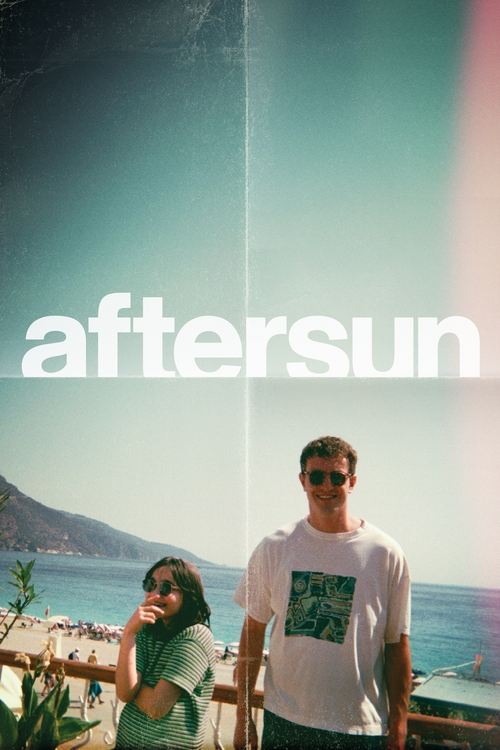
Aftersun
2022 · Charlotte Wells
Aftersun is the Letterboxd generation's consensus crying-movie and "greatest debut ever" candidate; the "Under Pressure" needle-drop is canonical. Her silence since only deepens the mystique.
For a quiet night when you want to feel something deeply — especially if you've ever tried to understand a parent as a person. Not comfort viewing exactly, but the kind of ache you're glad you let in; keep tissues close.
What it's about
A woman sorts through memories of a package holiday she took in Turkey with her young father twenty years ago, when she was eleven. Between what her camcorder caught and what it didn't, she tries to square the dad she adored — playful, sunburnt, up for karaoke and pool games — with a man quietly struggling in ways she was too young to see.
The experience
Gentle on the surface and devastating underneath. It moves at the unhurried pace of a real holiday, all sun and small talk, while a low hum of sadness builds until it lands on you all at once — less a story you follow than a feeling that sneaks up.
Performances
Paul Mescal is remarkable as the father, letting pain flicker under an easy charm, and eleven-year-old Frankie Corio matches him with one of the most natural child performances in recent memory — their rapport feels documentary-real.
The craft
Charlotte Wells's debut is built on restraint: the camera hovers at the edge of things, and the editing drifts between grainy camcorder tape and memory so you're never quite sure what's recorded and what's reconstructed. Sun-bleached textures and precisely chosen pop songs do the emotional heavy lifting a script would normally do.
Why it matters
One of the most acclaimed directorial debuts of the 2020s, it announced Charlotte Wells as a major filmmaker and confirmed Paul Mescal as one of his generation's finest actors.
Snapshot
Charlotte Wells's debut feature is a film about the limits of knowing another person — specifically a father — and the particular anguish of arriving at understanding too late. Set almost entirely over one late-summer holiday at a Turkish resort, Aftersun withholds more than it shows: the camera hovers beside its characters without quite entering them, and the edit drifts between what Sophie (Frankie Corio, eleven years old) recorded on her camcorder in 1999 and what adult Sophie (Celia Rowlson-Hall) — implied to be the same woman twenty years on — is doing with those images in some unstated present. The film refuses to decode Calum (Paul Mescal), Sophie's father, into a diagnosis or an explanation. What it offers instead is texture, duration, and the sensation of grief arriving in slow recognition. Running at 96 minutes, Aftersun is compact but dense; it rewards multiple viewings precisely because, on return, everything that seemed ambient discloses itself as signal.
Industry & production
Aftersun was developed and produced through a UK-Scottish partnership characteristic of ambitious British debut features in the early 2020s. Financing came from the British Film Institute and Screen Scotland, with Film4 also involved — the cluster of public funding bodies that have consistently backed exploratory British first films since at least the late 1990s. The film is semi-autobiographical: Wells has spoken in interviews about drawing on memories of holidays with her own father, though she has been measured about mapping the fiction onto autobiography too tidily. The budget was modest, in keeping with the scale of the project and Wells's status as an unproven feature director; the production was accordingly tight, shot primarily on location at a working resort in Turkey.
A24 came on board for North American distribution, their involvement signaling the film's expected reception as prestige arthouse rather than specialized-circuit-only fare. The film premiered at the Directors' Fortnight sidebar at Cannes in May 2022 — a launching position with strong precedent for debut features seeking to build critical momentum ahead of theatrical release. Its festival arc, moving through Telluride, Toronto, and New York after Cannes, was swift and extremely well-received; by the time of its November 2022 US theatrical release, the film had been placed on a significant number of year-end ten-best lists by American critics.
Technology
Aftersun constructs its temporal architecture through a deliberate and legible contrast of formats. The main body of the film is shot digitally by cinematographer Gregory Oke, with a controlled, clean quality that reads as retrospective reconstruction — Sophie's adult imagination filling in what she cannot remember. Intercutting with this is camcorder footage rendered in the degraded, color-shifted look of 1990s consumer video: this represents the recordings Sophie actually made on the holiday with a Hi8-style camcorder, the material that exists independent of memory and that she is, implicitly, watching in the present. The two registers are not kept entirely separate; they bleed into each other at moments of maximum emotional pressure, most notably in the film's final sequence, where the cut between formats becomes a formal argument about the unbridgeable distance between the Sophie who was there and the woman who survived.
The aspect ratio shifts between these modes reinforce the distinction: the digital cinematography operates in a wider format, while the camcorder footage adopts the squarer proportions of domestic video, carrying the indexical weight of the real even as the narrative around it becomes hallucinatory. This is a technique with precedent in the essay film tradition — Jonas Mekas and Chantal Akerman both used domestic and found footage to interrogate official cinema — but Wells employs it in a genre context (the family drama) that gives the contrast particular emotional charge.
Technique
Cinematography
Gregory Oke's work is observational without being verité. The camera is often too close to be documentary and too still to be restless; it adopts positions that a stranger might occupy — beside the pool, at the edge of a conversation — rather than the inside position of classical coverage. There is a studied avoidance of reaction shots in standard emotional beats; Oke and Wells frequently refuse to cut to the face we expect to see, or cut there a beat late, or frame it partially. This withholding accumulates into something systematic: the film trains the viewer to read peripheral and involuntary gesture — the way Mescal holds his spine, a hand pressed to a wall — rather than legible facial expression.
Color is warm but not saturating. The Turkish light is rendered as bleached and slightly exhausted rather than Mediterranean-glossy; the resort palette (blue pools, white tile, the cheap vivid color of souvenir shops) never tips into irony. The lighting in the camcorder footage is naturalistic to the point of sometimes losing faces to shadow — a fidelity to the aesthetics of consumer video that carries its own pathos.
Editing
Blair McClendon's editing is the film's most radical formal element. The cut between adult Sophie and the holiday past is not organized by any conventional logic of memory — there is no trigger-object, no crossfade softening the transition. Instead the cuts are abrupt and sometimes spatially rhyming: a gesture completed in one timeline is completed differently in another, or a sound carries across. The rave corridor — adult Sophie in a strobe-lit nightclub, reaching through the dance floor toward an image of her father — returns several times across the film in fragments of increasing duration and distress, organized not chronologically but affectively, reaching its fullest articulation in the film's final minutes. McClendon's editing here borrows something from the structure of trauma as theorized in psychoanalytic film theory: return, fragmentation, deferral.
Mise-en-scène / staging
Wells stages the holiday as fundamentally ordinary — poolside games, a buffet dinner, a karaoke evening, a scuba lesson — and finds the dissonance not in event but in undertow. Calum's darker moments are staged off to the side: the balcony at night, his back to the camera, the movement from social warmth to private unmooring achieved in the space of a cut rather than a dramatic scene. The film's staging resists the revelation scene, the emotional confrontation; what Sophie could not see as a child the film does not reconstruct as adult clarity. The decision to stage Calum's interiority as largely opaque is a moral as well as a formal choice — the film refuses to colonize his suffering with interpretation.
Sound
Oliver Coates composed the film's score, working in a register of extended cello and ambient drone that is more texture than theme — sound as atmospheric pressure rather than emotional annotation. The score's reticence matches the visual approach; it rarely tells the viewer how to feel. More dramatically deployed are two pop-song choices that have become central to the film's cultural afterlife: Queen and David Bowie's "Under Pressure" scores one of the film's most discussed sequences (Calum dancing alone with an abandon he never shows Sophie), and R.E.M.'s "Losing My Religion" appears in a karaoke context whose irony is neither underlined nor played for comedy. The choice of late-1990s pop is period-accurate but also thematically loaded; "Under Pressure" in particular has taken on a reputation, in discussions of the film, as one of the more effective deployments of a licensed song in recent British cinema.
Performance
Paul Mescal's performance is a sustained exercise in visible concealment. The physicality is precise — he is an actor who thinks in body before face — and there is a quality of Calum's physical ease with Sophie (the easy intimacy of a father who has remained close to his child despite a separation from the mother) set against his physical difficulty when alone that the film exploits without commentary. Mescal received an Academy Award nomination for Best Actor, a significant recognition for a performance built almost entirely on what it withholds.
Frankie Corio, making her screen debut, is the film's quieter formal achievement. Child performances of this quality — naturalistic, unself-conscious, genuinely inhabiting rather than performing girlhood — are rare, and Wells elicited one without any apparent strain visible in the result. The achievement belongs to both of them.
Narrative & dramatic mode
Aftersun operates in what might be called the interrogative mode of memory narrative: the film is not a record of what happened but a meditation on what Sophie does not and cannot know about what happened. The narrative mode is closer to the essay film than to the drama of revelation, though it contains enough event — the holiday has incident, social encounter, a trajectory toward departure — to function as a surface story. The deep structure is recursive; Sophie returns to images she has already seen, finding different things in them.
The film withholds explicit statement of what Calum's condition is or what happened to him after the holiday. Viewers have read the film as documenting a father on the edge of suicide — an interpretation the film supports without confirming. This productive ambiguity is not evasion; it is the film's central ethical position, insisting that grief cannot be retrospectively organized into full understanding.
Genre & cycle
Aftersun belongs to a loose cycle of early-2020s British and European films concerned with memory, grief, and family — films like Joanna Hogg's The Souvenir diptych (2019, 2021), Charlotte Regan's Scrapper (2023), and the broader wave of debut features by women directors working in auteur-adjacent registers. It also sits within a longer tradition of the holiday film as site of family tension and displacement, from Hogg's own Unrelated (2007) and Archipelago (2010) back through Eric Rohmer's moral tales and Agnès Varda's personal documentaries. The resort setting specifically — the package holiday, the all-inclusive, the specific social textures of 1990s British tourism in Turkey — gives the film a cultural-historical specificity that positions it within working- and lower-middle-class British experience rather than the middle-class travel dramas that usually occupy this formal territory.
Authorship & method
Charlotte Wells (born 1987, Scotland) trained at the National Film and Television School in the UK following earlier film studies in the United States. Aftersun is her feature debut; she had made short films previously. As writer-director, she controls both the narrative withholding and the formal strategy, and the film's coherence — the sense that every decision is oriented toward a single emotional and ethical argument — is the product of that dual authority. Wells has discussed the film in terms of not wanting to explain Calum or resolve what Sophie knows; the commitment to that position across all departments gives the film its unusual integrity.
Gregory Oke had worked in British independent film before Aftersun but the film established him at a higher level of visibility. Blair McClendon, the editor, is American and associated with the more experimental end of American independent cinema. Oliver Coates is a British cellist and composer with a background in contemporary classical and experimental music, and his scoring practice — ambient, spatially conceived — is consistent with his work outside film. This is a collaboration of relative newcomers working at a high level of formal ambition.
Movement / national cinema
Aftersun is a Scottish film — Wells is Scottish, Screen Scotland is a principal funder — but it fits awkwardly into the category of Scottish national cinema as it is usually constructed. It does not engage with the social realist tradition of Ken Loach or the genre inflections of Peter Mullan; it is closer, in sensibility and formal approach, to a strand of contemporary British auteur filmmaking associated with the BFI and Film4 that crosses national lines in its influences and ambitions. The film is also part of a recognizable contemporary A24 canon — films defined less by national origin than by a shared set of formal commitments (slow pace, emotional restraint, naturalistic performance, genre-adjacent but not genre-captured) and a distribution and marketing apparatus that positions them as prestige art film for a literate general audience.
Era / period
The holiday takes place in 1999; the adult-Sophie present is implied to be sometime in the 2010s or early 2020s. The late 1990s setting is not merely nostalgic; the camcorder aesthetics, the music (the film is precise about its pop-cultural period markers), and the specific texture of the resort all carry historical meaning about a particular kind of British working holiday and a particular moment in childhood media — when children first had cameras of their own, and when domestic footage accumulated in ways that anticipated later social media self-archiving without yet producing the same self-consciousness about being recorded. The film's interest in this moment is partly about what gets captured and what doesn't, and about the difference between being on record and being known.
Themes
The film's primary theme is the gap between love and knowledge — specifically that loving someone does not guarantee understanding them, and that this gap can become catastrophic only in retrospect. Sophie loved her father; she has his image, in multiple senses; she does not have access to his interior. The film refuses to collapse this into a statement about mental illness and parental responsibility, though both are present. Depression's invisibility to the people who live alongside it — the way it coexists with warmth, humor, physical presence, genuine love — is rendered not as diagnosis but as experience.
Secondary themes include the gender and generational dynamics of grief (the adult Sophie is implied to be navigating her own queer adulthood, glimpsed in the rave sequences without being foregrounded), the relationship between recorded image and living memory, and the specific texture of late-1990s British popular culture as a site of emotional formation. The film is also, obliquely, about the experience of being an only child with a single parent: the particular intensity of a relationship with no buffer, and the adult weight that can accrue to a child within it.
Reception, canon & influence
Critical response on Aftersun's festival run was near-unanimous and intensified rather than subsided through its theatrical release. The film appeared on the majority of English-language year-end best-of lists for 2022, frequently in the top five, and won numerous critics' circle prizes. Paul Mescal's Academy Award nomination was widely considered overdue recognition for a performance that had been cited throughout the year. The film's BAFTA presence was substantial, with nominations including Outstanding British Film.
Influences on the film (backward): the lineage is most legible in British and European auteur cinema. Joanna Hogg's holiday films — Unrelated and Archipelago in particular — are the closest formal antecedents in British cinema: the same resort or country-house settings, the same preference for staging over coverage, the same social observation with emotional violence suppressed beneath surface. Claire Denis is a clear presence — the bodily, tactile quality of the cinematography, the refusal to locate emotion in dialogue, the use of music as atmospheric rather than underlining. Lynne Ramsay's Scottish cinema (Ratcatcher, Morvern Callar) is relevant to the formal practice of ellipsis and to the working-class specificity. Apichatpong Weerasethakul's management of temporal registers and of waking and memory states is detectable, though at a remove. The essay film tradition — Varda, Chris Marker's Sans Soleil — informs the use of the camcorder and the interrogative relationship to archival image.
Legacy and forward influence: it is too early for a settled account of what Aftersun has shaped, but its cultural presence has been considerable. The film arrived at a moment when a loosely allied set of formal strategies — slow cinema, memory structure, ambient score, naturalistic performance — had sufficient visibility in English-language filmmaking to constitute a recognizable mode, and Aftersun will likely be cited in accounts of that mode's early-2020s consolidation. Its particular contribution — the use of consumer video as a formal argument about the limits of memory rather than as period flavor — and the precision with which it handles the unspeakability of a surviving child's grief for a parent whose inner life remained closed to her, mark it as a film likely to endure in both critical and pedagogical contexts. Whether it has directly influenced subsequent filmmakers remains, at this writing, a question the next decade will answer.
A Deleuzian reading
The image to begin with is a small one: a television, and on its screen the holiday plays back in the smeared colors of 1999 video, and faintly, laid over it, the reflection of the woman watching.
The full Deleuzian reading of Aftersun →
Reception
No reappraisal needed — it detonated on arrival. A tiny debut premiering in Cannes Critics' Week 2022, it ended the year topping Sight and Sound's best-of-2022 poll and has only tightened its grip since, now firmly lodged in the Letterboxd Top 250.
How Aftersun was received, from release to now →
Influences: the films it descends from and the films it influenced
- Unrelated (2007) — Holiday resort as pressure-sealed container for unspoken crisis; Hogg's staging-over-coverage practice — observational wide frame, no emphatic reverse angles — establishes the template for Wells's refusal to cut to reaction shots during emotional confrontations.
- The Souvenir (2019) — Semi-autobiographical memory film reconstructing a relationship the protagonist cannot fully interpret from within; the BFI/Film4 production ecosystem, the withholding of psychological resolution, and the commitment to productive ambiguity as ethical position are direct precursors within British auteur cinema.
- 35 Shots of Rum (2008) — Tender parent-child intimacy expressed through physical proximity and staged behavior rather than dialogue; Denis inserts the Commodores' 'Night Shift' at a pivotal scene, demonstrating the method — licensed period pop as emotional weather replacing explanation — that Wells employs throughout.
- Morvern Callar (2002) — Opaque female protagonist navigated entirely through physical behavior; Ramsay builds a licensed pop compilation (Boards of Canada, Aphex Twin, Velvet Underground) that functions as Morvern's inaccessible interior, the method Wells adapts for Sophie's subjective experience via period playlist.
- Ratcatcher (1999) — Naturalistic debut performance from a Scottish child lead (William Eadie) in a film that renders working-class interiority through lyrical textural scenes rather than dramatic incident; trauma-adjacent experience expressed through ambient detail rather than event.
- Sans Soleil (1983) — Consumer and documentary footage positioned as both intimate record and epistemological distortion; Marker's formal argument that the camera does not recover memory but produces a substitute is the philosophical ground for Wells's Hi8 sequences and their interrogative relationship to what Sophie can know.
- News from Home (1977) — Archival city footage set against a text whose emotional content it neither illustrates nor confirms; the structural gap between what is recorded and what is known — the camera's incapacity to capture another's interiority — is the essay-film position Wells inherits for her interrogative use of video.
- Les Glaneurs et la Glaneuse (2000) — Varda films herself with a consumer DV camera and makes its material qualities — compression, reach, intimacy — explicit subjects within the essay; Wells inherits this reflexive relationship between consumer technology and the limits of what can be recovered from footage, applying it to the Hi8 sequences as epistemological argument.
- Uncle Boonmee Who Can Recall His Past Lives (2010) — Multiple temporal and experiential registers — waking, memory, near-death — treated as coequal film space without hierarchical framing; ambient sound as connective tissue across ontological levels, a structural precedent for Wells's intercutting of memory footage and present-tense reality without privileging either.
- Mommy (2014) — The 1:1 aspect ratio deployed as formal argument — the frame expands at a single moment of imagined liberation, then contracts — establishing the precedent for using frame format not as period flavor but as an epistemological claim about constraint and the limits of a character's freedom.
- Fish Tank (2009) — Naturalistic debut performance from a British teenage girl whose experience is rendered through physical behavior and bodily register rather than facial expression or exposition; Arnold's handheld, close-bodily camera grammar is the British social-realist substrate Wells inherits and internalizes.
- All of Us Strangers (2023) — BFI/Film4 production using licensed period pop (Pet Shop Boys, Frankie Goes to Hollywood) not as nostalgia but as conduit to grief; parent-child relationship across temporal impossibility; the ambient-scored, formally restrained British auteur mode Aftersun consolidates, extended here into an explicitly queer register.
- Sorry, Baby (2025) — The direct Pastel-house model: an elliptical, memory-inflected structure and a composed, withholding camera that lets emotional rupture occur off-frame — the formal template for Mia Cioffi Henry's photography here.
- My Father's Shadow (2025) — The direct template (and Element stablemate): an autobiographical-debut memory film that reconstructs a lost father through a child's incomplete vision, withholding the adult interior and using grainy lo-fi texture as the membrane between past and recollection.
- All Dirt Roads Taste of Salt (2023) — Affective nonlinear memory structure that refuses chronology; physical performance foregrounded over dialogue; ambient sound design as primary emotional carrier; the ethical refusal to resolve what a body has carried is extended here to a Black Southern American interiority, from the same formal moment.
- How to Have Sex (2023) — BFI-backed British debut feature set in a package holiday resort (Malia) with naturalistic teenage female performance registering experience the film refuses to diagnose; the holiday container for suppressed crisis transposed from Aftersun's familial register to an explicitly social and sexual one.
- Past Lives (2023) — Interrogative memory mode that withholds what the protagonist feels or chooses; reaction shots suppressed in favour of staged behavior as primary grammar; naturalistic restrained performance in a film whose formal refusal to resolve constitutes its ethical argument about what cannot be recovered.
- Romería (2025) — Built on the same retroactive-reveal architecture — a guarded, diaristic reconstruction of a lost parent whose meaning detonates only late, with the protagonist's grief withheld until a final formal breach.
- Hamnet (2025) — Builds grief from a withholding, elliptical structure and a recessive lead performance that buries feeling beneath surface calm — the Mescal-register restraint Hamnet extends.
- Blue Heron (2026) — Named in the dossier as the crystallizing autobiographical memory feature: it reconstructs a lost parent through analog camcorder footage and elliptical, restricted child recollection, the immediate model for Romvari's scaling-up.
- Pillion (2025) — Shares composer Oliver Coates, whose ambiguous, dread-tinged strings score both; both are assured British debuts built on internalized reaction and held tonal suspension.
- Urchin (2025) — A prize-winning British debut built on elliptical-momentum editing and strobe/rave oneiric interludes that externalize psychology — the same elliptical-plus-reverie architecture.
- Small Things Like These (2024) — Memory-braiding through fragmentary, withheld images and an internalized, near-wordless emotional register — the contemporary sibling in elliptical, affect-suppressed storytelling where meaning accrues in the gaps.
- Close (2022) — Reconstructs unbearable loss through elliptical restraint and the ache of what a young person couldn't yet see, a contemporary twin to Close's under-stated grief mechanics.
- Falcon Lake (2022) — A holiday reconstructed as fallible memory through analog/lo-fi texture and elliptical ambiguity, with grief and loss hovering unspoken beneath a child-and-elder vacation gaze.
- Riceboy Sleeps (2023) — Semi-autobiographical memory film built from grainy, low-fi textures and elliptical patient observation of a parent-child relationship, trusting the audience to assemble grief from withheld information.
Similar films
- Blue Heron (2026) — influence & lineage
- Past Lives (2023) — influence & lineage
- Sound of Falling (2025) — influence & lineage
- All of Us Strangers (2023) — influence & lineage
- Pillion (2025) — influence & lineage · same viewing thread
- News from Home (1977) — influence & lineage · often watched together
- Falcon Lake (2022) — shared sensibility
- Midsommar (2019) — shared sensibility
All the films related to Aftersun →
Watch it with: curated runs of related films
- Desire on Uneven Ground — A run of tender, lopsided intimacies — an outsider fixed on someone just out of reach — that keep slipping from realism into dream, myth, or memory.