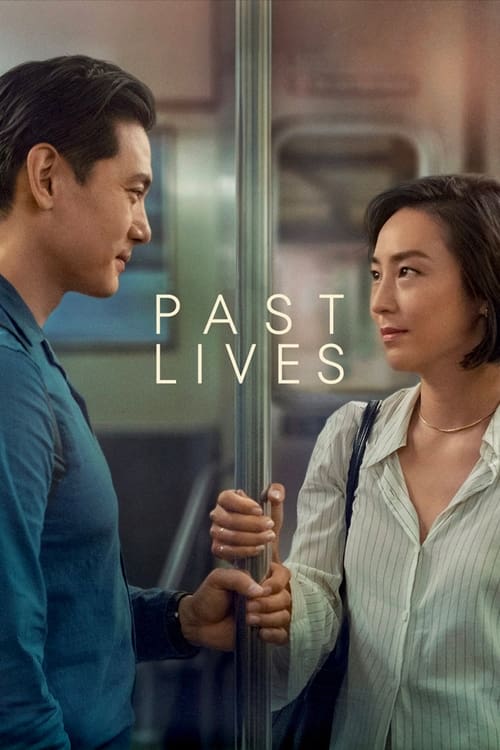
Past Lives
2023 · Celine Song
Past Lives made her the debut-of-the-decade story; Materialists then triggered a genuine backlash-to-the-backlash cycle about whether her dating-app drama betrayed or extended her romanticism. The face of "playwright-turned-filmmaker" prestige.
For when you want to feel something true about roads not taken — a tender, grown-up heartbreaker for a reflective night, more bittersweet than sad. Comfort viewing for the melancholy; bring tissues anyway.
What it's about
Nora and Hae Sung were twelve-year-old sweethearts in Seoul when her family emigrated, and the film follows them across twenty-four years — a tentative reconnection over video calls, then a single weekend in New York where he finally visits. By then Nora is a playwright married to an American, and the three of them end up sharing rooms, meals, and one long night of conversation. It's a love story about the person you might have been as much as the person you might have loved.
The experience
Quiet, patient, and devastating by stealth — long pauses and small looks carry more weight than any declaration. It builds to an ache rather than a climax, and the last stretch will sit in your chest for days.
Performances
Greta Lee makes Nora's composure its own drama — you watch two languages and two lives flicker across her face. Teo Yoo gives Hae Sung a shy, held-in longing, and John Magaro is quietly remarkable as a husband generous enough to see what's happening.
The craft
Celine Song's debut direction is all restraint: static, carefully composed frames that let silences breathe, and a script that trusts subtext over speeches. The bar scene at its heart — three people, two languages, one translator — is a small masterclass in staging. It's an intimate film, but the hushed sound design and unhurried rhythm reward a distraction-free watch.
Why it matters
A Sundance-to-Oscars phenomenon that made Song one of the most watched new directors of her generation and became A24's defining romance of the decade so far, earning Best Picture and Original Screenplay nominations.
Snapshot
Past Lives is the feature debut of the Korean Canadian playwright Celine Song, a chamber romance built around a deceptively simple structure: two childhood friends, separated when one emigrates from Seoul, reconnect across twenty-four years and three time periods, culminating in a single weekend in New York where the woman's first love and her American husband finally occupy the same room. The film is widely understood to be semi-autobiographical — Song has described an evening when she sat in an East Village bar literally translating between her Korean childhood sweetheart and her American husband, a moment she has called the seed of the screenplay. Released by A24 after a Sundance premiere in January 2023 and a Berlinale competition slot, it became one of the most acclaimed films of its year and earned Academy Award nominations for Best Picture and Best Original Screenplay. Its reputation rests on restraint: a refusal of the love-triangle's melodramatic payoff in favor of an essayistic meditation on the lives one does not lead. Threaded through it is the Korean concept of in-yun (인연) — the providence accreted across thousands of lifetimes that brings two people into contact — which the film treats less as mysticism than as a structuring metaphor for contingency and choice.
Industry & production
Past Lives is a product of the mature A24 model and of Killer Films, the long-running independent shingle of Christine Vachon and Pamela Koffler whose history runs from the New Queer Cinema of the early 1990s through Boys Don't Cry and Carol. The film was produced by Killer Films and A24 in association with CJ ENM, the Korean entertainment conglomerate behind Parasite; David Hinojosa of Killer Films produced alongside Vachon and Koffler. This financing structure — American independent capital braided with Korean industry money — mirrors the film's bicultural subject and made possible location shooting in both New York and Seoul.
Song came to filmmaking from the theater. She had written plays (including Endlings, produced at the American Repertory Theater and New York Theatre Workshop) and worked briefly as a staff writer, but Past Lives was her first time directing a camera. The decision to entrust a substantial, two-continent production to a first-time director reflects both the strength of the screenplay on the page and the A24 house tendency to back distinctive authorial voices. The film was modestly budgeted by studio standards and shot economically, and it followed the now-familiar festival-to-awards path: Sundance launch, international validation at Berlin, a platformed theatrical release over the summer, and a sustained awards campaign that carried it to the Oscars the following winter. Beyond the precise figures the public record does not always make exact — and I will not invent them — the salient industrial fact is that Past Lives exemplified how a specialty distributor could turn a small, dialogue-driven, partly subtitled drama into a genuine awards contender.
Technology
Technologically the film is unshowy by design. It was shot digitally on contemporary cinema cameras and finished as a standard theatrical digital release; there is no gimmick of format or process at its center. What technology serves here is intimacy and geography: the production's ability to capture Seoul and New York as distinct, lived-in light environments depends on portable, naturalistic digital workflows rather than on any single innovation. The most consequential "technological" choices are pedestrian ones elevated by taste — lens selection, the discipline to shoot in available and motivated light, and a sound design that can hold long silences without the safety net of a busy mix. In an era when independent dramas often lean on capable but anonymous digital cinematography, Past Lives is notable for how deliberately its tools are subordinated to composition and duration.
Technique
Cinematography
The cinematography is by Shabier Kirchner, the Antiguan British shooter best known for Steve McQueen's Small Axe anthology, and his contribution is central to the film's identity. Kirchner and Song favor patient, often static or slow compositions that treat physical distance between bodies as the film's primary subject. The most discussed image is the opening bar shot — Nora seated between Hae Sung and Arthur, observed from across the room by unseen strangers who speculate about the trio's relationships — a framing that makes the audience complicit in the act of reading lives from the outside. Throughout, the staging exploits horizontal space: characters held at the far edges of the widescreen frame, separated by negative space that the cutting refuses to collapse. Seoul and New York are differentiated chromatically and texturally, and the film's emotional grammar is built less on close-ups than on the precise calibration of how near or far the camera permits us to stand.
Editing
Keith Fraase, an editor who worked extensively with Terrence Malick, cut the film, and the Malickian lineage is legible in the handling of the time jumps. The screenplay spans roughly a quarter century in three movements — childhood in Seoul, a long-distance Skype reconnection twelve years later, and the New York weekend twelve years after that — and the editing manages these elisions with ellipsis rather than exposition. The film trusts gaps. It also withholds: the famous final passage, a wordless walk and wait on a Manhattan street, is sustained well past the point where a more conventional cut would have released the tension, and the duration is the meaning.
Mise-en-scène / staging
Song's theatrical training surfaces most clearly in the staging. Scenes are blocked with a playwright's attention to who stands where, who is permitted to touch, and how a third presence reorganizes a room — the bar booth, the apartment, the carousel and statue of the New York interludes. The recurring motif of the threshold and the doorway, of people framed on either side of a divide, externalizes the film's preoccupation with the roads not taken. Props and gesture do heavy lifting: the ride-share that finally separates Nora and Hae Sung, the act of translation Nora performs between the two men.
Sound
The score is by Christopher Bear and Daniel Rossen, both members of the indie band Grizzly Bear, and it is used sparingly — atmospheric, melancholic, never instructing the audience how to feel so much as deepening the ambient ache. Equally important is the film's confidence with silence and with the textures of two cities. The bilingual sound design, in which Korean and English carry different intimacies, is itself thematic: Nora's two languages mark her two selves, and the film lets us hear the seam between them.
Performance
The performances are tuned to the film's restraint. Greta Lee, as Nora, gives a performance of controlled interiority, registering decades of accommodation and ambivalence in micro-expression; the role is widely regarded as her breakout. Teo Yoo, as Hae Sung, plays longing held rigorously in check, a man whose courtliness is also a kind of grief. John Magaro, as the husband Arthur, performs the film's most quietly generous turn — a man self-aware enough to know he may be the less romantic destiny and decent enough not to compete. The triangle works because none of the three is a villain; the drama is structural, not moral.
Narrative & dramatic mode
The dramatic mode is elegiac realism organized around a counterfactual. Past Lives is not a story about whether Nora will leave Arthur for Hae Sung — it never seriously entertains that — but about mourning a self that emigration foreclosed. Its three-act, three-era architecture is closer to the well-made play than to genre romance, and its climaxes are conversations and silences rather than events. The film frames itself reflexively, opening on strangers narrating the trio and returning at the end to the consequences of that long-deferred meeting, so that the audience is positioned as readers of a life. The mood is bittersweet by intention: it offers neither the catharsis of union nor the punishment of tragedy, only the recognition that a life is made of the doors that quietly close.
Genre & cycle
The film sits within the prestige independent romantic drama and converses pointedly with the "encounter" or "what-if" romance — stories of lovers held apart by time, circumstance, or the wrong moment. Critics quickly placed it in dialogue with Richard Linklater's Before trilogy for its talk-driven intimacy and with Wong Kar-wai's In the Mood for Love for its aesthetics of restraint and unconsummated longing; David Lean's Brief Encounter is the deeper ancestor of the form. It also belongs to a contemporary cycle of diasporic and immigrant cinema — films negotiating dual identity and the costs of leaving — alongside which it is frequently discussed.
Authorship & method
Past Lives is a strong authorial statement precisely because its author drew on her own biography while resisting confession. Song has been explicit that the film is autobiographically rooted, yet the writing converts private incident into something architectonic and universal. Her method is recognizably that of a dramatist: dialogue that performs subtext, structure as argument, and a faith that staging can carry emotion that exposition would cheapen.
Her collaborators are essential to the result. Kirchner's compositional patience, Fraase's elliptical cutting honed under Malick, and the Bear–Rossen score together produce the film's signature stillness. The casting of Lee, Yoo, and Magaro completes the authorship: Song's restraint only registers because the actors trust it. The film is thus a debut that already exhibits a coherent sensibility — the mark of an author rather than a beginner.
Movement / national cinema
Past Lives occupies a hyphenated position. It is an American independent film, made within the Killer Films / A24 ecosystem, and it is also a work of the Korean diaspora, financed in part by CJ ENM and shot substantially in Korean. It arrived during a period of heightened global attention to Korean and Korean American cinema — in the wake of Parasite's historic Oscar and Lee Isaac Chung's Minari — and it is frequently grouped with that ascendancy. But its true "national cinema" is the in-between: the condition of the immigrant who belongs fully to neither place, which the film treats as both wound and vantage point.
Era / period
The film is firmly of the early 2020s independent landscape: a moment when A24 and its peers had normalized small, formally rigorous, internationally minded dramas as awards material, and when streaming had reshaped exhibition without extinguishing the prestige theatrical run. Its use of long-distance video calls to bridge its middle act locates it in the contemporary texture of transnational intimacy — relationships sustained, and strained, across screens and time zones. It is a 21st-century film about distance made both smaller and crueler by technology.
Themes
The governing theme is in-yun — the idea that connection is the residue of countless past lives — which the film deploys as a way of thinking about contingency: the staggering improbability and fragility of any two people meeting at all. Around it cluster the film's other concerns: emigration as a form of self-division, in which to gain one life is to bury another; the persistence of a first self that a chosen life cannot fully absorb; language as identity, with Nora's Korean and English marking incompatible versions of who she is; and the dignity of the ordinary, faithful love embodied by Arthur against the mythic pull of the road not taken. Above all the film is about mourning — not a lost lover so much as a lost possible self — and the quiet maturity required to grieve it and still choose the life one has.
Reception, canon & influence
Critical reception was strongly positive from its Sundance premiere onward, and Past Lives consolidated a reputation as one of the defining American independent films of 2023; it appeared widely on year-end lists and earned Academy Award nominations for Best Picture and Best Original Screenplay, a notable feat for a first feature. (I am keeping to nominations and acclaim rather than citing specific prize tallies or grosses I cannot verify precisely.)
Its influences run backward to Brief Encounter, In the Mood for Love, and the Before films, and to the broader tradition of the talk-driven, restraint-based romance; the Malick lineage reaches it through editor Keith Fraase. Looking forward, its legacy is twofold. It established Celine Song as a major directorial voice and accelerated her career; it elevated Greta Lee to leading-role prominence; and, at the level of the wider culture, it strengthened the case that small, bilingual, emotionally exact dramas of the diaspora could command both critical canonization and the mainstream awards conversation. In the longer view, Past Lives is likely to be remembered as a touchstone of 2020s diasporic cinema and as a near-definitive modern treatment of the counterfactual romance — the film that made in-yun legible to a global audience and turned the ache of the unled life into a durable piece of film grammar.
A Deleuzian reading
Three people sit in a bar.
The full Deleuzian reading of Past Lives →
Reception
A Sundance 2023 breakout that arrived with near-unanimous acclaim and rode a year of 'best film of the year' talk to Best Picture and Original Screenplay Oscar nominations — then won nothing, which only cemented its status; it's already settled in as the defining quiet heartbreaker of its decade rather than needing a reappraisal.
How Past Lives was received, from release to now →
Influences: the films it descends from and the films it influenced
- Brief Encounter (1945) — Establishes the restraint-romance grammar Song inherits wholesale — a love left unconsummated by duty, staged at a transit threshold (the railway station / here the airport and subway), where the emotional climax is two people declining to act rather than acting.
- Late Spring (1949) — Source of the threshold-staging and stillness vocabulary: low static framing, characters held in doorways and liminal architecture, and emotion carried by composition and duration rather than dialogue — the formal patience Kirchner's camera reproduces.
- In the Mood for Love (2000) — Directly cited template for negative-space longing — bodies separated by frame edges, doorways, and held distance — and for the counterfactual ache of a romance that exists almost entirely as the road not taken, time-skips standing in for the unlived years.
- Before Sunrise (1995) — Defines the talk-driven, walk-and-talk encounter romance built on real-time sustained dialogue, where connection is performed through unhurried conversation rather than plot — the two-hander idiom Song deploys in the bar and street scenes.
- Before Sunset (2004) — Supplies the reunion-years-later structure that is Past Lives' engine: lovers meeting again after a long gap, the entire drama generated by the gap between who they were and who they became, and an ending suspended on an unresolved choice.
- Yi Yi (2000) — Model for the counterfactual-romance thread embedded in a diaspora-of-time drama — NJ's reunion with his first love mirrors Nora and Hae Sung — handled with controlled interiority and reflective-surface staging that refuses melodrama.
- The Tree of Life (2011) — Direct conduit for the editing: cutter Keith Fraase honed his elliptical, memory-logic assembly under Malick here, and brings that associative time-collapse — eliding 12- and 24-year jumps with a single cut — to Past Lives.
- Still Walking (2008) — Source of the sustained-duration domestic register — scenes allowed to run past their dramatic 'point,' grief and longing leaking out at the edges of ordinary interaction — and the trust that staging and stillness carry what exposition would cheapen.
- Lost in Translation (2003) — Shares the bilingual-encounter form: an emotionally charged, unconsummated bond shaped by language barrier and cultural dislocation, with longing rendered through negative space and silence rather than declaration.
- The Farewell (2019) — Closest contemporary kin in diaspora self-division — a bicultural protagonist split between Korean/Chinese origin and American present — using bilingual sound design and controlled performance to dramatize the untranslatable cost of leaving.
- Minari (2020) — Companion in the Korean-diaspora movement — autobiographically rooted but architectonic rather than confessional, using bilingual register and understated performance to universalize a specific immigrant interior life.
- Drive My Car (2021) — Shares the multilingual sound design and sustained-duration, talk-driven method — long dialogue scenes in cars and rehearsal rooms where languages overlap, and grief processed through controlled interiority across elliptical time jumps.
- Materialists (2025) — Song's own debut established her signature triangulated staging — two suitors flanking a woman held in sustained two-shots — and the playwright's patience of letting a scene run on dialogue until an unspoken calculation surfaces, which Materialists directly extends.
- Columbus (2017) — Parallel A24-era restraint two-hander built on architectural negative space and precise static composition, where two people circle an unspoken attraction through conversation framed against buildings, emotion staged spatially.
- Aftersun (2022) — Sibling A24 debut working in elliptical memory-cinema — fragmentary cutting, withheld interiority, and the ache of an irrecoverable past reconstructed from gaps — a contemporaneous proof that restraint plus elliptical editing can carry a feature.
- 45 Years (2015) — Kindred study of the unled life resurfacing — a long-buried alternate love disturbing the present — sustained in long takes and micro-expressive performance, where the drama is entirely subtextual and the camera simply waits.
- All of Us Strangers (2023) — Contemporaneous counterfactual-romance built on threshold-crossing and the conversation with a lost past self, sharing Past Lives' negative-space framing, elliptical time logic, and tear-suspended emotional restraint.
- Twinless (2025) — Sundance-era restraint that stages longing in the silence between what's spoken and what's felt, the understated emotional register Twinless shares.
- Riceboy Sleeps (2023) — Diaspora narrative built on transnational return and decade-spanning ellipses, holding emotion in patient two-shots and withheld reaction rather than expository dialogue.
- A Real Pain (2024) — A mid-2020s two-hander of diaspora memory built on hushed observational realism and location shooting across a homeland, letting restraint and negative space voice what dialogue withholds.
- We Live in Time (2024) — Sibling in the revived adult-romance-as-prestige mode: restraint, contingency and 'the shape of a life in time' rendered through hushed indie-classical scoring and behavioral acting rather than melodramatic pitch.
- Eternity (2025) — Renders the choice-between-two-loves and idealized-vs-lived-love structure through restrained, contained-observation cinematography and performances of active ambivalence rather than melodrama.
- Dìdi (弟弟) (2024) — An Asian American debut built on restraint — long, quiet naturalistic takes and bilingual code-switching carrying subtext the dialogue withholds — extending the same understated diaspora performance register.
- Touch (2024) — Lovers parted by migration and reunited across decades, the drama held in restraint and near-touch with a present frame reflecting on the past — the contemporary memory-quest melodrama Touch shares.
- Voicemails for Isabelle (2026) — Stages an entire relationship between parties who share almost no physical space, using the compressed, band-limited audio of mediated calls as an emotional texture in its own right — the same telephony-filter-as-feeling technique the seed applies to the reassigned number.
Similar films
- Drive My Car (2021) — influence & lineage · same viewing thread
- In the Mood for Love (2000) — influence & lineage · often watched together
- All of Us Strangers (2023) — influence & lineage
- Before Sunset (2004) — influence & lineage
- Portrait of a Lady on Fire (2019) — same viewing thread · often watched together
- Soulmate (2023) — same viewing thread
- Lost in Starlight (2025) — same viewing thread
- Burning (2018) — same viewing thread
All the films related to Past Lives →
Watch it with: curated runs of related films
- The Ache of Almost — Watch these together for the way each circles a love that time, distance, or duty keeps just out of reach — long looks, feelings left unsent, and the life that gets lived instead.