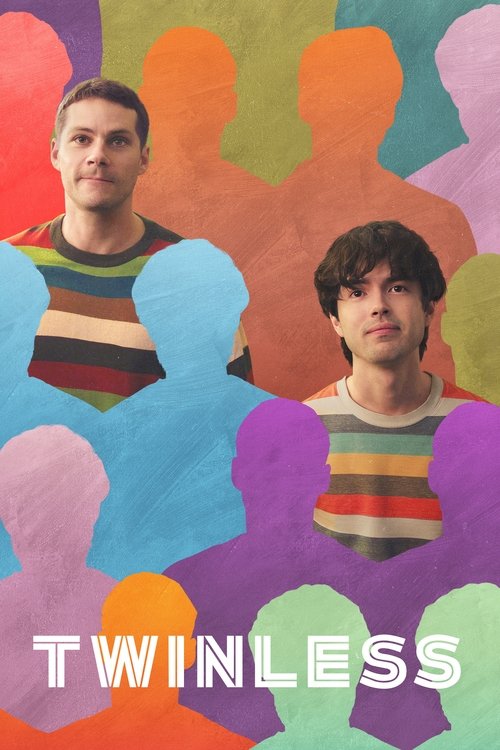
Twinless
2025 · James Sweeney
For a night when you want a grief film that doesn't wallow — one that keeps you laughing even as it earns real feeling. Not a comfortable watch, but not a punishing one either.
What it's about
Roman, a straight Portland man still flattened by the death of his gay twin brother, meets Dennis at a support group for people who've lost their twins. The two strike up an intense, slightly off-kilter friendship — tender, funny, edged with something neither of them quite names. Both are carrying secrets about the dead man between them that the film surfaces slowly rather than through a single revelation.
The experience
A tonal high-wire act — genuinely funny, then quietly devastating, then unsettling in ways that sneak up on you. The film earns its emotional weight through the accumulation of small awkward moments rather than dramatic confrontation.
Performances
Dylan O'Brien brings unexpected depth to Roman, a man holding himself together through politeness and routine. James Sweeney, who also wrote and directed, is precisely calibrated as Dennis — brittle, eager, hiding in plain sight.
The craft
Sweeney builds the film as a compressed two-hander: small spaces, close performances, conversations that carry more weight than they let on. The decision to rotate point of view rather than spring a single third-act revelation is structurally honest — the deception unravels rather than explodes.
Why it matters
Premiered in U.S. Dramatic Competition at Sundance 2025, establishing Sweeney as a filmmaker who can sustain a dark comic register without sacrificing emotional sincerity across a feature.
Snapshot
Twinless is the second feature written and directed by the American filmmaker James Sweeney, a psychological black comedy about grief, deception, and male loneliness that doubles as a sly two-hander. Roman (Dylan O'Brien), a straight Portland man flattened by the death of his gay twin brother Rocky, meets the mannered, lonely Dennis (Sweeney) at a support group for "twinless twins," and the two strike up an intense, slightly off-kilter friendship. The film's engine is a withheld truth: Dennis never had a twin. He has insinuated himself into Roman's grief because of a prior, secret entanglement with the dead Rocky — and a complicity in his death — that the narrative reveals by rotating its point of view rather than springing a third-act gotcha. Premiering in U.S. Dramatic Competition at Sundance in January 2025, the film won the Audience Award and earned O'Brien a Special Jury Award for Acting for his dual turn as both brothers. It became one of the more warmly received American independents of its year, balancing farce-adjacent comic timing against a genuinely mournful study of men who cannot say what they feel.
Industry & production
Twinless is a product of the contemporary Sundance pipeline: a mid-budget, star-anchored independent built around a recognizable lead (O'Brien) and a distinctive writer-director-performer (Sweeney). It was produced by David Permut's Permut Presentations together with Republic Pictures — the heritage label reactivated under Paramount — with Permut and Sweeney credited as producers. The film was shot in Portland, Oregon, whose overcast, low-key textures suit its melancholy register and align it with a strand of Pacific Northwest indie filmmaking.
The commercial story is a familiar festival-to-acquisition arc. After its January 23, 2025 premiere and Audience Award win, the film became a sales title, ultimately acquired for U.S. release by Lionsgate and Roadside Attractions, with Sony Pictures Releasing handling international territories. It opened theatrically in the United States on September 5, 2025, running roughly 100 minutes, and earned a reported domestic gross of about $1.3 million — modest in absolute terms but consistent with a specialty release that leaned on strong reviews, awards-season positioning, and an "A" CinemaScore rather than wide saturation. One notable production-adjacent incident: during Sundance's online viewing window, clips from the film's intimate scenes were captured and circulated on social media before being removed, prompting the festival to pull the title from its streaming platform — a small case study in the vulnerabilities of hybrid festival distribution.
Technology
The film's central technological problem is the oldest trick in the twin-movie book made to look effortless: one actor, Dylan O'Brien, playing two characters who must occupy the same emotional and occasionally the same physical space. Modern dual-role work of this kind typically combines split-screen compositing, motion-control or locked-off camera setups, body doubles for over-the-shoulder coverage, and digital seam removal to let a single performer share the frame with himself. The published record on Twinless's specific methods is thin, and I won't invent particulars; what is clear from the film's reception is that the seams were judged largely invisible, with the jury explicitly praising O'Brien's "seamless" rendering of two distinct people. Much of the illusion is also achieved without effects at all — through performance, wardrobe, and posture — since Rocky exists mostly in flashback and memory rather than in sustained two-shots with Roman.
The other quietly significant "technology" is musical and global: the score is by Jung Jae-il, the South Korean composer best known for his work with Bong Joon-ho on Parasite and for Squid Game. His presence on a small American queer comedy signals the increasingly borderless talent economy of post-2020 art cinema, where a marquee international composer can anchor the tonal control of an indie financed and shot entirely in the U.S.
Technique
Cinematography
Greg Cotten photographed the film. Critics singled out Sweeney's command of framing and "exquisitely uncomfortable dramatic tension," which is as much a function of camera placement as of writing — the film holds on faces a beat too long, lets two-shots curdle, and uses the controlled, slightly clinical compositions to keep the audience uncertain about how much menace lurks under the comedy. The Portland palette is muted and wintry, favoring interiors, diners, apartments, and support-group rooms over picturesque exteriors, which keeps the focus claustrophobically interpersonal. Precise lens and camera-format details are not well documented in the public record, so I'll avoid asserting them.
Editing
The film was cut by Nik Boyanov, and the editing is structurally load-bearing rather than merely functional. Twinless withholds and then reorganizes information: it begins inside Roman's grief and later rotates to expose Dennis's hidden history and culpability, so that scenes the viewer has already watched acquire a second, darker meaning. This is a screenplay-and-editing trick more than a twist — the cut governs when sympathy transfers and when the comedy turns sour — and the film's tonal whiplash between dry humor and devastation depends on rhythm that never tips into either pure farce or pure melodrama.
Mise-en-scène / staging
Staging foregrounds the awkward physics of male intimacy: two men negotiating closeness in spaces — diners, couches, doorways — that are coded as non-romantic but charged with unspoken longing and deceit. Recurring motifs do quiet structural work, most pointedly the shared ritual of asking a waitress for a to-go box, a small habit that once bound Roman to Rocky and that resurfaces to bind Roman to Dennis in the film's closing beat. The support-group setting is staged as both comic and genuinely tender, a room where grief is performed and, in Dennis's case, counterfeited.
Sound
Beyond Jung Jae-il's score, the sound design serves the film's comedy-of-discomfort: pauses, the dead air of conversations that won't resolve, the texture of two lonely people filling silence. Detailed technical sound credits are not prominent in the public record, so I'll note only that the music functions less as emotional underlining than as a stabilizing tonal frame that lets the film risk its tonal extremes.
Performance
The performances are the film's most celebrated element. O'Brien's dual role — the grieving, blokeish Roman and the more flamboyant, vanished Rocky — was the basis of his Sundance Special Jury Award, with the jury praising "two roles in one fearless performance" and an "immersive and seamless character study of a set of twins." It marks a deliberate departure from his studio and YA-adjacent screen image. Sweeney, as Dennis, plays the harder part: a manipulator whose pathos must remain legible enough that the audience neither fully condemns nor exonerates him. Aisling Franciosi (Marcie) supplies the moral pressure that forces the plot toward confession, and Lauren Graham appears as the twins' mother, with Tasha Smith, Chris Perfetti, and François Arnaud filling out the ensemble.
Narrative & dramatic mode
The dominant mode is ironic tragicomedy built on dramatic irony: the audience eventually knows what Roman does not, which converts ordinary scenes of friendship into suspense. Structurally the film is a perspective machine — it begins as a grief drama, reframes itself as the story of a predator-stalker's guilt, and resolves not with punishment but with an ambivalent, almost unbearable reconciliation. This refusal of clean catharsis is central to its design: the final diner scene offers connection without absolution, intimacy without honesty fully restored. The "secrets that threaten to tear them apart" of the logline are not a thriller's MacGuffin but the substance of the film's argument about how loneliness drives people to fabricate the bonds they cannot earn.
Genre & cycle
Twinless sits at the intersection of several cycles: the Sundance dramedy of damaged people; the queer American indie of the 2010s–2020s; and the "doppelgänger/twin" subgenre that stretches from melodrama through psychological thrillers. Its black-comic treatment of grief and its dual-role conceit invite comparison to twin-themed and identity-swap films generally, but it is closer in spirit to the talky, emotionally precise relationship comedies of contemporary American independents than to genre horror or thriller. It also belongs to a small but distinct cycle of films about male loneliness and the difficulty of platonic male intimacy, treating that theme with comedy rather than the prestige-drama solemnity such material often attracts.
Authorship & method
James Sweeney is the film's clear author — writer, director, and co-lead — and Twinless is best read as the maturation of the voice he introduced in his 2019 debut Straight Up, another dialogue-dense queer comedy preoccupied with intimacy, identity, and the gap between what people say and what they want. Sweeney's method is built on verbal precision and tonal control: critics repeatedly cited his ability to shift "between dry humor, gutting devastation and emotional poignancy" (Lovia Gyarkye, The Hollywood Reporter) and his "sophisticated sense of framing, pace and exquisitely uncomfortable dramatic tension" (Peter Debruge, Variety). His key collaborators here extend that control into other registers: cinematographer Greg Cotten for the muted, watchful visual scheme; editor Nik Boyanov for the perspective-rotating structure; and composer Jung Jae-il, whose pedigree lends the film a tonal sophistication beyond its budget. Producer David Permut, a veteran with a long and eclectic filmography, provided the production scaffolding. The casting of O'Brien against type is itself an authorial choice, using a familiar face to smuggle in a far stranger film than his image would predict.
Movement / national cinema
The film is a contemporary American independent in the Sundance tradition, and more specifically part of the ongoing maturation of queer indie cinema beyond coming-out narratives into stories where characters' sexuality is a given and the drama lies elsewhere — here, in grief, deception, and need. Its lineage runs through the dialogue-forward, low-budget American relationship comedy that followed mumblecore, refined into something more formally controlled. Jung Jae-il's involvement also locates it within the porous, transnational art-film economy of the 2020s. Geographically, its Portland production ties it loosely to a Pacific Northwest independent sensibility — overcast, interior, unglamorous.
Era / period
Twinless is firmly of its moment: a 2025 release shaped by post-pandemic festival economics (including the streaming-leak episode that exposed the risks of hybrid premieres), by an independent marketplace where a strong Sundance reception and a recognizable lead are prerequisites for distribution, and by a cultural conversation around male loneliness and the so-called crisis of male friendship that gives its themes contemporary charge. It is set in a recognizable present, with grief support groups, dating-app-adjacent encounters, and the textures of ordinary urban American life.
Themes
The film's governing themes are grief and its counterfeits, loneliness, and the difficulty of honest intimacy — especially between men. Twinship functions as a literalized metaphor for the longing to be perfectly known and never alone, and the film interrogates that fantasy: Roman has lost the one person who completed him, while Dennis fabricates a twin to manufacture the closeness he cannot otherwise obtain. Deception is framed not simply as villainy but as a symptom of need, which complicates the audience's moral footing. Sexuality and masculinity interlace throughout — the secret at the film's center is both a literal hidden relationship and a broader study of what men permit themselves to want and admit. The recurring to-go-box ritual crystallizes the film's quietest theme: that connection is built from small inherited habits, transferable and therefore both consoling and a little eerie.
Reception, canon & influence
Critically, Twinless was among the best-reviewed American independents of 2025, holding a 97% approval rating across 146 critics on Rotten Tomatoes (average 8/10) and a 79 on Metacritic, alongside an "A" CinemaScore signaling unusually strong audience approval for a film this dark. Benjamin Lee in The Guardian called it a "dark, inventive comedy" that "earns its boundary-pushing because he never loses sight of the inescapable, human sadness at its core"; The Hollywood Reporter and Variety echoed the praise for Sweeney's tonal control and O'Brien's performance. The awards record bears this out: beyond the Sundance Audience Award and O'Brien's Special Jury Award for Acting, Sweeney won Best Director at the Seattle International Film Festival and was named a Palm Springs "Director to Watch," O'Brien collected career-recognition honors at Miami and Savannah, and the film earned Independent Spirit Award nominations for Best Feature, Best Lead Performance, and Best Screenplay, plus a GLAAD Media Award nomination.
The influences on the film are legible: Sweeney's own Straight Up; the dialogue comedies and damaged-people dramedies of the Sundance tradition; and the long cinematic fascination with twins and doubles as engines of identity anxiety. As for what it shaped — the legacy question — it is genuinely too early to assess, and I won't manufacture a verdict. Its near-term significance is twofold and concrete: it functioned as a career-redefining showcase for Dylan O'Brien, recasting a former franchise lead as a serious dramatic actor, and it consolidated James Sweeney's standing as a distinctive American writer-director able to fuse comedy and grief without diluting either. Whether it proves durable as a reference point for the queer-indie and dual-role traditions will depend on the work that follows it.
A Deleuzian reading
A man sits in a circle of folding chairs and grieves a twin he never had.
The full Deleuzian reading of Twinless →
Reception
Premiered at Sundance 2025 to an electrified Eccles crowd and took home the Audience Award; by its September release it had ripened into one of the year's word-of-mouth indie hits, with Dylan O'Brien riding it to an Independent Spirit Best Lead Performance nomination.
How Twinless was received, from release to now →
How to watch Twinless: what to notice on a first viewing
- Watch how long the camera holds on faces in every scene. Cotten keeps two-shots running past the point of comfort, letting ordinary conversations curdle into something tenser than the dialogue admits. The camera is telling you something's off long before the story explains what.
- Notice that the same actor plays both twin brothers. Dylan O'Brien builds Roman and Rocky as distinctly different men, one blokeish and grieving, the other more flamboyant and only glimpsed in memory. You're watching one performer carry the whole weight of a twin relationship alone.
- Notice the habit of asking the waitress for a to-go box. This small, specific gesture recurs more than once across the film, always in the same understated, almost automatic way. A tiny inherited habit is doing more quiet work than it first appears to.
- Listen for the pauses that conversations never quite resolve. Dead air sits between lines more than dialogue does, two lonely men visibly working to fill silence rather than talking easily. The awkwardness itself is the comedy and the ache, running at the exact same time.
- Watch how carefully mannered and guarded Dennis seems. Sweeney plays him with a watchfulness that reads as social awkwardness on the surface and something more calculated underneath it. You can't quite tell if he's just lonely or working an angle you haven't spotted.
The whole guide to watching Twinless, with the keys for a rewatch →
Influences: the films it descends from and the films it influenced
- Straight Up (2019) — Sweeney's own debut establishes his method of dialogue-dense, verbally evasive queer comedy where every exchange measures the gap between what characters say and what they actually want.
- Dead Ringers (1988) — Pioneers the motion-control compositing that lets a single actor share the frame as identical twins, treating the technical doubling as a vehicle for dread about where one self ends and the other begins.
- Adaptation (2002) — Nicolas Cage's composited dual turn as the Kaufman twins fuses the dual-role technology to a tonally slippery dramedy, the same comedy-grief braid Twinless inherits.
- The Talented Mr. Ripley (1999) — Builds sustained dramatic irony from an impostor insinuating himself into a dead man's intimate circle, the deception-and-grief engine and queer-coded longing Twinless re-tools.
- Persona (1966) — Originates the long take held on faces until two identities visibly bleed into one another, the formal device Sweeney and DP Greg Cotten use to stage merging selves.
- Vertigo (1958) — Models the obsessive reconstruction of a lost double, withholding then exposing the deception so the audience aches ahead of the deceived character — pure structured dramatic irony.
- Parasite (2019) — Shares composer Jung Jae-il, whose tonal scoring lets a film whiplash from comedy into devastation without rupture — the exact tonal control Twinless borrows from the collaboration.
- Humpday (2009) — Mumblecore staging of straight-male intimacy negotiated through naturalistic, improv-feeling dialogue — the post-mumblecore lineage of male closeness Twinless extends.
- Frances Ha (2012) — Post-mumblecore dramedy that wrings precise emotional pain from friendship and rhythmic dialogue, the talk-driven indie register Sweeney matures.
- The Double Life of Véronique (1991) — Two identical women bound across a distance, shot in a saturated-yet-muted register, originates the 'two bodies, one soul' doubling motif Twinless secularizes into twinhood and grief.
- Broker (2022) — Another Jung Jae-il score deployed over tragicomedy and found-family grief, demonstrating the composer's method of warming bleak material that Twinless leans on.
- Enemy (2013) — Jake Gyllenhaal's composited doppelgänger pairing, set against a deliberately muted palette, turns dual-role compositing into a study of identity anxiety the way Twinless does.
- Moon (2009) — Sam Rockwell's dual-role compositing dramatizes profound isolation, using the one-actor-as-two technology specifically as an instrument of male loneliness.
- The Social Network (2010) — Face-replacement compositing makes one actor read as the Winklevoss twins seamlessly, advancing the invisible dual-role craft Twinless relies on for its twin staging.
- All of Us Strangers (2023) — Queer grief rendered in a muted palette and long takes lingering on faces, the same restrained visual scheme for processing male loss and loneliness.
- Past Lives (2023) — Sundance-era restraint that stages longing in the silence between what's spoken and what's felt, the understated emotional register Twinless shares.
Similar films
- All of Us Strangers (2023) — influence & lineage · same viewing thread
- Ghostlight (2024) — same viewing thread
- Father Mother Sister Brother (2025) — same viewing thread
- Sorry, Baby (2025) — same viewing thread
- Cha Cha Real Smooth (2022) — same viewing thread
- Short Term 12 (2013) — same viewing thread
- A Man Called Ove (2015) — same viewing thread
- Rental Family (2025) — same viewing thread
All the films related to Twinless →
Watch it with: curated runs of related films
- Funny Because It Aches — A run of tender, deadpan dramedies where love, grief, and the panic of becoming yourself all get metabolized through jokes — watch these when you want to laugh and cry in the same scene.