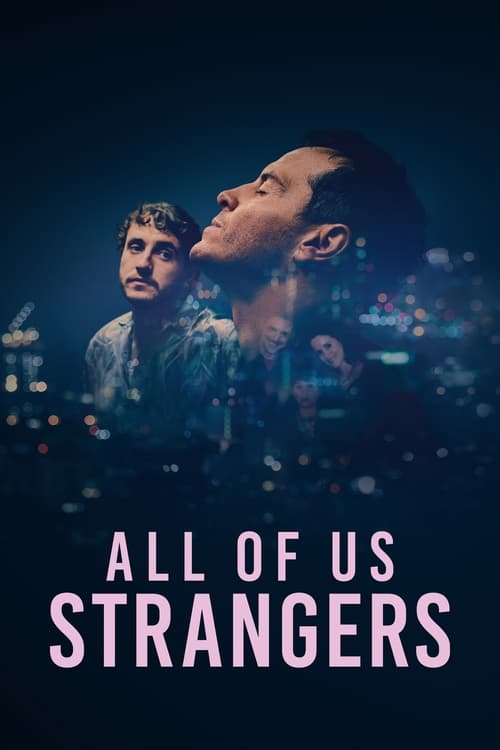
All of Us Strangers
2023 · Andrew Haigh
All of Us Strangers was the internet's collective heartbreak of its year, and its total Oscar shutout fueled a loud "queer cinema always gets snubbed" cycle.
For a night when you want to feel something deeply and don't mind crying — this is a challenge-and-catharsis watch, not comfort food. Reach for it when you're thinking about family, lost time, or the people you never got to say things to.
What it's about
Adam, a lonely screenwriter living in a nearly empty London tower block, is jolted out of his solitude when Harry, a neighbor from a lower floor, knocks on his door one night. As a tentative romance begins, Adam starts taking trips back to his suburban childhood home, where the past turns out to be far less finished than he thought. What unfolds is a love story braided with a ghost story — about grief, coming out, and the conversations we never got to have with our parents.
The experience
Quiet, dreamlike, and devastating — it moves at the pace of memory, drifting between tenderness and ache until scenes of simple domestic conversation land like body blows. It builds a warmth so intimate that the sadness underneath it catches you off guard, and it lingers for days.
Performances
Andrew Scott gives a career-defining performance of guarded longing, doing enormous work with silence and half-finished sentences; Paul Mescal is disarming and vulnerable as Harry, and Claire Foy and Jamie Bell are quietly shattering as parents frozen in the 1980s.
The craft
Andrew Haigh directs with extraordinary restraint, letting long, intimate two-person scenes carry the film, while the photography renders London as a glowing, half-empty dream space and the childhood home in warm, period-perfect detail. The 80s-inflected soundtrack is used with surgical precision — a few needle drops here carry the emotional weight of whole scenes. Headphones or good speakers, and no distractions.
Why it matters
One of the most acclaimed films of 2023, it swept critics' lists, marked Andrew Scott's arrival as a leading man, and confirmed Haigh as a master of intimate, emotionally precise cinema. It has quickly become a touchstone for how queer grief — especially of the generation that came of age in the AIDS-shadowed 1980s — can be put on screen.
Snapshot
All of Us Strangers is Andrew Haigh's fifth feature, a chamber-scaled ghost story that reroutes supernatural machinery into an anatomy of queer grief and inherited silence. Adam (Andrew Scott), a lonely screenwriter in a near-vacant London tower block, begins a tentative romance with a younger neighbor, Harry (Paul Mescal), while making pilgrimages to his suburban childhood home — where he finds his long-dead parents (Jamie Bell, Claire Foy) alive and unchanged, still the age they were when they died some thirty years earlier. The film braids two impossible reunions: with lovers and with the dead. It is at once a coming-out drama staged across the barrier of death, an elegy for the AIDS-shadowed generation of gay men who came of age in the 1980s, and a formal experiment in how memory, dream, and mourning dissolve the ordinary rules of time and space. Adapted freely from a 1987 Japanese novel, it became one of the most acclaimed English-language releases of its year and a touchstone in contemporary discussions of queer cinema and cinematic grief.
Industry & production
The film was produced by Blueprint Pictures — Graham Broadbent and Peter Czernin's outfit, known for the films of Martin McDonagh and Yorgos Lanthimos — with backing from Film4 and Searchlight Pictures, the Disney-owned specialty label that also released the picture theatrically. This places All of Us Strangers squarely within the British subsidized-plus-studio-specialty model that has sustained a certain register of prestige auteur cinema: Film4 development money and a well-capitalized American distributor with awards infrastructure behind it. Searchlight gave the film a platform release in the winter 2023 awards corridor following festival premieres, and it circulated as a specialty title rather than a wide commercial one; precise box-office figures are best confirmed against a dedicated source rather than asserted here.
A notable production fact, widely reported and confirmed by Haigh himself, is that the childhood-home scenes were shot in the actual house in which Haigh grew up in the London suburbs — a biographical layer folded directly into the mise-en-scène. The London flat and tower-block material anchors the film in a recognizably contemporary, depopulated cityscape. The project reunited Haigh with the smaller-scale, character-driven production discipline of his earlier work rather than pushing him toward larger apparatus.
Technology
All of Us Strangers was made with contemporary digital cinema tools, and its visual signature depends heavily on in-camera optical effects — reflections in glass, lens flares, prismatic smears of light, rack focus, and superimposition-like dissolves — rather than on conspicuous digital compositing. The "ghost" premise is realized almost entirely through performance, staging, editing, and light, with no monster-movie VFX; the parents are simply, unnervingly present. The film's most technologically expressive gesture is its final passage, in which two figures in a bed recede into a field of stars — an image achieved through the grammar of the dissolve and scale-play rather than spectacle. In keeping with Haigh's practice, technology serves intimacy: the apparatus is kept subordinate to faces and rooms. (Exact camera and lens packages are the sort of detail worth verifying against a shooting-crew source before being stated as fact.)
Technique
Cinematography
The cinematography is by Jamie D. Ramsay, whose work in the same period (including Living, 2022) shows a comparable feel for soft, memory-inflected light. Ramsay's images for All of Us Strangers are built around thresholds and glass: windows, reflections, the doubling of figures in panes, and the way artificial light — train windows, the tower block's corridors, Christmas bulbs at the parents' house — bleeds and blooms. The palette warms markedly in the childhood-home scenes, tilting toward amber and firelight nostalgia, while the London material runs cooler and emptier. The camera favors handheld proximity and shallow focus, holding on Andrew Scott's face for long stretches so that the fantastical premise registers as interior weather rather than external event. Crucially, the film refuses to visually distinguish "reality" from "vision": the dead parents are lit and shot with the same tactile solidity as Harry, so the viewer, like Adam, cannot draw a firm line around the real.
Editing
Jonathan Alberts, a longtime Haigh collaborator, edits the film to erode temporal and spatial certainty. Transitions between the London flat and the suburban house are frequently elided or made deliberately seamless, so that Adam seems to slip between present and past without the customary connective tissue of travel. The cutting is patient in dialogue scenes — long two-shots and unhurried reactions — but grows more associative and dreamlike as the film advances, particularly in a nightclub-and-ketamine sequence and in the disorienting late movement toward the twist. The film's structure withholds a key fact until near the end, and the editing is complicit in that withholding, never tipping its hand.
Mise-en-scène / staging
Two spaces organize the film. The tower block is a study in modern isolation: vast, half-lit, almost unpopulated, its emptiness a literalization of Adam's solitude (and, retrospectively, a clue to the film's revelation). Against it stands the childhood home, dressed with period-specific 1980s detail — decor, ornaments, a Christmas tree — that operates as a memory palace made physical. Haigh stages the family scenes around ordinary domestic geography: the kitchen table, the boy's old bedroom, the sofa, the front step. Because the location is Haigh's real childhood house, the staging carries an autobiographical charge that the film never announces but consistently exploits. The recurring image of Adam framed alone in enormous windows against the London skyline is the film's central compositional refrain.
Sound
Sound and, especially, music are load-bearing. The score by Emilie Levienaise-Farrouch (also the composer of Living) is spare, ambient, and piano-and-drone-based, providing an undertow of unresolved feeling. Over it, Haigh layers a curated 1980s pop soundtrack that functions as period signifier, emotional text, and thematic engine: Frankie Goes to Hollywood's "The Power of Love" recurs as the film's emotional keystone, associated with the mother and with the closing image; Pet Shop Boys and Blur feature among the needle-drops that root Adam's memory in a specific pop-cultural moment. The songs are not decorative — they carry the burden of nostalgia, queerness, and loss that the sparse dialogue leaves unspoken.
Performance
The film is a showcase for four performances calibrated to intimacy. Andrew Scott plays Adam as porous and wounded, doing much of the film's work in silence and micro-expression; his tearful reunions and confessions to his parents are the emotional core. Paul Mescal's Harry is tender, forward, and quietly desperate, a performance that gains a retrospective ache once the film's structure is understood. Jamie Bell and Claire Foy, playing parents younger than or contemporary with their own "child," achieve the film's most delicate feat: they are simultaneously loving and datedly limited, embodying the era's unexamined attitudes toward homosexuality even as they reach toward acceptance. The scene in which Adam comes out to his mother, and her painful, imperfect response, is among the most discussed performance passages of the year.
Narrative & dramatic mode
Structurally the film operates as a supernatural melodrama that withholds the true nature of its events until a late reversal — the revelation that reframes Harry's presence and the film's entire emotional architecture. Until then it proceeds through two interleaved courtships: Adam's romance with Harry, and his renewed "relationship" with his dead parents, in which he says as an adult everything the child could not. The dramatic mode is confessional and elegiac rather than plot-driven; suspense is largely absent, replaced by the accumulating pressure of grief seeking expression. The fantastical premise is never explained or rationalized, aligning the film with the tradition of the literary ghost story used as psychological allegory. The ending's turn toward the cosmic — bodies dissolving into stars — resolves the film emotionally rather than logically, closing on consolation and continuity rather than closure.
Genre & cycle
All of Us Strangers sits at the intersection of several cycles. It is a ghost story in the interiorized, grief-driven vein — closer to the melancholic supernatural of a film like Truly, Madly, Deeply or Ghost's more sober relations than to horror. It belongs to the contemporary wave of "grief cinema" that uses genre unreality to stage mourning. And it is a landmark entry in 2020s queer cinema, part of a cluster of prestige films centering gay male interiority, intergenerational trauma, and the long shadow of the AIDS crisis. Its fusion of romance, drama, and fantasy — the three genres the film openly wears — makes it resistant to single-cycle classification, which is itself characteristic of the mode.
Authorship & method
Andrew Haigh is the film's decisive author, functioning as both writer and director and drawing on autobiography to a degree unusual even for him. His body of work — Weekend (2011), the HBO series Looking, 45 Years (2015), Lean on Pete (2017) — is unified by attention to loneliness, the texture of relationships, and the gap between what people feel and what they can say. All of Us Strangers consolidates these preoccupations: the queer intimacy of Weekend, the ghost-of-the-past marriage of 45 Years, and a new autobiographical directness. Haigh's method here fuses lived material (his childhood home, his generational experience as a gay man) with adapted source, and favors small crews, long takes, and performance-led shooting.
His key collaborators extend the authorship: cinematographer Jamie D. Ramsay supplies the reflective, memory-warm image; editor Jonathan Alberts, a repeat collaborator, controls the film's temporal slippage and its central withholding; composer Emilie Levienaise-Farrouch furnishes the ambient emotional substrate beneath the pop soundtrack. The screenplay is Haigh's own, adapting Taichi Yamada's novel Strangers (1987) but transforming its heterosexual protagonist into a gay screenwriter and foregrounding the coming-out drama and AIDS-generational subtext absent from the source. Yamada's novel had previously been adapted by Nobuhiko Ōbayashi as The Discarnates (Ijintachi to no natsu, 1988), making Haigh's version the second major screen treatment of the material and a substantial reinvention rather than a faithful translation.
Movement / national cinema
The film is a product of British art cinema, continuous with a national tradition of socially attentive, emotionally restrained realism — but Haigh inflects that tradition with the frank queer intimacy and formal risk of a more personal auteurism. It can be read alongside the strand of contemporary British filmmaking supported by Film4 that pairs kitchen-sink specificity with elevated craft. At the same time, its literary source ties it to a transnational lineage, and its concerns — diaspora of feeling, isolation in the metropolis — are not narrowly national. Within British queer cinema it stands as a successor to Haigh's own Weekend and to the broader post-My Beautiful Laundrette tradition of British films examining gay life against a specific social and historical backdrop.
Era / period
Made and set in the contemporary early-2020s moment — a depopulated, glass-towered London that reads as pandemic-adjacent in its emptiness even where the pandemic is not named — the film is nonetheless obsessed with the 1980s. Its emotional and historical center of gravity is the era of Adam's childhood and his parents' deaths, and, by extension, the years in which a gay man of Adam's/Haigh's generation would have come of age amid Section 28 and the AIDS crisis. The film thus operates across two periods at once: a present of isolation and a past of both familial warmth and social repression, with the 1980s pop soundtrack functioning as the bridge. This doubled temporality is inseparable from the film's meaning; the "period" is not backdrop but the very material of its grief.
Themes
The governing themes are grief, loneliness, and the unfinished business of the dead. The film literalizes a fantasy familiar to the bereaved — the wish to speak once more, as an adult, to a parent lost in childhood — and uses it to stage a delayed coming-out, dramatizing both the longing for parental acceptance and the historical impossibility of it in the era the parents inhabit. Intergenerational silence and inherited shame run throughout, as does the specific weight of queer loneliness and the ghosting effect of the AIDS generation, whose absence haunts the near-empty tower block. Memory, nostalgia, and the unreliability of the remembered past are formal as much as thematic concerns. And underlying all of it is a meditation on love as a force that persists across the boundary of death — the "power of love" the film's recurring song names outright, resolved in a final image of union dissolving into the cosmos.
Reception, canon & influence
Critically, All of Us Strangers was among the most warmly received English-language films of 2023, praised in particular for Haigh's screenplay and direction, the four central performances (Andrew Scott's especially), and the film's fusion of formal control with raw feeling; the coming-out and reunion scenes were singled out as emotional high points. It featured on numerous year-end best-of lists and drew significant awards attention in the British sphere, including multiple BAFTA nominations, while its comparative absence from the top American awards races became a minor point of critical debate about the recognition of queer cinema. (Specific nomination and award tallies should be checked against an authoritative record before being cited precisely.)
Its influences run backward to Taichi Yamada's novel and, through it, to the tradition of the literary ghost story as psychological allegory; to Ōbayashi's earlier The Discarnates; and, within Haigh's own oeuvre, to the loneliness and lost-time preoccupations of Weekend and 45 Years. More broadly it stands on the shoulders of the melancholic supernatural romance and of queer British cinema's tradition of situating gay life within precise social history.
Looking forward, the film quickly entered the conversation as a modern reference point for "grief cinema" and for queer melodrama that uses unreality to reach the unsayable — a work invoked alongside its contemporaries whenever critics discuss the 2020s wave of films about mourning, memory, and gay male interiority. Its long-term canonical position is still settling, as is inevitable for so recent a film, but its immediate impact on critical discourse — cementing Haigh's standing as a major contemporary auteur and Andrew Scott's as a leading dramatic actor — is already clear. Where its ultimate influence on subsequent filmmakers lands remains, honestly, too early to fix with confidence.
A Deleuzian reading
A man stands at a window on a high floor of a nearly empty tower.
The full Deleuzian reading of All of Us Strangers →
Reception
Rapturously received from its Telluride premiere onward and a six-time BAFTA nominee, yet its total Oscars shutout became one of 2024's loudest snub discourses — the freeze-out only cemented its status as the great overlooked film of its year.
How All of Us Strangers was received, from release to now →
How to watch All of Us Strangers: what to notice on a first viewing
- Watch for Adam's reflection doubled in glass and windows. Ramsay keeps framing Adam through windows, train glass, and reflective panes, so his face floats over the world outside rather than standing apart from it. He is always shown as two overlapping images at once, which is exactly the condition the whole film is built around.
- Notice the childhood house glow amber while London stays cold. The palette turns warm, amber, and firelit whenever Adam is at his parents' house, and cools back down to something emptier once he returns to the tower block. You can feel which world is which from the temperature of the light.
- Listen for the same song returning at different moments. Frankie Goes to Hollywood's Power of Love recurs across the film, tied to Adam's mother and to key emotional moments, doing work the sparse dialogue leaves unspoken. The song is carrying feeling the characters cannot say out loud, and it keeps arriving exactly when the silence gets heaviest.
- Notice how empty and half lit the tower block feels. Adam's tower is vast, dim, and nearly unpopulated, while his childhood house is dense with 1980s period detail, a Christmas tree, ornaments, a kitchen table. The two spaces never blend. One space is built from almost nothing and the other from too much memory, and Adam moves between the two without much warning.
- Watch Andrew Scott's face held in silence for long stretches. Scott plays Adam mostly through small shifts in expression rather than dialogue, and the camera holds on him long enough that you start reading feeling in tiny increments. Most of what Adam actually feels is happening on his face in silence, not in anything he says out loud.
The whole guide to watching All of Us Strangers, with the keys for a rewatch →
Influences: the films it descends from and the films it influenced
- The Discarnates (1988) — The first screen adaptation of Yamada's novel, establishing the core architecture Haigh inherits — a lonely writer who visits his dead parents in the preserved childhood apartment while a fellow tenant/lover drains his life force, resolved by a late supernatural reveal.
- Weekend (2011) — Haigh's own template for the shallow-focus handheld two-hander, where queer intimacy is built out of long, unhurried dialogue takes that let attraction and confession unfold in near-real-time.
- 45 Years (2015) — Supplies the withheld-revelation engine and the marriage haunted by a preserved past, driven by performance-led long takes and a quiet late reversal that retroactively recolors everything before it.
- Distant Voices, Still Lives (1988) — Model for autobiographical working-class British memory assembled from period needle-drops, where pop songs function as emotional time-machines rather than scoring.
- The Long Day Closes (1992) — Stages the childhood home as a memory-space bathed in warm nostalgic light, using popular music and slow camera drift to render a lonely boy's interiority directly.
- Don't Look Now (1973) — Its associative cross-cutting collapses past and present, deploys reflections and glass as motifs of the uncanny, and delivers grief through elliptical editing capped by a withheld final reversal.
- Truly Madly Deeply (1990) — The British grief-ghost romance in which the returned dead are present chiefly so the bereaved can talk the loss through and finally release them — the emotional logic Haigh applies to parents rather than a lover.
- Three Colours: Blue (1993) — Uses a recurring, swelling musical motif as the ambient substrate of mourning and carries grief almost entirely on one actor's face in shallow, held close-ups.
- Mirror (1975) — Pioneers the temporal slippage between an adult present and the childhood home, letting the protagonist encounter a parent as a young person unmoored from linear chronology.
- Wild Strawberries (1957) — The return to the childhood home and the dreamlike reunion with parents as a route to late-life reconciliation — the confessional structure of revisiting the dead to repair the self.
- Drive My Car (2021) — Grief addressed through intimate confessional conversation with the absent/dead inside enclosed domestic spaces; the affectless-precise acting register in which what is withheld is more dramatic than what is spoken; duration held past the point of social comfort.
- Blue Jean (2023) — Reaches back into the Section 28-era queer childhood shadow with the same restrained, suppression-focused register, extending the contemporary British cycle re-examining the 1980s closet.
- Aftersun (2022) — Reconstructs a lost parent from fragmentary memory using era-specific needle-drops and aggressive temporal elision, fusing rigorous formal control with grief that is withheld until it detonates.
- Moffie (2019) — Cinematographer Jamie D. Ramsay's signature shallow-focus handheld and memory-warm, reflective light applied to queer trauma and repressed desire.
- Living (2022) — Ramsay again, working a muted period palette and glassy, reflection-laden compositions in service of mortality and a man reckoning with a wasted, lonely life.
- A Ghost Story (2017) — A grief-ghost story that runs on an ambient drone score and elastic, non-linear time, letting a dead figure linger in a domestic space to process unfinished attachment.
- Petite Maman (2021) — Uses gentle, unexplained unreality to let a child meet a parent as a contemporary peer, working through loss through quiet fantasy rather than genre spectacle.
- The Eternal Daughter (2022) — A ghost story about a dead mother staged within a single doubled interior space, holding back its central reveal so that the reunion's true nature only resolves at the end.
- Past Lives (2023) — Contemporaneous counterfactual-romance built on threshold-crossing and the conversation with a lost past self, sharing Past Lives' negative-space framing, elliptical time logic, and tear-suspended emotional restraint.
- Hamnet (2025) — Channels Paul Mescal's quiet, recessive presence into a domestic mourning drama that lets absence rather than incident carry the tragedy.
- Twinless (2025) — Queer grief rendered in a muted palette and long takes lingering on faces, the same restrained visual scheme for processing male loss and loneliness.
- Pillion (2025) — Haigh's later Element-tier queer feature handles explicit gay intimacy through intimacy coordination as craft, the same care-as-method authorship Pillion practices.
- Queer (2024) — Runs the parallel technique of letting the needle drop carry the emotional argument while continuity quietly slips — a room, a train, a body persisting where the timeline says it shouldn't — so the unreality arrives without a marked transition.
- Pressure (2026) — Jamie D. Ramsay's practice of lighting interiors as whole fields from practical and window sources rather than as discrete setups, which is what permits Pressure's atrium to be pre-lit and played continuously along its axis.
Similar films
- Weekend (2011) — influence & lineage
- 45 Years (2015) — influence & lineage
- The Long Day Closes (1992) — influence & lineage
- Ghostlight (2024) — same viewing thread
- Twinless (2025) — same viewing thread
- The Holdovers (2023) — same viewing thread
- A Man Called Ove (2015) — same viewing thread
- We Live in Time (2024) — often watched together
All the films related to All of Us Strangers →
Watch it with: curated runs of related films
- Funny Because It Aches — A run of tender, deadpan dramedies where love, grief, and the panic of becoming yourself all get metabolized through jokes — watch these when you want to laugh and cry in the same scene.