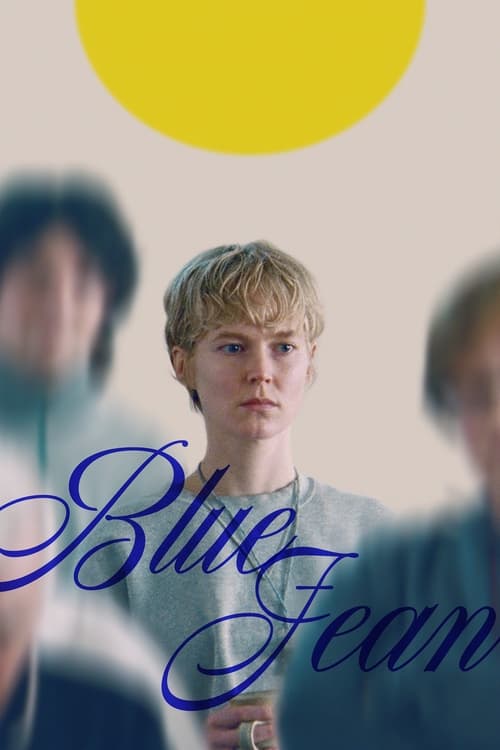
Blue Jean
2023 · Georgia Oakley
For when you want a serious, absorbing drama that earns its emotion — closer to a character study than a history lesson. A challenge, not a comfort watch, but a deeply humane one.
What it's about
Newcastle, 1988. Jean teaches PE by day and keeps her life as a lesbian sealed off from school, where a new law — Section 28 — has made her existence a firing offense in all but name. Then a new student spots her at the gay bar she frequents, and the wall between her two lives starts to crack. What follows is a slow squeeze: her job, her girlfriend, and her sense of who she is all pulling in different directions.
The experience
Quiet, tense, and intimate — the fear here isn't loud, it's ambient, the kind that lives in staffroom small talk and a glance held a beat too long. It builds a knot in your stomach through small compromises rather than big confrontations, and it stays with you after.
Performances
Rosy McEwen is remarkable as Jean — a performance built on watchfulness and self-control, where you can read the cost of every lie in her face without her ever announcing it. Kerrie Hayes brings warmth and defiance as her out-and-proud girlfriend, the film's counterweight.
The craft
Shot on 16mm, it has a soft, grainy, washed-denim look that makes 1988 feel lived-in rather than costumed — all municipal sports halls, smoky bars, and pale northern light. Georgia Oakley's writing trusts silence and implication; the politics arrive through atmosphere and self-censorship, never speeches.
Why it matters
One of the most acclaimed British debuts of its decade, it brought Section 28 — a law many viewers had never heard of — back into public conversation and announced Oakley and McEwen as major talents.
Snapshot
Blue Jean is the feature debut of British writer-director Georgia Oakley, a period drama set in Newcastle in 1988 against the passage of Section 28 — the clause of the Local Government Act that prohibited local authorities and, by chilling extension, schools from the "promotion of homosexuality." Jean (Rosy McEwen), a physical-education teacher, keeps her lesbian life sealed off from her workplace; the arrival of a new pupil, Lois (Lucy Halliday), who recognizes Jean in a gay bar, collapses the wall between her two worlds and forces a series of moral compromises. The film is compact, interior, and deliberately unspectacular in its politics: the historical menace of the legislation is felt not through parliamentary set-pieces but through self-censorship, ambient fear, and the small betrayals of self-preservation. Shot on 16mm and steeped in the muted palette and pop-cultural texture of late-Thatcher Britain, it belongs to a recent wave of British queer historical cinema that reclaims the 1980s as living memory rather than distant heritage. It premiered on the festival circuit in 2022 and reached wider release in 2023, and it announced Oakley and McEwen as significant new talents.
Industry & production
Blue Jean is a British independent production, developed and financed within the UK's public-service-adjacent funding ecosystem — BFI and BBC Film support are central to the film's existence, the characteristic backing structure for first features of this scale and subject. It was produced by Hélène Sifre, with Oakley writing and directing; the project fits the model by which the BFI Film Fund and BBC Film cultivate debut auteurs working in modestly budgeted, socially engaged drama. Precise budget figures are not something I can reliably cite, and I will not invent one, but the film's scale — limited locations, a tight principal cast, regional shooting in the North East of England — is consistent with a low-budget independent feature.
The film's industrial pathway ran through the festival-and-awards circuit rather than a wide theatrical rollout. It premiered in the autumn 2022 festival season and won the audience award in the Giornate degli Autori (Venice Days) sidebar at the Venice Film Festival, an early signal that gave the film momentum. It went on to a strong showing at the British Independent Film Awards, where it was among the most-nominated and most-awarded titles of its year; I'd caution that I cannot recite the exact tally of wins from memory, so I'll characterize it as a leading BIFA contender rather than list categories I'm unsure of. Distribution followed in 2023 — Altitude in the UK and Magnolia Pictures in the United States are the distributors I associate with the release — positioning it as a specialty/art-house theatrical title supported by critical attention rather than marketing spend.
Technology
The defining technological choice is the decision to originate on 16-millimetre film. In a production era dominated by digital capture, shooting Super 16 is an aesthetic and ideological commitment: the format's visible grain, its softer resolution, and its particular rendering of color and skin bind the image to the analog textures of the 1980s the film depicts. The choice functions as period signature — 16mm was the workhorse gauge of British television drama and documentary in the era — and as an argument that the past should look lived-in rather than glossily restored. Beyond origination, the film's technological profile is modest and appropriate to its scale: naturalistic location work, practical and available light favoured over large lighting rigs, and a post-production chain built to preserve the filmic grain rather than sand it away in the grade. There is no reliance on visual effects or spectacle; the "technology" of the film is, pointedly, the older technology it chooses to honor.
Technique
Cinematography
The cinematography is credited to Victor Seguin, whose work is among the film's most-praised elements. The Super 16 image is handled to emphasize confinement and watchfulness: framings tend to be close and boxed, isolating Jean within the frame and within her own guardedness. The film has been widely described as using a constrained, nearly squared-off framing that evokes the television of the period and the sense of a life boxed in — I'd flag that I'm confident about the boxed, period-television quality of the compositions but would not over-specify an exact aspect ratio I can't verify. The palette is period-coded — bleached blues, denim tones, the film's own name folding the character (Jean) into a color and a fabric. Blue recurs as a motif of both identity and melancholy, most visibly in Jean's bleached hair and the cool cast of the domestic and school interiors. Camera movement is restrained; the film prefers a still, observational eye that makes Jean's face the primary landscape and lets the grain of the stock carry emotional temperature.
Editing
Editing is credited to Izabella Curry. The cutting favours patience and interiority over incident, holding on Jean's reactions and letting scenes accumulate dread rather than resolve it cleanly. The film's structure is a slow tightening: the editorial rhythm withholds relief, cross-cutting Jean's separate lives — the staffroom, the classroom, the gay bar, the flat she shares with her girlfriend Viv — so that the audience feels the exhausting labor of compartmentalisation. A recurring device is the intercutting of television, notably the dating game-show Blind Date, which threads through the film as an ironic counter-text about performance, coupling, and the public staging of desire; the editing uses these interludes as tonal and thematic punctuation rather than mere period dressing.
Mise-en-scène / staging
Oakley and her collaborators build the period through accumulation of the everyday: the beige-and-denim domesticity of the flat, the strip-lit institutional grays of the school, the neon-and-smoke intimacy of the women's bar. The staging insists on the division of spaces — Jean physically crosses between worlds that must never touch, and the production design keeps those worlds visually distinct so that their collision (when Lois appears in both) carries a genuine shock. Costume and hair do heavy period work, with Jean's peroxide crop reading simultaneously as fashion, armor, and a coded, deniable form of self-expression. The bar interiors function as the film's one zone of relative safety and color, set against the muted danger of the outside.
Sound
The soundscape leans on period pop and the ambient media of 1988 — radio, television, the game-show chatter — to locate the film precisely in time and to externalize Jean's sense of a culture that is loudly, casually heterosexual. The original score is credited to Chris Roe, whose contribution is restrained and mood-setting rather than emphatic, supporting the film's interiority. Diegetic sound — the squeak of a gym floor, the hush of a staffroom, the din of a club — is used to mark the borders between Jean's compartments. Naturalistic dialogue recording and the quiet management of silence are as important as the needle-drops; the film often lets discomfort sit without musical rescue.
Performance
Rosy McEwen's central performance is the film's engine and its most acclaimed feature. It is a study in suppression: McEwen plays Jean largely through what she withholds — micro-hesitations, guarded eyes, the physical vigilance of someone perpetually editing herself. The performance refuses easy heroism; Jean's compromises, including her failures toward the vulnerable Lois, are allowed to be genuinely unflattering, which is the source of the film's moral seriousness. Kerrie Hayes as Viv, Jean's more openly political girlfriend, supplies a contrasting mode of queer life — visible, communal, unwilling to shrink — and the friction between the two women dramatizes the era's competing survival strategies. Lucy Halliday as Lois gives the film its destabilising third point, a teenager whose need and courage expose the cost of Jean's caution. The ensemble across the school and bar scenes sustains the naturalism the film depends on.
Narrative & dramatic mode
The dramatic mode is realist, intimate, and morally ambiguous — closer to the character study than the issue film, though it is unmistakably an issue film in its bones. The narrative is organized around a single protagonist's crisis of conscience rather than a plotted external conflict: the "threat" is diffuse (a law, a culture, a student's mere presence) and internalized. Suspense is generated not by whether Jean will be exposed in a thriller sense but by watching the moral erosion that self-protection demands of her. The film resists a redemptive arc; its power comes from letting Jean be complicit as well as victimized. This is drama in the British social-realist tradition — observational, empathetic, distrustful of catharsis — inflected with a subjective, almost expressionist attention to one woman's inner weather.
Genre & cycle
Blue Jean sits at the intersection of the British social-realist drama, the queer period film, and the teacher-in-crisis narrative. It belongs to a discernible contemporary cycle of British and Irish films reckoning with the recent queer past and specifically with the trauma of Section 28 — a wave revisiting the 1980s not as safely historical but as the formative, still-raw context for present-day LGBTQ+ life in Britain. Within the broader lineage of queer cinema it converses with earlier British works about desire under prohibition, and within realism it draws on the Ken Loach / Andrea Arnold tradition of regional, working- and lower-middle-class portraiture. Its particular contribution to the cycle is its focus on the institutional pressure of Section 28 on a teacher — the very profession the law most directly menaced.
Authorship & method
The film is a first-feature auteur statement by Georgia Oakley, who both wrote and directed and whose control of tone and moral ambiguity is the film's signature. Oakley's method here is one of restraint and specificity: she resists melodrama and speechifying, trusting texture, face, and situation to carry political meaning. Her key collaborators form a coherent authorial team — cinematographer Victor Seguin, whose 16mm image is inseparable from the film's meaning; editor Izabella Curry, whose patient cutting sustains the interiority; composer Chris Roe, whose spare score supports rather than dictates; and producer Hélène Sifre, who shepherded the project through the BFI/BBC Film system. Above all the authorship is shared with Rosy McEwen, whose performance realizes Oakley's conception of a protagonist defined by suppression. The collaboration reads as unusually unified for a debut, which is part of why the film was received as a mature, fully-formed work rather than a promising rough draft.
Movement / national cinema
This is emphatically a work of contemporary British national cinema, and specifically of its publicly-funded, regionally-rooted, socially-conscious strand. It extends the long British tradition of social realism while participating in a newer, distinctly queer and often woman-authored current within that tradition. Its Northern English setting matters: the film is part of a decentring of British cinema away from London, using Newcastle and the North East as more than backdrop. It also belongs to the international conversation of queer historical filmmaking, but its idiom — the funding, the realism, the specific legislative memory of Section 28 — is nationally particular. The film's festival path (a Venice sidebar, then a strong BIFA presence) is the classic circuit by which British independent cinema builds its reputation.
Era / period
Blue Jean is a period film about 1988 made in the early 2020s, and the gap between those moments is thematically load-bearing. Section 28 was passed in 1988 and not repealed until the early 2000s (2003 in England and Wales), and the film arrives at a time of renewed political struggle over LGBTQ+ rights and, especially, over what may be said about sexuality and gender in schools. The film's period reconstruction — the media, the music, the fashions, the 16mm grain — is therefore not nostalgia but argument: it insists that the mechanisms of the past are legible in, and warning to, the present. As a document of its own moment of production, it reflects a cultural appetite for reckoning with the costs Section 28 imposed on a generation of teachers, students, and families.
Themes
The central theme is the cost of the closet under state coercion — the way legally-mandated silence corrodes character, forcing decent people into cowardice and self-betrayal. Related is the theme of the divided self: Jean's two compartmentalised lives, and the impossibility and exhaustion of maintaining them. The film examines complicity and moral compromise, refusing to let its protagonist off the hook and thereby indicting the system that produces such choices rather than the individual alone. It contrasts visibility versus survival through Jean and Viv, staging a genuine and unresolved argument about whether safety or openness is the truer form of resistance. Institutional power — the school as an apparatus of normativity — runs throughout, as does the surveillance of desire, figured in Lois's gaze, the community's watchfulness, and the recurring television motif of publicly staged coupling. Underneath all of it is a study of fear as a daily climate, the quiet weather in which ordinary lives are deformed.
Reception, canon & influence
Critical reception was strongly favourable, concentrating praise on McEwen's central performance, Oakley's assured, unsentimental direction, and Seguin's 16mm cinematography; the film was widely received as one of the most accomplished British debuts of its year. Its awards profile — the Venice Days audience award and a leading position at the British Independent Film Awards — confirmed that institutional esteem, though I'd caution against my reciting an exact win-count I can't verify. A minority of critical response noted the film's restraint could read as narrowness, but the dominant view treated its containment as a strength.
Influences on the film (backward): Blue Jean draws on the British social-realist lineage (the Loach–Arnold tradition of empathetic regional portraiture) and on the broader history of queer cinema about forbidden or hidden desire. Its recovery of the 1980s connects it to prior British films and television about the AIDS era and Section 28's shadow, and its subjective, face-centred realism aligns it with the intimate character studies that strand has produced.
Legacy / what it shaped (forward): As a recent film, its long-term influence is still forming, and I want to be careful not to overstate it. Its most tangible immediate impact is as a career-launching work — establishing Georgia Oakley as a filmmaker to watch and vaulting Rosy McEwen to critical prominence — and as a prominent entry in the ongoing cycle of British and Irish films re-examining Section 28 and the queer 1980s. It has become a frequent reference point in discussions of that cycle and of contemporary British queer cinema, and it stands as evidence of what the BFI/BBC Film development model can produce. Whether it comes to be seen as a canonical text of the period will depend on how that cycle matures; what can be said now is that it is one of its most critically respected examples.
Reception
Premiered at Venice 2022 where it took the Venice Days People's Choice Award, then swept into the BIFAs with 13 nominations and four wins — no reappraisal needed, it arrived acclaimed and has only consolidated since as a word-of-mouth favorite of recent British queer cinema.
How Blue Jean was received, from release to now →
How to watch Blue Jean: what to notice on a first viewing
- Notice the tight, nearly squared-off framing throughout. Seguin's Super 16 image keeps Jean boxed and close, a constrained composition that evokes the television of the period and a life kept small on purpose. The frame itself feels guarded, the way Jean has trained herself to be.
- Watch for blue and denim tones through the film. Bleached blues recur in Jean's hair, her flat, and the school, tying her name to a color and a fabric that repeats scene after scene. The palette makes her identity visible in every shot, whether or not the scene says a word about it.
- Watch Jean's face for what she isn't saying. McEwen plays Jean mostly through withholding, micro-hesitations and guarded eyes, a body visibly editing itself in every scene at school. The performance makes suppression itself visible, which is what the whole film is actually about.
- Notice the film cutting between the staffroom and the bar. Curry's editing keeps crossing between Jean's separate lives, the classroom, the flat, the gay bar, so the audience feels the labor of keeping them apart. You start to feel exhausted by the compartmentalizing right alongside her.
The whole guide to watching Blue Jean, with the keys for a rewatch →
Influences: the films it descends from and the films it influenced
- Jeanne Dielman, 23 quai du Commerce, 1080 Bruxelles (1975) — Its fixed, patient observational camera holding a woman inside boxed domestic frames — trapping interiority in architecture rather than dialogue — is the formal grammar Oakley adopts to render Jean's suppression.
- Kes (1969) — The Loach template of unsentimental, texture-first regional realism that lets situation and face carry politics without speechifying is the social-realist restraint Blue Jean inherits.
- My Beautiful Laundrette (1985) — Embeds forbidden queer desire directly inside Thatcher-era British social realism, the exact fusion of period-political milieu and hidden intimacy Oakley returns to for Section 28.
- Beautiful Thing (1996) — Uses period pop as diegetic emotional release valve for closeted desire (the Mama Cass needle-drops), prefiguring Blue Jean's use of period-pop diegesis to voice what characters cannot say.
- Ratcatcher (1999) — Poeticized social realism built from held, still compositions and tactile grain rather than plot momentum — the observational stillness Seguin's 16mm image extends.
- Fish Tank (2009) — The Academy 1.33:1 boxing of a working-class woman within claustrophobic frames on grainy stock is the direct lineage for Blue Jean's boxed-framing confinement of its heroine.
- Weekend (2011) — Established the naturalistic, near-scoreless mode of British queer intimacy built on diegetic sound and long observational takes that Oakley's restrained-score approach descends from.
- Carol (2015) — Films desire through obstructing, boxed and glass-fractured frames as a suppression study of surveilled longing — the compositional strategy Blue Jean reworks for the closet under Section 28.
- Three Colours: Blue (1993) — Builds a saturated monochrome blue field as the externalized interior state of a woman withdrawing from the world, the color-as-emotion device echoed in Blue Jean's blue palette.
- Aftersun (2022) — Deploys Super-16 grain intercut with lower-fidelity video (camcorder) and a restrained score to build memory and interiority — the same technology/format and intercutting palette as Blue Jean's Super-16 and television intercuts.
- All of Us Strangers (2023) — Reaches back into the Section 28-era queer childhood shadow with the same restrained, suppression-focused register, extending the contemporary British cycle re-examining the 1980s closet.
- Sense and Sensibility (2026) — Oakley's debut built a performance of concealment out of long close-ups on a face holding back feeling, the same method she now applies to Elinor's self-suppression.
- Portrait of a Lady on Fire (2019) — Shares the withheld-look grammar and a composed, nearly scoreless still camera that makes surveillance of desire the film's central formal event.
- God's Own Country (2017) — Extends the same British queer social realism of emotional suppression — meaning carried in withheld gesture and landscape texture rather than confession.
- The Miseducation of Cameron Post (2018) — An 80s-set queer coming-of-age filmed as institutional surveillance and enforced concealment, sharing the cost-of-the-closet study under an era of state-sanctioned suppression.
- Great Freedom (2021) — Uses restrained, observational compartmentalised framing (the prison cell) to dramatize criminalised, surveilled desire, a sibling study in containment as form.
- Femme (2023) — A contemporary British queer film using cross-cutting between hidden and public selves and a divided-spaces staging of concealment, part of the same cohort mapping surveillance of queer identity.
Similar films
- Great Freedom (2021) — influence & lineage
- Carol (2015) — influence & lineage
- Girls Like Girls (2026) — shared sensibility
- Short Term 12 (2013) — shared sensibility
- Blue Film (2026) — shared sensibility
- Sense and Sensibility (2026) — shared sensibility
- Nickel Boys (2024) — shared sensibility
- Blue Is the Warmest Color (2013) — shared sensibility