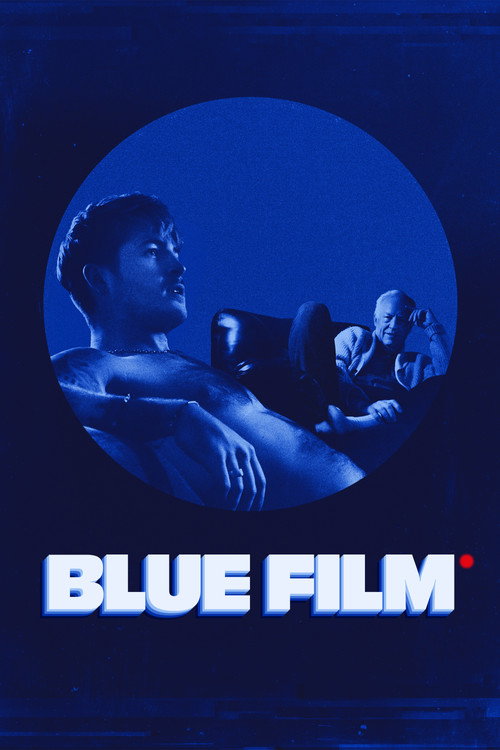
Blue Film
2026 · Elliot Tuttle
For when you want something raw and confrontational — a late-night watch that gets under your skin and starts an argument with itself. This is a challenge, not comfort viewing.
What it's about
Aaron Eagle is a queer camboy in Los Angeles, doing the work for easy money and the safety of anonymity, when a mysterious stranger pays for a private booking. What should be a routine transaction turns strange: the man on the other side of the camera turns out to be someone Aaron already has a personal connection to. The film sits inside that collision — sex work, screens, and the moment the anonymity you were counting on collapses.
The experience
Intimate, provocative, and deliberately uncomfortable — a chamber drama that trades in exposure, shame, and the strange charge between two people who can see each other too clearly. It's short and concentrated, the kind of film that leaves you unsettled rather than resolved.
The craft
At a tight 85 minutes, it's built like a pressure chamber: essentially two people, a transaction, and the camera between them. The cam-session framing does real work — screens, feeds, and performance-for-pay become the film's visual language, so the act of watching is never neutral.
Why it matters
It belongs to a current wave of queer American independent cinema taking sex work and platform-mediated intimacy seriously as drama — treating the cam economy not as scandal but as a place where identity and desire get negotiated.
Snapshot
Blue Film is an 85-minute American drama, in English, set in Los Angeles, concerning a queer camboy named Aaron Eagle who takes a private paid booking — drawn, per the synopsis, by "the promise of easy money and anonymous sex" — and discovers that the stranger on the other side of the transaction is someone to whom he already has a personal connection. The premise is a recognition plot fitted to the architecture of the contemporary sex-work platform: the camera that was supposed to guarantee anonymity becomes the instrument that collapses it.
A caveat belongs at the top rather than buried. The documentary record for this film, as of this writing, is genuinely thin. What can be established from primary catalogue data is the following: TMDB ID 1398655, IMDb tt34915693, a recorded release date of 8 May 2026, a runtime of 85 minutes, a single genre classification (Drama), US origin, English language, and a small-sample TMDB user rating of 7.4 against low popularity. No cast list, crew credits, production company, budget, festival itinerary, or body of published criticism is available in the sources at hand. Everything below distinguishes carefully between what the record supports about this film and the well-documented film history against which it can be read. Where a claim is contextual rather than verified, it is marked as such. No credits, quotations, reviews, or financial figures have been supplied where none exist.
Industry & production
The production particulars are not documented in the available record, and it would be irresponsible to invent them. What the available metadata does support is a set of industrial inferences with reasonable confidence.
An 85-minute runtime is the signature length of the American microbudget festival feature — long enough to qualify as a feature under every major festival's rules, short enough to be shot in a compressed schedule and to sit comfortably in a programmer's afternoon slot. A Los Angeles setting for a film about a sex worker is, in industrial terms, a shoot-where-you-live decision as much as a thematic one: LA has been the default location for American microbudget filmmaking about sexual labor since at least Fred Halsted's L.A. Plays Itself (1972), and it remains so in the work of Sean Baker, whose Starlet (2012), Tangerine (2015) and Red Rocket (2021) established the dominant contemporary template — small crews, real locations, performers drawn from and near the world depicted.
The recorded May 2026 release date should be read with care. For films at this scale, catalogue release dates frequently mark a festival premiere, a limited theatrical window, or a digital/VOD drop rather than a conventional wide release, and the available data does not distinguish among these. The absence of a documented distributor is itself weak evidence of the tier the film occupies: queer microbudget features in the 2020s have generally reached audiences through a narrow set of routes — the LGBTQ+ festival circuit (Outfest, Frameline, BFI Flare, Inside Out), the discovery sidebars of the larger festivals, and specialty streaming labels. This is context, not a claim about Blue Film's actual path.
Technology
The film's subject is a technology. Cam performance as a commercial form is roughly as old as consumer broadband: token-based live-streaming platforms consolidated in the early 2010s, and the subscription model that reorganized the field around named, persistent personas arrived with OnlyFans in 2016 and scaled enormously during the pandemic. Two regulatory shocks shaped the world the film's protagonist would be working in. SESTA/FOSTA, signed into US law in April 2018, stripped platforms of intermediary immunity for content facilitating prostitution and drove much online sex work off general-purpose sites and into a smaller number of compliant, identity-verifying platforms. In 2021, payment-network policy did further work that legislation had not: OnlyFans briefly announced a ban on sexually explicit material in August of that year before reversing within days under user pressure, and Mastercard's expanded content requirements for adult sites took effect that autumn. The net effect was a sex-work economy that is simultaneously more visible, more corporate, more surveilled, and more dependent on documented identity than at any prior moment.
That last condition is the technological premise of the plot. Anonymity on a cam platform is a product feature, not a fact — it is manufactured by the interface and can fail. A film whose turn depends on a client turning out to be known is a film about the thinness of that manufactured distance. By 2026 a further pressure had entered the discourse around the form: synthetic and AI-generated performers competing with live ones, which sharpens the question of what exactly a paying viewer is buying when they buy a person's real time.
On the production side, the mid-2020s microbudget baseline is large-sensor digital capture — the Sony FX-series, Blackmagic, or an ARRI Alexa Mini/35 at the upper end — frequently paired with adapted vintage still glass for texture, and screen material composited in post rather than played back practically on set. This is the general state of the craft in 2026 and is offered as context; the specific package used on Blue Film is not documented.
Technique
A methodological note. This dossier's author has not had access to the film, and no shot-level description would be honest. What follows therefore sets out the problems the premise poses to each craft department and the established repertoire of solutions that comparable films have used — the field of choices, not an account of the choices made.
Cinematography
A cam drama presents a hard formal problem: it contains at least two image regimes. There is the performance image — the camboy's own feed, framed by him, lit by him, addressed directly to a lens, conventionally soft and warm and shot in the vertical or fixed-frontal grammar of the platform — and there is the film's own image, which watches him make that image. Every film in this line has had to decide how porous the boundary between the two should be. The maximalist option is full screenlife, the mode Timur Bekmambetov named and Unfriended (2015), Searching (2018), Profile (2018) and Host (2020) systematized, in which the desktop is the entire frame. The minimalist option, more common in drama, is to keep the feed as an inset object within a conventionally photographed world — the strategy of Cam (Daniel Goldhaber, 2018), which uses the interface as a source of horror precisely by cutting between the polished broadcast self and the ordinary room producing it. A two-hander built around a paid private session pushes toward the chamber-film end of the spectrum: sustained takes, a confined location, and a camera whose proximity has to negotiate the difference between erotic looking and clinical looking. The relevant precedents for that negotiation are Andrew Haigh's Weekend (2011) and Alain Guiraudie's Stranger by the Lake (2013), both of which found ways to photograph sex without either coyness or the pornographic conventions the films are thinking about.
Editing
The dramatic engine — a stranger who is not a stranger — is a recognition structure, and recognition structures live or die in the cut. The editor's central decision is where the audience's knowledge sits relative to Aaron's: if we learn the connection before he does, the film becomes suspense and the session plays as dramatic irony; if we learn it with him, it becomes a shock and the film's second half becomes an aftermath. A third possibility, associated with Gregg Araki's Mysterious Skin (2004), is to braid two timelines so that the connection is assembled by the audience across the whole film rather than delivered at a point. The second editorial burden is rhythmic: cam labor is durational, repetitive, and boring in ways that are dramatically meaningful, and the film has to represent that duration without inflicting it. This is the problem Manuel Abramovich's Pornomelancolía (2022) addressed by letting the flatness stand.
Mise-en-scène / staging
The bedroom-as-studio is the film's defining space: a private room dressed for public consumption, with ring light, monitor, and a single wall chosen for how it reads on camera. Its power as a set is that it is two rooms at once, and staging can make the seam visible simply by moving the camera past the edge of the broadcast frame. The Los Angeles exteriors implied by the keyword record bring their own inheritance — the hustler topography of Santa Monica Boulevard in Bruce LaBruce and Rick Castro's Hustler White (1996), the industry-adjacent Valley of The Fluffer (Glatzer and Westmoreland, 2001), the sun-bleached transactional city of Baker's films. A private booking, meanwhile, forces a second space — hotel room, client's house — whose furnishing is the film's clearest available statement about the class asymmetry inside the transaction.
Sound
Two registers again. The platform's audio is compressed, close-miked, and performed: the cam voice is an intimacy technology, and the microphone is as much the instrument of the work as the camera. Against it sits the film's own acoustic space, and the gap between performed intimacy and unperformed silence is available as the film's most economical dramatic tool — the sound of a room after the stream ends. No composer is credited in the available record. The convention in this corner of American independent film runs to sparse electronic scoring or to source-heavy soundtracks that place the character socially, and either would be unremarkable here; which was used is not established.
Performance
The lead role is unusually demanding because it is at minimum a double performance: the persona "Aaron Eagle" transmits to an audience, and the person operating him does not. An actor must play a character playing a character, calibrate the moment the mask slips, and do this while nude or near it under conditions that the film's own subject makes self-reflexive. The closest performance precedents are Madeline Brewer in Cam, Sophie Kauer's contemporaries in the sex-work realist mode, Ruaridh Mollica in Mikko Mäkelä's Sebastian (2024), and — as the founding case — Joe Dallesandro in Paul Morrissey and Andy Warhol's Flesh (1968), whose affect-free availability to the camera established a durable model for how bodies for sale are performed on screen. No cast information is available for Blue Film, so no assessment of the performances is offered.
Narrative & dramatic mode
The film's mode is chamber realism organized around anagnorisis — recognition, in the Aristotelian sense: a change from ignorance to knowledge that reorganizes everything preceding it. The specific variant is the transactional two-hander, in which a commercial arrangement between strangers is progressively revealed to be something else. Recent cinema has worked this seam hard: Zachary Wigon's Sanctuary (2022) confines a dominatrix and her client to a hotel suite and lets the power in the contract reverse; Steven Soderbergh's The Girlfriend Experience (2009) treats paid intimacy as a labor problem and a pricing problem; Mäkelä's Sebastian sets a writer's sex work against his authorship of it.
What distinguishes the premise as described is that the anonymity is paid for. Aaron is not merely surprised by a stranger's identity; he has purchased, and been purchased for, a specific guarantee of not-knowing. The reveal therefore functions as a breach of contract as much as an emotional event, and the film's dramatic pressure should run less toward romance than toward exposure — what the client knew, when, and whether the booking was an accident or a stalking. The phrase "personal connection" in the synopsis is doing deliberate work and is not resolved by the available record.
Genre & cycle
Blue Film sits at the intersection of three live cycles. The first is the queer sex-work drama, an old and continuous line running from Midnight Cowboy (1969) and Warhol's My Hustler (1965) through Gus Van Sant's Mala Noche (1986) and My Own Private Idaho (1991), João Pedro Rodrigues's O Fantasma (2000), Camille Vidal-Naquet's Sauvage (2018), and Sebastian. The second is the platform-era film about mediated sexuality — Cam, Zola (Janicza Bravo, 2020), Pleasure (Ninja Thyberg, 2021), Pornomelancolía — which differs from its predecessors in treating the interface, not the body, as the site of the drama. The third is the anonymous-encounter thriller-adjacent queer drama, in which desire and danger are formally inseparable: Stranger by the Lake, Knife+Heart (Yann Gonzalez, 2018), Femme (Freeman and Ng, 2023). The film's single Drama classification suggests it stays on the near side of genre, but the premise has an unmistakable thriller shape available to it.
Authorship & method
Here the record is at its thinnest. The catalogue sources credit Elliot Tuttle as director and supply no writer, cinematographer, editor, or composer. No prior filmography is documented in the material available, and rather than speculate about a body of work that may or may not exist, this dossier declines to characterize Tuttle's development as an artist. A reader seeking that should consult festival programs and the film's own credits.
What can be said structurally is that features at this budget and subject matter are typically written and directed by the same person, and typically depend on an unusually close director–cinematographer relationship, because the ethics of the shoot — nudity, simulated sex, intimacy coordination, which is now standard practice in US production — require the smallest possible circle of people in the room. This is the general condition of the form. Its application to Blue Film is not verified.
Movement / national cinema
American, English-language, Los Angeles. The film belongs to the long tail of US independent cinema after mumblecore — small crews, naturalistic performance, contemporary subjects, festival-dependent distribution — and to the queer strand of that tail, which traces its authority to the New Queer Cinema that B. Ruby Rich named in 1992. It is worth noting how the polemical energy of that movement has changed register. Where the films Rich described were formally confrontational and often defiantly unsympathetic, the dominant queer independent mode of the 2010s and 2020s has been intimate, small-scale, and psychologically realist. A film about a camboy and a client is squarely in the latter tradition while inheriting the former's willingness to put sexual labor on screen without apology.
Era / period
Contemporary, and specifically post-2021. The film's world is unintelligible before the consolidation of subscription sex work, the FOSTA-era platform contraction, and the pandemic normalization of the webcam as the ordinary surface of work and intimacy alike. It arrives in a moment when the terms "content," "creator," and "subscriber" have absorbed sex work into the same vocabulary as every other kind of online labor — which is precisely the flattening the film's premise punctures, since the plot turns on the fact that the person on the other end is not an audience metric but a specific person who knows you.
Themes
The central theme is the manufactured distance of the interface and its failure. A cam platform sells asymmetry: the performer is seen, the viewer is not; the performer's identity is a persona, the viewer's is a handle. The plot as described inverts this in a single stroke.
Adjacent to it sits the film's likely thinking about money. "The promise of easy money" is the synopsis's own phrase, and the word promise frames the film's economics as a lure rather than a fact — the established argument of Baker's LA films, of Pleasure, and of the sociology of platform work generally.
A third theme is the relation between looking and knowing, which is where the film joins the oldest critical conversation in this area — Mulvey on the structure of the gaze, Linda Williams on what pornography believes it can show, Richard Dyer on gay pornography's specific address. The title is the clearest signal of that self-consciousness: "blue film" is a mid-century euphemism for a pornographic reel, and it necessarily invokes Warhol's Blue Movie (1968), the obscenity prosecution of which was part of the sequence that made explicit sexuality commercially available in American cinema. The word also carries Derek Jarman's Blue (1993) and the melancholic register of the color. Whether the film activates all of these is not established, but the title is not accidental.
Finally: shame. The crowd-sourced descriptive tags attached to the film in the catalogue record — "pathetic," "provocative," "demeaning" — are worth reporting as artifacts of reception rather than as description. They are user-supplied, unattributable, and not criticism. What they do indicate is that some portion of the film's early audience experienced it as abject rather than affirming, which would place it closer to the unsparing tradition of Rainer Werner Fassbinder's Fox and His Friends (1975) than to the consolations of mainstream queer drama.
Reception, canon & influence
Critical reception. No published criticism is available in the sources consulted for this dossier, and none is summarized or characterized here. The only reception datum on record is a TMDB user rating of 7.4 against a low popularity figure — a warm score on a small sample, which indicates a self-selected audience rather than a critical consensus and should not be reported as one. A reader wanting the film's actual critical standing should consult festival coverage and aggregators directly.
Influences on the film (backward). These can be stated as a field with confidence even where direct lineage cannot be proven. The most immediate are Cam (2018), for the grammar of platform performance and the doubled self; Weekend (2011) and Théo & Hugo (2016), for the two-hander in which an anonymous encounter becomes a person; Sauvage (2018) and Sebastian (2024), for sex work rendered as labor rather than as metaphor; Sanctuary (2022), for the transactional chamber drama; and Sean Baker's Los Angeles films for the industrial and tonal template of the American microbudget sex-work feature. Further back sit Warhol and Morrissey's My Hustler and Flesh, Halsted's L.A. Plays Itself, and the entire tradition of the film that is uneasy about its own looking — Peeping Tom (1960), Videodrome (1983), sex, lies, and videotape (1989), Atom Egoyan's video melodramas of the late 1980s.
Legacy (forward). It is too early to assess. The film is, at the time of writing, roughly four months old, with no documented critical corpus, no awards record, and no demonstrable influence on subsequent work. Any claim about its legacy would be fabrication. What can be said is positional rather than historical: if the film finds an audience, it will do so as part of a visibly consolidating cycle of platform-era sexual-labor cinema, and its distinctive contribution within that cycle is its premise — not the exposure of a sex worker to the public, which is the standard dramatic engine, but the exposure of the client, and the discovery that anonymity was the only thing either party was actually paying for.
A Deleuzian reading
A ring light, a monitor, one wall chosen because it reads well on camera.
The full Deleuzian reading of Blue Film →
Reception
Rejected by Sundance and SXSW as too hot to handle, it premiered at Edinburgh instead — and its distributor turned the snub into the whole marketing campaign, riding 'the film the big festivals wouldn't touch' straight into strong reviews.
How Blue Film was received, from release to now →
Influences: the films it descends from and the films it influenced
- Peeping Tom (1960) — Establishes the inset-apparatus shot Blue Film runs on — the viewfinder/monitor image nested inside the photographic frame so the audience is handed the operator's lens and made complicit in the looking rather than merely shown it.
- My Hustler (1965) — Fixes the reel-length take as the unit of sex-work drama: a static camera in one cramped room (the bathroom duet) where hustling is transacted entirely in talk, and the camera's own appetite is left inside the shot instead of being cut around.
- The Conversation (1974) — Invents the recognition-by-replay beat and the dead air after it — the anagnorisis arrives from re-listening to a recording rather than from dialogue, and the silence once the machine stops is scored as the loudest sound in the film.
- sex, lies, and videotape (1989) — The template for a four-hander built around a camcorder confession: the taped interview is nested inside the drama as a second register of performance, and the plot turns on a tape being played to the wrong person.
- Speaking Parts (1989) — Composites videophone and screening-room monitors into the frame as a separate, degraded image regime, so the recorded persona becomes a distinct character from the body performing it — Blue Film's persona-within-persona split in embryo.
- The Congress (2013) — Stages the licensed synthetic performer as a formal rupture: the scanned body is severed from its owner and rendered in a different image system entirely, which is the grammar Blue Film borrows for its AI-generated cam performers.
- Blue Valentine (2010) — Braids two timelines of one couple by giving each its own capture format (Super 16 for courtship, digital for collapse), so the cut between eras is legible as a change of image regime — precisely Blue Film's screenlife/inset-feed division.
- Weekend (2011) — The queer two-hander as chamber film: long available-light takes inside a single flat, drama metered by the escalating rate at which each man discloses biography, with sex shot in the same unhurried register as the talk.
- Théo & Hugo (2016) — Structural move from anonymous body to named person executed in near-real time — an unbroken sex reel followed by a walk-and-talk that retroactively supplies names, histories and serostatus to what the camera already showed.
- Tangerine (2015) — Supplies the industrial template for the American microbudget sex-work feature: a crew small enough to shoot in real bedrooms and cars, casting drawn from the milieu itself, and a comic register that refuses pity as the default tone.
- Cam (2018) — Codifies the camming grammar Blue Film inherits — the bedroom dressed and lit as a working set, tip-goals and chat scroll composited as diegetic overlay, and the cut between operator's-eye and viewer's-eye framing of the same room.
- Sauvage (2018) — Keeps the handheld camera on the parts of sex work that ellipsis usually removes — the negotiation, the money changing hands, the body's exhaustion afterward — rendering the transaction as labor process rather than as figure of speech.
- Searching (2018) — Pushes screenlife to full mise-en-scène — cursor movement as blocking, window layering as depth, webcam resolution shifts as lens changes — the vocabulary Blue Film sets against its inset feed.
- Zola (2020) — Cuts a sex-work road narrative to the rhythm of the platform that first told it, using notification stings and posted-prose narration as the film's edit metronome and its unreliable second image of events.
- Pleasure (2021) — Builds scenes out of workplace procedure rather than incident — the consent check, the on-set monitor, the visible crew — so the pornographic frame and the frame filming it are always both in view.
- Anora (2024) — Runs the same transaction-to-recognition arc from the worker's professional competence outward, sustaining long club-and-bedroom sequences in which the client's world, not hers, is the thing that finally breaks open.
Similar films
- Weekend (2011) — influence & lineage
- I Want Your Sex (2026) — shared sensibility
- Queer (2024) — shared sensibility
- Castration Movie Anthology i. Traps (2024) — shared sensibility
- Blue Jean (2023) — shared sensibility
- Strange Darling (2024) — shared sensibility
- Working Girls (1987) — shared sensibility
- Relay (2025) — shared sensibility