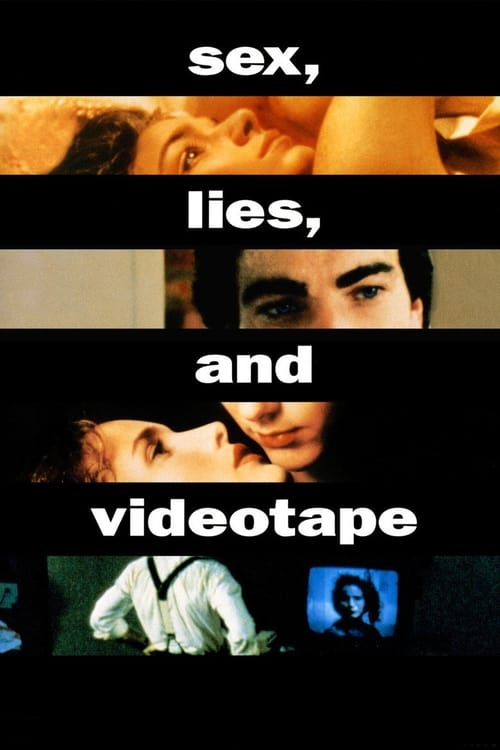
sex, lies, and videotape
1989 · Steven Soderbergh
For a slow-burn grown-up evening when you want intimacy and tension instead of plot — a film to talk about in bed afterward. More absorbing than feel-good.
What it's about
In Baton Rouge, a brittle marriage is quietly rotting: Ann is anxious and untouched, her lawyer husband John is sleeping with her sister. Then John's old college friend Graham drifts into town — a soft-spoken loner whose only intimacy is videotaping women as they talk frankly about their sex lives. His arrival, and his camera, start pulling every hidden thing in the marriage into the open.
The experience
Hushed, talky, and quietly electric — almost nothing 'happens,' yet the conversations feel dangerous, like everyone is one honest sentence away from detonation. It's seductive and uncomfortable at once, and it makes you think hard about what honesty actually costs.
Performances
James Spader's Graham — gentle, damaged, unnervingly candid — won him Best Actor at Cannes and remains a career-defining piece of stillness. Andie MacDowell and Laura San Giacomo make the sisters' rivalry cut deep, and Peter Gallagher is perfectly loathsome without ever raising his voice.
The craft
Soderbergh, in his mid-twenties, directs with startling poise: a four-character chamber piece built on framing, silence, and razor-exact dialogue, where a camcorder's grainy footage carries more charge than any love scene. It's minimal by design — proof of how much heat talk alone can generate.
Why it matters
Its Palme d'Or win detonated the American independent film boom of the 1990s, put Miramax and Sundance on the map, and launched Soderbergh's career in a single stroke.
Snapshot
sex, lies, and videotape is the debut feature of Steven Soderbergh, written and directed when he was in his mid-twenties, and one of the most consequential American independent films of its era. A four-character chamber drama set in Baton Rouge, Louisiana, it observes a brittle marriage between Ann (Andie MacDowell) and John (Peter Gallagher), John's affair with Ann's sister Cynthia (Laura San Giacomo), and the catalytic arrival of John's old college friend Graham (James Spader), a soft-spoken drifter who is impotent and who can engage erotically only by videotaping women as they talk candidly about their sexual histories. The film's reputation rests on two intertwined facts: its formal poise — talky, controlled, emotionally exact — and its industrial impact. Its Palme d'Or at the 1989 Cannes Film Festival and its strong commercial performance helped consolidate Miramax and are routinely cited as a hinge point in the rise of the 1990s American independent movement. It is at once an intimate psychological study of intimacy itself and an early reckoning with how recording technology mediates desire and truth.
Industry & production
The film was made cheaply and quickly. Its budget is commonly reported in the vicinity of $1.2 million, financed substantially through RCA/Columbia and independent backers, with production company support from Outlaw Productions (producers Robert Newmyer and John Hardy). Shooting took place in Baton Rouge over roughly five weeks in 1988. The economy of the production — a handful of principal actors, a small number of domestic interiors, a confessional structure that concentrates resources on performance rather than spectacle — is inseparable from its aesthetic.
By his own repeated account, Soderbergh wrote the screenplay rapidly, in roughly eight days, much of it conceived while driving across the country; the speed of composition is part of the film's lore, though the script itself shows considerable architectural care. The decisive industrial event was distribution by Miramax, then a comparatively small company run by Harvey and Bob Weinstein. The film's festival success — first a strong reception at the U.S. Film Festival (the precursor to Sundance), where it took the Audience Award, then the Palme d'Or at Cannes — gave Miramax a prestige title it could platform into a substantial theatrical run. Domestic grosses are widely cited in the mid-twenty-million-dollar range, an extraordinary multiple on its budget, and the film became a template for the specialty-distribution model that the company would ride through the decade. Precise contemporaneous financial figures vary across sources, so specific numbers should be treated with appropriate caution.
Technology
Technology is not merely a production detail here but the film's central subject and apparatus. The camcorder — by the late 1980s a rapidly proliferating consumer object — is Graham's instrument of both withdrawal and connection. The film arrives precisely at the moment when video recording was migrating from the institutional and broadcast spheres into the private home, and it dramatizes the psychological consequences of that migration: the way a lens can license a confession that a face-to-face encounter cannot, the way playback fixes and replays intimacy, the way a tape becomes evidence. The shift between the film's own 35mm photographic image and the diegetic video Graham captures is a built-in commentary on registers of truth — the "live" world versus the recorded one. The film anticipates, without sensationalizing, a culture in which mediated self-disclosure would become routine, and it treats the tape as something closer to a sacrament of honesty than a tool of pornography.
Technique
Cinematography
The cinematography is by Walt Lloyd, who would work with Soderbergh again. The visual approach is restrained and naturalistic, built around interiors, available-feeling light, and a palette of muted domestic tones appropriate to a film about people who are emotionally muffled. Compositions favor sustained two-shots and tight singles that hold actors in close psychological proximity; the camera tends to observe rather than editorialize, letting performances carry the scene. The diegetic video footage is deliberately differentiated in texture and grain, so that the film's two image-systems read as distinct epistemologies — the polished outer life against the rawer recorded confession.
Editing
Soderbergh edited the film himself, and the cutting is one of its quiet achievements. The rhythm is patient, organized around conversation rather than action, with an attentiveness to reaction and to the beat after a line lands. The structure cross-cuts among the four characters' overlapping situations, building toward the climactic taping of Ann, where the film's interest in confession, exposure, and reversal comes to a head. The editing's confidence — knowing when to hold, when to withhold a cutaway, how to let a silence sit — belies the director's inexperience and signals the editorial sensibility that would define his later, more kinetic work.
Mise-en-scène / staging
The staging is essentially that of a chamber piece: a small set of domestic and semi-domestic spaces — the marital house, Graham's sparsely furnished apartment, an office, a bar — that function as moral arenas. Graham's near-empty apartment, dominated by the recording setup, externalizes his ascetic, self-quarantined interiority; the marital home's tasteful order masks its dishonesty. Props carry weight: the videotapes themselves, the camera, the objects of a settled bourgeois life that the film quietly interrogates. Blocking is intimate and frontal, often arranging characters for confession and scrutiny.
Sound
The score is by Cliff Martinez, a former drummer for the Red Hot Chili Peppers, for whom this was an early and formative film credit; it began a long and important collaboration with Soderbergh. The music is spare, atmospheric, and unobtrusive, eschewing conventional melodic underscoring in favor of texture and mood — an approach that would become a signature of both composer and director. The film's sound design privileges speech, breath, and the small ambient details of rooms, reinforcing a drama that is conducted overwhelmingly through talk.
Performance
Performance is the film's principal medium. James Spader's Graham — watchful, courteous, wounded, faintly menacing — anchors the film and won him the Best Actor prize at Cannes; it is a performance of stillness and precision. Andie MacDowell gives Ann a fragile, awakening interiority, her early primness gradually cracking open. Peter Gallagher plays John's smug complacency with unflattering exactness, and Laura San Giacomo's Cynthia — earthy, appetitive, the marriage's antagonist-by-desire — was a striking screen breakthrough. The four performances are calibrated to a naturalistic key, and the film's effects depend almost entirely on their nuance.
Narrative & dramatic mode
The film operates in the mode of the intimate psychological drama, closer to chamber theater and the literary novella than to plot-driven cinema. Its engine is confession: the structuring device of Graham's interviews makes self-disclosure literal, and the narrative advances less through external events than through shifting alignments of knowledge and honesty among the four characters. The dramaturgy is one of reversal — the man who appears most damaged becomes the agent of others' truth-telling; the woman who appears most repressed becomes the one who turns the camera around. The title's triad names the film's thematic axes directly, and the screenplay's structure is essentially a moral chamber piece in which each character is exposed in turn.
Genre & cycle
Generically the film is a relationship drama with strong currents of the erotic and the psychological, but it is most legible as a foundational text of the American independent cinema cycle of the late 1980s and 1990s. It belongs to a lineage of intimate, talk-centered, character-driven films made outside the studio system, and it helped define what "indie" would mean commercially in the decade that followed: literate, adult-themed, festival-launched, specialty-distributed. Its concern with mediated sexuality also places it within a broader contemporary fascination with video and surveillance, though it treats that material with unusual interiority rather than as genre thriller.
Authorship & method
The film is the inaugural statement of one of the most protean American directors of the following decades. Soderbergh is its sole credited writer, its director, and its editor, and the control evident across those functions established him immediately as an auteur in the fullest sense. He later published the screenplay together with a candid production diary, an unusually transparent document about the making of a first feature and about his own ambivalence toward its success. Key collaborators recur in his subsequent career: cinematographer Walt Lloyd and especially composer Cliff Martinez, whose minimalist scoring became integral to Soderbergh's sound world across many later films. Soderbergh's method here — small scale, tight ensemble, naturalistic performance, self-editing — would expand and mutate dramatically over a career that includes Out of Sight, Traffic (for which he won the Academy Award for Best Director), Erin Brockovich, the Ocean's films, and a long run of formally restless experiments, but the authorial signature of precision, intelligence, and editorial control is already fully present in the debut.
Movement / national cinema
The film is a landmark of American independent cinema and is frequently positioned, alongside a handful of contemporaries, as a catalyst for the movement's commercial breakthrough. Its Sundance and Cannes trajectory helped establish the festival-to-distribution pipeline that would define the independent sector through the 1990s, and its association with Miramax made it a cornerstone of that company's mythology. It is an American film with no national-cinema affiliation beyond that, but its Cannes triumph also marked a moment when American independent work commanded the highest international art-cinema prestige.
Era / period
sex, lies, and videotape is very much a film of the late 1980s: its bourgeois Sunbelt setting, its anxieties about marriage and fidelity, and above all its engagement with the newly domesticated camcorder root it firmly in that moment. It captures a culture on the cusp of the video age, before the internet, when private recording was novel enough to carry genuine moral charge. At the same time, its preoccupations — honesty and performance, the mediation of desire, the difficulty of real intimacy — proved durable enough that the film reads as prescient rather than dated.
Themes
The film's governing themes are announced by its title and developed with care. Sexuality is treated less as spectacle than as a site of truth and evasion: characters reveal themselves through what they will and won't say about desire. Lying — marital, social, self-directed — is the film's moral center; nearly every character is engaged in some deception, and the drama charts the cost of dishonesty and the difficult value of confession. Video functions as the third term that binds the other two: the recording apparatus becomes a paradoxical instrument of honesty, a way for people to tell the truth precisely because they are mediated, distanced, and observed. Adjacent themes include voyeurism and the ethics of looking, impotence as both literal condition and metaphor for emotional withdrawal, and the gulf between bourgeois respectability and private reality.
Reception, canon & influence
Critically the film was received as a major debut, and its festival honors — the Palme d'Or at Cannes (where the jury was presided over by Wim Wenders) and the Best Actor award for Spader, together with its earlier Audience Award at the U.S. Film Festival — gave it immediate canonical standing. Soderbergh, in his mid-twenties, was among the youngest filmmakers to take the Palme d'Or, a fact that became central to the film's reception and to his own well-documented unease about peaking so early. It earned an Academy Award nomination for Soderbergh's original screenplay.
Looking backward, the film's influences are more sensibility than direct citation: a debt to literate American and European chamber drama, to the talk-driven intimacy of certain art-cinema traditions, and to a contemporary cultural preoccupation with video and self-recording. The film wears these lightly, and the historical record is thin on specific acknowledged models beyond Soderbergh's own stated impulses.
Looking forward, its legacy is outsized. It is repeatedly credited as a key film in the commercial ascent of American independent cinema and of Miramax specifically, helping to create the conditions and the distribution model that would carry filmmakers such as Quentin Tarantino, Kevin Smith, and many others to prominence over the following decade. Its success demonstrated that a small, adult, character-driven film could reach a substantial audience and command prestige, reshaping expectations for what independent film could be commercially. For Soderbergh himself it launched a singular career, and the film remains a touchstone — studied as a model of economical, performance-centered direction and as an early, thoughtful meditation on the technologies of intimacy that have only grown more pervasive since.
A Deleuzian reading
Start with the room.
The full Deleuzian reading of sex, lies, and videotape →
Reception
It arrived as a thunderclap — Palme d'Or at 26, Sundance sensation, the little $1.2M film that outgrossed studio pictures — and is now remembered less as a movie than as the big bang of the '90s American indie boom. Soderbergh himself has been famously shruggy about it, which only fuels the periodic 'actually, it still holds up' rediscoveries.
How sex, lies, and videotape was received, from release to now →
Influences: the films it descends from and the films it influenced
- Faces (1968) — Establishes the naturalistic, talk-driven chamber ensemble held in sustained close two-shots that lets confession and self-exposure play out in unbroken performance — Soderbergh's staging grammar in miniature.
- Scenes from a Marriage (1973) — Models the dramaturgy of intimate reversal: couples dismantling each other through quiet confessional dialogue, the camera staying on the face that listens rather than the one that speaks.
- My Dinner with Andre (1981) — Proves a feature can be built almost entirely from sustained two-shot conversation, pacing cut purely to the rhythm of disclosure rather than physical action.
- My Night at Maud's (1969) — The moral-tale method of extended seductive dialogue as a self-incriminating confession, where talk about sex substitutes for and exposes desire — Graham's interview structure descends from it.
- Who's Afraid of Virginia Woolf? (1966) — A four-character chamber piece whose architecture is a series of escalating revelations and reversals, the 'game' of deception driving the staging.
- The Conversation (1974) — Makes the recording device itself the subject — surveillance/playback as a moral instrument — and pairs it with a minimalist, texture-forward sound design that anticipates Martinez's scoring approach.
- Peeping Tom (1960) — Foundational equation of the camera with voyeuristic compulsion: a protagonist who can only access intimacy through the lens, the direct ancestor of Graham's camcorder confessions.
- Carnal Knowledge (1971) — Built the American indie relationship film on candid, confessional talk about sex and impotence in spare rooms, inheriting Carnal Knowledge's faith in dialogue and face over incident.
- In the Company of Men (1997) — Extends the cold chamber-drama of sexual cruelty built on dramaturgy of reversal, dialogue-driven and clinically staged, as an indie calling card in the lane sex, lies opened.
- Tape (2001) — Single-room three-hander in which recording technology becomes the engine of confession and entrapment, shot on consumer video as a formal choice — a near-explicit elaboration of the camcorder-as-subject device.
- Closer (2004) — Four-character lattice of sexual confession and deception advanced through talk and timed revelations, including mediated intimacy (the chat-room scene) as a structural set piece.
- The Limey (1999) — Soderbergh's self-editing pushed to its formal extreme, fracturing conversation across time so that editorial rhythm, not plot, carries the drama — the debut's editing instinct radicalized.
- Solaris (2002) — Carries forward the Cliff Martinez minimalist-texture score as the film's emotional substrate, the sound-world first established on the debut applied to genre material.
- Full Frontal (2002) — Turns the video-vs-35mm distinction into the organizing formal device, with consumer digital footage interleaved against film — the debut's video/35mm tension made structural.
- Bubble (2005) — Returns to the small-scale naturalistic ensemble using nonprofessional actors in real interiors, the chamber-piece, performance-centered economy of the debut taken to its logical limit.
- Clerks (1994) — A dialogue-driven, micro-budget chamber comedy whose entire craft is conversation as event, viable only through the Sundance/Miramax indie pathway sex, lies established.
- Trust (1990) — Its Sundance-to-arthouse success made the low-budget, confession-driven talky two-hander commercially thinkable, the industrial precondition that let Trust be financed and distributed.
- Erin Brockovich (2000) — Soderbergh's own origin point for performance-close, unshowy direction and the American-indie-to-studio path that the star-vehicle Erin culminates.
- Chasing Amy (1997) — Proves that sexual history recited in an unbroken take is more charged than depicting it; Chasing Amy's confession scenes adopt the same discipline of holding on a listening face while the other party narrates, letting the cut come only after the damage lands.
- Blue Film (2026) — The template for a four-hander built around a camcorder confession: the taped interview is nested inside the drama as a second register of performance, and the plot turns on a tape being played to the wrong person.
- Secretary (2002) — Builds a sexual psychodrama on James Spader's signature register of withholding, watchful stillness — the same erotically charged passivity Soderbergh cast and framed in Graham.
- Drive (2011) — Inherits the Cliff Martinez minimalist synth-texture scoring method — atmosphere over melody as emotional connective tissue — that Martinez pioneered with Soderbergh.
Similar films
- The Limey (1999) — influence & lineage · often watched together
- Faces (1968) — influence & lineage
- My Dinner with Andre (1981) — influence & lineage
- Black Bag (2025) — often watched together
- Traffic (2000) — shared sensibility
- Love Streams (1984) — shared sensibility
- Marriage Story (2019) — shared sensibility
- She's Gotta Have It (1986) — shared sensibility
All the films related to sex, lies, and videotape →
Watch it with: curated runs of related films
- Strangers Who Walk and Talk — Watch these back to back for the particular magic of two people, a city, and a few borrowed hours of talk that may not outlast the night.