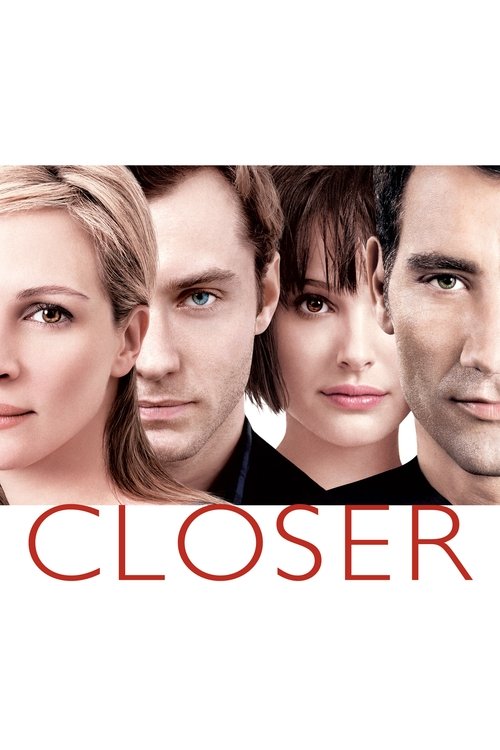
Closer
2004 · Mike Nichols
For when you want grown-up drama with teeth — a film to argue about with whoever you watch it with. Definitely a challenge, not a comfort watch; reach for it when you're ready to have your ideas about honesty in love roughed up.
What it's about
Four Londoners — an obituary writer with novelist ambitions, a young American stripper, a portrait photographer, and a dermatologist — collide, pair off, and betray each other across four years. A chance meeting on a street sets off a chain of affairs and confessions in which each couple's fate gets tangled up with the other's. Nearly everything happens in charged two-person conversations: seductions, breakups, interrogations where the truth is demanded and then used as a weapon.
The experience
It's bruising — witty on the surface and cruel underneath, with dialogue that lands like body blows. The film moves in jumps, skipping the happy stretches to drop you straight into the moments where relationships crack, so it feels intimate and merciless at once.
Performances
Natalie Portman and Clive Owen both earned Oscar nominations, and they're the live wires — Owen is frightening in his appetite for the wounding question, Portman guarded and slippery in ways that keep you re-reading her. Jude Law and Julia Roberts play against their charm to often uncomfortable effect.
The craft
Patrick Marber adapted his own hit stage play, and the script's stripped-down structure is the star: no subplots, no filler, just the collisions. Mike Nichols directs it at close range in cold, elegant light, trusting the words and faces to carry everything — it's a film you lean into rather than one that washes over you.
Why it matters
A late-career landmark for Nichols that returned him to the terrain of corrosive intimacy he'd mapped decades earlier, and the film that announced Portman and Owen as serious dramatic forces.
Snapshot
Closer is Mike Nichols's chamber drama of sexual cruelty, adapted by Patrick Marber from his own 1997 stage play. It tracks four Londoners—an obituary writer turned aspiring novelist (Jude Law), a young stripper and would-be ingénue (Natalie Portman), a portrait photographer (Julia Roberts), and a dermatologist (Clive Owen)—across roughly four years of couplings, betrayals, and confessions. The film is structured as a series of charged two-handers: meetings, breakups, interrogations. Its subject is not love so much as the appetite for possession and the use of language—especially the language of truth-telling—as a weapon. Stripped of subplot and incident, the film is essentially a study of how intimate partners wound each other, conducted at close range and in cold light. It earned Oscar nominations for Owen and Portman in supporting categories and, with its hard R-rated frankness about sex and its acidic dialogue, became one of the more divisive prestige releases of its year: admired for its performances and writerly precision, criticized for its airlessness and misanthropy. As Nichols's late-career return to the territory of Who's Afraid of Virginia Woolf? and Carnal Knowledge, it is best understood as a deliberate exercise in theatrical compression by a director who began in that world and never fully left it.
Industry & production
Closer was produced and released by Columbia Pictures (Sony), a mid-budget adult drama of a kind that was already growing scarce in the early-2000s studio landscape—a star-driven, dialogue-forward picture aimed at awards-season audiences rather than the multiplex. Nichols, by then in his early seventies and one of the few directors whose name still carried genuine prestige weight, was instrumental in shepherding Marber's play to the screen. The casting drew on a register of transatlantic star power: Roberts, the era's preeminent American leading woman, took a deliberately unsympathetic supporting-scale role; Law was at a commercial peak; Portman and Owen were rising. Owen carried a particular continuity with the material, having originated the role of Dan in the play's premiere at the Royal National Theatre in London before later being cast as Larry in the film—an unusual instance of an actor crossing from one role to its mirror within the same text.
The production was comparatively contained, shot largely in and around London, befitting a four-hander with few locations. Marber adapted his own script, which kept the screen version close to the play's spine while opening it modestly—most famously into an internet-chat sequence and into exteriors that the stage could only imply. The film's commercial profile was modest by blockbuster standards; it functioned as a prestige play rather than a mass release, and its awards recognition (Golden Globe wins and Academy Award nominations for the two supporting performers) was the principal vehicle of its visibility. Hard numbers on budget and gross I'll leave aside rather than risk inaccuracy.
Technology
Closer was made and finished on photochemical film in the standard professional manner of mid-2000s studio drama; it is not a film whose interest lies in technological novelty. The one genuinely period-specific technological element is diegetic rather than productive: the now-famous cybersex scene, in which Law's and Owen's characters carry on an anonymous, deceptive exchange in an internet chat room, the typed text displayed on screen. That sequence is a small time capsule of early-2000s online intimacy—the anonymity, the textual flirtation, the ease of impersonation—and Marber used the technology as a dramatic engine: a deception conducted entirely in language, which is the film's larger theme rendered in its most literal form. Beyond this, the film's craft is resolutely traditional; its "technology" is the older apparatus of actors, lenses, and cutting.
Technique
Cinematography
The film was photographed by Stephen Goldblatt, a cinematographer with a long association with Nichols. Goldblatt's images are clean, controlled, and unromantic. The palette favors cool tones and even, often unflattering light; this is a London of gallery whites, hospital interiors, and apartment rooms that offer no soft cover for the characters. The camera tends to hold on faces during the long verbal exchanges, trusting performance and dialogue rather than coverage tricks. Where many romantic dramas use light to flatter and enclose, Closer uses it to expose—the visual scheme is of a piece with a film about people stripped of their evasions. The photography's discretion is a deliberate strategy: it keeps the audience's attention on the words and the faces, the two instruments through which the cruelty is delivered.
Editing
Cut by John Bloom and Antonia Van Drimmelen, the film's editing is built around ellipsis. Closer repeatedly drops the audience into scenes after a relationship has already changed, withholding the connective tissue and forcing the viewer to reconstruct what has happened in the gaps between encounters. Time jumps—months, then years—are handled with minimal signposting; a conversation will reveal, mid-scene, that an affair has begun or ended off-screen. This elliptical construction is the film's signature formal device and its inheritance from the stage: the play, too, leaps across time between scenes. The cutting within scenes is restrained, favoring sustained two-shots and reverse angles that let the verbal duels play at length. The effect is of a series of discrete, pressurized panels rather than a flowing continuum.
Mise-en-scène / staging
Closer never disguises its theatrical origins, and Nichols does not try to. The film is essentially a sequence of two-character confrontations staged in well-defined spaces: a hospital room, a photographer's studio, a strip club's private booth, restaurants and apartments. Nichols—who came to film from theater and from improvisational comedy—blocks these encounters with a stage director's attention to proximity and distance, to who advances and who retreats across a room. The strip-club scene between Owen and Portman, in which money buys words but not the truth he demands, is the most theatrically conceived set piece: a single location, two people, a transaction that becomes an interrogation. The restraint of the staging concentrates everything onto the actors; there is nowhere to hide, which is precisely the point.
Sound
The film's sound design is unobtrusive, subordinated to dialogue, which is the true acoustic event of Closer. Marber's lines—clipped, profane, epigrammatic—are the score that matters most. The actual musical scoring is sparse; the film's most pointed musical gesture is its use of Damien Rice's "The Blower's Daughter," which opens the film over the slow-motion meeting of Law and Portman on a London street and recurs at the close, bracketing the narrative with a single plaintive song. The choice ties the film's emotional register to a particular early-2000s singer-songwriter melancholy and gives the otherwise astringent picture its one frankly lyrical frame.
Performance
Performance is where Closer lives. Nichols, a famous director of actors, draws four sharply differentiated turns. Owen, moving from the play's Dan to the film's Larry, gives the most volcanic performance—his dermatologist is coarse, possessive, and devastatingly articulate in anger; the strip-club interrogation is built on his appetite for humiliating detail. Portman plays Alice with a guardedness that conceals a final reversal, and her performance turns on what she withholds. Roberts, cast against her warm public image, plays Anna as recessive and unhappy, complicit in betrayals she narrates with flat candor. Law's Dan is the film's weakest and vainest figure, a man who mistakes his own restlessness for honesty. The performances were the most widely praised aspect of the film, and Owen and Portman were both Oscar-nominated; both won Golden Globes for the roles.
Narrative & dramatic mode
The film's dramatic mode is the dialectical two-hander: scene after scene of two people negotiating, accusing, confessing, and lying. Its structure is elliptical and episodic rather than continuous—a chain of decisive encounters separated by unshown stretches of time. The governing device is the confession scene, in which one partner extracts or volunteers a damaging truth, and the film's recurring discovery is that truth, freely demanded and freely given, does not liberate but wounds. The drama is unusually verbal: physical action is minimal, and the "events" are almost entirely things people say to each other. This is theater of language, and the film keeps faith with that mode. The narrative withholds resolution and sentiment; its arcs end not in reconciliation but in attrition and revelation, including a final-act reframing of Alice that recasts the relationships retrospectively.
Genre & cycle
Nominally a romantic drama, Closer is more precisely an anti-romance—a film that uses the apparatus of the love story (the meet-cute, the score, the beautiful leads) to dismantle romantic consolation. It belongs to a lineage of acidic adult relationship dramas concerned with sexual power and emotional cruelty rather than courtship. Within Nichols's own career it forms a clear cycle with Who's Afraid of Virginia Woolf? (1966) and Carnal Knowledge (1971), both likewise studies of partners lacerating each other through talk. In the context of mid-2000s cinema it stands somewhat apart: a literate, sexually frank, star-driven chamber piece in an era increasingly inhospitable to such middle-budget adult drama, which lends it the quality of a holdout from an earlier studio sensibility.
Authorship & method
The dossier's authorship question is genuinely double, split between director and writer. Mike Nichols brought to the film a half-century of experience staging exactly this kind of verbal combat, beginning in improvisational comedy with Elaine May and continuing through a celebrated theater career and a film career bookended by Virginia Woolf and Carnal Knowledge. His method here is one of disciplined restraint: trust the text, cast precisely, stage cleanly, and get out of the actors' way. Patrick Marber is the other author—the playwright adapting his own work, preserving its structure, its time-jumps, and above all its language. The film is faithful to the play to a degree that makes Marber's voice as audible as Nichols's; the wit and the cruelty are his.
Among the key collaborators, cinematographer Stephen Goldblatt supplied the cool, exposing light; editors John Bloom and Antonia Van Drimmelen executed the elliptical structure; and the film's most memorable "musical" authorship belongs less to a composer than to the curatorial choice of Damien Rice's song as bookend. Clive Owen's passage from stage Dan to screen Larry is itself a kind of authorial continuity between the two versions of the work. The collaboration is unusually writer-centered for a star-studded studio release, and that is its defining method.
Movement / national cinema
Closer sits athwart two national contexts. It is a Hollywood studio production with American stars and American financing, yet its source, its writer, half its cast, and its setting are British, and its sensibility is closer to the tradition of contemporary British stage drama—the Royal National Theatre milieu from which the play emerged—than to mainstream American romance. It belongs to no film "movement" in the avant-garde sense; rather it represents the transatlantic prestige drama, a hybrid form in which British theatrical material is financed and starred through Hollywood. Nichols himself was a figure of the American New Hollywood and the New York theater, which makes the film a meeting point of his American studio standing and Marber's British stage idiom.
Era / period
The film is firmly a product of the mid-2000s, and bears the marks of its moment in ways both incidental and structural. The internet-chat sequence dates it precisely to a period when online anonymity was novel enough to carry dramatic charge. The Damien Rice song fixes its emotional register in the singer-songwriter melancholy of the early 2000s. More broadly, it arrives at the tail end of the era when major studios still routinely made and marketed adult dramas for grown audiences; within a few years that space would contract sharply, which in retrospect gives Closer the character of a late example of a vanishing studio category. As a Nichols film it is a work of his final phase, made decades after the films it most resembles, and it reads partly as a senior director's return to founding themes.
Themes
The film's central theme is the destructive cult of honesty—the conviction that to demand and confess the full truth of one's desires is a virtue, when in the film's account it is mostly an instrument of cruelty and control. Bound up with this is possession: the characters want to own their partners' histories, bodies, and secrets, and sex functions less as intimacy than as territory. Language is itself a theme—Closer is preoccupied with what words can extract and inflict, with lying and confessing as parallel verbal acts, and with the gap between what people say and what is true. Identity and self-invention run beneath the surface, surfacing in the film's final reframing of who Alice is. Underlying all of it is a bleak account of romantic love as appetite and competition rather than tenderness—a vision continuous with Nichols's earliest serious films.
Reception, canon & influence
Critical reception was sharply divided. Admirers praised the precision of Marber's dialogue, the rigor of Nichols's staging, and above all the performances—Owen and Portman drew the strongest notices and were both nominated for Academy Awards (Best Supporting Actor and Actress respectively) and won Golden Globes. Detractors found the film airless, schematic, and misanthropic—a beautifully made record of unpleasant people being cruel, with little beneath the cruelty. That split has largely persisted: the film is remembered more as an actors' showcase and a faithful translation of a admired play than as a major cinematic achievement in its own right.
Looking backward, the film's influences are primarily theatrical and Nicholsian: the verbal-combat tradition of Albee's Who's Afraid of Virginia Woolf?, which Nichols himself had filmed, and the corrosive sexual candor of his own Carnal Knowledge; behind those, the broader lineage of modern stage drama about marital and sexual cruelty. Marber's play drew on that theatrical inheritance, and the film carries it intact.
Looking forward, Closer's legacy is modest but real. It stands as a durable example of stage-to-screen adaptation that preserves a play's language and structure rather than dissolving them into conventional cinema, and it is frequently cited as a high point for its supporting performers—particularly Portman, for whom it marked a decisive adult turn, and Owen, whose Larry became one of his signature roles. Its strip-club interrogation and its bracketing use of "The Blower's Daughter" entered the culture as memorable set pieces. More diffusely, it remains a reference point for the acidic relationship drama—the romance built to refuse romantic comfort. Its larger significance may finally be as a late specimen of the adult studio drama, a category whose subsequent near-disappearance has lent the film a retrospective poignancy its makers could not have intended.
A Deleuzian reading
A green cursor blinks in a dark room.
The full Deleuzian reading of Closer →
Reception
Divisive on release — hailed for its performances but accused of being cold and cruel — it has since settled in as the definitive 'beautiful people being awful to each other' movie, a late-career Nichols standout that people revisit rather than recover from.
How Closer was received, from release to now →
Influences: the films it descends from and the films it influenced
- Carnal Knowledge (1971) — The episodic time-jump structure that elides years between scenes of sexual recrimination, plus the cool clinical candor about how people wound each other in bed—Nichols's direct self-quotation.
- sex, lies, and videotape (1989) — The confession scene as set piece: characters narrating their sexual transgressions aloud, talk made unbearably intimate, anticipating Closer's strip-club interrogation.
- After the Hunt (2025) — Supplies the four-hander of educated cruelty in which desire and power are negotiated entirely through verbal sparring and weaponized subtext rather than action.
- Who's Afraid of Virginia Woolf? (1966) — Nichols's own template for filming a stage two/four-hander of verbal blood-sport: preserve the playwright's language intact and trust escalating dialogue rather than 'opening it up,' the exact method he reuses on Marber's text.
- La Ronde (1950) — The four-lover roundelay of swapped partners and serial betrayal, descending from Schnitzler's daisy-chain dramaturgy that Marber's pairings-and-recombinations structure formalizes.
- Betrayal (1983) — Pinter's stage-to-screen affair told through elliptical, non-chronological jumps where a scene's emotional charge depends on what the cut withheld—the editing-by-ellipsis grammar Closer inherits.
- Scenes from a Marriage (1973) — The sustained held-on-faces two-shot during dialogue duels, refusing coverage so the camera becomes a clinical instrument exposing a relationship dissolving in real time.
- Glengarry Glen Ross (1992) — Stage-to-screen fidelity that keeps a playwright's (Mamet's) profane verbal aggression as the film's whole event—language as combat, cast precisely and shot cleanly out of the actors' way.
- Eyes Wide Shut (1999) — Another Schnitzler-rooted anatomy of jealousy and erotic possession, where one partner's demand to hear the other's fantasies/confessions detonates the couple—the same possession-through-honesty engine.
- In the Company of Men (1997) — Theatrical compression and a misanthropic refusal of sympathy, staging cruelty as deliberate sexual strategy in clean dialogue scenes—the contemporary anti-romance Closer runs parallel to.
- Notes on a Scandal (2006) — Patrick Marber's screenplay carries his acidic, epigrammatic cruelty forward—the same writer-centered voice of weaponized candor driving a possession drama.
- Carnage (2011) — A single-set stage adaptation (Reza) preserving the play's real-time verbal escalation, treating theatrical compression as a virtue rather than dissolving it into 'cinema.'
- Blue Valentine (2010) — An elliptical two-hander anti-romance that cross-cuts a relationship's beginning and ruin, holding on unguarded faces in cool natural light to refuse romantic comfort.
- Marriage Story (2019) — Builds its centerpiece around an extended dialogue-driven marital-combat scene, theatrically staged and sustained, where language inflicts the damage—the Nichols/Albee set-piece tradition.
- Take This Waltz (2011) — An anti-romance built on destructive honesty and jealous possession, withholding tidy resolution and using performance restraint to expose desire's cruelty.
Similar films
- Carnal Knowledge (1971) — influence & lineage
- Marriage Story (2019) — influence & lineage
- Who's Afraid of Virginia Woolf? (1966) — influence & lineage
- Gone Girl (2014) — often watched together
- The Hours (2002) — shared sensibility
- The Notebook (2004) — shared sensibility
- Synecdoche, New York (2008) — shared sensibility
- The Hurt Locker (2008) — shared sensibility
All the films related to Closer →
Watch it with: curated runs of related films
- Love as a Wrecking Ball — Watch these when you want desire pushed all the way to self-destruction — affairs and infatuations that leave nothing standing.