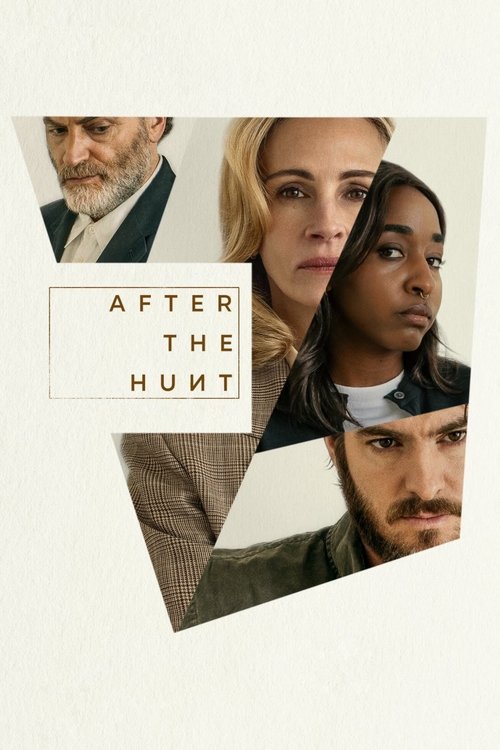
After the Hunt
2025 · Luca Guadagnino
The horniest working prestige director, in the culture's affectionate phrasing: Challengers and Queer in a single year made him the center of every conversation about desire on screen, and his prolific pace (Bones and All, After the Hunt) is itself a talking point. Also permanently attached to the Call Me by Your Name/Armie Hammer asterisk.
For a night when you want a smart, thorny drama to argue about afterward — one that refuses to hand you a hero. Challenge, not comfort: it wants you slightly complicit.
What it's about
A tenured philosophy professor at Yale has built a life of careful control — the marriage, the reputation, the star students — until her most brilliant pupil accuses a close colleague and friend of sexual misconduct. Forced to pick a side in a scandal that splits the department along generational lines, she discovers the case pressing on a buried chapter of her own past. What follows is a war of loyalty, ambition, and self-protection fought over seminar tables and dinner parties.
The experience
Coiled and conversational — the tension lives in what people almost say, and every polite exchange feels like a chess move. It keeps you guessing about who's telling the truth and, more uncomfortably, whether anyone fully is, and it leaves you arguing with yourself on the way home.
Performances
Julia Roberts works against her own warmth as Alma, all armored poise with hairline cracks; Ayo Edebiri brings a watchful, needling intelligence as the accuser, and Andrew Garfield plays the accused colleague with a charm you keep re-reading.
The craft
Luca Guadagnino directs Nora Garrett's debut screenplay as a chamber piece of academic manners, letting long, barbed conversations do the work a thriller would do with plot. The film is tuned to faces and pauses — a movie of glances across rooms that rewards close, uninterrupted attention more than a big screen.
Why it matters
Landing in the thick of the culture's ongoing fight over accusation, belief, and institutional power, it capped an astonishingly prolific run for Guadagnino — his third feature in barely eighteen months — and gave Julia Roberts one of her most talked-about dramatic roles in years.
Snapshot
After the Hunt is a chamber drama of academic manners and moral ambiguity, the third feature Luca Guadagnino released in barely eighteen months — arriving after Challengers (2024) and Queer (2024) and confirming a phase of unusual productivity. Set largely within the philosophy department of an elite American university (Yale), it centers on a tenured professor, Alma (Julia Roberts), whose carefully managed life is destabilized when a brilliant graduate student, Maggie (Ayo Edebiri), accuses a colleague and close friend, Hank (Andrew Garfield), of sexual misconduct. The accusation forces Alma to take sides, and in doing so threatens to disturb a buried chapter of her own past. The film is written by Nora Garrett, marking her feature screenwriting debut — a notable fact given the project's high-wattage cast and the director's stature. Premiered on the autumn-2025 festival circuit and distributed by Amazon MGM Studios, the film positions itself as a deliberately uncomfortable entry in the post-#MeToo dramatic cycle, less interested in adjudicating guilt than in anatomizing the institutional, generational, and rhetorical machinery that surrounds an allegation. Where Guadagnino's reputation rests on sensuality and lush surfaces, here he turns the same compositional precision toward talk, glance, and withholding — a film of conversations weaponized.
Industry & production
After the Hunt is an Amazon MGM Studios production, situating it within the studio's post-acquisition push toward adult, awards-oriented dramas anchored by major stars. The casting of Julia Roberts in the lead is the film's central industrial proposition: a movie star of the first magnitude returning to a serious dramatic vehicle, paired with a director whose art-house cachet had recently crossed into wider commercial visibility through Challengers. The supporting ensemble — Andrew Garfield, Ayo Edebiri (then ascendant from The Bear), Michael Stuhlbarg (a Guadagnino veteran from Call Me by Your Name), and Chloë Sevigny — reflects a packaging strategy that blends prestige reliability with contemporary cultural currency.
The screenplay's provenance is the production's most distinctive feature. Nora Garrett's script reportedly circulated as a sought-after spec property, and its acquisition by a star-and-director package of this scale is the kind of trajectory the industry holds up as exemplary for emerging writers; the precise deal history is not exhaustively documented in the public record and should not be overstated. Guadagnino's involvement followed his established working method of moving quickly between projects with a recurring crew, allowing a relatively compressed production. The film debuted on the festival circuit in autumn 2025 — Venice and the New York Film Festival figured in its rollout — before a theatrical release through Amazon MGM. As with many studio dramas of the streaming era, the theatrical-versus-platform calculus shaped its commercial profile; specific box-office figures should not be asserted here without verification.
Technology
Guadagnino's recent work has been characterized by a flexible relationship to capture format, and After the Hunt belongs to the digital, location-driven mode of contemporary prestige filmmaking rather than the celluloid revivalism practiced by some of his peers. The production leans on available and practical light within real and dressed interiors — seminar rooms, faculty offices, apartments, dinner tables — so that the technological apparatus is largely subordinated to a naturalistic but controlled image. The exact camera system and lensing package are not matters I can specify with confidence, and I will not invent them. What can be said is that the film's technical bias is toward intimacy and proximity: shallow focus, close coverage of faces, and a palette that reads as muted and autumnal rather than the saturated, sweat-sheened surfaces of Challengers. The score's production is itself a technological signature — Trent Reznor and Atticus Ross work in a largely electronic, synthesized idiom, and their contribution functions as a designed sonic layer rather than a conventionally orchestral one.
Technique
Cinematography
The cinematography serves a drama of surveillance and self-presentation. In a film about who is watching whom — students watching professors, colleagues watching colleagues, an institution watching its own liability — the camera's placement carries argumentative weight. Guadagnino and his cinematographer favor framings that isolate Alma within her own environment, using doorways, windows, and the geometry of academic architecture to suggest both her authority and her containment. The handling of the dinner-party and seminar set pieces — staples of the campus-drama form — depends on coverage that lets the camera drift between speakers, registering reaction and withholding as much as speech. Reliable, granular attribution of the cinematography to a specific director of photography is something I won't assert without certainty; the visible strategy, however, is one of restraint, proximity, and a cool, controlled tonality that resists the melodramatic.
Editing
The film's cutting is, by design, a rhetorical instrument. In a story built on competing testimonies and the impossibility of a clean verdict, editing controls what the audience is permitted to know and when. Guadagnino's recent collaborator Marco Costa — editor of Challengers — represents the kind of sensibility the material requires, though the credit should be confirmed rather than assumed. The technique foregrounds the withheld cut: scenes that end a beat early, reaction shots held a beat too long, and a structural refusal to grant the flashback that would settle Alma's past. Rather than the kinetic, time-bending montage of Challengers, the editing here is patient and conversational, accumulating ambiguity by privileging duration and the unresolved exchange.
Mise-en-scène / staging
Staging is where the film does much of its thematic work. The academic interior — its books, its tasteful clutter, its performance of intellect — becomes a stage on which characters audition versions of themselves. Dinner tables and seminar rooms are blocked as arenas of social combat, where seating, proximity, and the right to speak are themselves dramatic stakes. Guadagnino's well-documented attention to domestic texture (the lived-in houses of Call Me by Your Name and A Bigger Splash) is redeployed toward an atmosphere of curated privilege that the film regards with skepticism. Costume and décor encode class and self-fashioning; Alma's wardrobe and apartment are extensions of her armor.
Sound
Sound design and score collaborate to keep the audience destabilized. The Reznor–Ross music tends toward unease — pulsing, textural, anxious — rather than emotional underscoring, refusing to tell the viewer how to feel about an unresolvable conflict. The film also exploits the sound of talk itself: overlapping conversation, the pointed silence after an accusation, the ambient hum of institutional spaces. In a drama where language is both weapon and evidence, the precise audibility of words — and the moments when they are swallowed or interrupted — is part of the design.
Performance
Performance is the film's principal medium. Julia Roberts is asked to play opacity: a woman whose professional poise is a performance she cannot afford to drop, and whose interiority the film deliberately withholds. The role inverts the warmth associated with her star image, demanding control, evasion, and a slowly cracking composure. Ayo Edebiri's Maggie must hold the audience's sympathy and suspicion simultaneously, embodying a generation fluent in the vocabulary of harm without flattening into either victim or opportunist. Andrew Garfield's Hank navigates charm curdling into defensiveness, the accused man as both possible predator and possible casualty of a process. Michael Stuhlbarg and Chloë Sevigny supply the surrounding social fabric. The ensemble plays in a register of subtext, where the drama lives in what is not quite said.
Narrative & dramatic mode
The film operates in the mode of the moral-ambiguity drama, structured around an allegation whose truth it declines to resolve. Its dramatic engine is not the question "did he do it?" so much as "what does each character need to be true, and what will they sacrifice for it?" The narrative withholds the omniscient access that would let the audience render judgment — most pointedly regarding Alma's own undisclosed history, which functions as the film's buried second story. This is a drama of revelation deferred, in which information is currency and every conversation is a negotiation. The structure recalls the chamber play: limited locations, dialogue-driven, escalating through a sequence of confrontations rather than external events. Its closest dramaturgical relatives are the talk-driven moral thrillers of the stage and screen, where the catastrophe is reputational and ethical rather than physical.
Genre & cycle
After the Hunt belongs to two intersecting cycles. The first is the campus drama — the long tradition of films set in the hothouse of the university, where intellectual idealism collides with appetite, ambition, and abuse of power. The second, more topical, is the post-#MeToo allegation drama, a cycle that gained momentum after 2017 and includes works that dramatize accusation, due process, and the social aftermath of harm. The film consciously situates itself amid debates about "cancel culture," generational conflict, and the limits of institutional accountability, and it courts discomfort by refusing the reassurance of a clear villain. Within Guadagnino's filmography it represents a turn toward the dialectical and the verbal, distinct from the eros-and-appetite films, though it shares their preoccupation with desire as a destabilizing force.
Authorship & method
Luca Guadagnino's authorship is defined by sensuous surfaces, an interest in transgressive desire, and a method built on trusted, recurring collaborators and a fast working tempo. After the Hunt extends that method into colder, more cerebral territory while retaining his signature attention to bodies, rooms, and the social rituals of the privileged. The most significant collaboration here is with first-time screenwriter Nora Garrett, whose script supplies the architecture of argument that Guadagnino stages; the pairing of a debut writer with a veteran auteur is itself a statement about the material's primacy. The music is by Trent Reznor and Atticus Ross, continuing the partnership that scored Challengers and Bones and All and giving the film its anxious sonic identity. Guadagnino's editorial and visual collaborators from his recent run — including editor Marco Costa — plausibly recur, consistent with his repertory approach, though individual technical credits should be verified rather than assumed. Michael Stuhlbarg's presence links the film back to Call Me by Your Name, underscoring the director's habit of building a recurring company of actors.
Movement / national cinema
The film sits at the intersection of two cinematic identities. Guadagnino is an Italian director working within international art cinema, and his sensibility — formal control, an outsider's eye for American privilege, a European feel for atmosphere — informs the film even as it depicts a thoroughly American institution. As an Amazon MGM production with American stars and setting, After the Hunt is also a product of the U.S. studio prestige-drama apparatus. It thus belongs to the transnational mode of contemporary auteur filmmaking, in which a European director is engaged precisely to bring an estranging perspective to American subject matter — a lineage that includes Antonioni's and others' American excursions, and more recently Guadagnino's own English-language work.
Era / period
The film is emphatically of its moment: a mid-2020s artifact responding to a decade of cultural argument about sexual misconduct, institutional power, and generational change. It reflects the period's preoccupation with the contested epistemology of the allegation — the gap between believing survivors and guaranteeing due process — and with the role of universities as battlegrounds for these debates. Stylistically it belongs to the streaming-era prestige drama, made for an audience presumed fluent in the discourse it dramatizes. Its setting is contemporary, and its texture — the seminar, the academic dinner, the careful liberal milieu — is rendered as a recognizable present.
Themes
The dominant theme is moral ambiguity itself: the film's refusal to settle the truth of the central accusation is its argument that certainty is often unavailable and that the demand for it can be its own form of violence. Adjacent themes include the abuse and asymmetry of power within mentorship; the performance of virtue and the gap between professed and lived ethics; generational conflict over the language of harm and accountability; and the return of the repressed, embodied in Alma's hidden past, which suggests that those who adjudicate others' conduct may be evading their own. The university functions as a metaphor for the liberal institution's self-regard and self-protection. Running beneath these is a characteristically Guadagninian interest in desire and its consequences, here treated not as liberation but as liability — the secret appetite that, exposed, unmakes a public self.
Reception, canon & influence
As a very recent release, After the Hunt has not yet acquired a settled critical or canonical status, and any account of its reception must be provisional. The film's festival launch positioned it for awards-season conversation, with attention concentrated on Julia Roberts's against-type performance and on the topicality of its subject; reactions to films of this kind tend to divide between admiration for their refusal of easy answers and frustration at their perceived equivocation, and After the Hunt appears designed to provoke exactly that split. I will not attribute specific reviews, quotations, or figures that I cannot verify.
The influences on the film are legible. It draws on the campus-novel and campus-film tradition and on the contemporary lineage of allegation dramas that probe consent and institutional response. Dramaturgically it inherits the chamber-play model of moral combat conducted through dialogue. Within Guadagnino's own corpus it answers the heat of Challengers with a cooler, more verbal interrogation of desire and power, and it continues his collaboration with Reznor and Ross. Its forward influence cannot yet be assessed: as a 2025 release, its legacy — whether it comes to be seen as a defining statement of the post-#MeToo drama or as a polished provocation of its moment — remains to be written. What can be said is that it consolidates the late-period image of Guadagnino as a director able to move between sensual spectacle and austere moral inquiry, and that it offered Julia Roberts one of the more deliberately unsettling roles of her later career.
A Deleuzian reading
Watch Julia Roberts' face across a dinner table as the talk turns dangerous.
The full Deleuzian reading of After the Hunt →
Reception
Premiered at Venice 2025 to a six-minute ovation in the room and a critical brawl outside it — reviews were sharply mixed and the early Julia Roberts awards buzz fizzled. Since then it's settled into 'divisive Guadagnino entry' status, with a vocal minority insisting everyone watched it wrong.
How After the Hunt was received, from release to now →
How to watch After the Hunt: what to notice on a first viewing
- Notice where each person sits at the dinner table. Guadagnino blocks these seminar rooms and dinner tables as arenas, where who sits where and who gets to speak next carries real weight. This ordered, tasteful room is not neutral. Watching the seating tells you who currently holds power in it.
- Watch Alma's face in the beat after she's asked a question. Roberts holds a controlled, poised expression that almost cracks and then doesn't, composure she plainly cannot afford to drop in front of anyone. You are watching a performance of a performance, a woman assembling herself fresh for every room she enters.
- Notice when a scene ends a beat before you expect. Guadagnino keeps cutting away just short of a reaction resolving, or holds a face a moment past where a cut would normally land. You are being denied the confirmation a normal drama would give you, on purpose, again and again.
- Listen for how the score never tells you how to feel. Reznor and Ross keep the music pulsing and textural instead of swelling for sympathy or dread, refusing to hand you an emotional verdict. The score matches the film's whole method: present the situation and withhold the judgment.
- Watch how often doorways and windows box Alma in. The camera frames her through architecture, doorways, window edges, hallway lines, so her authority in these rooms always looks slightly contained. The framing tells you her position is both powerful and precarious at the same time.
The whole guide to watching After the Hunt, with the keys for a rewatch →
Influences: the films it descends from and the films it influenced
- Who's Afraid of Virginia Woolf? (1966) — Establishes the academic-interior chamber play in which a single faculty house becomes an arena for corrosive, subtext-loaded dialogue concealing a withheld secret — the staging template Guadagnino inherits.
- The Children's Hour (1961) — Pioneers the dramaturgy of a possibly-false accusation that destroys careers within a closed pedagogic institution, refusing to settle the question of truth as moral pressure.
- Closer (2004) — Supplies the four-hander of educated cruelty in which desire and power are negotiated entirely through verbal sparring and weaponized subtext rather than action.
- Oleanna (1994) — Models the professor-student harassment two-hander as theatrical combat, structuring an allegation drama so the audience cannot adjudicate what actually occurred.
- Doubt (2008) — Builds a chamber play on an unresolved accusation and an opaque authority figure, treating deliberate non-resolution as the film's central formal device — the withheld revelation.
- Carnage (2011) — Compresses moral warfare into a single bourgeois interior in near real time, escalating polite argument into exposure — the chamber-play pressure cooker Guadagnino's academic rooms reprise.
- The Hunt (2012) — Defines the modern allegation drama of a community turning on the accused before any verification, suspending the viewer in presumption — a debt the very title gestures toward.
- The Social Network (2010) — Originates the Reznor-Ross anxious-synth scoring of cold institutional ambition, pairing surveillance-flat framing with verbally dense status combat that After the Hunt's sound design extends.
- Gone Girl (2014) — Fuses a Reznor-Ross score with an opaque female lead and a he-said/she-said withheld-truth structure, the model of performed opacity Julia Roberts is directed toward.
- Call Me by Your Name (2017) — Within Guadagnino's own corpus, sets the professorial-intellectual interior and the recurring-company method — Michael Stuhlbarg as the humane academic presence carried forward here.
- A Bigger Splash (2015) — His prior chamber ensemble of desire and concealed power among privileged adults, shot in shallow focus on bodies and rooms, with a withheld past surfacing through staging.
- Challengers (2024) — The immediate companion piece After the Hunt 'cools': same Reznor-Ross propulsion and power-triangle of desire, here re-routed from athletic heat into verbal interrogation.
- Tár (2022) — The defining recent character study of abuse-of-power in an elite arts milieu built around an opaque, possibly-culpable protagonist whose guilt the film withholds and stages through institutional ritual.
- The Assistant (2019) — Renders institutional abuse of power through quiet surveillance-observation and what is unsaid, withholding the perpetrator from frame — a restraint that informs the film's elision-based editing.
- Anatomy of a Fall (2023) — Constructs a prestige drama on the structural refusal to confirm guilt or innocence, anchored by an opaque protagonist, advancing the withheld-revelation form into the streaming-prestige register.
- She Said (2022) — Codifies the post-#MeToo institutional-reckoning drama, mapping how organizations manage allegation and consent — the genre conversation After the Hunt enters and complicates with moral ambiguity.
Similar films
- TÁR (2022) — influence & lineage · same viewing thread
- Anatomy of a Fall (2023) — influence & lineage
- Doubt (2008) — influence & lineage
- Who's Afraid of Virginia Woolf? (1966) — influence & lineage
- Challengers (2024) — influence & lineage
- Closer (2004) — influence & lineage
- Gone Girl (2014) — influence & lineage
- Crimes and Misdemeanors (1989) — shared sensibility
All the films related to After the Hunt →
Watch it with: curated runs of related films
- Whose Word Counts — A run of contemporary prestige dramas where a single allegation cracks open a career and an institution — watch them near each other to see how differently each answers who we choose to believe.