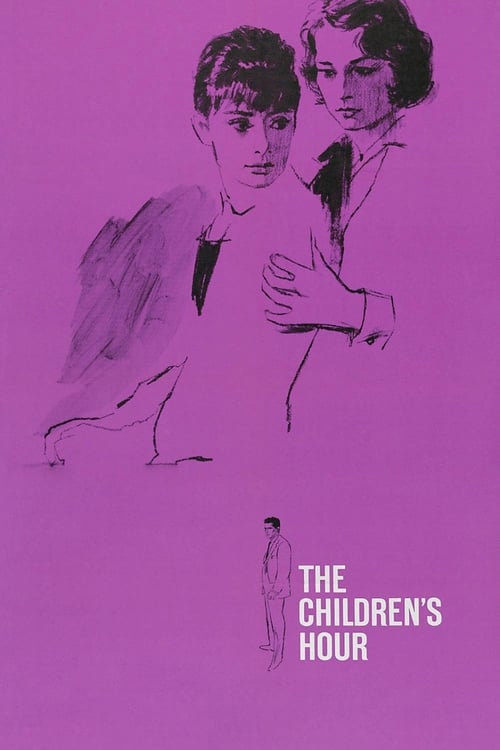
The Children's Hour
1961 · William Wyler
For when you want a serious classic Hollywood drama that still stings — a film about rumor, prejudice, and courage to watch when you're ready to be moved and angered. Challenge, not comfort.
What it's about
Two women — lifelong friends Karen and Martha — have poured everything into the private girls' boarding school they run together. When a spiteful, manipulative pupil retaliates against discipline by whispering to her grandmother that the two are lovers, the rumor tears through their small community, and the women watch their school, their reputations, and their own bond come under siege. It's a drama about how a lie spreads — and about what the accusation forces each woman to confront.
The experience
Tense, claustrophobic, and increasingly wrenching — a chamber drama where the violence is all social: whispers, withdrawn children, closed doors. It builds a quiet fury at injustice and lands somewhere genuinely devastating.
Performances
Shirley MacLaine is shattering as Martha — a performance of mounting self-reckoning far ahead of its era — opposite Audrey Hepburn's finely controlled Karen, with Fay Bainter memorably venomous-then-broken as the grandmother who believes the lie.
The craft
William Wyler directs Lillian Hellman's play in austere black and white, staging it as a tightening vise of parlors, corridors, and courtrooms of public opinion. The precision of the framing — who's watching whom, who's shut out of the frame — does the accusing, and the restraint makes the melodrama cut deeper.
Why it matters
One of the first major American studio films permitted to center on an accusation of homosexuality as the Production Code loosened — a landmark, and a much-debated one, in Hollywood's treatment of gay lives, made more pointed because Wyler had been forced to strip the subject from his own 1936 version of the same play.
Snapshot
The Children's Hour is William Wyler's stark, chamber-scaled adaptation of Lillian Hellman's 1934 Broadway play about two women who run a private girls' boarding school and are ruined when a malicious pupil accuses them of a lesbian relationship. It is one of the most conspicuous artifacts of Hollywood's late Production Code loosening: the first major American studio film permitted to build its plot explicitly around the accusation of homosexuality, a subject the Code had flatly banned when Wyler first filmed the same play in 1936 as These Three. Shot in austere black and white, anchored by Audrey Hepburn and Shirley MacLaine, the film treats its subject through the grammar of tragic melodrama — insinuation, whisper, and self-destruction — rather than open affirmation. That tension between what it dared to name and what it could not endorse has made it a permanent fixture in histories of queer representation on screen, cited repeatedly (most influentially by Vito Russo) as a defining example of the "tragic homosexual" template Hollywood built and then could not escape.
Industry & production
The film was produced by the Mirisch Company and released through United Artists, the studio-distributor arrangement that gave a producer of Wyler's stature substantial autonomy. Wyler was returning to material he knew intimately: he had directed These Three for Samuel Goldwyn in 1936, when the Production Code Administration under Joseph Breen forbade any suggestion of homosexuality and Hellman was obliged to convert her central accusation into a heterosexual love triangle. The 1961 remake was possible because the industry's self-censorship regime was fracturing. In October 1961 the Motion Picture Association amended the Production Code to permit the treatment of homosexuality and "sex aberration" provided it was handled "with care, discretion and restraint" — a revision widely understood to have been prompted by films then in production or seeking approval, including this one and Otto Preminger's Advise & Consent. The Children's Hour thus sits precisely on the hinge of that policy change.
The screenplay is credited to John Michael Hayes, with the screen adaptation credited to Hellman herself, who had also written the 1936 version's reworked material. In the United Kingdom the film was released under the more discreet title The Loudest Whisper, a marketing decision that itself registers how gingerly the industry approached the subject. The casting carried its own historical echo: Miriam Hopkins, who plays the vain, meddling aunt Mrs. Lily Mortar, had played Martha — the MacLaine role — in These Three twenty-five years earlier, a piece of continuity that binds the two adaptations across the span of the Code's rise and decline.
Technology
Technologically the film is deliberately conservative. It was made in black and white at a moment when prestige dramas increasingly defaulted to color and widescreen spectacle, and the monochrome cinematography was a considered aesthetic choice suited to the material's severity and its 1930s theatrical origins. The production is essentially studio-bound, built on interior sets — the school, the parlors, the bedrooms — with the camera and lighting technology of the classical Hollywood soundstage rather than any location-driven innovation. There is no significant technical novelty to claim here, and it would be wrong to invent one; the film's interest lies in the disciplined application of mature tools rather than in any new apparatus.
Technique
Cinematography
The cinematography is by Franz Planer, the Austrian-born veteran who had shot Roman Holiday for Wyler and Hepburn and who received one of the film's Academy Award nominations for this work. Planer's black-and-white photography favors clean, deep-focus compositions and a controlled tonal range that keeps the drama legible and unadorned. Wyler was historically associated — through his long collaboration with Gregg Toland — with staging in depth, allowing multiple planes of action to remain in focus so that dramatic relationships play out spatially within the frame rather than through cutting. That sensibility persists here in Planer's handling: characters are frequently arranged so that reactions in the background register simultaneously with foreground action, a technique well suited to a story about eavesdropping, overheard accusation, and the gap between what is seen and what is inferred.
Editing
Robert Swink, Wyler's regular editor of the period, cut the film. Wyler's reputation as a director who shot many takes and preferred to let scenes breathe within a shot translates into an editing style that is patient rather than aggressive; the cutting serves performance and the gradual tightening of the dramatic screws. The film's structure builds deliberately from domestic routine through the child's lie to the collapse of the two women's world, and the editing supports that slow constriction rather than fragmenting it.
Mise-en-scène / staging
As an adaptation of a stage play, the film is fundamentally an exercise in mise-en-scène: rooms, thresholds, and the movement of bodies through a confined institutional space. Wyler and his designers use the boarding school's architecture — corridors, doorways, the separation of the adult and child worlds — to externalize the drama of surveillance and rumor. The staging repeatedly isolates Karen and Martha within domestic frames that become progressively emptier as the community abandons them, and the film's most discussed moments (Martha's confession, the closing funeral) are blocked with a theatrical clarity that keeps the actors' bodies and faces at the center of meaning. The film received Academy Award nominations for both black-and-white art direction and Dorothy Jeakins's costume design, recognition of the care taken with this restrained visual world.
Sound
Sound design in the classical sense is unshowy; the film's soundscape is dominated by dialogue, and the drama turns on the acoustics of gossip — whispers, overheard fragments, accusations passed from mouth to mouth. The film earned an Academy Award nomination in the sound category (recording supervised through the Goldwyn studio's sound department), reflecting the technical polish of its dialogue recording. Beyond that, the record does not support elaborate claims about sonic experimentation, and none should be manufactured.
Performance
Performance is the film's true medium. Audrey Hepburn plays Karen Wright with a contained, almost brittle gentleness, and Shirley MacLaine plays Martha Dobie as the more volatile and vulnerable of the pair — the woman whose feelings, the film finally suggests, may not be entirely innocent of the accusation leveled against her. MacLaine's late-film confession scene is the performance the film is most remembered for, and MacLaine herself has spoken candidly in later years — including in interviews associated with the documentary The Celluloid Closet — about how little the cast openly discussed the lesbian theme during production, and her belief that the film pulled its punches. Fay Bainter, as the grandmother Amelia Tilford who credulously spreads the child's lie, received the film's sole acting nomination (Best Supporting Actress). Karen Balkin plays the malicious child Mary Tilford, and James Garner plays Karen's fiancé, Dr. Joe Cardin, whose own creeping doubt is part of the tragedy. Miriam Hopkins's Mrs. Mortar supplies the careless adult vanity that helps set the catastrophe in motion.
Narrative & dramatic mode
The dramatic mode is domestic tragedy in the naturalist tradition Hellman worked in — a "well-made play" of accumulating consequence in which a single lie, told by a manipulative child, metastasizes through a small community until it destroys two lives. The narrative engine is not spectacle but insinuation: the film withholds any depicted transgression and instead stages the social machinery by which an unfounded accusation becomes irreversible fact. This gives the film its distinctive irony — the women are punished for something that, in the story's terms, has not happened, only for Martha finally to recognize a buried truth in herself. The structure moves from equilibrium (the school as a going concern) through the introduction of the lie, its viral spread, the collapse of the women's livelihood and relationships, a courtroom-adjacent reckoning, and a tragic resolution centered on Martha's confession and death. It is a study of how communities weaponize suspicion, and of the tragedy of a truth that can only surface under conditions of ruin.
Genre & cycle
The film belongs to the cycle of "social problem" prestige dramas and stage adaptations that characterized serious Hollywood filmmaking around 1960 — talky, actor-driven films about controversial themes newly permitted by the crumbling Code. More specifically it belongs to the small cluster of early-1960s American films that, taking advantage of the 1961 Code amendment, broached homosexuality directly: it is frequently discussed alongside Advise & Consent (1962) and, slightly later, The Best Man (1964). As a Wyler property it also extends his lifelong engagement with theatrical adaptation and with morally serious dramas about individuals crushed by social pressure — a throughline from The Little Foxes (also Hellman) through The Heiress to this film.
Authorship & method
Wyler was among the most decorated and craft-obsessed directors of the studio era, known for exacting, take-heavy direction that prioritized nuanced performance and for a preference for staging in depth. That The Children's Hour is the only property he filmed twice — first constrained by the Code, then freed to restore its central subject — makes it unusually revealing of his relationship to censorship and to Hellman's writing. The collaborators are the ones who defined much of his late output: cinematographer Franz Planer, whose luminous restraint had already served Wyler on Roman Holiday; editor Robert Swink, his cutter across this period; and composer Alex North, one of the leading Hollywood modernists, whose score supplies the film's emotional undertow. On the writing side, Lillian Hellman's authorship is doubly present — as the original playwright and as the adapter who finally got to put her play's real accusation on screen — while John Michael Hayes, a screenwriter best known for his Hitchcock collaborations, holds the screenplay credit. The method throughout is one of fidelity to the theatrical source, refined through classical Hollywood craft rather than reinvented for the camera.
Movement / national cinema
This is a work of mainstream American studio cinema, not of any avant-garde or national art-film movement. It nonetheless sits at a turning point in Hollywood history — the erosion of the Production Code and the tentative arrival of adult subject matter that would accelerate through the 1960s toward the ratings system of 1968. Its closest "movement" affiliation is to the tradition of the American theatrical adaptation, the transfer of serious Broadway drama to prestige film, in which Hellman and Wyler had both long worked.
Era / period
Produced and released in 1961, the film is a product of the late classical Hollywood system in its transitional phase: the studios in decline, the Code loosening, television reshaping the audience, and filmmakers testing what "adult" content the market and the censors would now bear. It is set, per Hellman's play, in a contemporary American milieu, but its sensibility — the enclosed girls' school, the power of respectable gossip, the social absolutism about sexual reputation — carries the moral atmosphere of the 1930s world from which the play sprang.
Themes
The film's central themes are the destructive power of the lie and of rumor; the fragility of reputation, especially for women whose livelihood depends on respectability; and the social policing of sexuality. Beneath the plot of false accusation runs its deeper and more disquieting subject: the possibility of a real, unspoken same-sex desire, and the tragedy that in this world such a feeling can be acknowledged only as self-condemnation. The film is also about childhood malice and adult credulity — the ease with which authority figures believe a child's lie because it confirms their own suspicions — and about the corrosive effect of shame internalized. Martha's arc dramatizes the theme most sharply: the accusation, false as a matter of fact, becomes the occasion for a truth she cannot survive, and the film's most searching (and, to later critics, most troubling) claim is that this recognition can end only in death.
Reception, canon & influence
Contemporary critical reception was mixed. The film was recognized by the industry with five Academy Award nominations — Fay Bainter for Best Supporting Actress, Franz Planer for black-and-white cinematography, black-and-white art direction, Dorothy Jeakins for costume design, and sound — but it won none of them, and a number of critics found it stagey, cautious, and dated relative to the boldness its subject seemed to promise. That charge of timidity has followed the film ever since, and it was sharpened decisively by the queer-cinema criticism that emerged in the 1980s and after. Vito Russo, in The Celluloid Closet, treated the film as a paradigm case of Hollywood's handling of homosexuality: a subject finally allowed on screen only to be punished, with the lesbian character's suicide standing as the archetype of the "tragic gay" ending. In this reading the film's importance is genuinely double-edged — a landmark for naming what had been forbidden, and a cautionary example of the terms on which that naming was permitted.
The influences on the film are clear: Hellman's 1934 play (itself reportedly drawn from a historical Scottish libel case), Wyler's own 1936 These Three, and the loosening of the Production Code that made the restoration of the original story possible. Its legacy forward lies less in stylistic imitation than in its status as a reference point. It became one of the most-cited texts in the historiography of LGBT representation, a fixture of The Celluloid Closet and of subsequent scholarship on the "coming out to die" trope; it remains a touchstone against which later, more affirming lesbian narratives on screen have been measured. As a piece of filmmaking it endures chiefly as a showcase for its performances — particularly MacLaine's — and as a document of a precise historical threshold, the moment American cinema began, haltingly and imperfectly, to speak about what it had long been forbidden to show.
A Deleuzian reading
The parlor doesn't change.
The full Deleuzian reading of The Children's Hour →
Reception
In 1961 it landed as a 'daring' censor-buster that critics found tasteful but timid — respectful reviews, five Oscar nominations, no wins. Today it's been reclaimed as a foundational queer-cinema text, with Shirley MacLaine's performance in particular treated as one of the era's bravest.
How The Children's Hour was received, from release to now →
How to watch The Children's Hour: what to notice on a first viewing
- Watch people's faces in the background while others talk up front. Franz Planer's deep-focus photography keeps multiple planes sharp at once, so a listener's reaction in the back of the frame registers at the same time as the speaker's words. This is what the reading calls the relation-image: meaning built from the web of glances and reactions around a scene, not just from what's said.
- Watch for corridors, doorways, and thresholds between the adult and child worlds. Wyler uses the boarding school's architecture, corridors, doorways, the split between where adults gather and where children play, to stage rumor and eavesdropping as physical geography. The building itself is arranged so that overhearing and being overheard are always possible, everywhere.
- Listen for whispers and overheard fragments passed between characters. The film's soundscape is built from dialogue and the specific acoustics of gossip, a remark caught half-overheard and carried by someone else to a third party. A rumor's whole life cycle, from whisper to accepted fact, plays out entirely in what you can hear.
- Notice how crowded or empty each room is as the story moves. The school is busy with adults and girls at several distances in the frame at once. Note how much furniture surrounds Karen and Martha, and who else is in the room. This is what the reading calls an any-space-whatever: a room that can stop being a setting and become a held feeling.
- Watch how differently Hepburn and MacLaine hold their bodies still. Hepburn plays Karen with a contained, brittle gentleness, while MacLaine plays Martha as the more volatile and exposed of the pair, always closer to the surface. Two different ways of holding yourself together are set right next to each other for you to compare.
The whole guide to watching The Children's Hour, with the keys for a rewatch →
Influences: the films it descends from and the films it influenced
- These Three (1936) — Wyler's own first filming of the same Hellman play, where the Production Code forced the lesbian accusation into a heterosexual love triangle — the exact staging blueprint he restored and re-blocked in 1961.
- The Little Foxes (1941) — Establishes the Wyler-Hellman method of the drawing-room domestic tragedy staged in depth, with Gregg Toland composing action across sharp foreground/background planes that Planer's later deep focus continues.
- Dead End (1937) — Hellman's screenplay adaptation of a stage play shot by Toland on a single confined set — the fidelity-to-theatrical-source discipline refined through classical craft rather than opened up for the camera.
- The Best Years of Our Lives (1946) — Toland's patient deep-focus long takes let a whole moral situation play in one unbroken frame — the staging-in-depth grammar Wyler carried into the confined interiors of the school.
- The Heiress (1949) — Wyler's take-heavy, actor-driven direction of a theatrical adaptation, building through restraint toward a single devastating performance climax — the model for MacLaine's confession.
- Roman Holiday (1953) — Franz Planer's luminous, restrained black-and-white cinematography, the same collaborator and tonal palette Wyler brought directly to this film.
- Citizen Kane (1941) — Toland's deep-focus template — keeping multiple planes in simultaneous sharp focus — is the technical origin point for the staging-in-depth Wyler and Planer deploy.
- A Streetcar Named Desire (1951) — Alex North's modernist jazz-inflected score (his breakthrough, and Wyler's composer here) plus a Method-driven theatrical adaptation pressing against Code limits on unspeakable sexuality.
- Tea and Sympathy (1956) — Builds its entire theatrical-adaptation engine on rumor-and-reputation and insinuated homosexuality that the Code forbids naming — the insinuation-as-plot-motor Wyler inherits.
- Advise and Consent (1962) — Extends the Code-loosening threshold with a gay character whose exposure drives him to suicide — the 'coming out to die' ending Vito Russo paired with this film as archetype.
- The Killing of Sister George (1968) — Carries the tragic-lesbian screen narrative forward, still resolving a lesbian relationship through ruin and loss on the terms Russo's Celluloid Closet traced back here.
- Doubt (2008) — A single-institution theatrical adaptation whose actor-driven drama runs entirely on accusation and insinuation without proof — the same rumor-as-engine, staged in confined rooms.
- The Hunt (2012) — Structures its narrative on a child's false accusation and the community insinuation that destroys a reputation — the exact rumor-and-libel mechanism drawn from Hellman's source case.
- Atonement (2007) — Uses a child's false accusation as the irreversible narrative device that wrecks lives — the same libel-driven tragic architecture as Hellman's play.
- Carol (2015) — The affirming lesbian narrative explicitly measured against this film's tragic template — refusing the suicide/punishment ending that critics fixed to The Children's Hour.
- After the Hunt (2025) — Pioneers the dramaturgy of a possibly-false accusation that destroys careers within a closed pedagogic institution, refusing to settle the question of truth as moral pressure.
- Suddenly, Last Summer (1959) — A Williams theatrical adaptation that structures its drama around an unnameable homosexuality kept offscreen and reached only by verbal insinuation — the same Code-era rhetoric of the unspoken.
- Victim (1961) — A contemporaneous social-problem drama that names homosexuality on screen to argue for reform — occupying the identical historical threshold of censorship loosening.
- Le Corbeau (1943) — Builds its drama on an anonymous accusatory lie whose contagion destroys reputations, the poison-pen-denunciation engine driving a community's moral collapse.
Similar films
- Tea and Sympathy (1956) — influence & lineage
- Suddenly, Last Summer (1959) — influence & lineage
- A Streetcar Named Desire (1951) — influence & lineage
- The Heiress (1949) — influence & lineage
- Mädchen in Uniform (1931) — shared sensibility
- Au Revoir les Enfants (1987) — shared sensibility
- Carnal Knowledge (1971) — shared sensibility
- Diary of a Chambermaid (1964) — shared sensibility