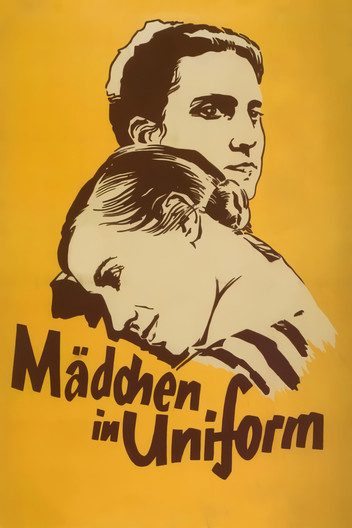
Mädchen in Uniform
1931 · Leontine Sagan
For a night when you want to be moved by first love against the odds, and to feel the shock of how daring an old film can be. It's gentle in texture but emotionally serious — comfort and ache at once.
What it's about
A newly orphaned teenager arrives at a strict Prussian boarding school for the daughters of officers, a place run on hunger, cold, and drill in the name of building character. Among the rules and uniforms she finds one warm presence — a young teacher who treats the girls with real tenderness — and her gratitude deepens into love. The school's headmistress sees affection itself as a threat to discipline, and the collision between the two becomes unavoidable.
The experience
Intimate and quietly charged, it moves like a hushed conversation in a dormitory after lights-out — tender scenes of girlhood friendship pressed up against the chill of institutional cruelty. The emotion builds slowly and lands hard, and it feels startlingly modern for a film made in 1931.
Performances
Hertha Thiele is piercing as Manuela, all open-faced longing, and Dorothea Wieck gives the teacher a warmth shadowed by restraint; the charge between them carries the film.
The craft
Made by an almost entirely female creative team under Leontine Sagan's direction, it turns the school itself into a character — shadowed stairwells, ranks of uniforms, faces in close-up breaking through the regimentation. The black-and-white photography has a soft, expressive glow that makes the tender scenes feel stolen from the institution around them.
Why it matters
One of the first films to portray love between women with open sympathy, it was suppressed after the Nazis came to power and later rediscovered as a founding classic of queer cinema and a last flowering of Weimar filmmaking.
Snapshot
Mädchen in Uniform is the film that Weimar cinema produced at the edge of its own extinction: a chamber drama set inside a Prussian boarding school for the daughters of officers, made by an almost entirely female creative team, released in late 1931, and effectively erased from German screens within two years of the Nazi seizure of power. Its ostensible subject is discipline — the hunger, cold, and regimentation imposed on adolescent girls in the name of producing "soldiers' mothers." Its actual subject is desire, and the way an authoritarian institution both forbids it and depends on it. Manuela von Meinhardis, newly orphaned of her mother and deposited at the school, falls in love with Fräulein von Bernburg, the one teacher who treats the girls with tenderness; after a school theatrical and a glass of punch, she announces her love in front of everyone, and the institution moves to crush her.
The film's historical significance rests on several claims that have survived a century of scrutiny. It is among the earliest sound features to place love between women at the center of its narrative and to treat it not as pathology, criminality, or titillation but as the most honest emotion in the room. It was directed by a woman, adapted by women from a woman's play, and performed by an all-female cast — a configuration essentially without parallel in the commercial cinema of its moment. It was made on a cooperative financing arrangement that gave its participants a stake in the outcome rather than a flat fee. And it uses the young sound cinema with unusual sophistication at a moment when many directors were still bolting dialogue onto static tableaux.
It is also a film whose ending has been argued over for ninety years. Two versions circulated; the question of whether Manuela dies has been a live scholarly and archival problem rather than a settled fact, and it bears directly on how the film reads politically.
Industry & production
The film derives from Christa Winsloe's play, staged in Leipzig and then Berlin around 1930 under the titles Ritter Nérestan and Gestern und heute ("Yesterday and Today"). Winsloe — a sculptor and writer who had herself attended a Potsdam boarding school, and who was involved with women — co-wrote the screen adaptation with F. D. Andam. Leontine Sagan, a Vienna-trained stage actress and director working in the orbit of Max Reinhardt's theater, was engaged to direct; it was her first film. Carl Froelich, an established veteran of German cinema going back to the Messter era, served as producer and supervising or artistic director, and the extent of his hand in the shooting has been a recurring question — Froelich's later prominence in the Nazi film industry (he became head of the Reichsfilmkammer) gave some postwar accounts an incentive to credit him more than the record supports, while feminist scholarship from the 1970s onward pressed hard in the other direction. The honest position is that Sagan directed, Froelich produced and was present, and the division of labor cannot be reconstructed with precision from surviving documentation.
The production company, Deutsche Film-Gemeinschaft, was assembled for the project. What is repeatedly cited — and is the most industrially interesting fact about the film — is that cast and crew worked on a profit-participation basis rather than conventional salaries, a cooperative arrangement suited to a low-budget picture with no stars and a subject no major studio was likely to underwrite. Ufa, the dominant German studio, was not behind it. The film was shot in and around Potsdam, with the school interiors built or dressed to evoke the severe institutional architecture the story requires.
The cast combined Reinhardt-trained professionals with genuine adolescents. Dorothea Wieck played von Bernburg; Hertha Thiele, then barely twenty and previously in Winsloe's stage production, played Manuela; Emilia Unda played the Prussian headmistress; Hedwig Schlichter, Gertrud de Lalsky and Ellen Schwanneke filled out the school. There are no men in the film's world at all — a fact of casting that becomes a structural argument.
Distribution abroad was substantial and, in the United States, contested. The film ran into censorship difficulties with American state boards and with the emerging Production Code apparatus; exhibition proceeded, with cuts and with intertitle framing that softened the relationship into something closer to schoolgirl hero-worship. The film's American release was aided by advocacy from figures who admired it, though the precise mechanics of that intervention are recounted differently in different sources and should be treated with care.
After 1933 the film was suppressed in Germany. Winsloe emigrated, and was shot in France in 1944 under circumstances involving resistance-era denunciation; Sagan left for Britain, where she directed Men of Tomorrow (1932), and later worked extensively in South African theater. Thiele's career in Germany ended with the Nazi period and resumed in the DDR decades later. The film's afterlife is inseparable from the dispersal of the people who made it.
Technology
Mädchen in Uniform is an early sound film made on the German optical-sound systems that had displaced silent production only two or three years earlier, and it belongs to the brief transitional window when directors were still discovering what the new apparatus could do beyond recording speech. The technology imposed real constraints: microphones with limited pickup range, cameras requiring blimping or booth enclosure to keep motor noise off the track, and sound recorded live on set rather than assembled freely in post. Much German production of 1930–31 responded to these constraints by simply standing still.
The film's technical interest lies in how consistently it works against that default. The camera moves — up staircases, along corridors, past ranks of girls — more than the recording conditions made convenient. And the soundtrack is treated as a compositional element rather than a transcript, with music, bells, marching feet, and offscreen voices carrying narrative weight independent of dialogue. This is a picture made by people who understood that sound had arrived and were unwilling to let it make cinema less mobile.
Technique
Cinematography
Reimar Kuntze and Franz Weihmayr shot the film. Their strategy is built on a systematic contrast between two visual regimes. The institutional spaces — stairwells, dormitories, refectory, the headmistress's chambers — are rendered in hard verticals, deep shadow, and a graphic use of the great staircase that turns architecture into a diagram of hierarchy. Girls are repeatedly framed in ranks, in uniform, receding into depth; the striped dresses and the geometry of the building do much of the film's ideological work before anyone speaks.
Against this, the scenes with von Bernburg are lit with a diffusion and softness that reads as almost a different film — most famously in the nightly ritual where she moves down the row of beds bestowing a goodnight kiss on each girl's forehead. The image there is close, warm, and shallow; the institutional grid dissolves. The cinematography thus encodes the film's central opposition — Prussian discipline versus erotic tenderness — as a matter of light and lens rather than dialogue.
A superimposition sequence, layering faces and imagery during Manuela's crisis, extends the Weimar avant-garde's interest in optical subjectivity into a sound-era narrative context.
Editing
Oswald Hafenrichter's cutting is at its most conspicuous in two registers. First, the montage of institutional routine — bells, drills, ranks, hands, the mechanics of daily order — which owes an obvious debt to Soviet and German experimental practice of the 1920s and compresses the school's regime into rhythmic shorthand. Second, the accelerating fragmentation of the final movement, where Manuela's ascent of the staircase is cut against the girls running to find her and the adults converging, building a suspense structure out of parallel action.
Between these poles the film cuts conventionally and unobtrusively, holding scenes long enough for performance to register. The contrast is deliberate: the institution is edited, the human moments are allowed to breathe.
Mise-en-scène / staging
The school is the film's argument. Long tables, identical dresses, the confiscation of personal possessions, the letters read by authority, the ritualized queue — every element of the production design converts the Prussian ideal into visible constraint. Uniform is not merely costume here; the title makes it the subject. When Manuela's real clothes are taken and she is issued the striped dress, the film stages assimilation as a physical act.
The staircase is the organizing spatial figure — the vertical axis along which authority descends and along which Manuela finally climbs. The dormitory, with its rows of white beds, is the counter-space where the regime's grip loosens at night.
The theatrical performance sequence, in which Manuela plays a male role in Schiller's Don Carlos and appears in doublet and hose before the school, is the film's hinge. Cross-dressing licenses the declaration that follows: costumed as a man, flushed with punch, Manuela can say what the uniform exists to prevent. Sagan's stage training is legible in how the sequence is blocked — the play-within-the-film, the audience arranged as spectators, the collapse of performance into confession.
Sound
The most sophisticated element of the film. The soundtrack is stratified: bells and bugles govern institutional time; footsteps and the massed sound of girls moving in formation render discipline audible; Hansom Milde-Meissner's score is used sparingly rather than as continuous underscore. Silence is used structurally — the hush after Manuela's declaration is more devastating than any musical sting would be.
Offscreen sound carries considerable narrative load, particularly in the final passage, where voices calling and searching precede and shape what we see. The film also exploits the acoustic character of its spaces: the reverberant stone stairwell versus the muffled dormitory. For 1931 this is advanced practice, closer to what Lang was doing in M the same year than to the filmed-theater norm.
Performance
Hertha Thiele's Manuela is the performance the film lives on. She plays adolescence without archness — grief, hunger, infatuation and humiliation registered in a face that the camera holds in close-up more than convention would then allow. Dorothea Wieck's von Bernburg is the harder role and the more interesting one: she must be tender enough to justify Manuela's devotion, self-aware enough to know the danger, and sufficiently a product of the institution that she cannot simply defy it. Wieck plays the ambivalence rather than resolving it; her final confrontation with the headmistress is a performance of a woman discovering her own complicity.
Emilia Unda's headmistress — stick, hooked posture, a voice of dry authority — risks caricature and mostly avoids it by being played as a true believer rather than a villain. The ensemble of girls is handled naturalistically, with overlapping chatter and unforced physicality that keeps the school from feeling like a stage set populated by types.
Narrative & dramatic mode
The structure is a compressed institutional tragedy in the classical mode: arrival, assimilation, transgression, exposure, crisis. Manuela enters a closed world, learns its rules, violates the central one — that feeling must not be spoken — and is subjected to the machinery of punishment. What complicates the tragic shape is the collective: the other girls, initially conformist, become an active force, and the film's climax turns on solidarity rather than on the heroine's individual will.
The mode is realist-melodramatic. It uses melodrama's machinery — the pure protagonist, the tyrannical authority, the moment of public shame — but withholds melodrama's usual consolations. There is no romantic resolution, no external rescue, no villain unmasked. The dramatic irony is sustained and cruel: von Bernburg loves Manuela back, and this is precisely why she must withdraw.
The ending is the interpretive crux. The version most widely circulated, and the one that current scholarship generally treats as the original theatrical form, has Manuela pulled back from the stairwell by the other girls — a rescue by collective action, with the headmistress left retreating down the corridor, visibly diminished. Other versions and later accounts have Manuela complete the fall. The suicide ending appears in some circulating prints and in a good deal of secondary literature; the archival record has been muddied by censorship cuts, export variants, and postwar re-releases. This is a case where a scholar should state the ambiguity rather than resolve it. The difference matters enormously: the rescue makes the film a statement about solidarity defeating authoritarianism; the death makes it a lament.
Genre & cycle
Formally the film belongs to the boarding-school drama, a durable European form with roots in nineteenth-century fiction and a specific interwar cinematic presence — Jean Vigo's Zéro de conduite (1933) is the obvious near-contemporary, made independently and arriving at strikingly convergent conclusions about institutions and revolt. The genre's affordances are clear: a closed world, an artificial hierarchy, a captive population, and the metaphorical availability of the school as microcosm of the state.
It also participates in the Weimar cycle of social-problem films that used institutional settings to critique authoritarian structures, alongside work by Pabst and others. And it stands at the origin of what would become, retroactively, a lesbian film canon — though the film predates the categories through which it is now read, and the anachronism should be acknowledged even as the reading is defended.
The most direct generic descendant is the girls'-school-with-charismatic-teacher film, a lineage running through The Prime of Miss Jean Brodie and into contemporary work.
Authorship & method
Leontine Sagan brought theatrical craft — ensemble direction, blocking, work with actors — to a first film, and the picture's strengths in performance and staging are legibly hers. Her subsequent filmography is thin: Men of Tomorrow in Britain, then a return to theater, including foundational work in South African stage direction. She is one of the significant cases of a woman director whose cinema career was truncated by exile and by an industry with no place for her.
Christa Winsloe supplied the source play and co-wrote the screenplay with F. D. Andam. Winsloe is the film's authorial center in the sense that matters most: the material's specificity about boarding-school life, its refusal to pathologize Manuela, and its understanding of what von Bernburg's position costs her are all present in the play. Winsloe later produced a novel version of the story as well.
Carl Froelich produced. His artistic contribution is genuinely disputed and cannot be settled here; the incentive structures around the claim — his Nazi-era eminence, later feminist recovery of Sagan — should make any confident assertion suspect in either direction.
Reimar Kuntze and Franz Weihmayr shot it. Weihmayr went on to a substantial career in the Nazi-era industry, notably with Zarah Leander vehicles — one of the many uncomfortable continuities linking this film's personnel to what followed.
Hansom Milde-Meissner composed. The score's restraint is a virtue; it does not tell the audience what to feel at the moments where the film most needs the audience to decide.
Oswald Hafenrichter edited, and later cut The Third Man — a career trajectory that connects Weimar practice to postwar British cinema.
Movement / national cinema
The film sits at the terminal edge of Weimar cinema. It carries forward that cinema's formal inheritance — expressionist lighting, architectural framing, montage — while belonging to the sober, socially engaged register of the Neue Sachlichkeit years rather than to the fantastic mode of the early 1920s. Its immediate context includes M (1931), Kuhle Wampe (1932), and the Pabst films of the period: works using the mature sound apparatus to examine German society rather than to escape it.
It is also a document of the specific liberty of Weimar Berlin, where a homosexual subculture had institutional and publishing presence unmatched elsewhere, and where Magnus Hirschfeld's Institut für Sexualwissenschaft made non-normative sexuality a subject of public discourse. That context explains how a film like this could be financed and released in 1931 — and its violent closure explains why nothing comparable followed for decades.
Era / period
Released in the winter of 1931–32, into a Germany of mass unemployment, street violence, and collapsing parliamentary government. The Nazi party had become the second-largest in the Reichstag in September 1930. The film's attack on Prussian militarism, its portrait of an institution starving children in the name of national strength, and its sympathy for a form of love the coming regime would criminalize with new severity were all legible as political positions at the moment of release.
The retrospective irony is total: within eighteen months the film's Jewish and dissident personnel were in flight, its subject matter was unfilmable, and the school's ideology had become state policy.
Themes
Authoritarianism and the body. The regime works through hunger, cold, uniform, and surveillance — discipline as a physical fact before it is an ideological one. The headmistress's justification is explicitly nationalist: hunger builds soldiers' mothers.
Desire against institution. The film's argument is not that Manuela's love is acceptable but that it is true, and that an institution requiring it to be denied is thereby indicted. The film never diagnoses her.
The complicity of the sympathetic. Von Bernburg is the film's most morally complex figure precisely because she is kind within a system she serves. Her withdrawal from Manuela is an act of institutional loyalty, and the film understands it as a betrayal.
Solidarity. The girls' collective action — in the rescue-ending version, decisively — proposes that authority is defeated horizontally, by those it disciplines, not by appeal to a higher authority.
Absent men. No man appears, yet patriarchal militarism structures everything: the fathers are officers, the ideal is the soldier, the school exists to produce mothers of soldiers. The film demonstrates that patriarchy does not require men to be present in order to operate.
Reception, canon & influence
Contemporary German reception was strong; the film was a commercial success relative to its modest cost and traveled widely in Europe. It reached the United States and was reviewed seriously there, where the response combined admiration for its craft with careful circumlocution about its content — a pattern of critical euphemism that persisted for decades, with reviewers describing "schoolgirl adoration" or "hero-worship" rather than what the film plainly shows. It encountered censorship in multiple territories; the American release was cut and reframed.
Influences on the film. Sagan's Reinhardt-adjacent theatrical training; Winsloe's autobiographical material and her play; the Weimar formal repertoire (expressionist lighting, architectural framing); Soviet-influenced montage practice; the boarding-school novel tradition; and the sexological and emancipatory discourse of Weimar Berlin.
Forward legacy. The film was rediscovered by feminist and gay/lesbian film scholarship in the 1970s and 1980s. B. Ruby Rich's essay on it is the standard reference point for the modern reading, arguing for the film's anti-fascist politics and against the reduction of the relationship to adolescent phase — an intervention that effectively reset the film's critical status. It has since been a fixture in queer film canon-building and in histories of women's filmmaking.
Its formal and narrative DNA is visible in the closed-institution revolt film (Vigo's Zéro de conduite, and later Anderson's if....), in the girls'-school drama, and in the long line of films about a student's charged attachment to a teacher. It has been remade directly — most notably the 1958 German version with Lilli Palmer and Romy Schneider, and there is a Mexican adaptation, Muchachas de uniforme (1951) — none of which have displaced the original.
Its most consequential legacy is simply that it exists: a pre-Code, pre-Nazi film in which love between women is shown as the one honest thing in a cruel institution, made by women, and preserved. For the historiography of queer cinema, everything before Stonewall is measured against it.
A Deleuzian reading
Every night at lights-out, Fräulein von Bernburg walks the row of beds and kisses each girl on the forehead.
The full Deleuzian reading of Mädchen in Uniform →
Reception
A genuine hit in Weimar Germany that the Nazis banned soon after — then it drifted into obscurity until 1970s feminist and queer film scholars (B. Ruby Rich's landmark essay above all) reclaimed it as the founding text of lesbian cinema.
How Mädchen in Uniform was received, from release to now →
How to watch Mädchen in Uniform: what to notice on a first viewing
- Watch how hard and shadowed the light gets in stairwells and dorms. Kuntze and Weihmayr shoot every institutional space in stark verticals and deep shadow, turning the great staircase into a diagram of hierarchy. The architecture is doing the disciplining before any character says a word.
- Watch the striped uniform get issued the moment personal clothes are taken. The school confiscates each girl's own clothing on arrival and replaces it with an identical striped dress, turning discipline into a physical act. Uniform here is not costume. It is the film's whole argument, staged as a single gesture.
- Count the girls who get the same goodnight kiss, in order. Von Bernburg moves down the row of beds each night, a single ration of tenderness dispensed at a fixed hour to every girl in turn. The ritual shows exactly how much affection this institution allows itself to give out.
- Listen for bells and bugles marking every hour of the day. Institutional time is rendered audible through bells, bugles, and the massed footsteps of girls moving in formation, while the score stays sparse. You hear the discipline as much as you see it, which is how total it is.
- Watch the camera climb stairs and glide down corridors, rarely holding still. Sound cameras in 1931 were usually blimped and static, but Sagan keeps hers moving up staircases and along corridors and past ranks of girls. The moving camera argues that cinema could still measure a hierarchy in motion even boxed in by new sound gear.
The whole guide to watching Mädchen in Uniform, with the keys for a rewatch →
Influences: the films it descends from and the films it influenced
- The Last Laugh (1924) — Murnau and Karl Freund's entfesselte Kamera plus the doorman's braided coat give Sagan both her template for the uniform as a garment that confers and withdraws a self, and the precedent for gliding camera movement through stairwells and corridors that Kuntze and Weihmayr had to reconstruct under the weight of early sound blimps.
- Battleship Potemkin (1925) — The Odessa Steps sequence supplies the grammar Sagan uses for her climax: a staircase shot as a vertical geometry of authority, cut in accelerating fragments of hands, banisters and descending bodies, with the institution rendered as architecture rather than as characters.
- Berlin: Symphony of a Great City (1927) — Ruttmann's rhythmic montage of clocks, whistles and mechanized routine is the direct model for the opening sequence of statuary, bugle calls and bells that establishes the school as a timetable before a single character is introduced.
- The Passion of Joan of Arc (1928) — Dreyer's uncosmetic close-up of a young woman isolated in low-angle against tribunal authority, sustained past the point of narrative necessity, is the shot logic behind Sagan's framing of Hertha Thiele under interrogation by the Oberin.
- Pandora's Box (1929) — Pabst's method of cutting on the glance and directing an untrained-seeming naturalism out of Louise Brooks — plus Countess Geschwitz as a woman whose desire is filmed without caricature — is the performance and editing practice Sagan extends to Thiele and Dorothea Wieck.
- The Blue Angel (1930) — Sternberg's gauze-and-key-light treatment of Dietrich is inverted here into von Bernburg's soft diffusion, and Rath's classroom establishes the sound-era German convention of the pedagogic institution as the site where authority is eroticized and then humiliated.
- People on Sunday (1930) — Its cast of amateurs playing versions of themselves legitimized the unaffected, non-declamatory register Sagan drew from Thiele, at a moment when most German sound films were still pitching performance at theatrical volume.
- Zéro de conduite (1933) — Vigo takes the closed-boarding-school revolt whole — dormitory insurrection, low-angle verticals that dwarf children under institutional architecture, adults staged as grotesques — and adds slow motion where Sagan used montage.
- The Third Man (1949) — Cut by Oswald Hafenrichter, who edited Mädchen in Uniform, it carries the Weimar rhythmic-montage and parallel-chase construction directly into postwar British cinema, most visibly in the canted, staircase-and-vertical cutting of the pursuit sequences.
- Olivia (1951) — Audry restages the girls'-school drama with a woman behind the camera and Colette-adjacent source material, reproducing Sagan's device of filming the pupil's desire through what the teacher's lighting and voice do to her rather than through dialogue.
- Mädchen in Uniform (1958) — A direct remake that preserves the staircase climax and the play-within-the-film cross-dressing scene shot for shot in outline, while adding color and a conventional score — a useful negative proof of how much the 1931 version's power depended on structural silence.
- if.... (1968) — Anderson keeps the institutional-montage structure of bells, roll calls and chapter divisions marking the school day, the vertical framing of dormitory and hall, and the eruption of revolt from within the ranks — transposed to a boys' school and armed.
- The Prime of Miss Jean Brodie (1969) — The charged pupil-teacher attachment is staged as Sagan staged it — the teacher's cultivated voice and privileged reception hours as the mechanism of seduction, the classroom as an arena of loyalty — with the film finally turning on the institution's power to expel the adult instead of the girl.
- Picnic at Hanging Rock (1975) — Russell Boyd's bridal-veil diffusion over the lens is the descendant of the soft-focus treatment of von Bernburg, and Weir builds the same institutional time-marking — clocks, corsets, timetables — as the pressure that produces the girls' escape.
- Portrait of a Lady on Fire (2019) — Sciamma works an all-female production and a closed female enclosure with no non-diegetic score, so that desire is carried entirely by the shot/reverse exchange of looks and by silence around a few sung or spoken sounds — the structural-silence method Sagan improvised in the first months of optical sound.
- M (1931) — The same year, Lang builds a film out of structural silence, disembodied offscreen voices and a cross-cut climax between two parallel authorities — the identical early-sound toolkit Sagan uses for the offscreen dormitory whispers and the intercut search for Manuela.
- Kameradschaft (1931) — Pabst treats an enclosed institution acoustically — shafts, bells, orders relayed through metal — and refuses non-diegetic scoring, exactly the restraint Milde-Meissner's near-absent music practices so that the audience is never told how to read Manuela.
- Anna und Elisabeth (1933) — Made two years later with the same pairing of Hertha Thiele and Dorothea Wieck, it reruns the charged asymmetrical bond between an adolescent and an older woman through the same soft-diffused two-shot vocabulary, then displaces it onto mysticism to survive the changed censorship climate.
Similar films
- The Blue Angel (1930) — influence & lineage
- Pandora's Box (1929) — influence & lineage
- The Last Laugh (1924) — influence & lineage
- Tea and Sympathy (1956) — shared sensibility
- The Bitter Tears of Petra von Kant (1972) — shared sensibility
- Portrait of a Young Girl at the End of the '60s in Brussels (1994) — shared sensibility
- Dreams (2024) — shared sensibility
- The Children's Hour (1961) — shared sensibility