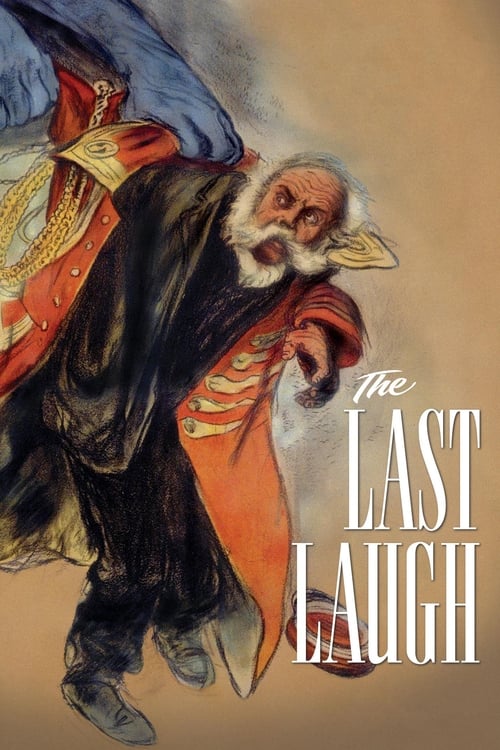
The Last Laugh
1924 · F. W. Murnau
For when you're curious about silent film but want feeling rather than homework — a patient, deeply human tragedy about dignity and work. Bring some sympathy; it earns it.
What it's about
An aging doorman at a grand Berlin hotel lives entirely inside his magnificent brass-buttoned uniform — it's his pride, his standing with his neighbors, his whole identity. When management decides he's too old and demotes him to washroom attendant, the coat comes off, and the film follows what's left of the man as his tenement courtyard turns from admiration to ridicule.
The experience
Quietly devastating: you watch a proud body physically deflate, scene by scene, and nearly a century on it still stings. It's tender, cruel and surprisingly immersive — including a drunken dream sequence where the camera itself seems to reel.
Performances
Emil Jannings acts with his entire body — the set of his shoulders, the weight of his walk — charting a man's collapse from strut to shuffle without a word of dialogue.
The craft
Murnau and cinematographer Karl Freund invented the 'unchained camera' here, sending it gliding through lobbies, down elevators and into a drunkard's spinning head at a time when cameras simply didn't move. The story is told almost entirely in images and gesture, with virtually no title cards — a masterclass in showing instead of telling.
Why it matters
Its moving camera changed how films everywhere were shot and helped bring Murnau to Hollywood; it remains a benchmark of what silent cinema achieved at its peak.
Snapshot
The Last Laugh — released in Germany as Der letzte Mann ("The Last Man") — is F. W. Murnau's chamber tragedy of an aging hotel doorman whose entire sense of self is bound up in a braided, brass-buttoned uniform. When management demotes him to lavatory attendant on grounds of age, the loss of the coat strips him of dignity, family respect, and standing in his tenement courtyard. Produced by Universum Film AG (UFA) from a screenplay by Carl Mayer and photographed by Karl Freund, the film is celebrated above all for its mobile camera — the so-called entfesselte Kamera, the "unchained camera" — and for telling its story almost entirely through image and gesture, with virtually no intertitles. Emil Jannings's central performance, built around posture and the weight of the body, anchors a work widely regarded as a high point of the Kammerspielfilm and of Weimar cinema's visual storytelling. A studio-mandated, ironic happy ending — flagged in the film's single explanatory title card — complicates its tragedy and has been debated ever since.
Industry & production
The film was made at UFA, the dominant German studio of the period, during the years when the company was investing heavily in prestige productions built around technical innovation and the international export market. It belongs to the orbit of producer Erich Pommer, who oversaw UFA's most ambitious artistic projects of the early-to-mid 1920s and championed the integration of writer, director, designer, and cameraman into a tightly controlled studio system. That system is essential to understanding the film: nearly everything was constructed and shot on UFA's Babelsberg stages, including the hotel exterior, the revolving door, the rain-slicked street, and the tenement courtyard, allowing total control over light, camera movement, and architecture.
The production exemplifies the German studio ideal of the "designed film," in which environment is built to express psychology rather than to document a real place. Sets were engineered to permit the camera's movement and to manipulate scale and perspective — forced-perspective construction and built-to-purpose architecture let the filmmakers exaggerate the looming hotel and the cramped courtyard. The film was conceived for an international audience, and its near-absence of intertitles was understood at the time as a commercial as well as artistic asset, since a film "without words" could in principle cross language borders with minimal adaptation. Precise budget and box-office figures are not something I can state reliably here, and I will not invent them; what is securely established is the film's status as a showcase production intended to demonstrate German cinema's technical and artistic leadership.
Technology
The Last Laugh is a silent black-and-white film of the orthochromatic era, and much of its historical importance is technological. Its signature achievement is the systematic liberation of the camera from the fixed tripod. Karl Freund and Murnau devised an array of methods to keep the camera in motion and to bind that motion to the doorman's subjectivity: the camera descends in the hotel lift and glides out across the lobby; it travels, it cranes, it sways. The celebrated opening — a move down and through the lobby — and the later sequences in which the camera reels with the drunken doorman are the most cited instances of an apparatus made to behave like a participant rather than an observer.
To achieve these effects the production improvised rigging that the standard heavy studio camera did not allow: mounting the camera on moving platforms, strapping it to the operator's body, and suspending or tracking it through the built sets. The dream and intoxication sequences extend the technological repertoire into superimposition, distortion, and optical effects, including imagery in which the hotel architecture itself seems to topple and swim. These were not gratuitous tricks but a purpose-built vocabulary for rendering interior states externally. The film's influence on Hollywood technique was direct and personal: Freund subsequently worked in the United States, carrying the mobile-camera practice into American production.
Technique
Cinematography
Karl Freund's camerawork is the film's defining authorial signature alongside Murnau's direction. The cinematography fuses two registers: a fluid, gliding mobility that ties the viewer to the doorman's experience, and a heavily controlled chiaroscuro that models the figure and the architecture in deep contrasts of light and shadow. Reflections, wet pavement, glass, and the gleam of the uniform's braid are used as expressive surfaces. The camera repeatedly adopts optical point of view — most famously in the drunken-revel sequence, where focus, framing, and movement distort to convey perception rather than record space. Where earlier narrative cinema tended to present a stable, theatrical view of action, Freund's camera makes vantage and movement carry meaning, so that the loss of the coat, the leering of the neighbors, and the humiliation of the lavatory are felt as much through how they are seen as through what occurs.
Editing
Compared with the montage-driven Soviet cinema emerging in the same years, The Last Laugh is built less on the collision of shots than on duration, camera movement, and in-shot staging. Editing serves the continuity of the doorman's experience and the rhythm of his decline, rather than calling attention to itself as a constructive principle. The film does, however, deploy editing decisively in its subjective passages — the dream, the drinking sequence — where dissolves, superimpositions, and accelerating cutting break from the otherwise measured pace to render distortion and collapse. The result is a style in which the long, mobile take is the basic unit and cutting is reserved for psychological intensification.
Mise-en-scène / staging
The film's meaning is carried overwhelmingly by mise-en-scène. The two governing spaces — the gleaming modern hotel and the dim tenement courtyard — are set in opposition, and the doorman shuttles between them as between two social worlds. The revolving door becomes a recurring motif and a near-symbol: a turning threshold between status and shame, public grandeur and private exposure. Architecture is scaled to feeling, with the hotel looming and the courtyard pressing in. Costume is the film's central object: the uniform is the man, and the narrative turns on its removal. Staging emphasizes the body in space — the way the doorman fills the doorway in his pomp and shrinks against walls and into corners after his fall — so that social standing is legible as physical posture and spatial position.
Sound
The Last Laugh is a silent film and carried no synchronized recorded soundtrack; it was exhibited with live musical accompaniment, as was standard. The specific scores played at its screenings varied by venue and are not something I can attribute with confidence, and I will not invent a composer or cue. What is notable is how the film "sounds" without sound: it dramatizes noise visually — the bustle of the lobby, the clatter of the courtyard, the swell of laughter and gossip — and conveys speech through gesture so completely that intertitles become almost unnecessary. The single substantive title card in the film is not dialogue but an authorial intervention introducing the epilogue, which makes the film's overall silence all the more pointed.
Performance
Emil Jannings's performance is among the most discussed in silent cinema. Without the aid of dialogue titles, Jannings constructs the doorman entirely through carriage, gait, facial weight, and the handling of objects. In his glory he is upright, expansive, almost strutting; stripped of the coat, he becomes stooped, furtive, diminished — the same body rewritten by shame. The performance risks and at moments embraces a heightened, demonstrative style, but it is disciplined by the camera's intimacy and by the realist chamber-drama framework, which keeps emotion tethered to a recognizable social situation. The supporting playing — the neighbors, the relatives, the hotel staff — is staged as a chorus of looks, turning communal scorn into a visible force pressing on the protagonist.
Narrative & dramatic mode
The film is a compressed, near-unity tragedy of social humiliation, told as a Kammerspielfilm — the "chamber-play film" that adapted the intimacy and psychological focus of small-cast stage drama to cinema. Its dramatic mode is realist and observational, concentrated on a single protagonist, a single decisive reversal, and the slow social consequences that follow. The narrative dispenses almost entirely with intertitles, an extraordinary formal commitment that forces the storytelling into pure image, gesture, and staging. The structure builds toward what looks like an unrelieved descent — demotion, exposure, ridicule, despair in the lavatory — before swerving, via the explicit authorial title card, into an ironic, improbable epilogue in which the doorman is suddenly enriched and indulged. This coda, which the film itself frames as a fairy-tale concession the world rarely grants, converts the ending into a double-edged commentary: it satisfies a demand for relief while underscoring, through its very implausibility, the cruelty of the social order the film has anatomized.
Genre & cycle
The Last Laugh sits at the intersection of two strands of Weimar filmmaking. It belongs to the Kammerspielfilm cycle associated above all with screenwriter Carl Mayer — intimate, present-day dramas of ordinary people, often involving fate, class, and humiliation, told with restraint and few titles. At the same time it draws on the visual resources of German Expressionist cinema without being fully Expressionist: its distortions are largely reserved for subjective episodes, while its baseline world is rendered with a heightened realism. It can also be read as an early instance of the social-realist "street film" sensibility, attentive to milieu, work, and status. The film is thus less a pure genre piece than a synthesis, and its lasting reputation rests partly on how it absorbs Expressionist technique into a humane, character-centered drama.
Authorship & method
The film is a paradigm of collaborative authorship within a strong studio. Murnau directs with a precise control of camera, light, and architecture, orchestrating the contributions of an exceptional team. The screenplay is by Carl Mayer, the central writer of the Kammerspielfilm, whose conception of a near-wordless, image-driven cinema and whose focus on humiliation and fate shape the film as decisively as Murnau's staging. The cinematography is by Karl Freund, whose mobile-camera innovations are inseparable from the film's identity and who carried these methods into later German and American production. The production design — by the team responsible for the hotel, courtyard, and forced-perspective architecture — translates psychology into built space and is integral to the film's authorship. As a silent work the film had no original composer of record attached in the way a sound film would; I will not attribute a specific score. The collaboration of Murnau, Mayer, Freund, and the designers, under UFA's prestige-production conditions, is the proper unit of authorship here, and the film is often cited as a model of how Weimar cinema fused writing, direction, camera, and design.
Movement / national cinema
The Last Laugh is a central work of Weimar German cinema and of UFA's golden era. It stands at the meeting point of Expressionism and the more sober chamber and street tendencies that succeeded the most stylized Expressionist films. In the broader story of national cinemas, it represents the German contribution of psychological depth, designed environment, and camera mobility — a counter-tradition to both the theatrical tableau and the analytic montage developing elsewhere. Its makers, especially Murnau and Freund, soon became conduits through which this German style entered Hollywood, making the film a hinge between national traditions as well as a monument within its own.
Era / period
The film dates from 1924, the mid-Weimar moment when, after the catastrophic inflation of the early 1920s, German cinema was producing some of its most ambitious and internationally oriented work. It precedes the full arrival of synchronized sound, which would arrive in the years following and reshape the very practices — wordless storytelling, the freely moving silent camera — that the film perfected. It thus belongs to the late, mature phase of silent narrative art, a period in which filmmakers pushed the silent image to its expressive limit precisely as that mode neared its historical end.
Themes
The film's governing theme is the dependence of human dignity on social recognition, concentrated in the symbol of the uniform: identity worn on the body and revocable by an employer's decision. From this flow its other concerns — the cruelty of communal judgment, in which neighbors and family turn the protagonist's misfortune into spectacle and scorn; the precariousness of age and labor, as a lifetime of service is undone by a single assessment of fitness; and the gulf between public façade and private shame, embodied in the opposition of glittering hotel and squalid courtyard. The revolving door and the costume make these abstractions physical. The ironic epilogue adds a meta-theme: the appetite of audiences and societies for redemptive endings that real life withholds, and the way fortune, when it comes, arrives as arbitrary fairy tale rather than justice.
Reception, canon & influence
The Last Laugh was received as a landmark on its appearance and has remained securely in the canon of silent cinema, regularly cited in histories of film for its mobile camera, its near-elimination of intertitles, and Jannings's performance. Its critical reputation has rested less on novelty of story than on the demonstration that cinema could tell a complete, emotionally complex narrative through visual means alone.
Looking backward, the film draws on the German chamber-play tradition and on Carl Mayer's prior development of the Kammerspielfilm, on the visual experiments of Expressionist cinema, and on the studio culture of UFA that made designed environments and technical ambition possible. Its restraint can be read as a corrective response to the more extreme stylization of earlier Expressionist films.
Looking forward, its influence is substantial and traceable. The "unchained camera" became a permanent part of film technique, and through Karl Freund — and through Murnau's own subsequent move to Hollywood — German mobile-camera and expressive-lighting practices entered American filmmaking, informing both prestige drama and, later, the visual language of Hollywood genre cinema. Murnau's career immediately following the film extended its methods into further celebrated works, and the picture is routinely invoked as a key influence on the development of subjective camera, on the integration of camera movement with character psychology, and on the ideal of "pure cinema" that recurs throughout later film culture. The film's ironic ending, too, has had an afterlife as a much-discussed case in debates over the studio happy ending and authorial intention. Where specific contemporary reviews or exact attributions are uncertain, the safest statement is the well-established one: The Last Laugh is among the most influential demonstrations in film history that the camera itself can narrate.
A Deleuzian reading
Watch the old man in the doorway.
The full Deleuzian reading of The Last Laugh →
Reception
Acclaimed on arrival in 1924 and never really dethroned — it's the film that got Murnau his Hollywood invitation, and a century on it's still the textbook example silent-cinema courses reach for when they want to show what the camera could suddenly do.
How The Last Laugh was received, from release to now →
Influences: the films it descends from and the films it influenced
- The Cabinet of Dr. Caligari (1920) — Established the Expressionist principle of building psychology into architecture; Murnau inverts its painted-flat distortion into the restrained forced-perspective realism of the hotel and courtyard.
- Shattered (1921) — Carl Mayer's prototype Kammerspielfilm — a near-titleless chamber tragedy of a humiliated working man — supplied the image-driven, dialogue-free narrative model Mayer perfected here.
- Backstairs (1921) — Mayer chamber-play that confines fate and social humiliation to a single domestic stairwell, the spatial-compression staging Murnau scales up to the hotel.
- Warning Shadows (1923) — A near-titleless Weimar drama driven by chiaroscuro and subjective projection, modeling story told purely through light and shadow rather than text.
- Tartuffe (1925) — Direct Murnau–Mayer–Freund–Jannings reunion that carries the gliding camera and framed-narrative irony forward within months.
- Faust (1926) — Extends the film's superimposition and flying-camera technique into full optical spectacle, with chiaroscuro modeling and Jannings's physical performance as Mephisto.
- Sunrise (1927) — Transplants the unchained camera to Hollywood — the marsh tracking shot and superimposed city traffic are the mobile-camera-plus-superimposition grammar of The Last Laugh expanded to feature scale.
- Metropolis (1927) — Karl Freund's camera department applies the freed, swinging camera and expressive UFA lighting to monumental sets, the same studio mobile-rig craft serving spectacle instead of intimacy.
- The Crowd (1928) — The camera climbs the skyscraper and dives through the office grid to isolate one anonymous clerk — the narrating mobile camera plus the ordinary-man's-humiliation subject taken into American cinema.
- Dracula (1931) — Karl Freund's cinematography imports German chiaroscuro and the slow advancing camera into American horror, the 'Freund-to-Hollywood' conduit made concrete.
- The Mummy (1932) — Freund directing applies The Last Laugh's mobile camera and lighting himself, including a flashback narrated almost entirely through image and superimposition.
- Citizen Kane (1941) — Realizes the 'pure cinema' ideal with a restlessly narrating camera and ceilinged forced-perspective sets, descended from Murnau's conviction that architecture and camera movement can carry the story.
- Touch of Evil (1958) — Its crane-borne continuous opening is the unchained camera as sustained long take, choreographing space and suspense without a cut.
- Birdman (2014) — Stages the whole film as one gliding unchained-camera long take whose movement tracks a humiliated performer's psychology — the Murnau premise of camera-as-subjective-narrator pushed to its limit.
- Sunrise: A Song of Two Humans (1927) — Karl Freund's 'entfesselte Kamera' — camera mounted to a chest harness, bicycle, and elevator cage — gave Murnau the continuous-tracking-shot grammar he then scaled up in Sunrise's city-walk and trolley sequences.
- Key Largo (1948) — Karl Freund developed his mobile camera and shadow-laden interior compositions here — corridors that narrow into humiliation, rooms that express hierarchy through depth — and transported this visual grammar directly into Key Largo's hotel staging.
- New Year's Eve (1924) — Companion Mayer script of the same year that pushes the intertitle-less Kammerspielfilm, sharing the cyclical-time framing and image-as-narration ambition.
- Variety (1925) — Karl Freund mounts the unchained camera on a trapeze for vertiginous subjective-POV swings, the most literal extension of Freund's mobile-rig work with Jannings again as the cuckolded performer.
- The Docks of New York (1928) — Builds an almost wordless waterfront drama out of atmospheric chiaroscuro and expressive set design, the Weimar light-as-narration aesthetic in Hollywood.
- Nosferatu (1922) — Develops Murnau's 'unchained camera' and his treatment of architecture as an extension and oppressor of the human figure.
- The Cranes Are Flying (1957) — Origin of the 'entfesselte Kamera' (unchained subjective camera) — Freund's strapped-on and moving rigs — that Cranes extends into fully subjective, vertiginous handheld point-of-view.
- A Woman of Paris: A Drama of Fate (1923) — Independent contemporaneous proof that a feature needs no intertitles, with a uniform (the significant prop taken to its limit) bearing the entire arc of the character's standing — the same wager Chaplin made on the collar and the handkerchief.
Similar films
- The Cabinet of Dr. Caligari (1920) — influence & lineage · often watched together
- Faust (1926) — influence & lineage
- Metropolis (1927) — influence & lineage
- Touch of Evil (1958) — influence & lineage · often watched together
- The Great Dictator (1940) — often watched together
- Modern Times (1936) — often watched together
- The Phantom Carriage (1921) — often watched together
- The Testament of Dr. Mabuse (1933) — often watched together
All the films related to The Last Laugh →