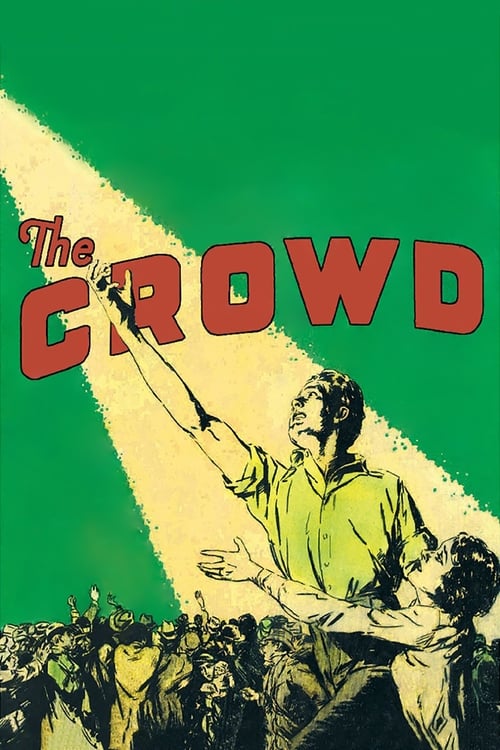
The Crowd
1928 · King Vidor
For when you want a film that tells you the truth — not an escape but a mirror, best met when you're ready to feel something and sit with it. One of the great serious silents, and more accessible than that sounds.
What it's about
John Sims arrives in New York certain he's destined for big things. He takes a desk in a vast office of identical desks, falls for Mary, marries her, and starts a family — and the film follows their ordinary life through money troubles, marital strain, and sudden grief, one couple nearly swallowed by a city of millions.
The experience
Startlingly honest and often heavy — it finds real warmth and humor in a young marriage, then puts it through wringers that still land hard a century later. You come out shaken by how contemporary it feels: the ambition, the disappointment, the getting up anyway.
The craft
Vidor smuggled radical filmmaking into a glamour studio: the famous camera move up a skyscraper and across an ocean of identical desks is one of the most imitated images in movies, and the whole film uses the city's geometry to dwarf its characters. Location-flavored street scenes give it a realism decades ahead of schedule.
Why it matters
A milestone of American realism — proof the studio system could make a film about an unexceptional man and his defeats — and its office-grid imagery echoes through every later film about anonymous modern work.
Snapshot
The Crowd is King Vidor's silent chronicle of an ordinary American life — the life of John Sims, one clerk among thousands, who believes he is destined for greatness and discovers instead the grinding anonymity of the modern city. Produced by MGM at the height of the studio's prestige and released in February 1928, it stands as one of the most formally ambitious and thematically austere films of the late American silent era: a deliberately unglamorous portrait of marriage, work, poverty, and grief made inside the most glamour-conscious studio in Hollywood. Vidor conceived it as a companion to his 1925 war epic The Big Parade — where that film set a single soldier against the mass of war, The Crowd sets a single man against the mass of the metropolis. Its famous crane movement up a skyscraper and into a vast grid of identical desks became one of the defining images of urban modernity in cinema, and its refusal of a triumphant ending marked it as a work of unusual honesty for a mainstream studio production. It was nominated at the first Academy Awards and has since been enshrined as a canonical American silent film, an acknowledged precursor to Italian neorealism and to later studio dramas of the anonymous white-collar worker.
Industry & production
The Crowd was a Metro-Goldwyn-Mayer production made under the aegis of Irving Thalberg, the studio's young head of production, who had backed Vidor's enormously successful The Big Parade and extended him a degree of creative latitude rare for the period. Vidor famously pitched the project as a story about "the average man" — a subject with no obvious commercial appeal — and MGM's willingness to finance it reflected both the prestige Vidor had earned and Thalberg's interest in artistically distinctive pictures that could burnish the studio's reputation. The film was made at a moment of maximum industrial confidence in silent cinema that was, in fact, about to end: sound arrived commercially during its production and release window, and The Crowd emerged as one of the last major silent statements from MGM before the studio converted fully to sound.
Casting was itself part of the film's realist program. Rather than a star, Vidor chose James Murray, a young actor he reportedly noticed working as an extra, precisely because Murray carried no established screen persona; the choice reinforced the film's premise that its hero is indistinguishable from the multitude. The female lead, Mary, was played by Eleanor Boardman, an established MGM actress who was also Vidor's wife. Contemporary accounts hold that MGM was uneasy about the film's downbeat material and its lack of conventional uplift, and the studio is widely reported to have shot and tested multiple endings before settling on the released version. Precise figures for the film's budget and box-office performance are not securely documented in the popular record; it is generally understood to have been a modest commercial performer relative to The Big Parade, though the exact numbers should be treated with caution.
Technology
The Crowd was produced with the standard silent-era apparatus — orthochromatic film stock, hand-cranked and motor-driven 35mm cameras, and intertitles carrying dialogue and narration — but its ambitions pushed against those tools' limits. The film is celebrated for extensive location shooting in New York City, including reportedly concealed-camera work that captured real crowds on real streets, a technique that lent the picture a documentary texture unusual for a studio drama. To achieve its signature vertical camera movements and the towering interior of the office, the production combined crane rigs, forced-perspective sets, and miniature and matte work; the great open-plan office, with its receding ranks of desks, was constructed and staged to read as effectively infinite. The film sits at the technological hinge between the silent and sound eras, and its very perfection of silent visual storytelling is inseparable from the fact that the medium's expressive vocabulary had reached full maturity just as it was about to be displaced.
Technique
Cinematography
The cinematography, by Henry Sharp, is the film's most discussed achievement. Its most celebrated passage begins on a crowded Manhattan street, cranes upward along the sheer face of a skyscraper, and then appears to pass through a window into an enormous office where hundreds of identical desks stretch into the distance — the camera tracking forward to single out John at desk 137. The movement condenses the film's entire thesis into a single gesture: the individual is located, with almost bureaucratic precision, as one interchangeable unit within a vast machine. Elsewhere Sharp and Vidor draw on the visual innovations of contemporary German cinema and of the Fox pictures made by Murnau — the mobile, subjective "unchained camera" — to render New York as both spectacle and oppression. Deep, geometric compositions repeatedly dwarf the characters within grids, corridors, and crowds, while the location photography grounds the film's expressionist flourishes in observed reality.
Editing
Cut by Hugh Wynn, the film moves between two registers: the fluid, unbroken camera movements that establish the individual's place in the mass, and montage passages that compress time and convey the rhythms of city life, labor, and leisure. The Coney Island and courtship sequences use associative cutting to sketch the acceleration of romance, while later passages employ editing to convey drudgery and disintegration. The film's tempo is carefully modulated so that its rare moments of stillness — grief, despair — land with force against the surrounding bustle.
Mise-en-scène / staging
Vidor's staging is organized around the tension between the singular figure and the engulfing multitude. Interiors are designed as systems rather than rooms: the office as an endless ledger of desks, the apartment as a cramped stage for domestic strain. Crowds are choreographed as environments the protagonist must move through and against — on the street, at the beach, in the theater. The art direction (credited within MGM's department under Cedric Gibbons, with Arnold Gillespie among the contributors) supports the film's dialectic of scale, alternating monumental spaces with claustrophobic ones.
Sound
The Crowd is a silent film, released at the precise moment sound was overtaking Hollywood. It tells its story through images, performance, and intertitles rather than synchronized dialogue. Like many prestige MGM releases of the late silent period, it circulated with a synchronized recorded musical accompaniment in some presentations; the specific attribution of that score is not something I can state with confidence and should not be asserted as fact. What matters formally is that the film represents silent technique at its most fully realized, achieving through purely visual means an emotional and social complexity that early sound cinema would struggle for years to match.
Performance
James Murray's John is the film's emotional center — callow, boastful, and vulnerable by turns, a performance built on ordinariness rather than star charisma. Eleanor Boardman's Mary is its counterweight: patient, wounded, and finally resilient, she carries much of the film's moral weight. Both performers work in a restrained, naturalistic register that avoids the broad pantomime associated with earlier silent acting, a choice consistent with the film's realist aims. The poignancy of Murray's casting is deepened, in retrospect, by his own difficult later life and early death, which have become part of the film's critical lore.
Narrative & dramatic mode
The film's dramatic mode is realist tragedy filtered through the everyday. Its structure follows a life rather than a plot: John is born (the intertitles mark him as born on the Fourth of July, his father predicting he will be "somebody"), grows up believing in his own destiny, comes to New York, takes a clerk's job, meets Mary at Coney Island, marries, has children, and then endures a cascade of ordinary catastrophes — financial strain, marital conflict, the sudden death of their young daughter in a street accident, unemployment, and near-suicidal despair. There is no villain and no melodramatic reversal; the antagonist is the impersonal structure of modern life itself. The ending is famously ambivalent: John, momentarily reprieved, sits with his family in a crowded vaudeville theater, laughing — and the camera pulls back to dissolve him into the anonymous mass of the audience, the crowd from which he was singled out at the start. The gesture is neither uplift nor condemnation but a statement of condition.
Genre & cycle
Nominally a drama and romance, The Crowd belongs most meaningfully to the cycle of "city films" that flourished in the 1920s — works fascinated by the modern metropolis as both wonder and threat. It shares that preoccupation with the European "city symphony" documentaries and with contemporaneous fiction features about urban life, most obviously Murnau's Sunrise (Fox, 1927), with which it is frequently paired as a portrait of the couple in the city. Yet The Crowd is distinguished by its focus on economic and social ordinariness: it is less a romance of the city than an anatomy of the salaried worker's existence, anticipating a strain of American social realism that would resurface in the 1930s.
Authorship & method
The Crowd is central to King Vidor's authorship. It forms part of what is often described as his loose thematic trilogy on the individual and the mass — The Big Parade (the soldier in war), The Crowd (the clerk in the city), and later Our Daily Bread (1934, the worker in collective agriculture during the Depression). Vidor's method here combined studio resources with quasi-documentary practices: real locations, hidden cameras, a non-star lead, and a willingness to let a narrative end without resolution. The screenplay is credited to Vidor with collaborators including John V. A. Weaver and Harry Behn, who helped shape the film's episodic, life-spanning structure and its plainspoken intertitles. The cinematography of Henry Sharp and the editing of Hugh Wynn are integral to the film's meaning rather than merely its execution, and MGM's art department under Cedric Gibbons provided the monumental sets that make the film's scale legible. The result is a work in which Vidor's directorial vision — humane, socially attentive, formally daring — is unmistakably legible.
Movement / national cinema
As American cinema, The Crowd occupies an unusual position: a Hollywood studio film that absorbed the lessons of European art cinema — the mobile camera and psychological expressionism of Weimar Germany, the atmospheric realism of Murnau — and turned them toward distinctly American subject matter. It is not the product of an organized movement but rather an early, isolated instance of studio-financed social realism, and it is routinely cited as a bridge between 1920s European modernism and the later realist currents of world cinema, above all Italian neorealism.
Era / period
The film is a document of late-1920s America and of the last full flowering of silent cinema. It captures the optimism and anxiety of the boom years — the faith in individual advancement, the pressures of consumer aspiration, the anonymity of the corporate workplace — on the eve of both the sound revolution and the Great Depression. Released in early 1928, it now reads almost as a premonition: its portrait of economic precarity and dashed aspiration would acquire additional resonance within eighteen months, when the 1929 crash gave its themes a national scale.
Themes
Its central theme is the fate of the individual within mass modern society — the collision between the American promise that anyone can be "somebody" and the reality that most lives are lived in obscurity. From this flow its subsidiary concerns: the alienation of white-collar labor; the fragility of marriage under economic stress; the randomness of grief; the seductions and cruelties of the consumer city. The film is unusually unsentimental about the myth of self-made success, presenting John's belief in his own specialness as both his engine and his affliction. Its final image — the individual reabsorbed into the crowd — crystallizes a vision of modern life as at once democratic and dissolving.
Reception, canon & influence
Critically, The Crowd was recognized on release as a work of exceptional artistic seriousness, admired for its technique and its candor even as its commercial prospects were hampered by its bleakness and its arrival amid the sound transition. It was nominated at the first Academy Awards ceremony, including recognition for Vidor's direction and in the short-lived "Unique and Artistic Production" category, where it competed with Murnau's Sunrise — a pairing that has fixed the two films together in histories of the period.
Its influences run backward to the mobile-camera aesthetics of Weimar cinema and to Murnau's American work, and to the broader 1920s fascination with the metropolis. Its legacy runs forward with unusual clarity. It is regularly named as a precursor to Italian neorealism for its ordinary protagonist, location shooting, and refusal of melodrama. Its image of the endless office of identical desks became a touchstone for later films about corporate anonymity — most often cited in connection with Billy Wilder's The Apartment (1960), whose vast insurance-office set is frequently read as an homage. Within Vidor's own career it anchors his engagement with the individual-and-mass theme that culminates in Our Daily Bread. The film has been preserved and periodically restored, and it holds a secure place in the canon of American silent cinema, admired precisely for doing what the studio system rarely permitted: telling the story of a man who is, by design, no one in particular.
A Deleuzian reading
The camera climbs the sheer face of a skyscraper, slips through a window, and enters a room where hundreds of identical desks recede toward a vanishing point.
The full Deleuzian reading of The Crowd →
Reception
MGM barely knew what to do with a plotless film about an ordinary nobody — it earned respect and Oscar nominations at the very first Academy Awards but was no Big Parade at the box office. Today it's routinely called one of the greatest silent films ever made, a proto-neorealist landmark decades ahead of its time.
How The Crowd was received, from release to now →
How to watch The Crowd: what to notice on a first viewing
- Watch the camera climb the building and glide into the office. The shot cranes up the skyscraper's face, appears to pass through a window, and tracks forward through hundreds of identical desks until it singles out John at desk 137. In one move you see the office as a whole machine and John as one interchangeable part inside it.
- Notice how often crowds surround John at the beach and office. Vidor choreographs crowds as environments John must move through, not backdrops behind him, so he is rarely alone in the frame even in his most private moments. The staging keeps reminding you that his story is never really separable from everyone else's.
- Watch the Coney Island courtship cut together in quick fragments. The editing compresses John and Mary's romance into an associative rush of rides, glances, and gestures, the same technique the film later uses to convey drudgery instead of delight. The same cutting style can sell you falling in love or grinding routine, depending only on what it shows.
- Watch how ordinary and unglamorous John's face and manner stay. Vidor cast an unknown, James Murray, and keeps his performance restrained and naturalistic, avoiding the broad gestures of typical silent-film acting. You are meant to see a type, not a star, which is the whole point of a film about being one of many.
- Notice the identical desks stretching back through the office. The office is designed as an endless ledger of desks rather than a room, while the apartment later appears as a cramped stage barely built for two people. The rooms themselves argue that a life can be organized like an accounting system.
The whole guide to watching The Crowd, with the keys for a rewatch →
Influences: the films it descends from and the films it influenced
- Intolerance (1916) — The Babylon sequence's giant elevator-dolly crane — descending through space toward figures in a monumental set — is the direct ancestor of The Crowd's signature crane that climbs the skyscraper and cranes across the desk-field to find John.
- The Last Laugh (1924) — Karl Freund's 'entfesselte Kamera' (unchained camera) and the near-titleless story of a little man's status collapse gave Vidor both his mobile-camera technique and his model for telling an ordinary humiliation with minimal intertitles.
- Greed (1924) — Its real-location shooting and refusal to redeem an ordinary marriage with melodramatic uplift established the American realist-tragedy of common people that The Crowd extends.
- The Big Parade (1925) — Vidor's own prior panel of the individual-and-mass trilogy, rehearsing the deep-file staging of the ordinary man swallowed into anonymous ranks (soldiers) before he tried it with clerks.
- Metropolis (1927) — The geometric massing of interchangeable workers in monumental architecture supplied the individual-versus-mass staging vocabulary Vidor reworked into the office grid.
- Berlin: Symphony of a Great City (1927) — Its associative city-montage of clocks, machines, traffic and crowds is the montage template behind Vidor's rhythmic assembly of the metropolis pressing on the individual.
- Sunrise: A Song of Two Humans (1927) — Vidor adopted Sunrise's stadtfilm grammar wholesale: forced-perspective office towers receding to a vanishing point, location tracking shots through dense Manhattan crowds, the couple dwarfed by urban architecture — all repurposed as the visual language for individual anonymity in mass modernity.
- Our Daily Bread (1934) — The culmination of Vidor's individual-and-mass trilogy — John and Mary literally return — resolving the clerk's alienation into collective agrarian labor.
- Modern Times (1936) — The little man ground through assembly-line grids and metropolitan machinery extends The Crowd's staging of the individual crushed by industrial mass, keeping its ambivalent walk-into-the-crowd ending.
- Bicycle Thieves (1948) — Realizes the neorealist program The Crowd anticipated: a non-professional lead, street-location shooting, an ordinary economic tragedy, and an unresolved ending swallowed by a crowd.
- The Apartment (1960) — Its vast insurance-office set of identical desks receding to a forced-perspective vanishing point is the film's most-cited direct homage to Vidor's office grid.
- The Trial (1962) — The immense hall of hundreds of identical clerk desks stretching into darkness restates The Crowd's image of bureaucratic anonymity as pure spatial oppression.
- Playtime (1967) — The maze of identical glass cubicles and desk-modules in which a single figure is geometrically lost pushes Vidor's deep-composition office grid to its modernist extreme.
- The Grapes of Wrath (1940) — Established the American social-realist subordination of the individual to the anonymous mass — Ford's 'group-over-individual' framing of the Joads as one cell in a migrant tide descends from Vidor's treatment of the worker as crowd-member.
- I Am a Fugitive from a Chain Gang (1932) — Models the anonymous everyman ground down by an impersonal social machine, closing on an unresolved, un-triumphant note that refuses the uplift ending.
- Tokyo Twilight (1957) — Vidor's dramatization of anonymous white-collar urban failure—an ordinary clerk crushed by economic and familial disappointment—modeled the downward-mobility realism that Ozu absorbed into the shomin-geki, whose Hollywood silents he studied closely as a young director.
- A Tree Grows in Brooklyn (1945) — Pioneered treating the anonymous urban working family as tragic subject, using the city apartment as pressure-chamber — the sociological-domestic frame Kazan's debut extends.
- Sunrise (1927) — Its co-nominee at the first Oscars shares the Weimar mobile-camera choreography and forced-perspective urban sets that engulf a naive protagonist in city traffic and crowds.
- Lonesome (1928) — A near-contemporary NYC film of two anonymous clerks, using an unchained camera and Coney Island location work to find romance inside the interchangeable urban mass.
- Man with a Movie Camera (1929) — A sibling city-film built from associative montage and candid/hidden-camera street footage of urban anonymity — the documentary-of-the-crowd impulse Vidor smuggled into fiction.
- People on Sunday (1930) — Non-professional Berliners shot on real locations without melodrama — the same precursor-to-neorealism method of the ordinary, unstarred protagonist.
Similar films
- The Apartment (1960) — influence & lineage
- Greed (1924) — influence & lineage
- The Last Laugh (1924) — influence & lineage
- Metropolis (1927) — influence & lineage
- Man with a Movie Camera (1929) — influence & lineage
- Modern Times (1936) — influence & lineage
- Bicycle Thieves (1948) — influence & lineage
- Sunrise: A Song of Two Humans (1927) — shared sensibility