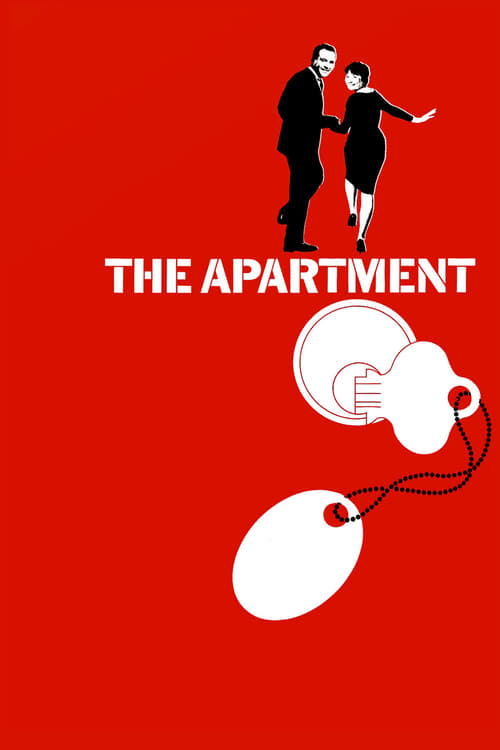
The Apartment
1960 · Billy Wilder
For a night when you want to laugh and feel something real at the same time — ideal around the holidays, perfect when you're a little lonely yourself and want a film that understands. Comfort viewing with actual teeth.
What it's about
A lonely junior clerk at a giant New York insurance company discovers a shortcut up the corporate ladder: lending his apartment to married executives for their affairs. He mops up after their evenings and pockets the promotions — until he falls for the elevator operator in his building and discovers exactly whose mistress she is. Set over a wintry New York Christmas and New Year's, it's an office comedy that keeps drifting into heartbreak.
The experience
Funny, then quietly devastating, then funny again — it walks a knife edge between farce and melancholy that almost no film manages. You laugh at the machinery of office life while it breaks your heart about loneliness, and the ending earns one of the great warm glows in movies.
Performances
Jack Lemmon is the definitive lovable schnook, all nervous decency curdling into self-disgust, and Shirley MacLaine gives Fran Kubelik a bruised wit that makes every scene she's in ache. Fred MacMurray, cast brilliantly against his nice-guy image, is chillingly casual as the boss who uses them both.
The craft
Billy Wilder's screenplay is a machine of setups and payoffs — a tennis racket, a cracked compact mirror, a bowler hat — where every joke returns later carrying real weight. The wide black-and-white frame turns the endless rows of office desks into an image of anonymity you never forget.
Why it matters
Swept the top Academy Awards including Best Picture and became the gold standard for the comedy that's secretly a drama — its DNA is in every workplace story and bittersweet romance since.
Snapshot
Billy Wilder's The Apartment is a CinemaScope black-and-white comedy-drama that anatomizes postwar American corporate culture through the story of C.C. "Bud" Baxter (Jack Lemmon), a junior actuary at Consolidated Life of New York who trades the use of his Upper West Side apartment to a rotating roster of philandering executives in exchange for professional advancement. When he discovers that his elevator operator, Fran Kubelik (Shirley MacLaine), is the mistress of his most powerful patron, Personnel Director Jeff Sheldrake (Fred MacMurray), the film's tonal register shifts from mordant farce toward something closer to moral melodrama. Released in June 1960, it became one of the most decorated films of its era, winning five Academy Awards including Best Picture, Best Director, and Best Original Screenplay, while lodging itself permanently in the canon of American cinema as a work that refuses to be simply comic, simply romantic, or simply satirical.
Industry & production
The Apartment was produced by the Mirisch Company and distributed by United Artists — an arrangement that gave Wilder unusual creative latitude within the shifting commercial landscape of late-1950s Hollywood. The Mirisch Company, formed in 1957, operated as an independent production entity that attracted talent by offering top-level directors genuine autonomy, a model made viable by United Artists' willingness to finance and distribute without the old studio-system interference. Wilder had already delivered the company Some Like It Hot (1959) under this arrangement; The Apartment followed immediately, with Wilder again producing and directing from his own script.
The casting choices carry their own industrial logic. Jack Lemmon, fresh from Some Like It Hot, was Wilder's natural collaborator; Shirley MacLaine, cast against type as a figure of fragility rather than comic energy, had been seen largely in lighter roles. The most pointed piece of casting is Fred MacMurray, who had built a wholesome, genial screen persona over decades — his embodiment of a smooth corporate seducer exploits and inverts that goodwill precisely. MacMurray reportedly had reservations about the role's moral exposure; the film benefits from the slight guardedness he brought.
Production took place on the Goldwyn Studios lot in Los Angeles. Alexandre Trauner, the Hungarian-born French production designer who became one of Wilder's closest collaborators, built the film's central sets there. The shooting schedule ran through the latter half of 1959 for a summer 1960 release.
Technology
The Apartment was photographed in black and white on an anamorphic Panavision format, yielding the wide 2.35:1 aspect ratio of CinemaScope without the chromatic aberration issues that had plagued early anamorphic lenses. The choice of monochrome was deliberate: color would have blunted the film's edge, softening the institutional grays of corporate Manhattan into something warmer and more palatable. In 1960, black-and-white still carried connotations of photojournalism, postwar social realism, and a certain unvarnished honesty that color could not provide.
The defining technological achievement of the film belongs to Trauner's production design rather than to the camera itself. To represent the cavernous open-plan offices of Consolidated Life — an environment Wilder wanted to read as both comically banal and genuinely dehumanizing — Trauner employed a rigorous forced-perspective construction. Desks and props diminish in scale toward the rear of the set; background "employees" were cast for shorter stature, and the furniture placed behind the midpoint of the frame was built proportionally smaller. The result is a floor that appears to recede into institutional infinity, creating a spatial metaphor for bureaucratic anonymity that no real office could have provided. This set is among the most discussed pieces of production design in American studio filmmaking.
Technique
Cinematography
Joseph LaShelle's camerawork is restrained and precise, lending the film a surface neutrality that makes its moments of visual expressionism hit harder. LaShelle favors clean framings in the wide CinemaScope field during office sequences, often placing Lemmon's Baxter as a lone figure amid rows of identical desks, the forced-perspective depth stretching the corporate world away from him in every direction. The apartment interiors are photographed with more clutter and intimacy — the frame fills with the evidence of other people's lives, their bourbon bottles and lipsticked glasses. The key symbolic object, Fran Kubelik's compact mirror with its cracked glass, is shot in close-up twice: once to introduce its distorting property, once when Baxter recognizes it belongs to her. The crack that bisects her reflection is the film's most compressed visual statement, economically rendered.
Editing
Daniel Mandell, who had edited Wilder's Stalag 17 and won an earlier Academy Award for William Wyler's The Best Years of Our Lives, cut the film and received the Oscar for Film Editing. His work is classical in the best sense: transparent, rhythmically sound, never drawing attention to itself except in the comedy sequences where timing is everything. The pacing shifts perceptibly in the film's second half — cuts lengthen, pauses accumulate — tracking the emotional gravity that settles over the material after Fran's suicide attempt.
Mise-en-scène / staging
Wilder's directorial approach descends from the Central European theatrical tradition filtered through classical Hollywood construction. His compositions consistently use depth and the wide frame to place characters in spatial relationships that communicate power: Sheldrake takes the center of every two-shot; Baxter is habitually placed at the margins of institutional space. The apartment itself is staged differently depending on whose emotional register dominates — when it is a site of humiliation for Baxter, it feels cramped and disordered; in the film's final scene, with the card table set and snow at the window, it becomes the warmest space in the film. Wilder's staging throughout is clear without being schematic, reserving genuine visual surprise for the moments that earn it.
Sound
Adolph Deutsch's score threads a persistent melancholy beneath the comedy without overwhelming it. The main theme is wistful rather than satirical, signaling from the outset that whatever laughs the film provides, something is genuinely at stake. The score largely withdraws during the film's most serious passages — the suicide sequence, the convalescent scenes — allowing silence and ambient sound to carry emotional weight. Deutsch had scored Some Like It Hot for Wilder and brought the same tonal dexterity to The Apartment.
Performance
Jack Lemmon's performance is one of the central achievements of the postwar American acting tradition: a sustained negotiation between broad physical comedy and interior emotional legibility. Lemmon was trained in the Method-adjacent New York school but had developed a distinctly kinetic screen physicality; Wilder used both registers. Baxter's abasement is played for laughs but never without dignity — Lemmon locates the precise gradient between complicity and victimhood and holds it for the film's duration.
Shirley MacLaine plays Fran with a quality of bruised practicality that resists sentimentalization. She does not play the character as foolish for her attachment to Sheldrake; she plays her as someone who understands exactly how she is being used and has chosen, for reasons legible in MacLaine's eyes, to accept it anyway. The performance makes the film's moral argument without stating it.
Fred MacMurray's work as Sheldrake is perhaps the most quietly accomplished in the film. His affability is completely intact at the surface; what MacMurray communicates is the absence of anything beneath it. The performance is chilling precisely because it remains pleasant.
Narrative & dramatic mode
The film's narrative architecture is that of classical Hollywood three-act construction with its moral equilibrium deliberately skewed. Act one establishes the comedic premise and its social logic; act two turns on the discovery that the woman Baxter loves is the mistress of the executive whose patronage he most needs; act three resolves the impasse through a moral choice that costs Baxter materially but restores him to himself. This structure is familiar. What is not familiar is the texture of the material within it — the suicide attempt at the midpoint, the tenderness of the recovery sequence, the refusal to punish Sheldrake in any visible way.
The closing line — "Shut up and deal," delivered by MacLaine as she returns to Baxter's card game after rebuffing Sheldrake — is among the most studied in American cinema, partly for what it withholds. No declaration is made. The romantic resolution is coded entirely in the resumption of an ordinary domestic ritual. It is a closing of rare emotional intelligence.
Genre & cycle
The Apartment belongs to the late-1950s/early-1960s cycle of American sex comedies — a cycle whose commercial viability rested on the post-Kinsey Report relaxation of certain studio-era inhibitions and the corresponding appetite for films that addressed adult sexuality with at least nominal frankness. Films like Pillow Talk (1959), Lover Come Back (1961), and others occupied this cycle at its more frothy end. The Apartment occupies the cycle's darkest register: the same premise that generates comedy is also the premise of sexual exploitation and psychological harm. Wilder uses generic familiarity as a kind of Trojan horse, delivering the form's pleasures while insisting on consequences the form usually elides.
The film also sits within the long American tradition of the workplace comedy-drama — a genre concerned with the individual's fate within institutions — and anticipates later explorations of corporate anomie in ways that give it a sociological as well as aesthetic durability.
Authorship & method
Billy Wilder was born in 1906 in what is now Poland, worked as a journalist in Vienna and Berlin, wrote screenplays in Weimar Germany, fled the Nazi ascent in 1933, and arrived in Hollywood by the mid-1930s. His career as a director-writer began in earnest with Double Indemnity (1944) and encompasses a remarkably heterogeneous body of work — noir, comedies of remarriage, social-problem films, prisoner-of-war dramas — united by a consistent interest in deception, self-delusion, and the price of moral compromise.
His partnership with I.A.L. Diamond, which began with Love in the Afternoon (1957), was the most productive of his collaborative relationships. Diamond brought a structural precision and a particular gift for dialogue that complemented Wilder's instinct for situation and tonal complexity. Their working method was reportedly meticulous and slow: scripts were written word by word through conversation, argued over at length, and arrived at after sustained deliberation. The Apartment was one of their first original screenplays together, not an adaptation.
Trauner's contribution to Wilder's visual language in this period is considerable and somewhat underappreciated relative to the writing. He had worked with Marcel Carné in France — designing sets for Les Enfants du paradis and Le Jour se lève — before emigrating after the war. His European theatrical sensibility informed the expressionist tendencies in Wilder's otherwise classically realist mise-en-scène.
Movement / national cinema
The Apartment belongs to classical Hollywood cinema in its technical and industrial construction, while standing somewhat apart from the mainstream in its tonal and moral seriousness. Wilder, like other European émigré directors — Fritz Lang, Otto Preminger, Douglas Sirk — brought to Hollywood a sensibility formed in the aesthetically and politically turbulent culture of interwar Central Europe. This background inflects even commercial genre work with a certain bitter knowingness that distinguishes it from the work of directors whose formation was entirely American.
The film was made in the last years before the collapse of the old studio system became irreversible, and before the New American Cinema of the late 1960s established its own terms. It is a work of the classical tradition being pushed toward its limits from within.
Era / period
The late 1950s and early 1960s were a transitional moment in American life and in American cinema. The postwar economic expansion had produced both unprecedented corporate expansion — the large-scale bureaucratic organizations that Consolidated Life satirizes were genuinely new phenomena — and a growing literature of dissent from that expansion, from William H. Whyte's The Organization Man (1956) to Sloan Wilson's The Man in the Gray Flannel Suit (1955). The Apartment engages this discourse not as social commentary in the obvious sense but as dramatic texture: the anonymity of corporate life is not explained, it is shown, and shown as the condition that makes Baxter's degradation both possible and comprehensible.
The film also anticipates, rather than reflects, the social upheavals of the 1960s. Its treatment of workplace sexual coercion is matter-of-fact about a reality that would not find political language for another two decades.
Themes
The film's central preoccupation is with the commodification of personal relationships within a market economy. Baxter literally rents human warmth — his apartment, his domestic space — for career advancement; the executives he serves commodify intimacy in a parallel and more damaging way. The apartment functions as the film's central symbol: a private space invaded and colonized by economic logic until its occupant can no longer inhabit it with any selfhood intact. Baxter's recovery of himself is staged as a recovery of that space.
Loneliness is the film's emotional undertow. Baxter and Fran are both isolated within their social contexts — he by his professional subordination, she by her attachment to a man who will not leave his wife. The film insists, without sentimentality, that connection between such people is possible but requires one of them to refuse the terms being offered. That Baxter is the one who refuses — surrendering his promotion, walking away from Sheldrake's patronage — is the film's moral argument encoded in plot mechanics.
Power asymmetry is everywhere in the film and is never resolved satisfactorily, as the real world rarely resolves it: Sheldrake faces no consequences. The film's ethical seriousness lies partly in this refusal of punitive fantasy.
Reception, canon & influence
The Apartment received enthusiastic critical response on release and was a major commercial success. It arrived in the same year as Hitchcock's Psycho and Fellini's La Dolce Vita, a year of unusual richness in world cinema, and held its own in the discourse. The Academy Awards were decisive in establishing its cultural standing: five wins from ten nominations, including the top prize, marked it as the industry's designated masterwork of its year.
Influences on the film: Wilder has spoken at length about the genesis of The Apartment in his viewing of David Lean's Brief Encounter (1945). The British film's story of an adulterous affair — conducted in borrowed spaces, dependent on the cooperation of unwitting third parties — prompted in Wilder a curiosity about the anonymous figure whose flat enables the liaison. That figure, extrapolated and centered, became Baxter. The debt is one of premise and moral tone rather than style; Lean's restrained romanticism and Wilder's sardonic comedy are temperamentally quite different. The influence of American social satire of the 1950s — the organizational-man literature, the workplace fiction — provides the film's sociological armature.
Legacy and forward influence: The film's influence on American comedy has been pervasive if not always traceable. Its tonal mode — comedy that insists on the real pain beneath the situation — became a template for a lineage of filmmaker-writers including James L. Brooks (whose early television and film work inherits the Wilder-Diamond combination of sharpness and emotional directness) and Cameron Crowe, who has written explicitly about Wilder as a primary influence. The workplace comedy as a genre in American television, from The Mary Tyler Moore Show forward, owes something to The Apartment's demonstration that institutional settings could generate genuine dramatic stakes alongside comic material.
The performance mode Lemmon developed here — the everyman whose accommodation of impossible social pressures becomes physically and emotionally legible — influenced a generation of comic actors working in hybrid registers. The Fran Kubelik character, a romantic lead whose life has been quietly damaged rather than dramatically wrecked, opened space for female characters in comedy who were not simply objects of pursuit.
Among scholars, the film has received sustained attention as a text about postmodern alienation, about gender and workplace power, and as a central document of Wilder's authorial sensibility. Andrew Sarris, in his initial formulation of the auteur theory's application to American directors, placed Wilder in complicated territory — acknowledging his evident mastery while questioning whether a sensibility so oriented toward audience satisfaction could be fully auteurist. Later critical reassessment, particularly in the wake of Wilder's death in 2002, has tended toward a more generous account: that the popular and the personal are not opposites in Wilder's work but are held in the same hand, which is the rarer and more difficult achievement. The Apartment remains the most complete exhibit for that argument.
A Deleuzian reading
Fran Kubelik hands Baxter her compact so he can fix his hair, and the little mirror is broken.
The full Deleuzian reading of The Apartment →
Reception
A hit that won five Oscars including Best Picture in 1961, though some contemporary critics sniffed at its 'dirty' premise and cynicism about corporate life; today that bittersweet sourness is exactly why it's revered, routinely ranked among the greatest American comedies ever made.
How The Apartment was received, from release to now →
Influences: the films it descends from and the films it influenced
- Trouble in Paradise (1932) — Wilder absorbed Lubitsch's method of encoding sexual negotiation entirely in mise-en-scène — closed doors, exchanged objects, displaced conversation — and The Apartment's whole grammar of implication (the apartment key as transaction object, the compact mirror as revelation device) is a direct technical inheritance of the Lubitsch touch's economy of disclosure.
- Double Indemnity (1944) — The casting of Fred MacMurray as Sheldrake is only operative against his Walter Neff in Double Indemnity; Wilder deploys audience memory of MacMurray's earlier complicit guilt as preloaded dramatic shorthand, making the against-type effect work retroactively rather than in the immediate performance.
- Brief Encounter (1945) — Lean's staging of a woman trapped in illicit rendezvous within borrowed domestic space — the Godby flat as site of asymmetric romantic exploitation — is the direct formal ancestor of Fran Kubelik's situation; both films use mundane objects (memorized timetables, cracked mirrors) as emotional anchors for an impossible relationship.
- Les Enfants du Paradis (1945) — Alexandre Trauner built Carné's Boulevard du Crime using theatrical forced-perspective to make a confined stage read as a world; he transferred that methodology exactly to The Apartment's Consolidated Life offices, where diminishing desk-rows and proportionally smaller rear-set furniture are a direct technical transplant from French poetic-realist stagecraft into Hollywood corporate satire.
- La Ronde (1950) — Ophüls' circular structure of sexual transaction — partners rotating through the same intimate spaces, each encounter shadowed by the previous one's emotional residue — established the formal grammar for depicting intimacy as a social system of exchange that Wilder applies structurally to Baxter's rotating apartment arrangement.
- Sunset Boulevard (1950) — The complicity-as-entrapment architecture — a man who accommodates a powerful patron's desires for advancement and finds the accommodation corrupting — is Wilder's recurring moral geometry, transposed here from Hollywood's self-portrait into corporate Manhattan; both films use the protagonist's narrated self-awareness as ironic counterpoint to his continuing complicity.
- Some Like It Hot (1959) — The Wilder-Diamond method of sustaining genuine emotional pain beneath sustained farce is perfected here and carried directly into The Apartment; Lemmon's performance register — physical comedy masking interiority that surfaces in the still moments — was developed in Some Like It Hot and refined for Baxter's register of loneliness.
- The Philadelphia Story (1940) — Inherits the emotionally intelligent talk-comedy that earns its romantic reconciliation through moral growth rather than farce, balancing wit against genuine feeling in the Cukor-Stewart manner.
- Sweet Smell of Success (1957) — The careerist toady's moral entrapment inside a corrupt urban hierarchy, where advancement is purchased by procuring for a powerful man.
- The Crowd (1928) — Its vast insurance-office set of identical desks receding to a forced-perspective vanishing point is the film's most-cited direct homage to Vidor's office grid.
- Remember the Night (1940) — Doane Harrison's patient, dialogue-respecting cutting method — which ran straight from Remember the Night into his lifelong Wilder partnership as editor/associate producer — governs this holiday-set redemption, again starring MacMurray.
- The More the Merrier (1943) — Makes a contested, shared apartment the very machinery of romance and moral compromise, extending the seed's spatial-logic-apartment premise into a bittersweet register.
- The Graduate (1967) — Nichols and cinematographer Robert Surtees used extreme telephoto compression to make Braddock household interiors feel institutionally crushing in exact correspondence to Wilder's forced-perspective Consolidated Life offices; the depth-of-field grammar of spatial entrapment passes directly from The Apartment into The Graduate's visual system.
- Nine to Five (1980) — A formal response to The Apartment's workplace-sexual-coercion grammar that inverts its power vectors: Higgins' staging of rows of female secretaries surveilled from elevated executive offices directly quotes Wilder's power-through-depth framing but now renders the same visual architecture as explicit feminist indictment rather than the complicit male protagonist's guilty viewpoint.
- Broadcast News (1987) — Brooks' workplace romantic triangle — in which the most professionally attractive figure is also the most ethically compromised — is a structural descendant of the Baxter-Fran-Sheldrake triangle; his screenplay method of undercutting comedy beats with genuine ethical weight and refusing clean romantic resolution is directly inherited from the Wilder-Diamond model.
- Working Girl (1988) — Nichols' second engagement with Wilder's corporate-satire visual grammar uses the Manhattan tower as power-space in direct quotation of The Apartment's Consolidated Life staging, with the executive floor versus secretarial floor spatial hierarchy — and the female protagonist's negotiation of that vertical power axis — structurally rhyming with Baxter's desk-depth compositions.
- The Hudsucker Proxy (1994) — Production designer Dennis Gassner built the Norville Industries corporate sets explicitly quoting Trauner's forced-perspective geometry from The Apartment; the deliberately theatrical scale distortion of the mailroom and boardroom sequences extends Trauner's institutional-infinity technique into conscious pastiche, and the film's monochrome-adjacent desaturated palette acknowledges the source.
- American Beauty (1999) — Conrad Hall's wide-angle compositions habitually place Lester Burnham at the physical margins of corporate and domestic spaces in visual quotation of Wilder's staging of Baxter — lone figure dwarfed by institutional depth — extending The Apartment's grammar of corporate emasculation-through-spatial-marginalization into the suburban professional landscape.
- Lost in Translation (2003) — Lance Acord's sound design extends The Apartment's score-withdrawal device — using ambient hotel noise and silence during the film's most emotionally charged scenes rather than conventional scoring — and Coppola's elliptical romantic closure (the whispered farewell whose content is withheld) is a direct technical inheritance of Wilder's elliptical-closure method.
- Wall Street (1987) — Wilder establishes the device of a young corporate climber who uses a physical space as literal currency in exchange for advancement — a transactional logic Bud Fox replicates when he delivers an insider tip as tribute; LaShelle's widescreen rendering of the corporate floor as a grid of identical desks anticipates Richardson's trading-floor geometry as moral cartography.
- Jerry Maguire (1996) — Establishes the workplace-conscience comedy-drama in which a decent operator forfeits career advancement for integrity and love, the exact moral architecture of Jerry Maguire's mission-statement crisis.
- PlayTime (1967) — Stages the insurance-firm office as an endless deep-focus grid of identical desks receding to vanishing point, the bureaucratic-modernist tableau Tati turns into the cubicle-maze sequence.
- Breakfast at Tiffany's (1961) — Made the provisional Manhattan apartment a moral space and ran comedy over loneliness at the Production Code threshold of kept relationships — the exact tonal and spatial scheme Tiffany's adopts.
- Just Go with It (2011) — I.A.L. Diamond (Cactus Flower's screenwriter) perfects here the method the seed inherits: burying a sincere, bruised romantic arc inside a machinery of comic deception so the lie carries real feeling.
- Days of Wine and Roses (1962) — Lemmon extends The Apartment's comedy-interiority method into explicit tragedy, and Henry Mancini's score deploys the same strategic withdrawal device Adolph Deutsch uses in The Apartment — pulling music at peak emotional moments and trusting performance and ambient space to carry the weight — in a film that uses the apartment as theater of romantic deterioration.
Similar films
- Double Indemnity (1944) — influence & lineage · often watched together
- Some Like It Hot (1959) — influence & lineage · often watched together
- Sunset Boulevard (1950) — influence & lineage
- The Graduate (1967) — influence & lineage
- The Shop Around the Corner (1940) — same viewing thread
- Brief Encounter (1945) — influence & lineage · often watched together
- Rear Window (1954) — often watched together
- Jay Kelly (2025) — often watched together
All the films related to The Apartment →
Watch it with: curated runs of related films
- Grace in the Dead of Winter — A run of cold-season films where a lonely or cynical soul, snowbound and nearly out of hope, stumbles into connection — watch them across one dark week.