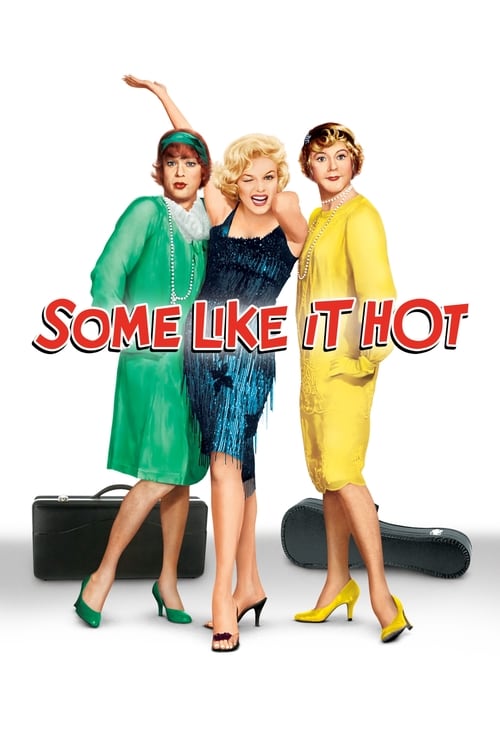
Some Like It Hot
1959 · Billy Wilder
For when you need a guaranteed laugh — date night, a bad week, or introducing someone to old Hollywood. This is comfort viewing of the highest grade: sixty-five years old and it still kills a room.
What it's about
Prohibition-era Chicago: two broke jazz musicians, Joe and Jerry, witness a mob massacre and have to vanish immediately. Their exit? An all-female band headed for Florida, which they join in dresses and heels as 'Josephine' and 'Daphne.' Once there, Joe falls for Sugar, the band's dreamy ukulele-playing singer, while a smitten millionaire pursues Daphne — and the gangsters they fled are never far behind. Every lie they tell buys them one more day and one more disaster.
The experience
Pure escalating delight — a farce engineered so precisely that every complication pays off, with real warmth under the gags. It's fast, silly, and genuinely romantic, and the last stretch is wall-to-wall laughs.
Performances
Jack Lemmon is a comic marvel, giving 'Daphne' a giddy life of her own, Tony Curtis juggles three identities with total polish, and Marilyn Monroe makes Sugar both hilarious and heartbreaking — funny, luminous, and vulnerable all at once. Joe E. Brown steals every scene he's in as the world's most cheerfully undeterred millionaire.
The craft
Billy Wilder and I.A.L. Diamond's script is a machine of setups and payoffs that screenwriters still study — barely a line goes to waste, and it lands one of the most famous closing lines in movie history. Shot in gleaming black and white and paced like a runaway train, it's a masterclass in comic structure. Watch it with a crowd if you possibly can; the laughs are communal.
Why it matters
Widely held to be the funniest film Hollywood ever made, it flouted the industry's censorship code and thrived anyway, helping loosen the Production Code's grip. It remains the gold standard against which screen comedies get measured.
Snapshot
Some Like It Hot is the high-water mark of the American sound farce: a film that takes the oldest gag in the theatrical trunk — men in women's clothes — and builds from it a comedy of such structural precision and humane wit that it has remained, for most of the time since, the consensus choice for the funniest film Hollywood ever made. Two Chicago jazz musicians, Joe and Jerry, accidentally witness a mob execution modeled on the St. Valentine's Day Massacre and flee the city disguised as Josephine and Daphne, members of an all-female band bound for Florida. There they fall in among Sugar Kane, the band's ukulele-playing singer, and a parade of gangsters and millionaires who pursue the heroes in both their identities at once. Directed by Billy Wilder from a script he wrote with I.A.L. Diamond, photographed in black and white by Charles Lang, and carried by Tony Curtis, Jack Lemmon, and Marilyn Monroe, the picture released through United Artists in 1959 and became one of the decade's signal commercial and critical successes. Its closing line — "Well, nobody's perfect" — is among the most quoted endings in cinema.
Industry & production
The film was produced by the Mirisch Company and the independent Ashton Productions and released by United Artists — a configuration emblematic of the late-1950s shift away from the old studio-contract system toward producer-driven independent packages distributed by a major. Wilder, who had spent the 1940s and early 1950s at Paramount, was by this point operating as his own producer-director, and Some Like It Hot was an early fruit of his association with the Mirisch brothers, a partnership that would also yield The Apartment the following year.
The production is as famous for its difficulties as for its results, and most of those difficulties orbited Marilyn Monroe. By 1958 Monroe was a major star and a notoriously unreliable presence on set, frequently late, dependent on coach Paula Strasberg, and subject to anxiety that made even short lines require many takes. The shoot ran over schedule and over budget. Curtis and Lemmon, by contrast, had to sustain elaborate comic performances through Monroe's repetitions. Tony Curtis was later quoted comparing the experience of kissing Monroe to "kissing Hitler," a remark he spent decades alternately repeating, qualifying, and softening; the record around it is murky, and it is best treated as a piece of set lore rather than a settled fact. What is not in dispute is that Monroe was pregnant during filming and miscarried afterward, and that the friction on set coexisted with a finished performance of real luminosity.
A consequential industry dimension concerns the Production Code. The film's premise — two men living as women, a love affair conducted across disguise, and a millionaire who proposes marriage to a man he believes is a woman — ran directly against the Code's prohibitions on "sex perversion." The film was released without the formal seal of approval from the Production Code Administration and was condemned by the Catholic Legion of Decency, yet its enormous popular success caused no commercial harm. It is routinely cited by historians as one of the films whose box-office triumph helped expose the Code's growing irrelevance, accelerating the erosion that led to the Code's replacement by the ratings system in 1968.
Technology
Some Like It Hot was shot on 35mm black-and-white film at a moment when color and widescreen were the industry's prestige defaults, and the decision to shoot in monochrome is the production's most discussed technical choice. The reason was practical rather than nostalgic: color tests of Curtis and Lemmon in full female makeup revealed a harsh greenish cast to the heavily applied cosmetics that made the disguise grotesque rather than plausible. Wilder concluded that black and white softened the makeup and preserved the audience's willingness to accept the men as passing, however precariously, for women. Monroe, whose contract reportedly entitled her to color, agreed to the monochrome film. The choice also lent the picture a glossy, period-evoking sheen appropriate to its 1929 setting and aligned it visually with the gangster pictures it affectionately parodies. The film was composed in the standard Academy-derived ratio rather than the anamorphic widescreen then fashionable, a framing that suits its theatrical, ensemble staging.
Technique
Cinematography
Charles Lang, one of Hollywood's most honored cinematographers, gives the film a luminous studio gloss that is essential to its effect. The black-and-white photography has to do double duty: it must flatter Monroe in the soft, high-key glamour idiom of the classical star portrait — her introduction, her musical numbers, the yacht seduction — while also rendering Curtis and Lemmon's drag convincingly enough that the comedy of disguise does not collapse. Lang's lighting is generous and rounded, smoothing the men's features and giving Monroe the shimmering, slightly diffused radiance associated with her best screen appearances. The gangster material is shot with crisper contrast, nodding to the visual grammar of the 1930s crime film. Throughout, the camera is unobtrusive and classical, prioritizing clean sightlines for performance and the legibility of who is fooling whom.
Editing
Arthur P. Schmidt's cutting serves a script built on escalating farce, where comic tension depends on timing and on the audience always knowing slightly more than the characters. The editing maintains the long, sustained takes that comedy of performance rewards — letting Lemmon and Curtis play full beats — while cutting crisply at the hinge points where a gangster nearly recognizes Joe, or where Daphne's and Josephine's two plots threaten to collide. The film's celebrated late stretch, intercutting Joe's seduction of Sugar aboard the yacht with Jerry's tango with Osgood, is a model of parallel construction, the cross-cutting wringing comedy from the symmetry of two impossible courtships.
Mise-en-scène / staging
The film is staged with the discipline of farce, a form that lives or dies on doors, entrances, and the management of who can be seen by whom. Its principal locations — the Chicago speakeasy, the train carrying the band, the Florida resort hotel, the millionaire's yacht — each function as a comic machine with its own rules of concealment and exposure. The Florida exteriors were shot at the Hotel del Coronado near San Diego, whose Victorian silhouette supplies the resort's period grandeur. Wilder, trained in the well-made construction of Continental theater and of his own screenwriting, blocks the disguise comedy so that the audience can always read the men's discomfort beneath the performance of femininity.
Sound
Music is woven into the film's fabric, since the heroes are working musicians and Sugar is a singer. Adolph Deutsch supplied the score, and the film makes diegetic use of period and standard songs; Monroe performs "Runnin' Wild," "I Wanna Be Loved by You," and "I'm Through with Love," the last delivered as a genuinely affecting torch number that briefly tips the farce toward pathos. The sound design also serves the gangster parody, with the rat-a-tat of machine guns and the snap of period slang. A central comic device is vocal: Curtis's Joe adopts a breathy, lockjawed Cary Grant impersonation for his "Junior" disguise as a Shell Oil heir, a layered joke of a man impersonating a woman impersonating a millionaire impersonating a star.
Performance
The performances are the film's engine. Jack Lemmon's Jerry/Daphne is a study in escalating delight — the famous moment when, shaking maracas, he announces his engagement to Osgood and has to be reminded by Joe that he is a man, is built on Lemmon's commitment to a character who is genuinely, anarchically enjoying the disguise. Tony Curtis plays the cooler, more calculating Joe, and shoulders the film's most technically demanding work in juggling three registers — Joe, Josephine, and Junior. Monroe's Sugar Kane is vulnerable, funny, and radiant, a performance whose ease on screen belies the labor behind it. Among the supporting cast, George Raft brings self-parody to gangster Spats Colombo, trading on his own 1930s tough-guy image, and Joe E. Brown's Osgood Fielding III delivers the closing line with an unbothered glee that retroactively reframes the entire film.
Narrative & dramatic mode
The film operates in the mode of sustained farce escalating toward romantic resolution. Its structure is mechanically elegant: a single inciting catastrophe (witnessing the massacre) forces a disguise that then generates an ever-thickening tangle of romantic and criminal complications, each new entanglement raising the stakes of exposure. Wilder and Diamond braid three plots — Joe's pursuit of Sugar, Osgood's pursuit of Daphne, and the gangsters' pursuit of the witnesses — and bring all three to a head simultaneously in the climactic hotel and speedboat sequences. The dramatic engine is dramatic irony: the audience always knows the disguises, and the comedy arises from watching characters act on partial knowledge. Beneath the farce runs a current of feeling — Sugar's loneliness, Joe's growth from cynic to something like a decent man — that keeps the film from curdling into mere mechanism.
Genre & cycle
Some Like It Hot sits at the confluence of several traditions. It is a late, knowing revival of 1930s screwball comedy, with its fast talk, romantic disguise, and battle of the sexes. It is simultaneously a parody of the Prohibition-era gangster film, drawing on the very iconography — and the very actors, like Raft — that Warner Bros. had made famous. And it belongs to the ancient theatrical line of cross-dressing comedy that runs from Roman farce through Shakespeare to vaudeville. By fusing the gangster picture's violence with the screwball's romance and the drag farce's disguise, Wilder produced a hybrid that feels both deeply traditional and, in its frankness about desire, startlingly modern for 1959.
Authorship & method
The film is a definitive product of the Wilder–Diamond partnership, the writing collaboration between Billy Wilder and I.A.L. Diamond that defined Wilder's late period. Wilder, an émigré schooled in Weimar cinema and the screenwriter's craft, built his films on airtight scripts and structural rigor rather than visual flamboyance, and his direction here is in service of the writing and the playing. Diamond shared Wilder's taste for the cynical line softened by sentiment. The screenplay derives loosely from earlier European films built on the same premise — the French Fanfare d'amour (1935) and the German Fanfaren der Liebe (1951) — but Wilder and Diamond transposed the conceit into Prohibition Chicago and reinvented it almost wholesale. Key collaborators reinforced Wilder's method: cinematographer Charles Lang supplied the glamour and the disguise-saving monochrome; composer Adolph Deutsch the musical fabric; editor Arthur P. Schmidt the farce timing; and costume designer Orry-Kelly the gowns whose plausibility was central to the joke and which won the film its single Academy Award.
Movement / national cinema
The film belongs to mainstream classical Hollywood, but its sensibility is inseparable from the European emigration that shaped so much of that cinema. Wilder was among the Central European exiles — alongside Lubitsch, whom he revered, and many others — who carried into American film a worldlier, more ironic attitude toward sex and morality than native Hollywood typically allowed. The "Lubitsch touch," with its sophisticated indirection about desire, is a clear ancestor of Wilder's method. Some Like It Hot is thus an American studio comedy informed by a Continental tradition, and its willingness to play knowingly with sexual identity reflects that double inheritance.
Era / period
The film arrived in 1959, at the end of a decade in which the studio system was contracting, television was draining audiences, and the Production Code was visibly fraying. Its independent-production financing, its star-driven packaging, and above all its successful defiance of the Code mark it as a film of the system's transitional twilight. At the same time it looks backward, setting its action in 1929 and lovingly reconstructing the imagery of Prohibition gangsterism — a doubled relationship to period in which a film of one moment of Hollywood change reanimates an earlier one.
Themes
Beneath its comic surface the film is unusually searching about gender and identity. By forcing its heroes to live as women, it lets them — and the audience — discover that masculinity is itself a performance, and that the disguise teaches Joe empathy he lacked. Jerry's growing comfort as Daphne, and his genuine pleasure at Osgood's courtship, push the film toward a fluidity remarkable for its era. The closing exchange, in which Jerry confesses "I'm a man" and Osgood replies "Well, nobody's perfect," refuses the tidy restoration of order that convention demands and instead leaves desire gloriously unresolved. Other themes run alongside: the gap between appetite and love, the redemption of the cynic, money and class as their own forms of masquerade, and the proximity of violence to comedy in the American imagination.
Reception, canon & influence
Some Like It Hot was a major commercial success on release and was widely praised, though some contemporary reviewers found it overlong or risqué. It received six Academy Award nominations — including for Wilder's direction, the Wilder–Diamond screenplay, Lemmon's performance, and Lang's cinematography — and won for Orry-Kelly's costume design. Its critical standing only grew with time. The American Film Institute named it the funniest American film of all time in its 2000 "100 Years…100 Laughs" poll, and it is regularly included on lists of the greatest films in any genre; it was among the earliest films selected for preservation in the United States National Film Registry.
Its influences run backward to the screwball comedies of the 1930s, the Prohibition gangster cycle it parodies, the sophisticated sex comedy of Lubitsch, and the long theatrical tradition of disguise farce, as well as directly to the European Fanfare of Love films from which its premise was adapted. Forward, its shadow falls across virtually every subsequent cross-dressing comedy — Tootsie, Mrs. Doubtfire, and many others operate in terrain it mapped — and more broadly across the modern comedy of identity and performance. Its final line has become cultural shorthand, and its reputation as the benchmark of Hollywood comic construction has, if anything, hardened into orthodoxy. Few American comedies have been so consistently held up, by audiences and scholars alike, as the form's finest example.
A Deleuzian reading
Watch Jack Lemmon when he comes back from the date.
The full Deleuzian reading of Some Like It Hot →
Reception
A smash hit in 1959 despite being condemned by the Catholic Legion of Decency and released without Production Code approval — Kansas even banned it. Now it routinely tops greatest-comedy-ever lists, including the #1 spot on AFI's 100 Years... 100 Laughs.
How Some Like It Hot was received, from release to now →
Influences: the films it descends from and the films it influenced
- Trouble in Paradise (1932) — Source of the 'Lubitsch touch' Wilder apprenticed under — innuendo conveyed through ellipsis and the suggestive cutaway rather than explicit line, the technique that lets Some Like It Hot stay risqué within the Code.
- Ninotchka (1939) — Wilder co-wrote it; the screenplay's comedy-of-transformation engine and structural rigor — character undone by a disguise/assumed identity that gradually melts into real feeling — is the template Wilder-Diamond rebuilt here.
- Fanfaren der Liebe (1951) — Direct source: the premise of two out-of-work male musicians donning drag to join an all-girl band, which Wilder-Diamond transposed wholesale into Prohibition Chicago.
- Fanfare d'amour (1935) — The original French film from which the cross-dressing-musicians conceit descends, the root premise Wilder traced back through its German remake.
- Bringing Up Baby (1938) — Screwball farce-blocking model — escalating physical chaos staged in long takes with bodies colliding in continuous space, the choreography Wilder adopts for the hotel-corridor and tango sequences.
- His Girl Friday (1940) — Pioneered the breakneck overlapping-dialogue tempo and machine-gun verbal exchange that Wilder-Diamond's rat-a-tat patter (Lemmon's maracas-punctuated lines) directly extends.
- The Lady Eve (1941) — Comedy of seduction built on sustained dramatic irony — the audience knows the imposture the dupe doesn't — the exact irony structure governing Curtis's fake-millionaire courtship of Monroe.
- Twentieth Century (1934) — Established the confined-transit screwball (the train as pressure-cooker farce stage); the sleeping-car-style enclosed comic geography recurs in the Florida-bound Pullman sequences.
- Scarface (1932) — The Prohibition gangster iconography being parodied — Wilder cast George Raft to spoof his own coin-flipping persona and restages the St. Valentine's Day massacre as the farce's inciting threat.
- Charley's Aunt (1941) — Screen exemplar of the long stage tradition of sustained-disguise drag farce, where comedy derives from maintaining the female impersonation under mounting threat of exposure.
- Adam's Rib (1949) — Gender-as-performance exposed as theatrical construction through sustained cross-dressing; Wilder makes explicit the formal argument Adam's Rib stages through courtroom role-play — that gender behavior is a role rather than a nature.
- Ball of Fire (1941) — Wilder's mature slang-drunk dialogue and the pairing of a tight all-male working group with a streetwise, musically-coded woman (Krupa-style band energy included) extend the verbal and ensemble craft he built in Ball of Fire.
- The Apartment (1960) — The immediate Wilder-Diamond-Lemmon follow-up, applying the same cynical-line-softened-by-sentiment writing method and Lemmon's reactive everyman register to a different milieu.
- Tootsie (1982) — Extends the gender-performativity engine — a man whose female impersonation forces self-revision — but grounds the farce in sustained naturalistic disguise rather than slapstick concealment.
- Victor/Victoria (1982) — Directly mines Some Like It Hot's nested gender-performance gag (a person performing the 'wrong' gender as a stage act) and its dramatic-irony courtship structure.
- La Cage aux Folles (1978) — Carries forward the farce-blocking of frantic identity concealment under an arriving threat, with timing built on exits, entrances and near-exposures Wilder perfected.
- Mrs. Doubtfire (1993) — Operates in the terrain Wilder mapped — comedy generated by maintaining an exhausting cross-dressed double life and the perpetual brink-of-discovery set piece.
- Charade (1963) — Charles Lang, Charade's cinematographer, demonstrates here the technique of maintaining high-key comedic lighting inside a genre hybrid that includes genuine lethal menace; the tonal balancing act—never so dark the comedy curdles, never so bright the danger dissolves—is the exact calibration Lang imports to Paris.
- The Sting (1973) — Wilder demonstrated that sustaining elaborate false-identity performances across an entire film's length could function as both comic engine and formal architecture; The Sting's chapter-organized deception, requiring protagonists to maintain personas for the duration, inherits this structural commitment to the performance-within-performance as organizing principle.
- To Wong Foo, Thanks for Everything! Julie Newmar (1995) — Establishes the comic grammar of hyper-masculine male stars 'passing' in full femme, where both the laughs and the tenderness come from the gap between the actor's body and the gown — the device that makes Swayze and Snipes' casting register.
- Just Go with It (2011) — Establishes the Wilder–Diamond escalating-disguise architecture — a single fabrication that must be propped up with ever-larger lies until forced exposure — that structures the seed's fake-wife spiral.
- My Mom Is a Character 3 (2019) — Foundational drag-comedy whose comic timing is built on the sustained concealment gag — men holding a female persona under pressure — the escalating-mistaken-identity beat Dona Hermínia's routines still run on.
- The Seven Year Itch (1955) — Wilder's prior calibration of Marilyn Monroe's comic persona — the breathy innocent whose sexuality is played as guilelessness — refined into the Sugar Kane performance.
Similar films
- Tootsie (1982) — influence & lineage · same viewing thread
- Trouble in Paradise (1932) — influence & lineage · same viewing thread
- Bringing Up Baby (1938) — influence & lineage · same viewing thread
- Midnight (1939) — same viewing thread
- Sabrina (1954) — same viewing thread
- Roman Holiday (1953) — same viewing thread
- Charade (1963) — same viewing thread
- Breakfast at Tiffany's (1961) — same viewing thread
All the films related to Some Like It Hot →
Watch it with: curated runs of related films
- Fast Talk & Fur Coats — A run of quick-witted charmers who disguise, con, and sweet-talk their way across class lines — watch them near each other and the century between Lubitsch and Sean Baker collapses into one long, glittering grift.