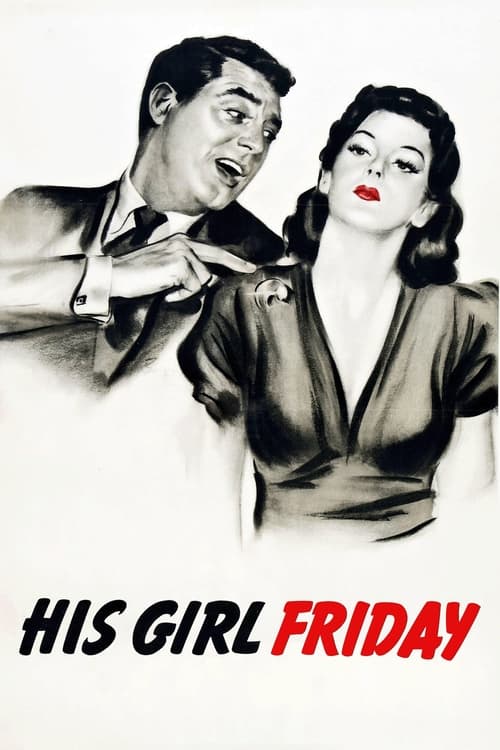
His Girl Friday
1940 · Howard Hawks
For when you need a guaranteed good time — a smart, cynical, ridiculously quotable comedy for a night in, alone or with company. Total comfort, zero homework.
What it's about
Newspaper editor Walter Burns learns his star reporter — who is also his ex-wife — is quitting the business to marry a nice, dull insurance man. Walter will say or do anything to stop it, and his weapon of choice is the story of the year: a condemned man, a corrupt city administration, and a scoop no born reporter could walk away from. The remarriage plot and the newsroom plot collide at full speed.
The experience
It's the fastest-talking movie you'll ever see — dialogue overlapping, jokes stacked three deep, no time to breathe. Pure exhilaration; you'll want to watch it twice just to catch the lines you laughed over.
Performances
Cary Grant is at his most gleefully shameless, and Rosalind Russell matches him syllable for syllable — hat, cigarette, typewriter, and a delivery so fast it feels like a sport. Theirs is one of the great screen duels.
The craft
Hawks had his actors deliberately talk over each other, engineering the script so key lines land inside the chaos — a technique that still feels radical. The staging turns a stagebound farce into perpetual motion, and the whole thing runs like a precision machine disguised as bedlam.
Why it matters
It set the speed record for screen comedy and became the model for every fast-talking, sparring-couples workplace romance since; its gender-flip of the reporter role turned a good play into a legendary film.
Snapshot
His Girl Friday is Howard Hawks's adaptation of Ben Hecht and Charles MacArthur's stage comedy The Front Page, distinguished from its predecessors and imitators by a single conceptual stroke: the star reporter Hildy Johnson is now a woman, and Walter Burns's estranged ex-wife. Released by Columbia Pictures in January 1940, the film stars Cary Grant as the manipulative newspaper editor Walter Burns and Rosalind Russell as Hildy, a battle-of-wills that doubles as a courtship. It is among the most technically audacious comedies produced in classical Hollywood: its overlapping, staccato dialogue operates at a speed rarely matched before or since, and its staging transforms the mechanics of farce into something approaching jazz. Considered a superior—many would say the superior—version of the Front Page material, it stands as one of the defining texts of the screwball comedy cycle and of the Hawks canon.
Industry & production
The Hecht–MacArthur play The Front Page (1928) had already reached the screen once, in Lewis Milestone's 1931 adaptation starring Adolphe Menjou and Pat O'Brien, before Hawks brought it to Columbia. Hawks's essential revision was to read the script aloud and notice, reportedly on instinct, that every line Hildy spoke would play equally well if the character were a woman—and, taken further, if Hildy and Walter had once been married. This single structural reorientation converted a buddy comedy about male professional loyalty into a screwball romance about a couple whose marriage failed because both partners were too good at the same job. Columbia, under Harry Cohn, was the natural home for this kind of fast, economical comedy: the studio had built much of its 1930s prestige on Frank Capra's populist pictures and was comfortable with the newspaper milieu that ran through a significant portion of Depression-era Hollywood output.
The screenplay was entrusted to Charles Lederer, a wit who had worked with Hecht previously and who preserved the original play's crackling cynicism while reshaping its architecture around the new love triangle. Rosalind Russell's path to the role is a matter of some documented negotiation: she has spoken in interviews about feeling that Cary Grant's role as written carried more comic ammunition than Hildy's, and she arranged for additional material to be written for her character—though the exact attribution of this punched-up dialogue is not fully settled in the historical record. What is clear is that the chemistry between Grant and Russell, and the apparent equality of their sparring, was not purely accidental; it was partly fought for. Ralph Bellamy was cast as Bruce Baldwin, the decent, bovine insurance man Hildy claims she intends to marry—a piece of casting that locked in a running joke: Bellamy had just played nearly the same role in Leo McCarey's The Awful Truth (1937), also opposite Grant, and Hawks and Grant reportedly named the character after the actor as a private gag.
Technology
His Girl Friday was shot in black and white on 35mm, in the standard Academy ratio, using the well-maintained studio infrastructure of Columbia's Gower Street lot. The most significant technological challenge the film posed was acoustic rather than photographic: how to record two or more actors speaking simultaneously without losing intelligibility. The overlapping dialogue Hawks demanded pushed the limits of the sound recording technology then in use, which was calibrated for sequential speech and had difficulty separating voices at similar frequencies. The problem was managed through careful blocking—actors were positioned so that their voices would not wholly cancel each other on the optical track—and through a degree of selective emphasis in the sound mix. The result is that the overlaps, while genuinely present and genuinely disorienting in the manner Hawks intended, are not as acoustically chaotic as a naive recording of the same scene might be. The technology served the aesthetic rather than fully satisfying it.
Technique
Cinematography
Joseph Walker served as director of photography, bringing to His Girl Friday the same efficient, unshowy command of the Columbia house style he had developed over years of work with Capra and others. Walker's lighting is functional rather than expressive: the press room is bright, unromantically illuminated, more in the manner of a working newsroom than a glamorous studio space. The camera tends to remain at or near eye level, holds medium shots and two-shots as its default grammar, and avoids the high-contrast chiaroscuro of the decade's noir tendency or the swooning backlighting of the prestige romance. This restraint is deliberate and consequential: Walker keeps the camera from competing with the performers. The sustained two-shot, in which Grant and Russell occupy the same frame while simultaneously speaking different things, becomes the film's fundamental visual unit.
Editing
Gene Havlick's editing is calibrated to the dialogue rather than driving it. The cuts are frequent but rarely conspicuous; their function is to maintain the rhythm established by the verbal performances and to manage the spatial geography of the press room—keeping track of who is where in a crowded, kinetic environment. The editing does not use montage as an independent source of meaning; it is subordinate to the sound track in a way that reinforces the film's essential argument that language, not image, is the primary medium of power.
Mise-en-scène / staging
The press room set is a masterclass in managed disorder. Characters enter and exit through multiple doorways; background players type, telephone, and argue in semi-audible counterpoint to the foreground action; the desk where Hildy writes her story and, later, the roll-top cabinet where Earl Williams is hidden, function as the film's spatial anchors in an otherwise centrifugal environment. Hawks's staging gives every actor a clear physical objective while allowing their paths to collide and interrupt each other—a spatial grammar that mirrors the verbal grammar of the overlapping dialogue. The result is a mise-en-scène that looks chaotic but is in fact intricately choreographed, a controlled combustion.
Sound
The film's achievement in sound is inseparable from its identity. Hawks had observed in rehearsal that when actors talked simultaneously the scene felt more alive, and he instructed his cast to begin speaking before other characters had finished—to interrupt, to overlap, to allow one line to drown another. This was not common practice in studio filmmaking, where intelligibility was a premium value, and the decision to maintain it through production was a creative commitment with real technical costs. The overlapping dialogue creates an impression of surplus: more is being said than can be fully absorbed, which produces both the sensation of crowded mental energy and, paradoxically, an aerodynamic forward motion—one hears enough to follow the plot while the excess creates turbulence.
Performance
Grant operates here in his most elastic mode: physically restless, vocally mercurial, capable of switching within a single sentence between apparent sincerity and naked manipulation. His Walter Burns is not quite a villain—Grant's charm prevents that reading—but he is genuinely amoral, and the film does not entirely excuse him. Russell matches him line for line and rarely yields ground; her Hildy is a woman whose professional intelligence is not incidental to her character but constitutive of it, and Russell plays the role without softening Hildy's toughness into likability. The dynamic between them is erotic precisely because neither has the upper hand for long. Bellamy's performance as Bruce operates in a different register: slow, warm, perpetually a beat behind, his Bruce is not stupid but he is relentlessly decent in a film that finds decency mildly comic. The performance is entirely in on the joke.
Narrative & dramatic mode
The plot inherits from Hecht and MacArthur a double track: the romantic contest between Walter, Hildy, and Bruce, and the journalistic subplot centered on Earl Williams, a mild-mannered man condemned to hang for the accidental shooting of a police officer, whose case has become a football in a corrupt election campaign. Hawks keeps the two tracks in constant ironic counterpoint: the Earl Williams story is the vehicle through which Walter manipulates Hildy back into journalism and, by extension, back into his life, while Hildy's growing investment in the Williams story mirrors her growing, reluctant re-entanglement with Walter. The film's climax—Williams hidden in Hildy's roll-top desk, the governor's reprieve arriving in the nick of time, Walter finally confessing he has been using the story to recapture Hildy—resolves both tracks simultaneously, but in a manner that leaves Walter's ethics comprehensively unrehabilitated. The romantic resolution is accomplished in spite of Walter's manipulations rather than because of them, which gives the film an astringent quality absent from more conventional screwball happy endings.
Genre & cycle
His Girl Friday belongs to the screwball comedy cycle that crystallized in Hollywood roughly between Frank Capra's It Happened One Night (1934) and Preston Sturges's peak work in the early 1940s. The cycle is characterized by class conflict or its displacement into gender conflict, by slapstick that is verbal rather than physical (though not exclusively), and by a romantic couple whose antagonism is transparently erotic. Hawks had contributed to the cycle's development with Twentieth Century (1934) and Bringing Up Baby (1938); His Girl Friday extends his investment in it while pushing the verbal register further than almost any of its contemporaries. It also participates in a distinct sub-genre: the newspaper comedy-drama, a form that stretches from The Front Page through Citizen Kane (1941) and that tends to treat the press simultaneously as the guarantor and the corruptor of democratic life.
Authorship & method
Hawks's authorial signature in His Girl Friday is concentrated in two related ideas: the professional group and the competent woman. The first is a Hawksian constant—his films repeatedly center on people defined by what they do rather than what they feel, and the deepest bonds in his work are forged through shared professional competence. The second is specific to his comedies. The "Hawksian woman," as critics including Robin Wood have theorized, is characterized by the ability to operate in a male professional world without diminishment, often by beating men at their own game. Hildy Johnson is perhaps the purest instance of this figure: she is not merely as good a reporter as the men around her but better, and the film treats this not as exceptional or troubling but as simple fact. Hawks elicited performances by creating conditions of genuine competition—he was known for encouraging actors to fight for their scenes—and the dynamic that resulted between Grant and Russell on set appears to have been close to what the film required of their characters.
Charles Lederer's screenplay deserves specific credit. Lederer preserved the amoral newspaper cynicism of Hecht and MacArthur while retuning the dialogue for a pace beyond what the stage version attempted; his ear for comic rhythm was essential to the film's success.
Movement / national cinema
His Girl Friday is a product of classical Hollywood at the height of its institutional coherence: the studio system, the star system, the genre system, and the contract craftsman's infrastructure of cinematographers, editors, and sound engineers all functioning at peak efficiency. Its place in that system is slightly eccentric—Hawks was always more independent-minded than the average contract director, and Columbia under Cohn was a more combative environment than MGM or Paramount—but the film is not an insurgent text. It works within the conventions of classical narration while exploiting their possibilities more fully than most.
Era / period
The film was released in January 1940, months after the outbreak of war in Europe but more than a year before American entry. The political corruption satirized in the Earl Williams subplot—a governor and a sheriff manipulating a death sentence for electoral purposes—belongs to a tradition of American civic cynicism that runs through much of Depression-era film, but the film does not carry the explicit social-reform agenda of Capra's contemporaneous work. Hawks is more interested in how corrupt systems are navigated by competent individuals than in how they might be reformed.
Themes
The film's deepest theme is the relationship between professional excellence and personal attachment. Walter's argument—implicit throughout and barely articulated at the end—is that the bond between two people who are genuinely good at the same thing is more fundamental than the domestic comfort Hildy thinks she wants. The film takes this argument seriously enough to give it weight while maintaining enough irony about Walter's methods to prevent the conclusion from being simply romantic. A second theme is the ethics of journalism: the newspaper reporters in the film are depicted as cynical, competitive, and not above fabrication, yet the Earl Williams story they pursue is also genuinely important, and Hildy's instinct to report it is depicted as admirable. The film holds these contradictions without resolving them. A third theme, more latent, is the figure of the woman who refuses diminishment—Hildy's refusal to accept that marriage to Bruce would require her to become smaller.
Reception, canon & influence
Contemporary reviews were positive, with critics noting the film's speed and the performances of Grant and Russell; it performed solidly at the box office, though precise figures are not readily available in the accessible historical record. The film's elevation to canonical status came primarily through auteurist criticism in the 1950s and 1960s, as French and then American critics identified Hawks as a major director whose body of work rewarded systematic analysis. His Girl Friday became a key exhibit in the Hawksian argument: evidence that genre entertainment could be organized around a coherent personal vision.
The film's most documented influence is on the use of overlapping dialogue as a production technique. Robert Altman, who made overlapping conversation a signature element of his work from M\A\S\H* (1970) onward, cited the screwball tradition, and Hawks's work specifically, as a formative reference point. The film also anticipates the more widespread critical and industrial recognition of female professional competence as a legitimate subject of comedy, a line that runs forward through much of the postwar romantic comedy tradition.
The Front Page material has been returned to repeatedly: Billy Wilder's The Front Page (1974) and Peter Bogdanovich's Switching Channels (1988) are the principal remakes, neither of which is generally considered to have improved on Hawks's version. The 1940 film's specific combination of gender dynamics, verbal velocity, and ethical ambiguity has proved difficult to reproduce. It appears on the American Film Institute's list of the greatest comedies and is regularly cited in discussions of the screwball cycle's peak achievements.
What the film left behind is not so much a set of techniques as a standard: a demonstration that rapid, layered dialogue performance, when directed with precision and played by actors of sufficient intelligence, could become the primary bearer of cinematic meaning—that a film could be, above all, a sound event.
A Deleuzian reading
Watch it once and you lose half the words.
The full Deleuzian reading of His Girl Friday →
Reception
A hit in 1940 but shut out of the Oscars entirely, it lapsed into the public domain when its copyright wasn't renewed — decades of cheap TV airings and bargain prints quietly turned it into the screwball comedy everyone had actually seen, and critics eventually canonized it as the genre's peak.
How His Girl Friday was received, from release to now →
Influences: the films it descends from and the films it influenced
- The Front Page (1931) — Hawks inherited the press-room staging as managed acoustic chaos—simultaneous telephone calls, background typing, and overlapping conversations across multiple spatial planes—directly from Milestone's adaptation of the same Hecht-MacArthur play, then systematically intensified every element.
- Twentieth Century (1934) — Hawks's own earlier screwball established the battle of two professional performers matching verbal speed in sustained two-shots within a confined space; the train carriage as pressure-cooker for verbal combat is the direct formal prototype of the press room.
- It Happened One Night (1934) — Capra codified screwball's double-track plot structure—romantic pursuit running in counterpoint to a professional or escape obligation—that Hawks inherits and intensifies into the simultaneous romance/scoop engine driving His Girl Friday's narrative architecture.
- The Thin Man (1934) — Van Dyke's film established marriage-as-witty-verbal-sparring between professional equals as a romantic template; Nick and Nora's rapid overlapping repartee at matched speed directly anticipates the Walter-Hildy dynamic as Hawks's structural model.
- The Awful Truth (1937) — McCarey crystallized Cary Grant's comic persona as a charming, manipulative ex-husband deploying non sequiturs as tactical weapons; Hawks and Grant explicitly cast Ralph Bellamy in the identical 'decent dupe' role from this film, treating the callback as an embedded running joke.
- Bringing Up Baby (1938) — Hawks's direct precursor systematically deployed overlapping dialogue as a deliberate acoustic strategy for the first time in his work, and Katharine Hepburn's aggressive verbal drive—talking through pauses, hijacking the other speaker's sentence—establishes the Hawksian-woman vocality that Russell then inherits and sharpens.
- Holiday (1938) — Hawks takes the Grant that Holiday assembled — vaulting body, withheld feeling — and inverts Cukor's discipline of clean non-overlapping delivery, accelerating the stage-derived two-shot conversation into deliberate overlap.
- Ball of Fire (1941) — Hawks makes overlapping speech the film's explicit subject matter—a linguistics professor cataloging American slang encounters a gangster's moll—while transposing the press-room's managed-disorder ensemble staging onto a house of seven academics, each running a parallel conversational thread.
- Woman of the Year (1942) — Stevens directly inherits the professional-excellence-vs-domesticity dialectic: Hepburn's Tess Harding faces Hildy Johnson's exact structural choice between vocation and partnership, staged through the same grammar of sustained two-shots in which both speakers occupy the frame simultaneously rather than cutting between them.
- Sweet Smell of Success (1957) — Mackendrick inherits His Girl Friday's staccato overlapping-dialogue rhythm and civic cynicism about journalism as a machine of power, transposing both into noir; Sidney Falco's verbal dexterity in navigating Hunsecker's orbit descends directly from the press room's overlapping deal-making as professional survival tactic.
- The Big Sleep (1946) — Hawks transfers His Girl Friday's acoustic and visual grammar wholesale into film noir: functional-eye-level two-shots as default framing, dialogue-subordinate editing that refuses to cut away from a sustained exchange, and Lauren Bacall as a Hawksian-woman who operates through verbal threat rather than physical action.
- The Front Page (1974) — Wilder returns to the all-male Hecht-MacArthur source but deploys the staccato overlapping-dialogue pace that Hawks canonized in 1940; the film's verbal velocity is formally indefensible without Hawks's prior demonstration that the material could sustain it, and Wilder explicitly acknowledges this lineage.
- M*A*S*H (1970) — Altman explicitly cites Hawks as the model for his overlapping-dialogue system; the mobile army hospital unit functions as the press room—a professional ensemble in managed disorder—with conversations placed at different acoustic depths simultaneously, making multiple threads legible without privileging any single voice.
- Broadcast News (1987) — Brooks restages the Hawksian-woman template for television news: Holly Hunter's Jane Craig faces the professional-excellence-vs-domesticity dialectic in structural terms identical to Hildy's, and the film uses overlapping newsroom cross-talk as ambient texture in the same manner as the press-room background business that makes the foreground action feel inhabited.
- Citizen Kane (1941) — Hawks's overlapping, simultaneously-recorded multi-character dialogue — developed through his late-1930s screwball comedies as a technique for naturalistic crowd texture — is the specific sound practice Welles adapted and redirected toward Kane's newsroom and party scenes.
- North by Northwest (1959) — Grant's screwball-comedy timing under genuine pressure — rapid-fire dialogue remaining sardonic while the stakes escalate — is the performance register NxNW's cocktail-party drunk scene and Plaza Hotel sequences depend on; NxNW inherits the Hawks mode of comedy as the texture of fear rather than its relief.
- To Have and Have Not (1945) — Hawks's overlapping dialogue achieves its fastest tempo here — two actors speaking simultaneously and naturally rather than sequentially — and that technique is carried directly into To Have and Have Not's conversational scenes as a rhythm device operating on the audience's nervous system, not a naturalism device.
- Adam's Rib (1949) — Rapid overlapping dialogue as the formal mechanism for staging professional gender equality — both protagonists talk through each other simultaneously as a sign of competitive intimacy — a technique Cukor inherits for the Bonner marriage's verbal combat.
- The Social Network (2010) — Pioneers overlapping, faster-than-real rapid-fire dialogue as a rhythmic engine, the verbal velocity Sorkin's overlapping exchanges and the cold-open breakup scene inherit.
- The Philadelphia Story (1940) — Made concurrently with Grant playing a near-identical ex-husband, The Philadelphia Story imports Grant's vocally mercurial timing—the rapid non sequitur, the double-take disguised as a rejoinder—directly from their simultaneous work together, making the two films a stereo demonstration of the same comic instrument.
- Foreign Correspondent (1940) — Released the same year, it deploys the journalist-as-professional-armature framework and screwball romantic rivalry as identical generic synthesis — Hawks's overlapping-dialogue solution versus Hitchcock's staggered-suspense solution to the same formal problem.
- The Lady Eve (1941) — Contemporary apex of overlapping-dialogue tempo and the dominant woman / outmatched man dynamic, the same dialogue-forward, comic-timing-edited craft Sturges and Stanwyck deploy.
- The Little Shop of Horrors (1960) — The overlapping machine-gun dialogue tempo is the direct ancestor of Griffith's 'verbal velocity' comic patter, where lines are stacked and rattled off faster than the audience can fully parse them.
- Duck Soup (1933) — Hawks builds comedy from overlapping, machine-gun verbal economy and interruption — the same prizing of rapid-fire dialogue-as-aggression that drives Groucho's exchanges, engineered for maximum pace.
- Sullivan's Travels (1941) — Contemporaneous perfection of machine-gun overlapping dialogue that Sturges shares as the house style of early-'40s Hollywood comedy.
- You’re Missing the Point (1940) — A contemporaneous experiment in making sheer dialogue density and speed the comic mechanism, foregrounding talk over gesture in the same way Bustillo Oro's mixing and framing put Cantinflas's word-torrent at the center.
- The Palm Beach Story (1942) — Hawks pushed overlapping dialogue to its density limit inside a remarriage plot where the ex-husband recaptures the wife by controlling the professional machinery around her — the same wager Sturges makes that a scene can be carried by talk laid over talk in a sustained take.
Similar films
- The Philadelphia Story (1940) — influence & lineage
- Bringing Up Baby (1938) — influence & lineage
- Ball of Fire (1941) — influence & lineage
- The Awful Truth (1937) — influence & lineage
- The Big Sleep (1946) — influence & lineage
- It Happened One Night (1934) — influence & lineage
- Sweet Smell of Success (1957) — influence & lineage
- M*A*S*H (1970) — influence & lineage
All the films related to His Girl Friday →